
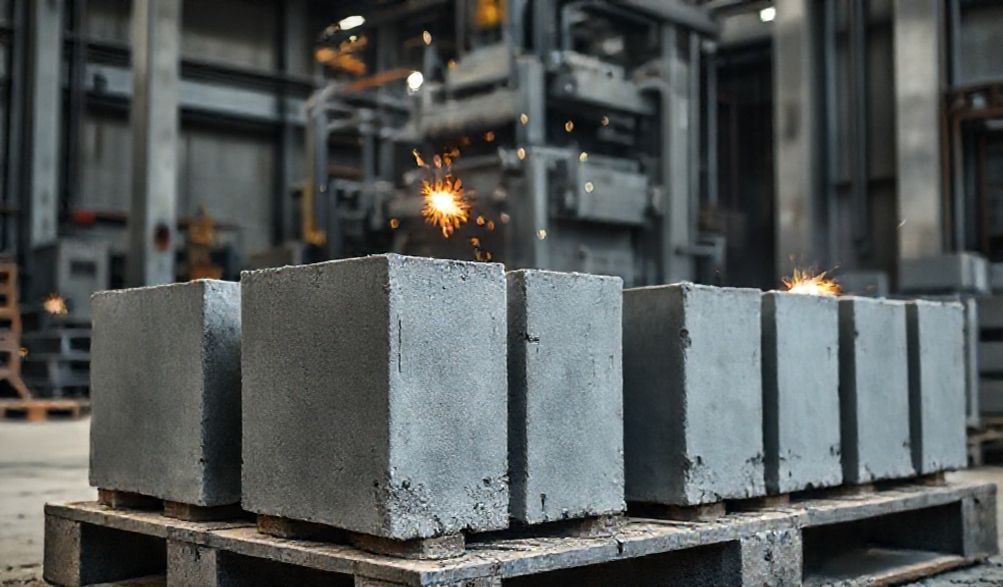
How Are Cinder Blocks Made? A Step-by-Step Guide to Manufacturing
Walk onto any construction site, and you’ll see them stacked like giant, gray Legos. They form the foundations of our homes, the walls of our garages, and the skeletons of countless buildings. We call them cinder blocks, but have you ever stopped to wonder how these ubiquitous building blocks are actually created? The process is a fascinating blend of raw geology, precise engineering, and industrial might.
This article will demystify that journey. Drawing from industry specifications, engineering principles, and insights into modern manufacturing, we’ll trace the path of a cinder block from a pile of raw materials to a precision-engineered concrete masonry unit (CMU). We’ll clarify common misconceptions, detail each step of the automated process, and explain the rigorous quality controls that ensure every block can bear its load. Whether you’re a DIY enthusiast, a construction professional, or simply curious, this guide will build your understanding from the ground up.
What Are Cinder Blocks? Clarifying the Name
Before we dive into қалай they’re made, let’s clarify не we’re talking about. The term “cinder block” is deeply ingrained in our vocabulary, but it’s often a historical misnomer in today’s construction world.
Cinder Block vs. Concrete Block: What’s the Difference?
This is a key point of confusion. Historically, in the early to mid-20th century, blocks were sometimes made using cinders—the ashy residue left from burning coal. These lightweight aggregates were cheap and readily available.
- The “Cinder Block”: This original version used Portland cement to bind these cinders. While lightweight, these blocks were generally less durable and had lower compressive strength. They are rarely, if ever, produced for structural purposes today.
- The Modern “Concrete Block”: Contemporary blocks are made from a mixture of Portland cement, water, and aggregates like sand and fine gravel. The term “cinder block” has persisted colloquially, but when you buy a block at a hardware store or from a masonry supplier, you are almost certainly getting a concrete masonry unit (CMU).
For the remainder of this article, we will use the technically accurate term concrete blockнемесеCMU, except when directly addressing the historical distinction.
Common Types and Sizes of Concrete Blocks
While the classic rectangular block is the most familiar, CMUs come in many shapes for specific functions:
- Stretcher Block: The standard block with two or three cores (holes). Used for running courses in a wall.
- Corner Block: Has one smooth, finished end for creating clean corners.
- Pillar (or Pilaster) Block: Used in columns and piers.
- Lintel Block: Has a U-shaped channel to be filled with concrete and rebar to form a beam over doors and windows.
The most common nominal size in the United States is 8 inches in height, 8 inches in depth, and 16 inches in length (often written as 8x8x16). The нақты dimensions are slightly smaller (typically 7 5/8″ x 7 5/8″ x 15 5/8″) to account for a 3/8-inch mortar joint.
The Raw Materials: What Goes Into a Block
The strength and durability of a concrete block begin with its ingredients. Modern manufacturing relies on precise, consistent recipes.
Core Components: Cement, Aggregates, and Water
This trio forms the backbone of every CMU.
- Portland Cement: This is the binder, the “glue” of the concrete. When mixed with water, it undergoes a chemical reaction called hydration, forming a hard matrix that locks the aggregates together.
- Агрегаттар: These provide bulk, strength, and dimensional stability. A mix is used:
- Fine Aggregates: Typically sand, which fills voids.
- Coarse Aggregates: Small gravel or crushed stone (usually less than 1/2 inch in diameter). Historically, “cinders” filled this role.
- Су It’s not just a mixer; it’s a crucial reactant. The quality and amount of water are critical. Too little prevents proper hydration; too much weakens the final structure by creating excess pores. The water-to-cement ratio is tightly controlled.
Modern Additives and Admixtures
To enhance performance and aesthetics, manufacturers include specialized additives:
- Color Pigments: Iron oxide pigments are added to the mix to produce red, brown, black, or tan blocks for architectural appeal.
- Air-Entraining Agents: These create microscopic air bubbles in the concrete, which provide crucial space for water to expand when it freezes. This prevents cracking and spalling in cold climates, dramatically improving freeze-thaw durability.
- Accelerators & Retarders: These chemicals speed up or slow down the hydration process, giving plants control over setting times based on production schedules and ambient conditions.
The Manufacturing Process: Step-by-Step
The transformation from a dry pile of rock and powder to a solid, sturdy block is a marvel of modern industrial automation. Here’s how it happens in a typical plant.
Step 1: Batching and Mixing
Precision is paramount. Raw materials are stored in large silos and bins. They are automatically weighed and dispensed via computer-controlled batching systems according to a specific, tested mix design.
The materials are then fed into a large industrial mixer—often a pan mixer or paddle mixer. A small amount of water is added to create a “no-slump” or “zero-slump” concrete. This mix is damp and holds its shape when squeezed, unlike the pourable concrete used for foundations. It must be uniform in consistency to ensure every block has identical properties.
Step 2: Molding and Compaction
This is where the block gets its shape. The no-slump concrete is fed into a block-making machine, the heart of the plant.
- The mixture is dropped into a mold box (or “mold cavity”) on a large, flat steel pallet. The mold defines the block’s shape, including its cores.
- The machine then applies immense compaction force. A combination of high-frequency vibration and hydraulic pressure (often thousands of pounds per square inch) is used to densely pack the mixture into every corner of the mold, eliminating air pockets. This compaction is what gives the block its initial “green strength” and final density.
- The mold is lifted, and a set of freshly formed, but still fragile, “green” blocks remains on the pallet.
Step 3: Curing: The Key to Strength
This is the most critical phase. Curing is not simply “drying out”; it’s the controlled continuation of the hydration chemical reaction. Proper curing develops the block’s design strength.
- Low-Pressure Steam Curing (Kiln Curing): This is the industry standard.
- The pallets of green blocks are automatically moved into a large, insulated curing chamber or kiln.
- The environment is carefully controlled: temperature is raised to about 150-180°F (65-80°C) with near 100% humidity.
- This warm, moist environment accelerates hydration without letting the blocks dry out. A full cycle typically takes 24 to 48 hours.
- After curing, the blocks have achieved a large percentage of their ultimate compressive strength.
Alternative methods include air curing (slower, weather-dependent) and high-pressure steam curing (autoclaving) used for certain lightweight or specialty blocks.
Step 4: Cubing and Palletizing
Once cured and cooled, the hardened blocks are ready for handling.
- An automated machine called a cuber picks up an entire pallet of blocks.
- It flips them, strips them from the production pallet, and assembles them into a stable, interlocked cube—typically containing 72 to 120 blocks, depending on size.
- This cube is placed on a wooden shipping pallet, strapped tightly with steel or plastic bands, and is now ready for forklift handling and transportation to your local supplier or job site.
Quality Control and Testing in Block Production
Reputable manufacturers don’t just make blocks; they engineer them to meet strict standards. This ensures safety and reliability in construction.
Meeting ASTM Standards
In the U.S., the benchmark is set by ASTM International (formerly the American Society for Testing and Materials). Key standards include:
* ASTM C90: Specifies the requirements for loadbearing concrete masonry units.
* ASTM C140: Describes the methods for sampling and testing concrete masonry units.
Compressive strength testing is the gold standard. Samples from a production run are crushed in a press to measure the load (in pounds per square inch, or psi) they can withstand before failing. A typical ASTM C90 block for foundation walls must have a minimum compressive strength of 1,900 psi. Blocks are also tested for moisture absorption, weight, and dimensional tolerances.
Visual and Dimensional Inspections
Beyond lab tests, every block is subject to visual scrutiny. Automated cameras and human inspectors look for:
* Cracks, chips, or broken corners.
* Surface defects that could affect mortar bonding.
* Consistent size and shape to ensure uniform mortar joints and level walls.
Modern Innovations and Sustainability
The industry continues to evolve, focusing on efficiency and reducing its environmental footprint.
Automated Manufacturing and Robotics
Today’s plants are highly automated. Robotics handle pallets, cubing, and stacking. Computerized controls manage batching, mixing, and curing cycles with incredible precision, leading to superior consistency and reduced waste.
Eco-Friendly Practices
Concrete block production has made significant sustainability strides:
* Recycled Materials: Industrial by-products like fly ash (from coal-fired power plants) and slag cement (from steel production) are commonly used as partial replacements for Portland cement. This reduces CO2 emissions from cement production and diverts waste from landfills.
* Water Recycling: Process water is often captured, treated, and reused in the mixing process.
* Энергия тиімділігі: Modern kilns are better insulated and use optimized steam cycles. Some plants even capture waste heat from other processes for curing.
Жиі қойылатын сұрақтар (ЖҚС)
Q: Are cinder blocks and concrete blocks the same thing?
A: Colloquially, yes—people use the terms interchangeably. Technically, a true “cinder block” uses coal cinders as aggregate and is largely obsolete. What you buy today is a concrete masonry unit (CMU) made from cement, sand, and gravel, meeting modern strength standards.
Q: How long does it take to make a cinder block?
A: The molding process takes seconds. However, the critical curing process in a steam kiln typically takes 24 to 48 hours for the block to achieve sufficient strength for handling and shipping.
Q: Can you make cinder blocks at home?
A: Yes, using manual metal or plastic molds, but the results are vastly inferior. Home-made blocks lack the high-pressure compaction and controlled steam curing of industrial processes, leading to lower strength, poor consistency, and reduced durability. For any load-bearing structure, always use commercially manufactured, ASTM-compliant blocks.
Q: Why do some blocks have holes (cores)?
A: The cores (or voids) serve several purposes: 1) They reduce the block’s weight and material cost. 2) They allow for vertical reinforcement (rebar) to be placed and filled with grout for stronger walls. 3) They improve thermal insulation by creating air pockets within the wall.
Q: How much weight can a cinder block support?
A: There is no single answer. The load-bearing capacity depends on the block type (hollow vs. solid), its compressive strength rating (e.g., 1,900 psi, 2,500 psi), and how it’s used in a wall system. Critical structural calculations must always be performed by a licensed structural engineer based on local building codes and the specific project.
Қорытынды
The journey of a cinder block—or more accurately, a concrete masonry unit—from a blend of stone, sand, and cement to a fundamental building component is a testament to precision engineering and controlled manufacturing. It’s a process that balances raw material science with industrial efficiency, all governed by rigorous standards to ensure safety and performance.
Understanding this process highlights why it’s crucial to specify quality, ASTM-compliant materials from reputable suppliers for any construction project. As innovations in recycling and energy efficiency continue, the humble concrete block is poised to remain a cornerstone of sustainable, resilient construction for generations to come.
For your projects, always consult with professional engineers and masons. Their expertise ensures that the manufactured strength of each block is correctly leveraged to build structures that are safe, durable, and built to last.
<