
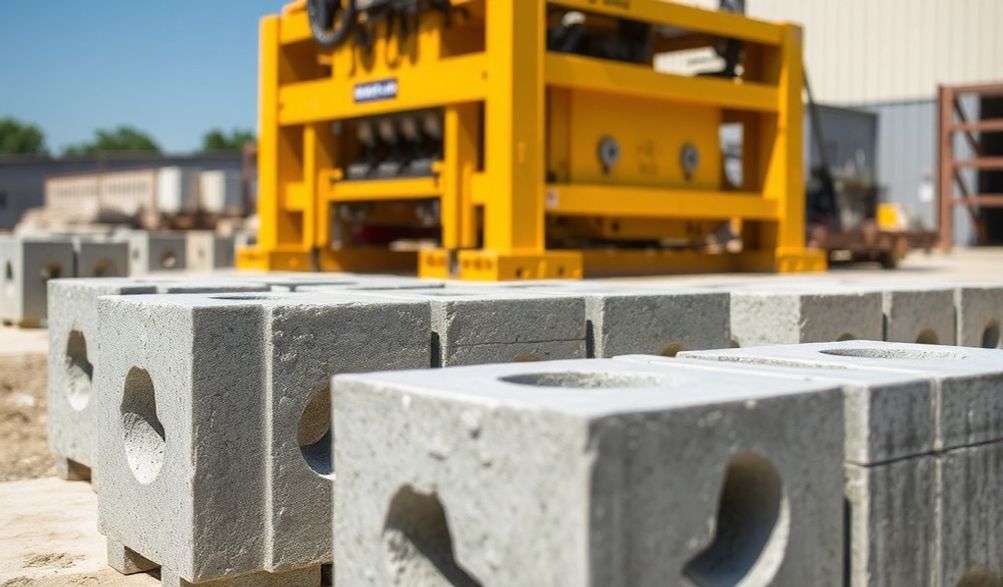
The QTJ4-25 Block Machine: A Comprehensive Guide to Features, Operation, and Benefits
Кіріспе
For small construction firms, housing cooperatives, and entrepreneurs, the challenge is consistent: how to produce high-quality, affordable building materials without the capital expenditure of large industrial equipment. The answer for countless projects worldwide has been a class of robust, simple, and remarkably efficient machines known as semi-automatic or “egg-laying” block makers. Among these, the QTJ4-25 block machine has established itself as a cornerstone for small to medium-scale concrete block production.
Drawing on extensive industry experience and technical analysis, this guide is designed to be your definitive resource. We’ll move beyond sales brochures to provide a detailed, trustworthy overview of what the QTJ4-25 concrete block machine is, how it works, and its real-world advantages. Whether you’re assessing it for a specific construction project or considering it as the foundation of a block manufacturing business, we’ll cover the critical features, practical setup requirements, and honest considerations you need to make an informed decision.
By the end of this post, you’ll have a clear understanding of its operation, maintenance, and ideal use cases, helping you determine if this popular кірпіш жасау машинасы is the right strategic investment for your goals.
What is a QTJ4-25 Block Making Machine?
At its core, the QTJ4-25 is a manually operated, mobile block-making machine. It’s classified as a “semi-automatic” or “egg-laying” type because it doesn’t have a built-in pallet conveyor system. Instead, the machine itself moves over a stationary concrete casting slab, depositing or “laying” freshly molded blocks in rows—much like a chicken laying eggs.
Core Design and “Egg-Laying” Operation
The defining characteristic of the QTJ4-25 is its workflow:
1. The machine is positioned on a flat, prepared concrete slab or metal pallets.
2. Workers manually feed the prepared concrete mix into the machine’s hopper.
3. Inside the machine, the mix is fed into a mold cavity. Simultaneously, a vibration motor engages, compacting the concrete and removing air pockets.
4. Once compacted, the mold is lifted vertically, leaving the freshly formed “green” block on the slab.
5. The entire machine is then manually rolled or pushed forward to the next position on the slab, and the cycle repeats.
This simple, mechanical process requires no complex hydraulics or programmable logic controllers (PLCs), which is key to its reliability and ease of repair.
Key Technical Specifications and Output Capacity
Understanding the specs translates to realistic project planning. Here’s a typical breakdown for a standard QTJ4-25 model:
| Спецификация | Толық мәлімет |
| :— | :— |
| Модель | QTJ4-25 |
| Block Size (Hollow) | 400x200x200mm (standard) |
| Blocks per Cycle | 4 pieces (of 400x200x200mm) |
| Өндірістік қуат | 2500 – 3000 blocks per 8-hour shift |
| Vibration Motor Power | 2 x 1.5 kW (or 3.0 kW total) |
| Forming Cycle Time | ~45-60 seconds |
| Машина салмағы | Approximately 1500-1800 kg |
| Power Source | Electric motor or optional diesel engine |
What does this mean in practice? An output of 3,000 standard hollow blocks per shift could supply enough material to build approximately 40-50 square meters of single-leaf wall, depending on the design. This capacity perfectly aligns with the pace of small-to-medium housing projects or a modest block supply business.
Common Block Types It Can Produce
The true versatility of the QTJ4-25 lies in its interchangeable molds. By simply changing the mold box, the same machine can produce:
* Қуыс блоктар: The most common product for load-bearing and non-load-bearing walls.
* Қатты блоктар: Used for foundations, pavements, and areas requiring higher strength.
* Құлыптасқан тақташалар:Жолдарға, жаяу жүру жолдарына және алаңдарға арналған.
* Curb Stones & Garden Borders:Ландшафттық дизайн және жол жиегін безендіру үшін.
* Арнайы пішіндер: Some suppliers offer molds for unique design blocks.
This flexibility allows a single investment to cater to multiple market segments.
Key Features and Advantages of the QTJ4-25 Model
Why has the QTJ4-25 remained a go-to choice for decades? Its advantages are rooted in practical, economic engineering.
Cost-Effectiveness and Low Investment Threshold
- Lower Initial Capital: The QTJ4-25 represents a fraction of the cost of a fully automatic production line. This dramatically lowers the barrier to entry for startups and small businesses.
- Faster ROI: With lower overheads and debt, businesses can reach profitability sooner, reinvesting earnings into growth.
Операция және техникалық қызметтеудің қарапайымдылығы
- Минималды оқыту қажет: Operators can be trained effectively within a day. The process is visual and mechanical.
- Easy Troubleshooting & Repair: The design uses common bearings, shafts, and motors. Most repairs can be handled by a competent local mechanic without needing specialized technicians or expensive imported parts.
Flexibility and Low-Power Operation
- Тор көзқарастылығы: Its low power requirement (often just a 3kW motor) makes it suitable for operation with a standard generator or a small diesel engine. This is a critical advantage in regions with unreliable electricity.
- Product Agility: Switching between producing hollow blocks today and pavers tomorrow is a matter of changing the mold—a process that takes a small team under an hour.
Durability and Robust Construction
A well-manufactured QTJ4-25 is built to last in a harsh environment. Key durability features include:
* High-Strength Steel Frame: Provides rigidity and resists warping.
* Wear-Resistant Steel Mold Liners: Critical for maintaining block dimensional accuracy over thousands of cycles.
* Heavy-Duty Vibration System: Uses durable eccentric shafts and sealed bearings to deliver consistent compaction force.
Practical Considerations Before Purchasing
Informed purchasing decisions prevent costly mistakes. Here’s a balanced, experience-based look at what you must consider.
Assessing Your Project Needs and Scale
Ask yourself these questions:
* Daily Volume: Do you need 2,000 blocks per day or 10,000? The QTJ4-25 has a clear upper limit.
* Қолжетімді Кеңістік: Do you have ample, level ground for a casting slab (at least 30m x 10m), raw material storage, a mixing station, and a covered curing area?
* Labor Availability: Are you prepared to hire and manage the 4-6-person team needed for efficient operation?
Understanding the Total Setup: Beyond the Machine
The machine is just one component. Your total setup budget and plan must include:
* A Level Concrete Casting Slab: A smooth, strong surface is non-negotiable for quality production.
* Raw Material Storage & Handling: Sheltered areas for cement, sand, and aggregate.
* Mixing Equipment: A pan mixer or planetary mixer of appropriate capacity (e.g., a 300L or 500L mixer).
* Инфрақұрылымды қалпына келтіру A shaded area to store green blocks and keep them moist for proper strength development.
* Еңбек For material handling, mixing, machine operation, and block stacking.
Manual Operation and Labor Requirements
Be honest about this aspect. The QTJ4-25 is labor-intensive. A typical efficient crew includes:
* 1-2 persons feeding the mixer and managing materials.
* 1 person operating the mixer and transporting concrete to the machine.
* 2 persons operating the machine (feeding, controlling vibration, moving it).
* 1-2 persons removing and stacking green blocks for curing.
Supplier Selection and Quality Checks
Your supplier’s reliability is as important as the machine’s. Vet them thoroughly:
* Request Customer References: Ask for contacts of previous buyers in a similar region.
* Inspect Photos & Videos: Don’t just look at glossy renders. Ask for detailed videos of the actual machine in operation, focusing on weld quality, paint finish, and assembly.
* Spare Parts List: A reputable supplier will readily provide a list of all bearings, seals, and motors used, confirming their commonality and availability.
* Support Terms: Clarify what’s included: installation manuals, video guides, online support, and warranty coverage.
Operating and Maintaining Your QTJ4-25 for Longevity
Proper care ensures maximum productivity and lifespan. Here’s an authoritative guide to operations and upkeep.
Step-by-Step Operational Cycle
- Slab Preparation: Lightly oil or dampen the casting slab/pallets to prevent block adhesion.
- Араластыру: Prepare a consistent, semi-dry concrete mix with the correct cement-aggregate ratio.
- Тамақтандыру: Fill the machine hopper. Avoid overfilling or letting it run empty.
- Қалыптау және діріл: Pull the lever to feed the mold, then engage the vibration for 5-10 seconds for optimal compaction.
- Демонтаждау: Lift the mold assembly smoothly and steadily.
- Movement: Push the machine to the next position, ensuring alignment.
- Емдеу: After initial set (24 hours), move blocks to the curing area and keep them moist for at least 7 days.
Essential Daily and Weekly Maintenance Routines
- Күнделікті Thoroughly clean all concrete residue from the mold, hopper, and frame. Check for loose bolts and nuts.
- Апталық: Lubricate all moving joints, pivot points, and bearings as per the manual. Inspect mold liners for significant wear or damage. Check the tension of the vibration motor mounts.
Жиі кездесетін мәселелерді шешу
- Blocks Breaking During Ejection: Usually caused by improper mix (too dry or weak), insufficient vibration time, or a damaged/worn mold liner.
- Poor Surface Finish: Often due to an overly wet mix, a dirty mold, or insufficient vibration force.
- Inconsistent Block Density/Height: Check for uneven feeding of the mold, inconsistent mix, or wear in the compaction system.
Comparing the QTJ4-25: Is It Right for You?
Context is everything. Let’s see how it stacks up.
QTJ4-25 vs. Fully Automatic Block Machines
| Factor | QTJ4-25 (Semi-Auto) | Fully Automatic Line |
| :— | :— | :— |
| Шығын | Very Low | Very High |
| Шығару | Medium (2,500-4,000 blocks/day) | Very High (10,000+ blocks/day) |
| Labor | High (4-6 persons) | Low (1-2 persons) |
| Skill Required | Low | High (technical operation) |
| Flexibility | High (easy mold change) | Low (complex changeovers) |
| Ең Қолайлы | Startups, variable demand, low capital | Large-scale, constant high-volume production |
Verdict: The QTJ4-25 wins on flexibility and entry cost but cannot match the output and labor efficiency of automation.
QTJ4-25 vs. Other Manual/Semi-Automatic Models
Compared to similar models (e.g., QT4-25, QMJ4-45), differences are often subtle:
* Pressure/Compaction: Some models may have a slightly higher vibration frequency or added hydraulic pressure for denser blocks.
* Автоматтандыру деңгейі: Some “semi-auto” models include a simple pallet feeder, slightly reducing labor.
* Size: Some are designed for larger or smaller standard block sizes.
Ideal Use Case Scenarios
The QTJ4-25 is the perfect fit for:
* Small Construction Companies building their own housing projects.
* Entrepreneurs starting a block supply business in a local market.
* Rural Development & Self-Help Housing Initiatives.
* Government Projects focused on community-based material production.
* Producers needing to make multiple product types without major retooling.
Жиі қойылатын сұрақтар (ЖҚС)
Q1: What is the production capacity of the QTJ4-25 block machine per day?
A: With a standard 400x200x200mm hollow block mold and an efficient crew, you can realistically expect between 2,500 to 3,200 blocks in an 8-hour shift. This depends heavily on crew skill, material preparation flow, and mold type.
Q2: Can I use local raw materials like sand and gravel?
A: Yes, this is one of its primary advantages. It is designed for locally sourced sand, gravel, and even crushed stone. The key is to develop a consistent mix design (e.g., a 1:3:5 cement:sand:gravel ratio is a common starting point) and test it to ensure the blocks meet your required strength standards.
Q3: What kind of after-sales support should I expect from a reliable supplier?
A: A trustworthy supplier will provide detailed mechanical drawings, a complete parts manual with bearing numbers, assembly instructions, and access to technical support (e.g., via WhatsApp or email). They should be willing to share video calls to help troubleshoot initial setup issues. Always confirm the warranty period and policy for key components.
Q4: Is this machine suitable for starting a block manufacturing business?
A: Absolutely. The QTJ4-25 is arguably the most common entry-point machine for block-making businesses globally due to its proven design and low risk. Success hinges not just on the machine, but on your business plan: securing reliable raw materials at good prices, accurately calculating your cost per block, and understanding the demand and competition in your target area.
Қорытынды
TheQTJ4-25 block machine stands as a testament to practical, appropriate technology. It won’t produce the staggering volumes of a fully automated factory, but it delivers exactly what it promises: a robust, economical, and flexible means of producing quality concrete blocks for small to medium-scale needs. Its value lies in its simplicity, durability, and remarkably low barrier to entry, making it an excellent foundational tool for specific business models and project scales.
Use this guide as a foundation for your research. Move forward by contacting multiple suppliers with informed, detailed questions. Request real-time videos of the machine in operation, speak to their past customers, and meticulously calculate your total project costs—from the concrete slab to the curing shed. For entrepreneurs and builders looking to take control of their material supply with a manageable investment, the QTJ4-25 remains a proven and reliable starting point on the path to growth.
<