
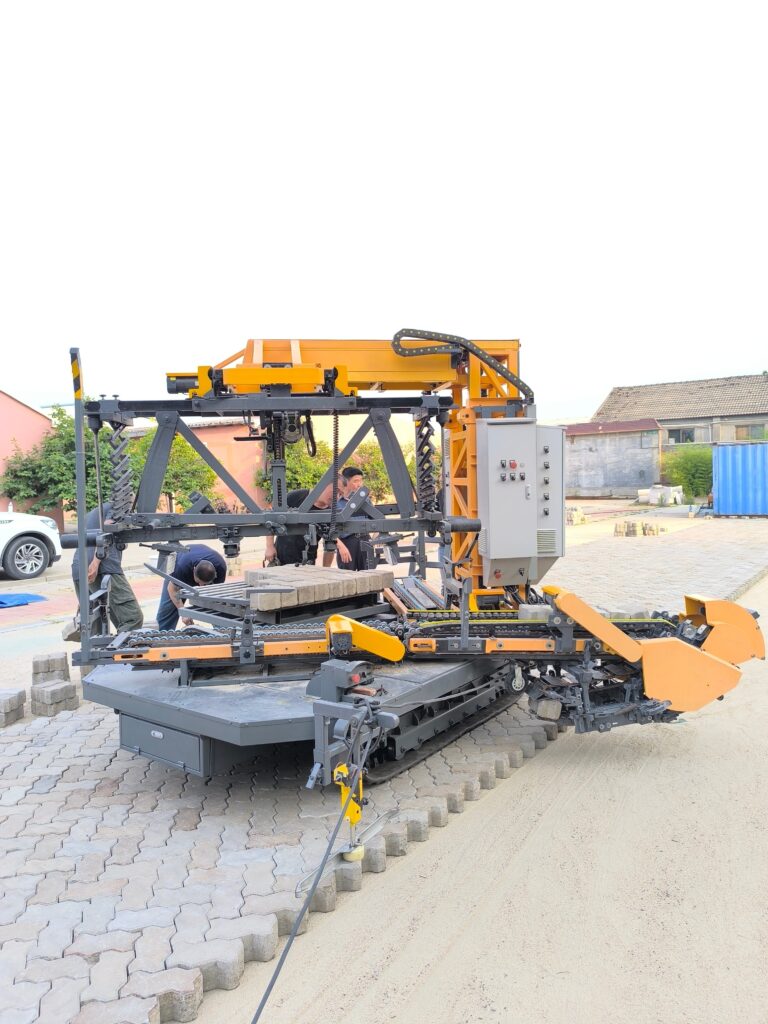
블록 벽돌 프린팅 기계의 운영 프레임워크
블록 벽돌 프린팅 기계는 콘크리트나 모르타르를 정밀하게 증착하여 건축 요소를 층별로 형성하도록 자동화된 통합 시스템입니다. 이 공정은 디지털로 제어되어 전통적인 방식과 달리 비교할 수 없는 정확성과 유연성을 제공합니다.
1. 핵심 시스템 아키텍처
이 장비는 디지털 설계를 물리적 구조로 변환하기 위해 여러 정교한 하위 시스템이 조화롭게 통합되어 작동하는 방식으로 구축되었습니다.
- 3.1. 중앙 제어 및 소프트웨어 인터페이스
모든 인쇄 시스템의 핵심에는 전문 소프트웨어로 작동되는 강력한 컴퓨터 수치 제어(CNC) 장치가 있습니다. 이 소프트웨어는 명령 센터 역할을 하며, 여기서 디지털 모델(일반적으로 STL 또는 G-code 형식)을 불러와 크기를 조정하고 얇은 수평 레이어로 분할합니다. 그런 다음 소프트웨어는 프린터의 움직임, 재료 공급 속도, 노즐 속도에 대한 정확한 공구 경로와 지시 사항을 생성하여 물리적 출력물이 디지털 설계도와 완벽하게 일치하도록 보장합니다. - 3.2. 재료 취급 및 혼합 시스템
일관되고 신뢰할 수 있는 재료 공급이 가장 중요합니다. 이 시스템은 건식 혼합물(시멘트, 골재 및 첨가제의 특수 배합)을 보관하는 대용량 사일로와 통합 혼합 장치로 구성됩니다. 건식 재료는 자동으로 믹서로 이송되며, 여기서 물과 기타 액체 첨가제가 투입되어 균질하고 펌핑 가능한 페이스트를 만듭니다. 연속 혼합기는 대규모 중단 없는 인쇄에 중요한 재료의 지속적인 흐름을 보장하기 위해 자주 사용됩니다. - 3.3. 로봇 포지셔닝 시스템
프린트 헤드는 기계의 작업 범위를 결정하는 견고한 위치 제어 시스템에 장착됩니다. 시장에서는 두 가지 주요 구성이 주를 이루고 있습니다:- 갠트리 시스템:이들은 고정된 인쇄 베드 위에서 X, Y, Z 축을 따라 인쇄 헤드를 움직이는 견고한 프레임을 특징으로 합니다. 갠트리 시스템은 안정성과 높은 정밀도로 크고 무거운 구조물을 제작할 수 있는 능력으로 유명합니다.
- 로봇 팔 시스템:工业级多轴机械臂相比其占地面积,提供了更大的灵活性和更广的工作范围。它能够制造更复杂的非平面几何形状,常用于精细的建筑构件。
2. 인쇄 과정: 디지털 파일에서 실제 인쇄판으로
The actual printing process is a meticulous, layer-by-layer additive manufacturing sequence.
- 3.1. Substrate Preparation and Calibration
Before printing commences, the build platform or print bed must be perfectly leveled. The printing system often performs an automated calibration routine to ensure the first layer adheres correctly. A release agent may be applied to the bed to facilitate easy demolding of the finished product. - 3.2. Material Extrusion and Nozzle Technology
The prepared mix is pumped from the mixer through high-pressure hoses to the print head. The print head is equipped with a extrusion nozzle, whose diameter can often be changed to achieve different print resolutions and bead widths. A precision servo-motor or peristaltic pump controls the extrusion rate, ensuring it is perfectly synchronized with the print head’s movement to deposit a continuous, consistent bead of material. - 3.3. Layer-by-Layer Fabrication and Curing
The printer deposits the first layer according to the toolpath. Subsequent layers are then built upon the previous ones. The specific material mix is engineered to possess thixotropic properties—it flows easily under pressure during extrusion but sets almost immediately afterward to support the weight of the layers above. This inter-layer adhesion is critical for the structural integrity of the final block or brick.
3. Key Technological Features and Innovations
Modern block brick printers incorporate several advanced features that differentiate them from conventional manufacturing equipment.
- 3.1. Real-Time Monitoring and Closed-Loop Control
High-end systems are equipped with an array of sensors that monitor material pressure, flow rate, print head position, and environmental conditions. This data is fed back to the central control system in a closed-loop, allowing for real-time adjustments. If a deviation is detected, the system can automatically compensate, ensuring consistent quality throughout the print job. - 3.2. Multi-Material and Color Printing Capabilities
Some advanced printers are designed with multiple material delivery systems. This allows for the simultaneous printing of different concrete mixes or the incorporation of color pigments into specific layers or sections of the design. This capability opens up new markets in architectural facades and custom decorative elements. - 3.3. Integrated Curing Systems
To accelerate the initial setting and achieve early-age strength, some printing cells are equipped with integrated curing systems. These can include misting nozzles that spray a fine curing compound or controlled environmental chambers that maintain optimal temperature and humidity, reducing the time between printing and handling.
Strategic Commercial Implications for Distributors and Procurement Agents
Adopting or sourcing from block brick printing technology presents a paradigm shift with distinct competitive advantages for your business.
- Unprecedented Design Freedom and Customization: This is the most significant value proposition. You can offer clients fully customized bricks, blocks, and architectural elements with complex geometries, internal channels, and bespoke textures that are impossible or prohibitively expensive to produce with traditional molds. This allows you to move beyond commodity products into high-margin, specialized markets.
- Radical Reduction in Lead Times and On-Demand Production: The digital workflow eliminates the need for expensive and time-consuming mold fabrication. A design can be sent to the printer and produced within hours. This enables a just-in-time manufacturing model, reducing inventory costs and allowing you to respond with agility to client requests and urgent project timelines.
- Minimized Material Waste and Sustainable Operations: Additive manufacturing is inherently a low-waste process. Material is deposited only where needed, drastically reducing scrap compared to subtractive methods. This aligns with the growing global demand for sustainable construction practices and can be a powerful marketing tool.
- Labor Optimization and Reduced Skill Dependency: The printing process is highly automated, requiring minimal human intervention for operation. This reduces dependency on highly skilled laborers for complex forming tasks and mitigates risks associated with labor shortages, while also enhancing overall site safety.
- Supply Chain Consolidation and Localized Production: The compact nature of some printing systems allows for the establishment of small-scale, localized production facilities. This can drastically reduce transportation costs and logistics complexity, enabling you to serve regional markets more efficiently and resiliently.
결론
Block brick printing machinery is not merely an incremental improvement; it is a disruptive force redefining the very nature of masonry unit manufacturing. For forward-thinking distributors and procurement agents, this technology represents a gateway to new business models, elevated product offerings, and a strengthened competitive stance. The ability to provide customized, high-quality, and sustainably produced building components on demand aligns perfectly with the future trajectory of the construction industry. By developing a deep expertise in this field and strategically incorporating printed products into your portfolio, you position your organization not just as a supplier, but as an innovative partner in construction, ready to meet the challenges and opportunities of the 21st century.
자주 묻는 질문 (FAQ)
Q1: What types of materials can be used with these printing machines?
A: The primary material is a specialized cement-based mix, often referred to as a “printable mortar” or “concrete ink.” These mixes are engineered with specific additives to control setting time, workability, and green strength. Research is ongoing into incorporating recycled materials and geopolymers to enhance sustainability.
Q2: What is the typical build volume or maximum product size achievable?
A: Build volumes vary significantly by machine model. Gantry systems can have print envelopes exceeding 10 meters in length and 5 meters in width and height, capable of producing large walls or multiple blocks simultaneously. Robotic arms may have a smaller footprint but a larger spherical work envelope, ideal for complex, free-form structures.
Q3: How does the structural strength of a printed block compare to a traditionally molded one?
A: When using properly formulated materials, printed blocks can achieve compressive strengths comparable to or even exceeding those of traditional high-grade concrete blocks. The layer-by-layer process can create anisotropic strength properties, but this is accounted for in the structural design and mix formulation.
Q4: What is the learning curve for operating this type of machinery?
A: Operating the machine itself is designed to be user-friendly, with intuitive software interfaces. However, the core expertise lies in mastering the digital design (CAD) for printability and understanding the material science behind the mixes. Comprehensive training from the equipment provider is essential, and many operators become proficient within a few weeks.
Q5: Can these machines print entire buildings, or are they just for components?
A: The technology exists on a spectrum. The machinery described here is primarily for manufacturing individual blocks, bricks, and prefabricated panels. Separate, larger-scale “contour crafting” systems are designed to print entire building shells on-site. The block printing approach offers more control and is better suited for integration into standard supply chains.
Q6: What are the primary operational costs associated with running this equipment?
A: The key operational costs include:
- 원자재 The cost of the specialized printable mix.
- 에너지 소비 Significant electricity usage from the robotic system, mixer, and pump.
- Maintenance: Regular servicing of the pump, hoses, nozzle, and robotic positioning system.
- Software Licenses: Ongoing subscriptions for the proprietary printing software.
- 노동 Skilled technicians for machine operation and monitoring.
