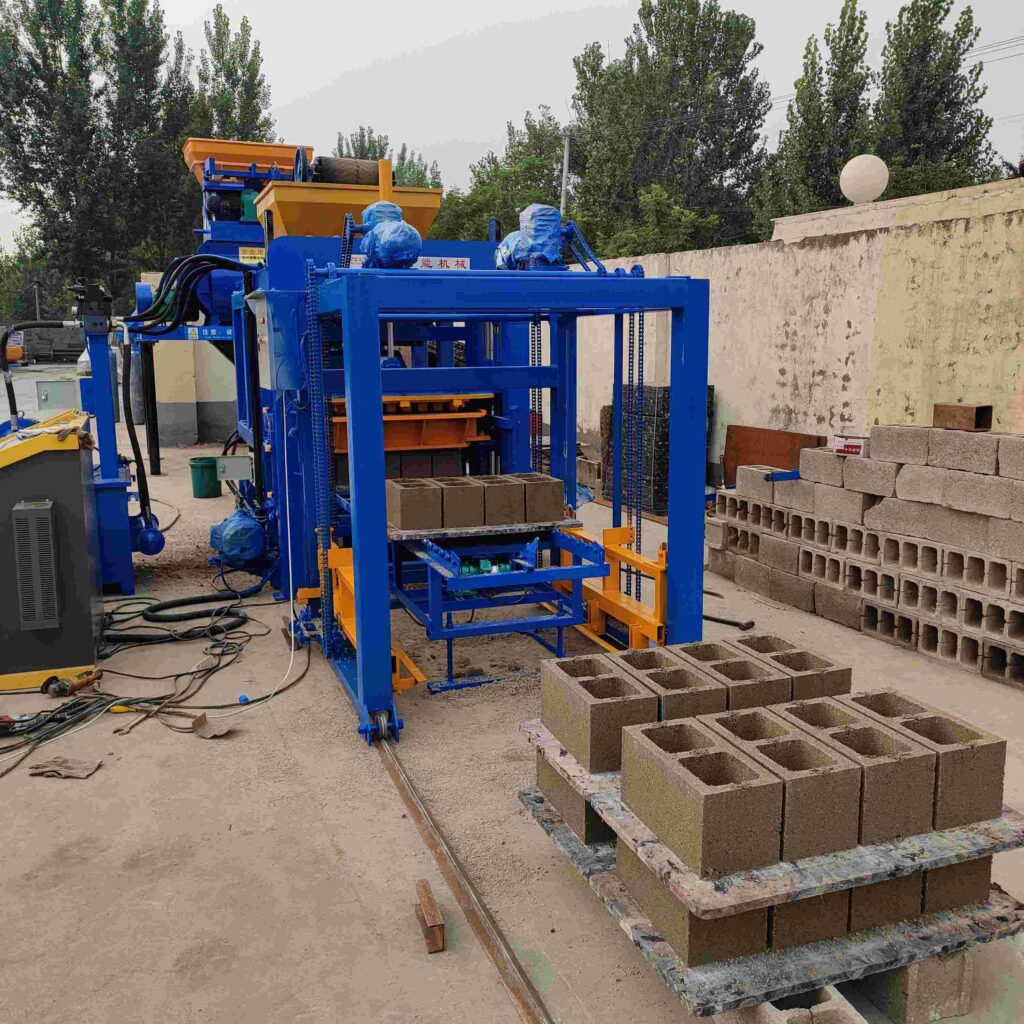
반자동과 완전 자동 시스템 간의 구분은 기업 투자의 근본적인 기로를 나타냅니다. 유통업자, 딜러, 조달 전문가들에게 이 차이를 이해하는 것은 단순히 사양을 비교하는 문제가 아닙니다. 이는 고객의 운영 능력, 재정적 제약, 시장 목표를 적절한 기술적 해결책과 조율하는 전략적 조언을 제공하는 데 핵심적입니다. 이 두 수준의 자동화 사이의 선택은 생산 기업의 본질, 즉 노동 모델, 규모, 일관성, 성장 경로를 정의합니다.
I. 기초적 구분: 핵심 운영 철학
주요 차이는 생산 주기를 완료하고 자재 흐름을 관리하는 데 필요한 인간의 개입 정도에 있습니다.
반자동 기계: 인간-기계 협업
반자동 시스템에서는 기계가 핵심적인 고압력 성형 공정을 자동화하지만, 주요 물류 기능은 인간 작업자가 관리합니다.
- 사이클 시작작업자는 일반적으로 발판이나 버튼을 통해 각 생산 주기를 시작합니다.
- 자동화된 핵심 프로세스:일단 시작되면, 이 기계는 미리 설정된 순서를 자동으로 실행합니다: 통합 호퍼에서 혼합된 재료를 끌어올리고, 이를 몰드로 옮긴 후, 진동과 유압을 가해 다지고, 마지막으로 몰드를 들어 올려 성형된 블록을 배출합니다.
- 중요한 수동 개입:운영자는 몇 가지 중요한 업무를 담당합니다:
- 준비된 재료 급여기계의 호퍼에 항상 올바른 콘크리트 믹스를 공급하는 것, 종종 휠바로우나 간단한 컨베이어를 사용하여.
- 제품 취급:신선하게 배출된 "그린" 블록(팔레트 위 또는 생산 표면에서)을 수동으로 제거하여 양생 구역으로 운반합니다.
- 팔레트 관리:팔레트 기반 시스템에서 빈 팔레트를 수동으로 기계의 입력 라인으로 반환하는 작업.
- 기본 품질 점검:블록을 시각적으로 검사하고 혼합 또는 기계 설정을 약간 조정합니다.
B. 완전 자동화 기계: 통합 시스템 자율성
全自动系统旨在最大程度减少生产流程中的人工干预,形成一条连续且同步化的制造生产线。
- 프로그래밍된 자율성整个过程由一台中央可编程逻辑控制器(PLC)协调,启动后系统只需极少操作员介入即可运行。
- End-to-End Integration: Key processes are fully mechanized:
- 자재 취급 Raw materials are often batched and mixed in an automated system that feeds the precise mix directly and continuously to the brick machine’s hopper via enclosed conveyors.
- Automated Production Cycle: The molding cycle (filling, compacting, ejecting) is entirely automatic and synchronized with material input.
- Product Logistics: Robotic arms, stackers, or sophisticated conveyor systems automatically transfer the green blocks onto curing racks or carts. Empty pallets are automatically cleaned, oiled, and returned to the start of the cycle.
- Curing Management: The system often integrates with automated curing systems (e.g., rack storage systems, chamber indexing) to create a seamless flow from production to curing.
II. Comparative Analysis: Key Differentiating Factors
The operational difference manifests in several concrete, measurable factors critical for business planning.
A. Labor Requirement and Skill Profile
- 반자동 Requires a higher number of personnel per output unit. Labor is primarily physical (material handling, block removal) but requires attentiveness to cycle timing. Skill levels can be lower, with training focused on manual tasks and basic machine operation.
- 완전 자동 Dramatically reduces direct labor count. Typically requires 1-3 highly skilled personnel per shift to monitor the PLC interface, perform quality control sampling, and conduct preventive maintenance. The labor cost shifts from unskilled physical labor to skilled technical supervision.
B. Production Output and Consistency
- 반자동 Output is 운전자 의존적 and variable. Production speed is limited by human efficiency in feeding and clearing the machine. Output can fluctuate based on operator fatigue, shift changes, or breaks. Realistic output is often 60-75% of the machine’s theoretical maximum cycle speed.
- 완전 자동 Output is system-defined and highly consistent. The PLC maintains a constant, optimal cycle time 24/7 if required. Output achieves 85-95% of theoretical capacity, as it is not subject to human pacing. This guarantees predictable daily, weekly, and monthly production volumes.
C. Product Quality and Uniformity
- 반자동 Quality is generally good but can exhibit minor variability. Factors like slightly inconsistent manual feeding or variations in how quickly a block is removed after ejection can lead to small differences in density or surface finish.
- 완전 자동 Delivers exceptional, batch-to-batch consistency. Precise, computer-controlled metering of material, pressure, vibration time, and handling ensures each unit is virtually identical. This is critical for large projects where precise structural calculations and uniform aesthetics are paramount.
D. Capital Investment and Financial Structure
- 반자동 Represents a moderate capital expenditure (CAPEX). The investment is primarily in the core machine itself. It offers a lower barrier to entry and a faster potential return on investment for a business starting or operating at a moderate scale.
- 완전 자동 Demands a significantly higher CAPEX. The investment covers not just a more complex press, but the integrated material handling, robotics, and sophisticated control systems. It is a long-term strategic investment justified by volume, labor savings, and market positioning.
E. Operational Complexity and Support Needs
- 반자동 Mechanically simpler. Troubleshooting often involves visible, mechanical, or basic hydraulic issues. Maintenance can frequently be performed by trained operators or local mechanics. Spare parts are generally less complex.
- 완전 자동 Highly complex. Troubleshooting requires understanding PLC software, sensor networks, and advanced mechatronics. Maintenance demands specialized technicians. Dependence on proprietary software and specialized spare parts from the original manufacturer is higher, making the choice of supplier and their after-sales support capability absolutely critical.
III. Strategic Application and Market Alignment
Choosing between the two is a strategic business decision that must align with the client’s profile and goals.
A. Ideal Clientele for Semi-Automatic Systems
- Small to Medium Enterprises (SMEs): Businesses with limited initial capital and a focus on local or regional markets.
- Market Entrants & Entrepreneurs: Those testing a business model or building a customer base gradually.
- Markets with Low Labor Costs: Where the economic driver for full automation (labor savings) is less compelling.
- Operations Requiring Flexibility: Businesses that frequently change products (e.g., switching between blocks and pavers) may find the simpler, more hands-on semi-automatic system more adaptable for short runs.
B. Ideal Clientele for Fully Automatic Systems
- Large-Scale Industrial Producers: Suppliers to major infrastructure projects, national retailers, or housing developers requiring guaranteed, massive volume.
- Businesses in High Labor-Cost Regions: Where automating manual tasks provides a rapid and necessary return on investment.
- Clients Focused on Premium/Standardized Quality: Producers of certified blocks for structural applications or suppliers to markets with stringent, enforceable building codes.
- Investors with Significant Capital: Those looking to establish a market-leading position with a focus on operational efficiency and low per-unit production cost over the long term.
IV. The Role of the B2B Professional: Guiding the Decision
For distributors and dealers, the role is to facilitate an informed choice, not to push a predetermined option. This involves a consultative process:
- 재무 분석: Modeling CAPEX against projected labor savings, output value, and payback period for both options.
- Market Demand Assessment: Quantifying the client’s current and projected order book. Does it justify and require the output of a full line?
- Operational Readiness Evaluation: Assessing the client’s ability to recruit and retain the skilled technicians needed for a fully automatic system, or their access to reliable manual labor for a semi-automatic one.
- Infrastructure Check: Verifying that the client’s site has the stable, high-capacity power supply and space required for an integrated automatic line.
결론
The divergence between semi-automatic and fully automatic brick making machines represents a strategic fork in the road for manufacturing businesses. The semi-automatic path offers accessibility, flexibility, and lower initial risk, positioning itself as the engine of growth for the entrepreneurial and SME sector. The fully automatic path represents the pinnacle of industrial efficiency, pursuing scale, consistency, and minimal variable cost, suited for established players in high-volume markets.
For the B2B professional, expertise is demonstrated by moving beyond a simplistic “manual vs. automatic” narrative. It requires a nuanced understanding that the “semi-automatic” machine is not an inferior version of the “fully automatic,” but a distinct tool for a different business model. The most valuable service a distributor can provide is to meticulously align the client’s capital, labor landscape, market ambition, and operational DNA with the appropriate level of technological integration. By doing so, you ensure the chosen machine does not become a burdensome asset, but rather the perfectly calibrated catalyst for your client’s sustainable success and profitability.
자주 묻는 질문 (FAQ)
Q1: Can a semi-automatic machine be upgraded to a fully automatic one later?
A: Generally, no, not through a simple upgrade kit. The fundamental design philosophies differ. A semi-automatic machine lacks the structural integration points, control system architecture, and often the mechanical robustness to seamlessly add robotic handling and full PLC orchestration. “Upgrading” typically means selling the semi-automatic machine and purchasing a new, designed-from-the-ground-up fully automatic system. However, some semi-automatic models can be enhanced with add-on automation (like an automatic feeder or a simple stacker), which improves efficiency but does not constitute full automation.
Q2: Which type offers a better return on investment (ROI)?
A: The ROI profile is different, not inherently better or worse. A 반자동 기계 often has a shorter ROI period due to its lower purchase price. It can become profitable quickly at a modest scale. A 완전 자동 기계 usually has a higher absolute ROI over its full lifespan due to vastly lower operating costs and higher output, but it requires a longer period to recoup the much larger initial investment. The “better” ROI depends on the client’s access to capital and their patience for a longer payoff horizon.
Q3: Is product quality drastically different between the two types?
A: The quality from a well-operated semi-automatic machine can be excellent and meet all common standards. The difference lies in consistency and repeatability. A fully automatic system eliminates human variables, ensuring that the 100,000th block is identical to the first. For most general construction, semi-automatic quality is sufficient. For precision-engineered projects or where a single client’s order spans multiple production runs over months, the guaranteed consistency of a full automatic becomes a major commercial advantage.
Q4: How significant is the difference in maintenance cost and complexity?
A: The difference is substantial. 반자동 기계 have lower and more predictable maintenance costs, often manageable with in-house staff. Fully automatic systems have higher annual maintenance costs due to the complexity and number of components (robotics, sensors, advanced hydraulics). This maintenance often requires service contracts with specialized technicians, representing a higher, ongoing operational expense that must be factored into the TCO (Total Cost of Ownership).
Q5: For a business planning to operate 16 hours a day with two shifts, which type is more suitable?
A: Intensive multi-shift operation strongly favors a fully automatic system. The consistency and output guarantee are maintained regardless of shift changes or operator fatigue. The higher initial investment is justified by maximizing utilization. A semi-automatic machine running on two shifts will see output variations between shifts and incur higher labor costs (for two teams of manual handlers), eroding the economic benefits of extended operation.