
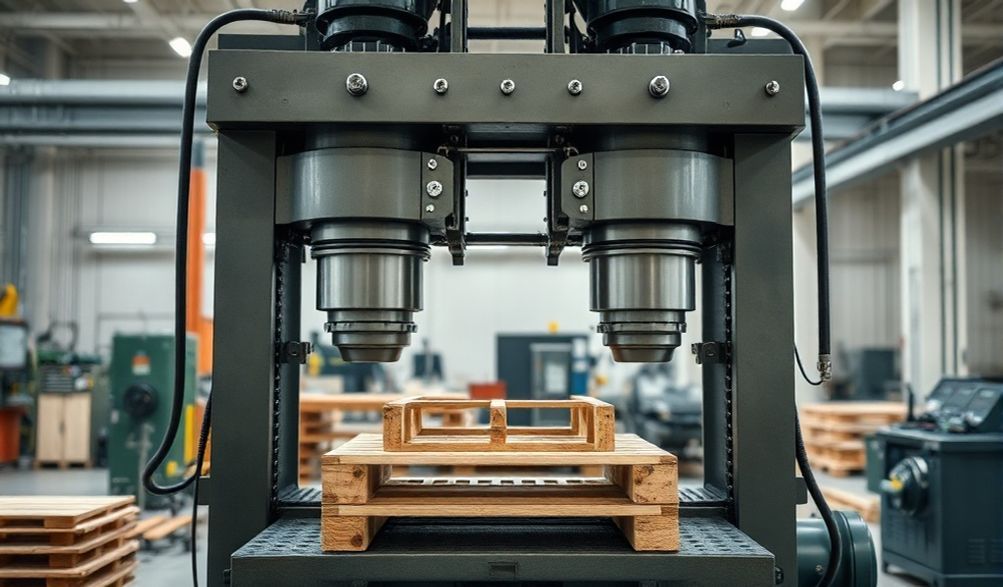
더블 헤드 팔레트 블록 프레스 머신 완벽 가이드: 목재 가공의 효율성과 품질
소개
팔레트 제조의 까다로운 세계에서는 끊임없는 긴장이 존재합니다. 더 높은 생산량을 위한 끊임없는 추진과 일관된 고강도 블록에 대한 양보할 수 없는 요구 사이의 긴장입니다. 생산 관리자와 공장 소유주에게 이러한 균형 잡기는 수익성, 평판, 그리고 운영의 안정성을 결정합니다. 속도를 위해 품질을 희생하면 제품 불량과 고객 불만으로 이어지며, 느리고 세심한 생산은 성장을 억제하고 수익을 잠식합니다.
이 핵심 산업 난제를 해결하기 위해 설계된 엔지니어링 솔루션, 바로 더블헤드 팔레트 블록 프레스 기계입니다. 이는 단순한 점진적 업그레이드가 아니라 블록 생산 기술의 패러다임 전환입니다. 양쪽에서 지능적이고 동시에 힘을 가함으로써 압축의 물리학 자체를 다루며 우수한 결과를 제공합니다.
수년간의 엔지니어링 분석과 현장 운영 경험을 바탕으로, 이 가이드는 더블 헤드 프레스를 분석합니다. 판매 브로셔를 넘어 이 기계의 작동 방식, 기존 싱글 헤드 모델에 비해 명확한 이점, 그리고 현명한 투자와 값비싼 실수를 구분하는 핵심 요소에 대한 명확하고 권위 있는 시각을 제공합니다. 생산 능력 확장을 평가하든 제품 품질을 통해 경쟁 우위를 추구하든, 이 핵심 장비를 이해하는 것이 첫걸음입니다. 이 자료는 생산 라인을 미래에 맞게 최적화할 준비가 된 팔레트 공장 소유자, 생산 관리자 및 목재 가공 전문가를 위해 특별히 제작되었습니다.
더블 헤드 팔레트 블록 프레스 기계는 무엇인가요?
이중 헤드 팔레트 블록 프레스는 핵심적으로, 톱밥, 칩, 부스러기 같은 느슨한 목재 잔여물을 접착제와 혼합하여 밀도 높고 내구성 있는 팔레트 블록(데크 또는 블록이라고도 함)으로 탁월한 효율성과 일관성으로 변환하는 정밀 압축 장치입니다.
핵심 기능과 설계 원칙
핵심 혁신은 그 이름에 있습니다. 한 방향으로만 힘을 가하는 단일 헤드 프레스와 달리, 더블 헤드 기계는 서로 반대 방향에 위치한 두 개의 프레스 헤드를 특징으로 합니다. 이 헤드들은 동기화되어 조화롭게 움직이며, 재료에 상하(또는 방향에 따라 좌우) 양쪽에서 동시에 고압력을 가합니다.
This bi-directional action is a game-changer. It compresses the material matrix evenly throughout the entire block profile during a single, rapid cycle. The result is a block with uniform density from its core to its surface, which is the fundamental prerequisite for structural integrity.
주요 구성 요소와 그 역할
Understanding the machine’s anatomy is key to appreciating its capabilities:
- 프레임과 구조 This is the machine’s backbone. Constructed from heavy-duty steel plate or reinforced casting, it must withstand immense, repetitive tonnage without flexing. A robust frame ensures alignment, safety, and long-term stability.
- Twin Press Heads: The defining components. Powered by the main system, these heads must operate with perfect synchronization to apply balanced force. Their surface area (platen size) determines the maximum block dimensions.
- 유압/공압 시스템: This is the machine’s muscle.
- Hydraulic systems are most common for high-tonnage applications, using fluid power to generate immense, controllable force. They are powerful and excellent for maintaining pressure during the critical “dwell time.”
- Pneumatic systems use compressed air and are typically faster but better suited for lower-pressure applications.
- 금형/캐비티: This is the precision tooling that gives the block its final shape (e.g., 4″x4″, 6″x6″) and often includes features for stringer notches. It must be precisely machined, hardened for wear resistance, and designed for easy release.
- Control System (PLC – Programmable Logic Controller): The machine’s brain. A modern PLC automates the entire pressing cycle: fill time, press head advance, pressure application, dwell time (the period pressure is held), and retraction. It allows for storing “recipes” for different block types, ensures repeatability, and provides diagnostic data.
Advantages of a Double-Sided Pressing System
The dual-head design isn’t just different; it delivers measurable, operational advantages that directly impact your bottom line and product quality.
Unmatched Production Efficiency & Speed
This is the most immediate benefit. By pressing from both sides at once, the machine completes the compression cycle in significantly less time than a single-head press, which must often press, hold, and then reverse.
- 영향 Cycle times can be reduced by 30-50% or more, depending on the model and block size.
- Tangible Result: This translates directly into higher output per hour. Where a single-head press might produce 200 blocks per hour, a comparable double-head model could produce 300-350, dramatically increasing your shift and daily throughput without increasing floor space or labor.
Superior Block Density and Structural Integrity
Even compression is the holy grail of block quality. Single-sided pressing can create density gradients—the material is very dense near the press head but less so on the opposite side.
- Balanced Force: The double-head system eliminates this gradient. The material is compressed uniformly from both surfaces inward, creating a homogeneous block structure.
- Critical Outcomes:
- Higher Load-Bearing Capacity: The block can withstand greater weight without cracking or failing.
- Better Nail-Holding Power: Uniform density means nails and screws grip consistently throughout the block, reducing assembly failures and pallet repair rates.
- Reduced Delamination: Even compression and proper adhesive penetration minimize the risk of the block layers separating, a common failure point in lower-quality blocks.
Enhanced Material Consistency and Waste Reduction
Consistency is profitability. Because the process is more controlled and efficient, block-to-block variation is minimized.
- 균일한 품질 Every block that comes out of the press meets the same high standard, reducing quality control rejects and ensuring reliable performance for your customers.
- 최적화된 자재 사용: Efficient compression ensures almost all input material is effectively bonded. This can allow for precise optimization of adhesive ratios and reduces the waste of uncompressed “fluff” that sometimes occurs with uneven pressing.
Operational Stability and Reduced Wear
Think of the force dynamics. A single-head press exerts massive, off-axis stress on its frame and the opposing stationary platen. A double-head press balances this force across its own structure.
- 영향 This balanced loading reduces vibration, minimizes stress concentrations on components, and leads to smoother operation.
- 결과 Lower long-term maintenance costs, less unexpected downtime, and a significantly extended service life for the entire machine.
Critical Applications in Modern Wood Processing
The double-head press isn’t for every small shop, but it has become essential in specific, high-stakes segments of the industry.
High-Volume Pallet Manufacturing Plants
This is the primary application. For mills supplying large-scale distributors, big-box retailers, or logistics hubs, the ability to produce thousands of consistent, strong blocks per shift is a basic requirement for staying competitive and fulfilling contracts.
Production of Specialty and Heavy-Duty Blocks
When block specifications are critical, the double-head press is the tool of choice.
* Export Pallets: Must meet strict ISPM 15 standards and survive intercontinental shipping.
* Chemical & Beverage Industries: Often require blocks with extra density to handle heavy, unstable loads and harsh environments.
* Block-Type Pallets: Where block quality is the sole determinant of pallet strength, leaving no room for compromise.
Integration with Automated Pallet Production Lines
In a fully automated “pallet factory,” the block press is a core component. It feeds a continuous, reliable stream of high-quality blocks directly to automated assembly stations or robotic nailers. The speed and consistency of a double-head press are non-negotiable for keeping an automated line running smoothly and profitably.
How to Choose the Right Machine for Your Operation
Selecting a press is a major capital decision. Asking the right questions and scrutinizing specifications will ensure you get a machine that fits your needs for years to come.
생산 요구사항 평가하기
Start with your own business, not the machine specs.
* What is your current and projected daily output (in blocks)?
* What block dimensions and types do you need to produce now, and in the future?
* What is your primary raw material? (Species mix, chip size, moisture content range)? These factors drastically influence the required press force.
Technical Specifications to Scrutinize
- Press Tonnage: This is the total force applied. More tonnage allows for higher density blocks from harder materials or finer particles. Don’t under-specify. A common range is 100 to 500+ tons for double-head block presses.
- Platen Size & Mold Options: The platen must accommodate your largest planned block size. Check the manufacturer’s standard and custom mold offerings. Quick-change mold systems can be a valuable feature for flexible operations.
- 사이클 타임: Ask for the demonstrated cycle time for a block of your specification, including fill, press, dwell, and eject. This number directly predicts your maximum throughput.
- Power Source (Hydraulic vs. Pneumatic):
- 유압식: Preferred for most pallet block applications. Offers higher force, excellent pressure control for dwell time, and is well-suited for dense blocks. Requires a hydraulic power unit.
- Pneumatic: Faster cycle, cleaner (no oil leaks), but limited to lower-pressure applications. May be suitable for softer wood species or less dense block requirements.
- Control System & Automation Level: A user-friendly, modern PLC with a touchscreen interface is essential. Look for features like recipe storage, production counters, fault history logs, and password-protected access to parameters.
Manufacturer Evaluation: Building a Trustworthy Partnership
The machine is only as good as the company behind it.
* Experience & Reputation: How long have they been building these specific machines? Ask for customer references and visit existing installations if possible.
* Engineering Support & Customization: Can they adapt the machine to your unique material flow or facility layout? A partner who understands your process is invaluable.
* After-Sales Service & Parts Availability: This is critical. What is their response time for technical support? Is there a local service network? Are common wear parts (seals, filters) standardized and readily available? Downtime is lost revenue.
Operational Best Practices and Maintenance
A world-class machine requires world-class care. These insights, drawn from operational experience, will maximize your ROI.
Optimal Setup and Daily Operation
- Material Preparation is 80% of Success: Ensure consistent chip size and moisture content. A fluctuating raw material feed is the biggest cause of variable block quality. The glue mix ratio and application must be precise and consistent.
- Respect the PLC Parameters: The programmed pressure and dwell time are set for a reason—to achieve the target density with your specific material. Operators should not arbitrarily change these to “speed things up,” as it will compromise quality.
- Regular Mold Maintenance: Keep molds clean and apply recommended release agents sparingly to prevent material sticking, which can jam the machine and damage blocks.
Essential Preventive Maintenance Schedule
| Frequency | Key Tasks |
| :— | :— |
| Daily/Weekly | Visual inspection for leaks, loose fittings, or unusual noises. Clean excess material from platens, molds, and surrounding area. Check hydraulic oil levels and temperature. |
| Monthly/Quarterly | Change hydraulic and pneumatic filters. Inspect cylinder rods for scoring or damage. Check all electrical connections for tightness. Test safety interlocks and emergency stops. |
| Annually | Perform a full hydraulic fluid analysis and change if needed. Have a qualified technician calibrate pressure sensors and review the PLC system. Inspect the structural frame for any signs of stress or cracking. |
Troubleshooting Common Issues
- Inconsistent Block Density: First, check the raw material feed for consistency in volume and composition. Next, verify the hydraulic system is maintaining stable pressure. An imbalance between the two press heads can also be a cause.
- Sticking in Mold: This is often related to material moisture being too high, insufficient or improper mold release agent, or a worn/damaged mold surface that needs polishing or re-coating.
- Hydraulic System Issues (Leaks, Pressure Drops): Identify the source of leaks immediately—they are a safety and environmental hazard. Pressure drops often point to worn pump seals, internal valve leaks, or contaminated fluid. Address these promptly to prevent further component damage.
자주 묻는 질문 (FAQ)
Q1: What is the typical output difference between a single-head and a double-head pallet block press?
A: While highly dependent on block size and material, a double-head press typically increases production rates by 40-70% due to its simultaneous pressing action and faster overall cycle times. The efficiency gain is substantial.
Q2: Can a double-head press handle different raw materials like hardwood and softwood mixes?
A: Yes, robust machines are designed for material variability. The key is to create separate PLC “recipes” for different mixes. You will likely need to adjust the compression pressure and dwell time—hardwood fibers often require more force and time to achieve the same density as softwood.
Q3: Is the investment in a double-head machine justified for a small to mid-sized shop?
A: It depends on your growth trajectory and value proposition. If you are capacity-constrained, competing on block quality (e.g., for specialty markets), or looking to reduce labor cost per block, the ROI can be very compelling. Conduct a thorough analysis based on your increased output potential and any price premium your stronger blocks could command.
Q4: How critical is the PLC control system?
A: Extremely critical. A modern PLC is not a luxury; it’s the guardian of your quality and productivity. It ensures every block is made identically, reduces operator error, allows quick changeovers between products, and provides vital data for predictive maintenance, protecting your capital investment.
Q5: What safety features should I look for?
A: Never compromise on safety. Essential features include: two-hand anti-tie-down initiation controls, fully interlocked mechanical guards that prevent access during the cycle, pressure relief valves on hydraulic systems, emergency stop buttons at multiple points, and proper machine grounding. Always verify the machine complies with relevant safety standards (e.g., CE, OSHA, ANSI).
결론
The double-head pallet block press machine has firmly established itself as a cornerstone technology for modern wood processors who refuse to choose between speed and quality. It represents a sophisticated application of engineering principles to solve a fundamental production challenge, delivering tangible gains in throughput, block integrity, and operational stability.
Ultimately, investing in this technology is about more than purchasing a piece of equipment; it’s an investment in your product’s reputation, your production line’s reliability, and your company’s competitive edge in a demanding market. It signals a commitment to excellence that your customers will see and feel in every pallet you produce.
Ready to evaluate how a double-head press can transform your output? The most important step is to move from knowledge to informed action. Consult with a reputable, experienced manufacturer. Prepare your specific production data—output goals, block specs, and material details—and request a detailed machine specification and performance analysis tailored to your unique operation. This guide serves as your foundational resource for asking the right questions and making a confident, capital equipment decision that will drive your business forward.
<