
지속 가능한 건축의 기초: 흙 블록 프레스 완벽 가이드
기후 변화에 대한 인식이 높아지고 건축 비용이 치솟는 시대에 전 세계의 건축업자, 주택 소유자, 지역사회는 가장 근본적인 재료, 즉 우리 발아래 있는 흙을 다시 주목하고 있습니다. 지속 가능하고, 경제적이며, 견고한 건축 방법을 찾는 노력은 이제 틈새 관심사에서 긴급한 글로벌 과제로 이동했습니다. 소성 벽돌과 콘크리트 같은 전통적인 재료는 상당한 탄소 배출, 높은 내재 에너지, 예산과 환경 모두에 부담을 주는 공급망이라는 무거운 부담을 안고 있습니다.
고대의 지혜와 현대 공학을 잇는 혁신적인 기술, 바로 '생체모방공학'입니다.흙 블록 프레스압축 흙 블록(CEB) 프레스 또는 토양 블록 프레스로도 알려진 이 장치는 주로 현지 토양을 사용하여 매우 내구성 있고 아름답고 고성능의 건축 블록을 만들 수 있도록 사람들에게 힘을 실어줍니다. 이는 원시적인 진흙 오두막으로의 회귀가 아니라, 우아한 개인 주택과 학교부터 대규모 인도주의 주택 프로젝트에 이르기까지 다양한 프로젝트에서 검증된 공학적 건축 접근법입니다.
흙으로 건축하는 관행은 대륙을 가로지르는 오래된 구조물들로 증명되듯, 문명 자체만큼이나 오래되었습니다. 현대 공학은 이러한 지식을 정제하여 일관되고 인증된 강도의 블록을 생산하는 프레스와 안정화 기술을 개발해왔습니다. 이 가이드는 검증된 원칙, 실전 경험, 그리고 수천 건의 프로젝트 성공 사례에 기반을 두고 있습니다. 우리의 목적은 여러분에게흙 블록 프레스 technology. By the end, you’ll understand how it works, its profound benefits, the critical factors for success, and the practical steps to begin your own journey toward building sustainably from the ground up.
What is an Earth Block Press? The Core Technology Explained
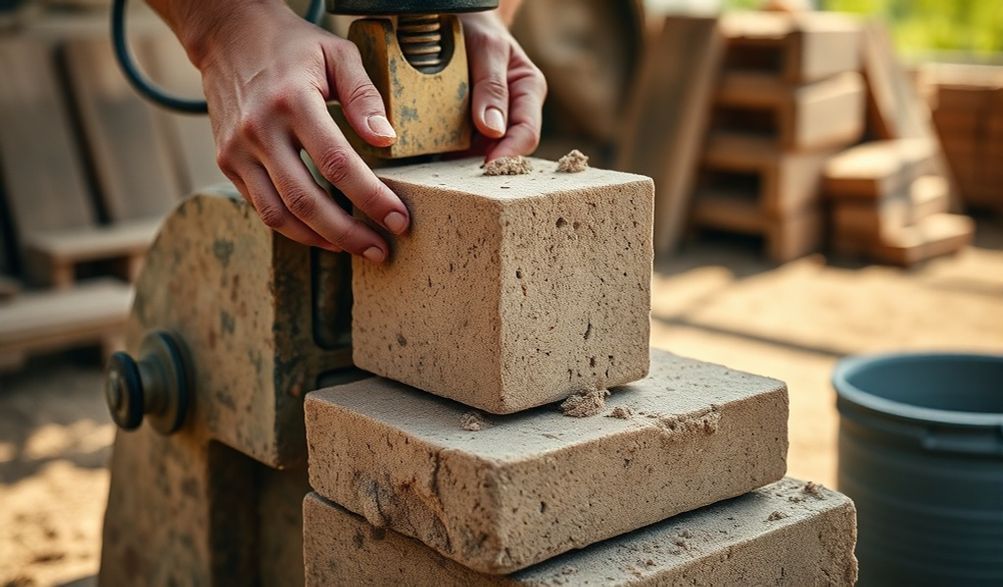
At its heart, an 흙 블록 프레스 is a mechanical or manual device designed to compress damp, prepared soil into dense, regularly-shaped blocks. Unlike adobe, which is simply molded and sun-dried, these machines apply high, focused pressure to the soil mixture. This compression mechanically binds the soil particles, dramatically increasing the block’s density, strength, and dimensional stability. The result is a 압축 흙 블록—a modern building unit that rivals conventional materials in performance.
How Does an Earth Block Press Work?
The process is elegantly straightforward but requires attention to detail. It follows a consistent sequence:
- 토양 준비: Suitable subsoil is sourced, cleared of organic matter, and often sieved to remove large stones.
- 믹싱 The soil is mixed with a small amount of water and, in most cases, a stabilizer (like cement or lime) to achieve optimal moisture content—damp but not wet.
- 로딩 중... The homogeneous mixture is loaded into a heavy-duty steel mold (die) within the press.
- 압축 A lever, hydraulic ram, or mechanical actuator applies intense pressure, typically measured in tons per block. This is the defining action that creates the block’s integrity.
- 이젝션 The newly formed, solid block is ejected from the mold, ready for curing.
Presses vary significantly in their power source:
* Manual/Lever Presses: Operated by human force (e.g., the iconic Cinva Ram design). Ideal for small-scale, community, or DIY projects with low production needs.
* 유압 프레스: Use a hydraulic pump (often hand-operated or motorized) to generate much higher pressure with less physical effort. A common choice for serious owner-builders and small enterprises.
* Motorized/Powered Presses: Employ an engine or electric motor to automate the pressing cycle, enabling high-volume production for commercial or large community projects.
Compressed Earth Blocks (CEBs) vs. Traditional Materials
How do CEBs stack up against the materials we know?
- vs. Adobe: CEBs are compressed, not just dried. This gives them greater compressive strength, more precise dimensions, and better resistance to erosion from the start. Both share excellent thermal mass.
- vs. Fired Clay Bricks: The key difference is energy. Firing bricks requires temperatures over 1000°C for days, consuming vast amounts of fuel. CEB production uses roughly 1/10th to 1/15th the energy. While high-quality fired bricks can be stronger, properly stabilized CEBs easily meet structural requirements for most low-rise buildings.
- vs. Concrete Blocks (CMUs): Concrete blocks have high embodied energy due to cement production. CEBs use a fraction of the cement (if any) as a stabilizer, not the primary binder. CEBs also offer superior thermal mass and humidity regulation, creating a more comfortable indoor environment naturally.
Key Benefits of Using an Earth Block Press
Choosing to build with an earth block press is not just a construction decision; it’s an ecological, economic, and aesthetic choice with far-reaching advantages.
Environmental and Sustainability Advantages
- 초저체화에너지: Eliminating the firing process is the single largest ecological win, slashing CO2 emissions associated with material production.
- 지역 자재 활용 Buildings are made from the site’s soil or locally sourced subsoil, virtually eliminating the environmental and financial cost of long-distance material transport.
- Non-Toxic & Biodegradable: At the end of its very long life, a CEB wall can simply crumble back into the earth, or the material can be reused. It contains no volatile organic compounds (VOCs).
- Superior Thermal Performance: The high thermal mass of earth walls absorbs heat during the day and releases it at night, naturally moderating indoor temperatures and reducing reliance on mechanical heating and cooling.
Economic and Practical Benefits
- 급격한 재료비 절감 The primary ingredient—soil—is often free or very low-cost. Even with stabilizers like cement, material costs can be 30-50% lower than conventional brick or block.
- Empowerment of Owner-Builders: The technology is accessible. It enables DIY construction and community-led projects, putting control and cost savings directly in the hands of people.
- Low-Tech & Repairable: The presses are mechanically simple, designed to be maintained and repaired with basic tools and skills, fostering local self-reliance rather than dependency on complex supply chains.
- 확장성: From a single manual press for a home to multiple motorized units for an affordable housing development, the technology scales to meet the need.
Structural and Performance Qualities
- 높은 압축 강도: When properly stabilized and compacted, CEBs can achieve compressive strengths exceeding that of common fired bricks, suitable for multi-story load-bearing walls.
- 화재 및 해충 저항성: Solid earth does not burn and is inherently unappealing to termites and rodents.
- Excellent Sound Insulation: The mass and density of the walls provide exceptional acoustic buffering.
- 내구성 With crucial but simple protective design features (good roofs, plasters, and foundations), earth block structures can last for centuries, as historical examples prove.
Critical Considerations Before You Press Your First Block
Success with CEBs hinges on understanding and respecting a few non-negotiable principles. Skipping this groundwork is the most common cause of failure.
Soil Suitability: Is Your Dirt Right?
Not all soil is building soil. You need subsoil, rich in clay and silt, not organic topsoil. The ideal is a blend of:
* 클레이: The binder (typically 15-30%).
* 실트: The filler.
* 모래 The aggregate providing compressive strength (typically 50-75%).
Simple Field Tests:
* Ribbon Test: Moisten a handful of soil and roll it into a pencil-thin ribbon. If it holds together for 2-3 inches before breaking, the clay content is likely sufficient.
* Jar Sedimentation Test: Place soil in a clear jar with water, shake vigorously, and let it settle over 24 hours. The layers will visually reveal the approximate ratios of sand, silt, and clay.
The Role of Stabilizers
While some very ideal soils can be used “raw,” most require a stabilizer for durability, especially in climates with freeze-thaw cycles or heavy rain.
* Cement (Portland): The most common stabilizer (often 5-10% by volume). It reacts chemically with water to bind the soil particles, providing strong, water-resistant blocks within a 28-day curing period.
* Lime: A more flexible, vapor-permeable stabilizer that carbonates over time. Excellent for historic compatibility and certain soil types.
* Natural/Biological Stabilizers: Options like cactus mucilage or plant oils have historical use and are the subject of modern research, but offer less predictable structural strength than cement or lime.
Choosing the Right Earth Block Press for Your Project
Selecting your tool is a balance of scale, budget, and labor.
* Manual Block Presses (e.g., Cinva Ram):
* 장점: Lowest cost, portable, no power required, perfect for learning and small projects (garden walls, sheds).
* 단점: Labor-intensive, slow production (50-100 blocks per person per day), lower pressure may require more stabilizer.
* Hydraulic Block Presses:
* 장점: Higher, more consistent pressure with less effort. Great for serious owner-builders and small businesses. Good balance of capability and cost.
* 단점: Higher initial cost, requires a hydraulic pump (manual or motorized).
* Motorized CEB Machines:
* 장점: High-volume production (hundreds to thousands of blocks per day). Essential for commercial projects or large community builds.
* 단점: Significant investment, requires fuel/electricity and more technical maintenance.
자문해 보세요: What is the scale of my project? What is my budget? How much labor is available? What block size and shape do I need?
A Step-by-Step Guide to Producing Quality Compressed Earth Blocks
Phase 1: Material Preparation & Mixing
- Source & Sieve: Excavate subsoil from a trench or borrow pit. Remove all vegetation and roots. Sieve through a 1/4″ or 1/2″ screen to achieve a consistent, stone-free mix.
- Calculate & Add Stabilizer: Determine the volume of soil and calculate the stabilizer percentage (e.g., for 5% cement stabilizer on 1 cubic meter of soil, use 0.05 cubic meters of cement). Dry-mix the soil and stabilizer thoroughly until uniformly colored.
- Add Water & Mix: Gradually add water while mixing (a mortar mixer is ideal). Aim for “optimal moisture content”—the soil should hold its shape when squeezed in your fist without dripping water and crumble when poked. This is critical for achieving maximum compaction in the press.
Phase 2: Pressing & Curing
- 프레싱 Load the mixed material into the press chamber. Apply steady, full pressure according to the machine’s instructions. Eject the block carefully onto a pallet. Consistency in loading and pressure is key to uniform blocks.
- Handling & Stacking: “Green” blocks are fragile. Handle them with care. Stack them on a level, dry surface with small gaps between them for air circulation. Protect them from direct sun and rain.
- 치유: This is where the block gains its strength. For cement-stabilized blocks, keep them moist by lightly misting and covering with plastic sheeting for 7-14 days, followed by 2 more weeks of protected, air-drying. The full 28-day cure is essential for the cement to fully hydrate and harden.
Phase 3: Construction Basics
- 기반 CEB walls require a solid, raised foundation (plinth)—typically of stone or concrete—to lift them well above ground splash-back and capillary moisture.
- Mortar: Use a compatible mortar, often a slightly richer version of your block mix (e.g., soil-cement mortar). Lay blocks in running bond, ensuring joints are fully filled.
- Protective Detailing: This is mandatory for longevity.
- Roof Overhangs: Provide wide overhangs (18-24 inches minimum) to shield walls from driving rain.
- Plaster/Render: Apply a protective coat of earthen, lime, or cement-lime plaster. This is the primary weather shield.
- Site Drainage: Ensure the ground slopes away from the structure on all sides.
Frequently Asked Questions (FAQ) About Earth Block Presses
Q: How strong are compressed earth blocks?
A: Properly produced, stabilized CEBs typically achieve compressive strengths between 600 and 1,200 psi (pounds per square inch), which meets or exceeds the strength of many conventional fired bricks (ASTM standard C62 for building brick starts at 1,500 psi for Grade SW, but many common bricks are lower). Strength is a direct function of soil quality, stabilizer type/percentage, and compaction pressure.
Q: Can I build a house with an earth block press in a rainy climate?
A: Yes, absolutely. Many successful CEB homes exist in humid and rainy regions. The key is in the design and detailing, not just the block itself. The use of cement or lime stabilizer is highly recommended, combined with the non-negotiable trio of: 1) a moisture-proof foundation, 2) wide roof overhangs, and 3) a well-maintained, vapor-permeable plaster (lime is excellent for this).
Q: What is the cost comparison to conventional bricks?
A: The raw material cost for CEBs is often 30-50% lower than purchasing fired bricks or concrete blocks. However, the total project cost savings depend heavily on labor. If you are an owner-builder providing the labor, savings are massive. If you are hiring labor, savings are still significant on materials, but labor costs for laying CEBs are similar to other masonry. The localization of materials provides insulation from market price volatility.
Q: Where can I buy an earth block press or find plans to build one?
A:
* Purchasing: Search for companies and NGOs specializing in sustainable building technology (e.g., organizations like Vela Creations, Vermaak Machines또는Vearth in various regions). Attend natural building workshops where suppliers are often present.
* DIY Plans: Open-source designs for manual presses like the Cinva Ram are available online from platforms like Open Source Ecology또는Appropedia. Building your own requires good metalworking skills.
Q: Do I need special skills or training to use a press?
A: Advanced construction skills are not a prerequisite. More important are patience, careful attention to the soil mix and moisture, and basic mechanical aptitude for operating and maintaining the press. A hands-on workshop is invaluable. For a large project, starting with a small test wall (a garden bench or shed) is the best training you can give yourself.
결론
그흙 블록 프레스 represents a powerful convergence of simplicity and resilience. It demystifies the process of creating building materials, transforming the abundant resource underfoot into walls that shelter, inspire, and endure. This method is not a speculative experiment; it is a time-tested, engineer-validated pathway to construction that is ecological, economical, and empowering.
We are standing on the perfect building material. The knowledge, refined over millennia and enhanced by modern tools, is now widely accessible. Whether your vision is a backyard studio, a family home, or a community project, the journey begins with looking down and seeing potential. Start small. Test your soil. Build a garden wall. Connect with the global community of natural builders. Each block pressed is a step toward a more sustainable and self-reliant future.
What’s your next step? Share your location or project idea in the comments below, research your local soil composition, or begin exploring the specific 흙 블록 프레스 models that could turn your vision into reality.
<