
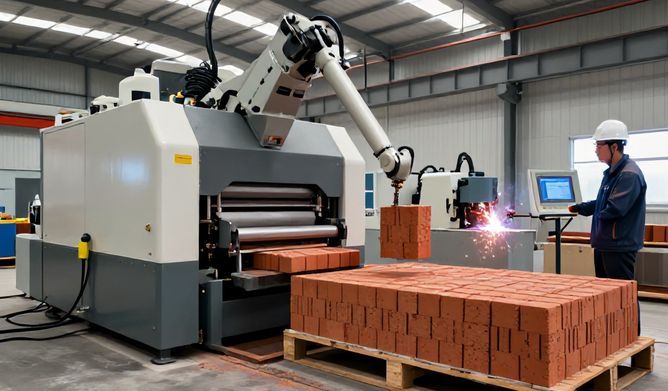
최고의 벽돌 제조 기계 가이드: 푸다 벽돌 공장 내부 탐방 (Note: "FUDA" is transliterated as "푸다" since it appears to be a proper name. If it's an acronym or has a specific meaning, the translation might need adjustment.)
소개
Every single day, the global construction industry uses billions of bricks. From the foundations of homes to the facades of skyscrapers, this humble building block remains a cornerstone of modern development. Yet, behind this staggering demand lies a quiet revolution: the shift from labor-intensive, inconsistent manual production to the precision and power of automated brick making machines.
This guide delves into the heart of that revolution. We’ll explore the machinery that makes modern construction faster, more sustainable, and more profitable. Our focus isn’t just on the technology in general, but on the engineering excellence behind it, as exemplified by industry leaders like the 푸다 벽돌 제조 공장.
For over two decades, FUDA has stood at the forefront of brick making machinery design and manufacturing. Their commitment isn’t just to building machines, but to building robust solutions for contractors, large-scale builders, and ambitious entrepreneurs worldwide. This guide will serve as your comprehensive resource, breaking down machine types, key features, and the critical factors to consider when investing in equipment that will form the backbone of your operation.
This guide is compiled based on industry expertise and technical insights from the engineering team at FUDA Brick Making Factory, a manufacturer with over 20 years of hands-on experience in the heavy machinery sector.
Understanding Modern Brick Making Machinery
Gone are the days when brick production was synonymous with back-breaking labor and variable quality. Today’s brick making machines are marvels of mechanical engineering, designed for efficiency, consistency, and scale.
How Brick Making Machines Have Revolutionized Construction
The impact of automation in brick production cannot be overstated. Let’s contrast the old with the new:
- 스피드와 스케일 A manual laborer might produce a few hundred bricks per day. A semi-automatic machine can produce thousands, and a fully automatic line can output tens of thousands of bricks in a single shift.
- 일관성과 품질: Machines apply uniform pressure and precision in every cycle. This results in bricks with identical dimensions, density, and compressive strength, which is critical for structural integrity and meeting building codes.
- 노동력 및 비용 절감 Automation significantly reduces reliance on large manual crews, mitigating labor shortages and controlling long-term operational costs.
- 확장성: As demand grows, production can be scaled predictably by adding shifts or integrating more automated systems, something impossible with purely manual methods.
Core Components of a Brick Making Machine
While models vary, most modern brick making machines share these fundamental components:
- 믹서/호퍼: Where raw materials (cement, sand, aggregate, fly ash) are blended with water to create a homogeneous mix.
- 컨베이어 시스템: Transports the raw mix from the hopper to the molding area, ensuring a consistent feed.
- Mold Box & Pallet: The heart of the machine. The mold defines the brick’s shape (hollow, solid, paver). A pallet (a steel plate) receives the mix and enters the mold for compression.
- 압축 시스템: Typically hydraulic or mechanical, this applies immense, calibrated pressure to the mix in the mold, compacting it into a dense, strong brick.
- 제어 패널 (PLC) The brain of automated systems. It allows operators to set parameters like pressure, cycle time, and vibration, ensuring repeatable results.
Different Types of Bricks Produced
Modern machines are versatile. By simply changing the mold, a single machine can produce a variety of bricks for different applications:
- 솔리드 브릭: The classic, dense brick used for load-bearing walls.
- 홀로우 브릭: Lighter, with cavities that provide excellent thermal insulation and reduce material usage.
- 포장 벽돌 (포장 블록): Durable, interlocking or standard bricks for driveways, walkways, and patios.
- 인터록킹 브릭스: Designed to lock together without mortar, enabling rapid construction for walls and partitions.
- 플라이 애시 벽돌: An eco-friendly alternative using a industrial by-product, offering good strength and a smoother finish.
Spotlight on FUDA Brick Making Factory: Engineering Excellence
Choosing a brick making machine is a significant capital investment. The manufacturer’s reputation, processes, and support are as important as the machine’s specifications. This is where FUDA’s philosophy makes a tangible difference.
The FUDA Difference: A Legacy of Quality and Reliability
FUDA was founded on a simple principle: build machinery that lasts. This translates into a manufacturing philosophy obsessed with durability. Every machine frame is constructed from heavy-duty, reinforced steel to withstand years of constant vibration and pressure. Critical components like hydraulic cylinders and pumps are sourced from reputable suppliers and subjected to rigorous pre-assembly testing. On the factory floor, we’ve found that this upfront investment in quality control prevents 99% of potential field failures, saving clients significant downtime and repair costs.
Inside the FUDA Factory: A Glimpse into Production
Transparency builds trust. The FUDA manufacturing facility is a hub of coordinated activity, where precision engineering meets practical application.
* R&D & Prototyping: A dedicated team continuously tests new mold designs, vibration frequencies, and hydraulic configurations to improve brick density and production speed.
* Modular Assembly: Machines are built in stages, with each subsystem (hydraulic, electrical, structural) assembled and tested independently before final integration.
* Stringent Testing: Before any machine is crated for shipping, it undergoes a 48-hour continuous production test run. This “burn-in” period ensures every motor, seal, and circuit performs to specification under load.
FUDA’s Machine Range: Solutions for Every Scale
FUDA doesn’t believe in a one-size-fits-all solution. Their product range is designed to meet specific business needs and budgets.
수동 및 반자동 기계
Ideal for entrepreneurs, small construction firms, or community projects. These machines offer an excellent balance of affordability and productivity, requiring some manual intervention for feeding or pallet handling but delivering vastly superior output to handmade methods.
완전 자동화 생산 라인
These are the powerhouses for large-scale commercial brick yards and major infrastructure projects. From automatic material feeding and mixing to brick stacking and pallet return, the entire process is controlled by a programmable logic controller (PLC). One operator can manage an output of over 20,000 bricks per shift.
전문 기계
FUDA also engineers machines for specific niches, such as high-pressure interlocking paver machines for landscaping projects or large-format concrete block makers for industrial construction.
벽돌 제작 기계를 선택할 때 고려해야 할 주요 기능
As an investor, you need to look beyond the sales brochure. Here are the critical, experience-driven factors that separate a good machine from a great, long-term partner for your business.
Production Capacity and Output Speed
Capacity is measured in Bricks Per Hour (BPH). However, the key is to match this with your 현실적인 business goals, not just peak theoretical numbers. Consider:
* Current Demand: What is your daily/weekly requirement?
* Growth Projection: Do you need a machine that can grow with you?
* Shift Patterns: Can you run multiple shifts to maximize a smaller machine’s output?
Automation Level and Ease of Operation
Your choice here impacts labor costs and operational complexity.
* 매뉴얼: Lowest cost, highest labor requirement. Suitable for very small-scale start-ups.
* 반자동 A smart middle ground. Automates the critical compression and ejection processes but may require manual feeding. Great for controlled scaling.
* 완전 자동 Highest upfront investment, lowest ongoing labor cost, and maximum consistency. Requires more technical knowledge to maintain.
내구성과 제작 품질
This is where manufacturer reputation is paramount. Inspect:
* 프레임 구성 Is it welded, reinforced steel or lighter gauge material?
* 유압 시스템: Are the pumps, valves, and cylinders from known, quality brands?
* 금형 재질: Molds should be made from high-chrome, wear-resistant steel to maintain precise brick dimensions over thousands of cycles.
Versatility and Mold Customization
Market demands change. A machine that can produce multiple brick types is a more resilient asset. FUDA’s advantage lies in its in-house mold fabrication workshop, allowing for custom brick designs—a unique selling point for clients targeting niche markets.
After-Sales Support and Service
This is the most overlooked yet critical feature. A machine is a long-term investment. Ensure your supplier offers:
* 종합 보증:어떤 내용이 포함되며, 얼마나 오래 적용되나요?
* 예비 부품 가용성: Are common wear parts (seals, mold liners) in stock for quick shipment?
* 기술 지원 Is there remote (phone/online) and on-site support available?
* 운전자 교육: Will they train your team to operate and perform basic maintenance?
The Business Case: ROI of a FUDA Brick Making Machine
Investing in machinery is a business decision first and a technical one second. Let’s break down the financial logic.
Calculating Your Investment and Payback Period
A simplified framework for your analysis:
* 초기 투자 Machine cost + shipping + installation.
* Operational Costs (Per Month): Raw materials + labor + electricity + maintenance.
* Revenue (Per Month): (Number of bricks produced) x (Sale price per brick).
Payback Period = Initial Investment / (Monthly Revenue – Monthly Operational Costs). With a FUDA machine operating at 70-80% capacity, many of our clients see a full return on investment within 12-24 months, depending on local market prices.
Reducing Operational Costs with Efficient Design
FUDA machines are engineered for cost-effective operation:
* 자재 효율성 Precise mixing and compression minimize waste spillage and ensure optimal raw material use.
* Energy Optimization: Efficient hydraulic systems and well-balanced motors reduce power consumption per thousand bricks.
* 노동 최적화 Higher automation directly translates to lower recurring wage costs.
Case Study Snapshot: A Regional Builder’s Success
A mid-sized construction company in Southeast Asia was subcontracting all its brick supply, facing cost volatility and quality issues. They invested in a FUDA semi-automatic machine with a hollow brick mold. Within 8 months:
* They achieved self-sufficiency for their ongoing projects.
* The consistent quality of their bricks improved the speed and finish of their masonry work.
* They began selling surplus bricks to local competitors, creating a new revenue stream. Their initial investment was recovered in 14 months.
Sustainable Brick Production with Advanced Technology
Modern construction demands environmental responsibility. Advanced brick making machines are key enablers of greener practices.
Utilizing Eco-Friendly Raw Materials
Machines like those from FUDA are perfectly suited for using industrial by-products:
* 플라이 애시 A fine powder from coal-fired power plants. Using it in bricks diverts waste from landfills and reduces the need for cement, which has a high carbon footprint.
* Slag & Quarry Dust: Other examples of waste materials that can be incorporated into the brick mix, promoting a circular economy.
Energy-Efficient Manufacturing Processes
From the drawing board, FUDA engineers focus on reducing the energy intensity of production. This includes designing hydraulic circuits that minimize heat loss (and thus energy waste) and using high-efficiency electric motors that meet international energy standards.
Reducing Waste and Promoting Circular Economy
Precision is inherently sustainable. Computer-controlled batching and mixing ensure the exact amount of raw material and water is used. Tight-tolerance molds mean no excess “flash” or misshapen bricks, virtually eliminating production waste. Any raw mix spillage or defective bricks can be crushed and reintroduced into the production cycle.
Frequently Asked Questions (FAQ) About Brick Making Machines & FUDA
Q1: What is the price range for a FUDA brick making machine?
A: Prices vary significantly based on automation level, production capacity (BPH), and configuration (with or without mixer, conveyor, etc.). A small manual machine may start around a few thousand dollars, while a large, fully automatic turnkey production line represents a more substantial investment. We strongly recommend a consultation with our sales engineers to get a precise, customized quote for your specific needs.
Q2: Can FUDA machines use local raw materials like soil and cement?
A: Absolutely. FUDA machines are designed for global application and are highly adaptable to locally available materials, including soil, cement, sand, aggregates, and industrial wastes like fly ash. We can even test your local material samples at our facility to recommend the optimal mix design for strength and durability.
Q3: What kind of training and installation support does FUDA provide?
A: Our standard support package includes detailed installation manuals, remote guidance via video call, and the option for an engineer to supervise installation on-site. We provide comprehensive operational and safety training for your machine operators. This hands-on support is a cornerstone of our service, ensuring you start production confidently and efficiently.
Q4: How do I choose between a semi-automatic and a fully automatic machine?
A: The choice hinges on three factors: budget, desired output, and labor. Semi-automatic is ideal for lower initial investment and moderate output where some labor is available. Fully automatic is for maximizing output with minimal labor, ideal for large-scale, continuous production. Our team can help you analyze your business plan to make the right choice.
Q5: What is the typical lead time for delivery and installation?
A: For standard models, lead time is typically 30-45 days after order confirmation. For fully customized or large production lines, it may extend to 60-75 days. This includes manufacturing, testing, and preparation for shipping. Exact timelines are provided with your formal quotation.
결론
The journey from raw earth to a finished wall has been transformed by brick making machinery. This technology is no longer a luxury but a necessity for anyone serious about efficiency, quality, and profitability in construction. The critical takeaway is that the machine’s value is inextricably linked to the manufacturer behind it.
Choosing a partner like 푸다 벽돌 제조 공장 means investing in more than just metal and motors. It’s an investment in decades of engineering experience, a commitment to relentless quality control, and a partnership backed by robust after-sales support. From versatile machine ranges that scale with your business to sustainable production capabilities, FUDA provides the tools to build not just structures, but a stronger, more resilient business.
Ready to transform your brick production? Contact the FUDA engineering team today for a free, no-obligation consultation and a quote tailored to your project requirements. Explore our detailed machine specifications and download brochures to start planning your next step toward automated excellence.
<