
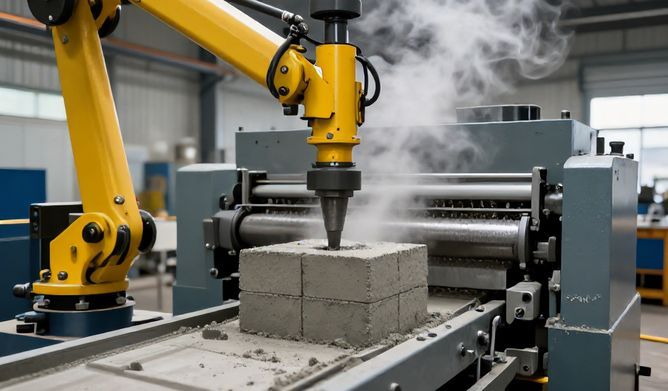
기계식 블록 제조 완벽 가이드: 공정, 장비 및 산업 통찰력
The global market for construction blocks is projected to reach staggering figures, driven by relentless urbanization and infrastructure development. Yet, behind every sturdy wall and durable pavement lies a critical, often overlooked, factor: the consistency and quality of the individual blocks. In an industry where structural integrity is non-negotiable, the shift from manual, variable production to precise, mechanized manufacturing isn’t just an upgrade—it’s a necessity.
이 포괄적인 가이드는 여러분의 확실한 참고 자료가 되도록 설계되었습니다.machine block making. Whether you are a manufacturer looking to scale, an entrepreneur entering the construction materials sector, or a construction professional seeking to understand your supply chain, we will demystify the entire process. You will gain expert insights into the different manufacturing methods, the machinery that powers them, operational best practices, and the crucial factors to consider when choosing the right solution for your specific output and budgetary needs.
What is Machine Block Making? Core Concepts and Benefits
At its core, machine block making is the mechanized process of manufacturing construction blocks—such as concrete hollow blocks, solid blocks, and paving stones—using controlled force and vibration. It represents the fundamental evolution from labor-intensive, inconsistent manual casting to a streamlined, repeatable industrial process.
Defining the Process: From Raw Material to Finished Block
The basic principle is consistent across machine types: a precisely measured mix of raw materials (like cement, aggregates, and water) is fed into a mold. The machine then applies two key forces:
1. 진동 High-frequency vibration consolidates the mix, removing air pockets and ensuring the material flows into every corner of the mold.
2. 압축 Hydraulic or mechanical pressure compacts the material, achieving the high density and strength required for construction.
After a brief holding period, the mold is lifted, and a green (freshly formed) block is ejected onto a pallet, ready for curing. This cycle repeats with precise timing, producing block after block with identical dimensions and properties.
수동 방식에 비해 주요 장점
The adoption of block making machinery is driven by tangible, bottom-line benefits that manual methods cannot match.
- 일관성과 품질: Machines produce blocks with uniform dimensions, density, and compressive strength. This uniformity simplifies construction, reduces mortar use, and ensures compliance with building standards like ASTM C90.
- 높은 생산량 From a few hundred to over ten thousand blocks per shift, machines meet the demands of large-scale housing projects, commercial developments, and municipal infrastructure.
- Labor Efficiency & Cost Reduction: A single semi-automatic or automatic machine can replace a large team of manual laborers, significantly reducing long-term labor costs and minimizing human error.
- 재료 최적화 Automated dosing systems ensure the exact amount of raw material is used per block, dramatically reducing waste compared to manual batching.
- 다재다능함: With a simple mold change, most machines can switch between producing different block types—hollow blocks for walls, solid blocks for foundations, or interlocking pavers for landscaping—offering tremendous product flexibility.
Primary Types of Block Making Machines
Choosing the right machine hinges on understanding the categories available. They are primarily classified by their level of automation and mobility.
수동 블록 제조 기계
- 설명: These are hand-operated or mechanically lever-operated machines. The operator fills the mold, initiates vibration (often via a foot pedal or lever), and then manually applies pressure via a lever system before stripping the mold.
- 이상적인 사용 사례: Perfect for very small-scale projects, startups with minimal capital, or in remote locations with limited electricity. They are a low-risk entry point.
- 제한 사항: Production output is low (typically 300-500 blocks per 8-hour shift), physically demanding, and highly dependent on operator skill for consistency.
반자동 블록 제작 기계
- 설명: This category strikes an optimal balance for many businesses. Key processes like vibration and compaction are powered (usually by an electric motor and hydraulic system), but the machine requires operators to feed raw material, place pallets, and sometimes remove finished blocks.
- 균형: They significantly boost output and quality over manual machines while keeping the initial investment and operational complexity lower than fully automatic systems.
- 전형적인 출력 Capacities can range from 1,000 to 4,000 blocks per 8-hour shift, depending on the model and crew efficiency.
완전 자동 블록 제작 기계
- 설명: These are complete production lines. They feature automatic material feeding via conveyor belts, robotic pallet handling, programmable logic controller (PLC) systems, and sometimes integrated curing systems. Human intervention is primarily for monitoring and maintenance.
- 고속 생산: Designed for maximum throughput, with some models capable of producing 10,000+ blocks in a shift.
- ROI 고려사항: The high initial investment is justified by the drastic reduction in labor costs, exceptional consistency, and massive scale. They are the choice for established plants supplying large regions or major projects.
고정식 vs 이동식 블록 기계
- 고정식 기계 These are set up in a fixed factory or plant. They are typically larger, more powerful, and form the heart of a permanent production facility. All automatic and most semi-automatic machines are stationary.
- 모바일 블록 머신: Mounted on a trailer or wheels, these can be towed directly to a construction site. They are ideal for producing blocks on-site for large projects, eliminating transport costs for the finished blocks. They are usually smaller in output and more robust to handle site conditions.
Critical Components of a Block Making Machine
Understanding the key subsystems of a block making machine helps in evaluating quality, troubleshooting issues, and communicating effectively with suppliers.
The Vibrating System: Ensuring Compaction and Strength
This is the heart of block quality. A powerful vibrator (often mounted under the mold table) subjects the material mix to high-frequency oscillations. This action:
* Liquefies the concrete mix momentarily, allowing it to flow uniformly into all parts of the mold.
* Eliminates entrapped air voids, which are weak points that reduce the final block’s compressive strength (measured in MPa).
* The amplitude and frequency of vibration are critical settings that may be adjusted for different mix designs.
The Hydraulic System: Delivering Forming Pressure
After vibration, the hydraulic system provides the immense force needed for final compaction.
* Pressure Measurement: Machine capability is often described by its pressing force in tons (e.g., 150-ton press). Higher pressure generally yields denser, stronger blocks.
* Impact on Density: The hydraulic cylinders deliver controlled, even pressure across the entire mold surface, ensuring consistent density from the top to the bottom of the block.
The Mold System: Determining Block Shape and Design
The mold is the tool that defines the product. Key aspects include:
* 재료: Made from hardened, high-quality steel to withstand constant abrasion and pressure.
* 맞춤 설정: Molds can be fabricated to produce virtually any block shape: standard hollow blocks, interlocking blocks for dry-stack walls, grass pavers, chimney blocks, and more. The versatility of a machine is defined by its available molds.
The Control System: From Levers to PLC Panels
This is the “brain” of the operation, varying greatly by machine type.
* Manual Controls: Simple levers and switches for basic functions.
* Relay Logic: An electrical panel with relays and timers to automate sequences like vibration and pressing duration.
* 프로그래머블 로직 컨트롤러(PLC) The standard in automatic machines. A PLC allows for precise programming of the entire production cycle, fault diagnostics, and data tracking, enabling true “set-and-forget” automation.
The Raw Materials: Formulating the Perfect Block Mix
The machine is only as good as the material it forms. A proper mix design is non-negotiable for producing durable, specification-grade blocks.
Common Material Components
- 시멘트: The primary binder. Ordinary Portland Cement (OPC) is most common.
- 집계체 Sand and gravel (crushed stone) provide the bulk and structural skeleton. Well-graded, clean aggregates are essential.
- 플라이 애시 A pozzolanic by-product from coal plants, often used to partially replace cement, reducing cost and improving long-term strength and workability.
- 물: Required for the cement hydration reaction. The water-cement ratio is a critical factor determining final strength.
- Pigments & Admixtures: Iron oxide pigments for colored blocks. Admixtures can be used to accelerate setting, improve workability, or introduce air entrainment for freeze-thaw resistance.
Mix Design Ratios for Different Block Types
Note: These are general starting points. Always test with local materials.
* 홀로우 블록: A typical mix might be 1 part cement, 6-8 parts mixed aggregates (sand & gravel), with just enough water for a “semi-dry” consistency that holds its shape after pressing.
* 솔리드 블록 및 포장 돌 Require a richer mix for higher strength, often in the range of 1 part cement to 4-6 parts aggregates. Paving mixes may use harder, more durable aggregates.
Importance of Material Testing and Curing
- Material Testing: Consistent raw material quality is paramount. Regularly test sand for silt content and aggregates for gradation. Inconsistent materials lead to inconsistent blocks.
- 치유: The green block gains most of its strength during curing. This involves keeping the blocks moist and at a controlled temperature for a period (often 7-28 days). Steam curing in a kiln can accelerate strength gain to within 24 hours, a common practice in high-output plants.
How to Choose the Right Machine for Your Operation
Selecting a block making machine is a significant capital decision. A systematic approach prevents costly mismatches.
생산 요구사항 평가하기
Ask these key questions:
* 타겟 출력: How many blocks do you need per day or month? Be realistic about current demand and growth projections.
* 블록 유형: What product mix will you sell? (e.g., 70% hollow blocks, 30% pavers).
* 사용 가능한 공간: Do you have a factory shed for a stationary plant, or do you need a mobile solution?
* 전원 공급 장치: What electrical power (Voltage, Phase) is available? Automatic lines have higher power demands.
* Labor Availability: What is your access to skilled operators versus general laborers?
Budgeting: Initial Investment vs. Operational Costs
Look beyond the sticker price of the machine.
* 초기 투자 Includes machine cost, shipping, installation, and foundation work.
* 운영 비용 Factor in ongoing expenses for labor, maintenance, spare parts, and energy consumption. A fully automatic machine has a high initial cost but very low per-block labor cost.
Key Supplier Selection Criteria
This step is critical for long-term success and directly impacts your 경험, 전문성, 권위성, 신뢰성 (E-E-A-T) as a producer.
* Manufacturer Reputation & Experience: How long have they been in business? Do they specialize in block making machinery?
* 애프터세일즈 서비스 및 지원: This is arguably the most important factor. Ensure they offer installation supervision, operator training, and have a responsive technical support team.
* 예비 부품 가용성: Check if commonly wearing parts (molds, vibrator motors, hydraulic seals) are readily available.
* Client Testimonials & Site Visits: Ask for references and, if possible, visit an existing installation to see the machine running.
* Live Demonstration: Always request a live demo using a raw material mix similar to yours to see the machine’s performance firsthand.
Operational Best Practices and Maintenance
Proper operation and care maximize uptime, product quality, and machine lifespan.
Daily Startup and Shutdown Procedures
- Startup: Check hydraulic oil levels, inspect for loose parts or leaks, ensure the mold is clean and secure, and run the machine empty for a minute to circulate oil.
- Shutdown: Clean the mold, hopper, and feed system thoroughly to prevent hardened concrete buildup. Park the machine in its safe position.
Routine Maintenance Schedule
- Daily: Clean machine, check for oil/air leaks.
- Weekly: Lubricate all grease points (bearings, guide rods), check belt tensions.
- Monthly: Inspect hydraulic oil for contamination, check vibration motor mounts and electrical connections.
- Annually: Consider a full system check by a technician, replace hydraulic filters, and inspect structural integrity.
Troubleshooting Common Issues
- Blocks Sticking in Mold: Likely caused by a worn or dirty mold, insufficient vibration, or an overly wet mix. Clean the mold thoroughly and check mix consistency.
- Poor Surface Finish or Chipped Edges: Often due to a dry mix, inadequate vibration, or a worn-out mold.
- Low Block Strength: Caused by incorrect mix design (too much water, insufficient cement), inadequate compaction pressure, or improper curing.
- Machine Jams: Usually from a foreign object in the feed system or an overfilled mold. Always stop the machine immediately, lock out power, and clear the obstruction safely.
FAQ Section
Q1: What is the average production capacity of a standard block making machine?
A: Capacity varies immensely. A small manual machine may produce 400 blocks/day, a semi-automatic 2,500-3,500 blocks/8-hour shift, and a fully automatic line 8,000-15,000+ blocks/shift. The specific model and block size determine the exact number.
Q2: Can one machine produce different types of blocks?
A: Yes, absolutely. This is a key advantage. By changing the mold assembly, a single machine can produce various block types. The time required for mold changeover (from 30 minutes to a few hours) is a factor in production planning.
Q3: What is the typical payback period for an automatic block making machine?
A: While highly variable, a well-utilized automatic plant in a strong market can see a return on investment in 1.5 to 3 years. The payback period depends on local block prices, operational efficiency, utilization rate, and financing terms.
Q4: How important is after-sales service when purchasing a machine?
A: It is critical. A machine is a long-term investment. Reliable, accessible technical support and guaranteed spare parts availability are essential to prevent weeks of costly downtime. Prioritize suppliers with a proven service network over those offering only a marginally lower price.
Q5: Are there eco-friendly options in block making?
A: Yes. The industry has significant green potential. Machines can utilize industrial by-products like fly ash or slag. Furthermore, producing permeable paving blocks that allow water drainage supports sustainable urban development. Many modern plants also recycle process water.
결론
Machine block making has fundamentally transformed the construction materials landscape, enabling the efficient, scalable, and quality-conscious production essential for modern infrastructure. From defining the core process to navigating the choice between manual, semi-automatic, and fully automatic systems, success hinges on informed decision-making.
Remember, the most sophisticated machine is only one part of the equation. Long-term profitability and product quality are built on partnering with knowledgeable and reputable suppliers, investing in comprehensive operator training, and adhering to a disciplined regimen of raw material control and equipment maintenance. By viewing your block making operation as an integrated system—where machine, material, and method converge—you lay the foundation for a resilient and competitive business.
Ready to take the next step? We strongly advise you to consult with expert engineers or seasoned equipment suppliers to analyze your specific project requirements, local market conditions, and material availability. Before making any final decision, request detailed quotations, performance data sheets, and client references to ensure your investment drives growth for years to come.
<