
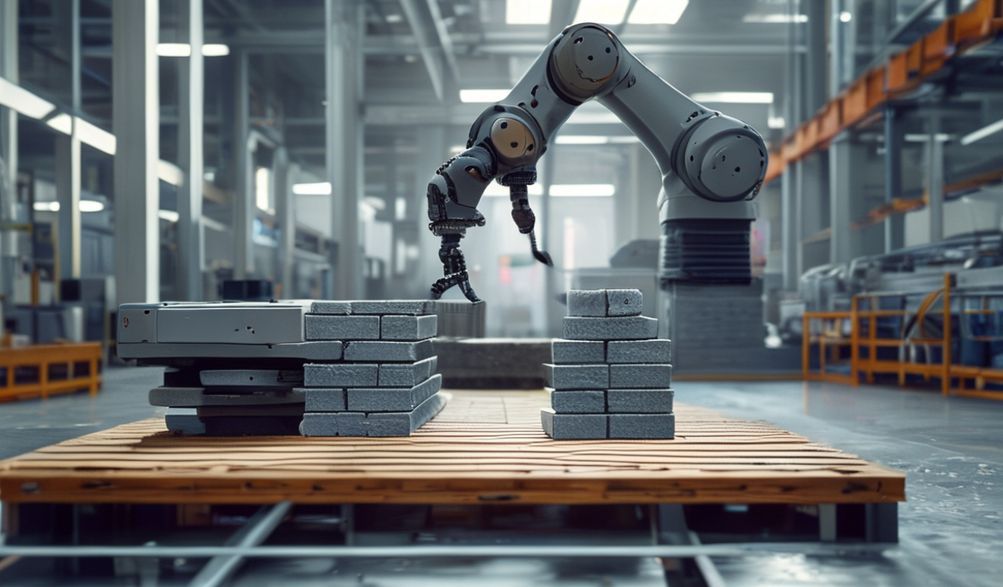
The Ultimate Guide to Automatic Concrete Block Stacking Machines: Efficiency, Types & ROI
소개
If you’re in the business of manufacturing concrete blocks, you know the scene all too well. The production line hums, blocks stream steadily from the machine, and then—a bottleneck. A team is manually lifting, turning, and stacking heavy, abrasive blocks. It’s labor-intensive, slow, and fraught with risk: rising labor costs, persistent worker shortages, product damage from handling, and the physical toll on your team. This manual stacking process isn’t just a chore; it’s a ceiling on your plant’s potential, limiting output, eroding margins, and compromising safety.
This comprehensive guide is built on a foundation of industry expertise, engineering principles, and real-world operational data. We’ve analyzed cost-benefit models and spoken with plant managers who have made the leap. Our goal is to move beyond the sales brochure and provide you with the actionable insights needed to make an informed decision.
We will delve deep into the world of automatic concrete block stacking machines, exploring how they revolutionize concrete block handling그리고palletizing automation. You’ll learn about the different types of systems, their key benefits, critical features to consider, and most importantly, how to calculate the tangible return on investment (ROI) for your specific operation.
By the end of this guide, you will have a clear framework to evaluate this technology, understand its strategic value, and know the right questions to ask as you consider automating your block production line.
자동 콘크리트 블록 적층 기계란 무엇인가요?
An automatic concrete block stacking machine is a sophisticated robotic or mechanical system designed to perform one of the most physically demanding tasks in a precast plant: the precise picking, orienting, and arranging of concrete blocks into stable, transport-ready stacks or onto pallets.
At its core, it replaces the human element in the final, critical stage of handling. Where a worker might lift a hollow block or interlocking paver, an automated system uses programmed mechanics—via grippers, vacuum heads, or forks—to execute the same action with unerring consistency.
The Automation Journey: From Manual to Mechanical
- Manual Stacking: Reliant on human strength and endurance. It is inherently variable, slow, and exposes workers to repetitive strain and injury risks. Stack patterns can be inconsistent, and product damage from drops or impacts is common.
- Automated Stacking: A seamless, programmed extension of the production line. Blocks are received from the conveyor, precisely positioned, and built into perfect stacks at a constant, high-speed cycle. The process is continuous, predictable, and operates independently of shift changes or fatigue.
Visualizing the Flow: In a fully integrated block production line, the stacking machine is the crucial link between the block maker and the curing system (racks or kiln cars). It takes the “green” or cured blocks from the conveyor, forms them into a configured stack, and places them onto a pallet or directly into a curing chamber, ready for the next phase.
Key Benefits of Automating Your Block Stacking Process
Investing in an automatic stacker is not merely about buying a machine; it’s about upgrading your entire operational DNA. The benefits cascade across your business.
Dramatically Increased Production Speed & Output
Manual stacking has a hard speed limit defined by human capability. An automatic stacker removes that limit.
* It operates at a constant, pre-programmed cycles-per-hour rate, often stacking hundreds or even thousands of blocks per hour without pause.
* It eliminates the natural slowdowns over a shift, breaks, and shift changeover delays.
* This directly translates to higher throughput, allowing you to maximize the output of your block-making machine and meet tighter delivery schedules.
인건비 및 종속성의 현저한 감소
Labor is one of the most volatile and challenging costs for manufacturers.
* A single automatic stacker can typically replace multiple manual stacking positions per shift.
* It mitigates the growing difficulty of finding and retaining labor for physically demanding, repetitive jobs.
* The long-term financial saving on wages, benefits, and associated overhead is often the primary driver of a compelling ROI.
Enhanced Product Quality & Reduced Damage
Manual handling with forks or hands is a leading cause of product damage—chipping corners, cracking webs on hollow blocks, or scuffing finished faces.
* Automatic stackers use controlled, gentle handling mechanisms specifically designed for the product.
* They place blocks with precise alignment and consistent pressure, creating stable stacks that are less prone to shifting and damage during transport.
* This reduction in waste directly improves your yield and protects your brand reputation for quality.
Improved Workplace Safety
This is a non-negotiable benefit. The block yard is a high-risk environment.
* Automation removes workers from the direct hazards of heavy lifting, reducing the risk of acute injuries and chronic musculoskeletal disorders.
* It minimizes worker interaction with moving conveyors and heavy loads in the stacking zone.
* A safer workplace also leads to lower insurance premiums and workers’ compensation claims.
Unmatched Consistency and Traceability
Every stack is identical.
* Whether it’s a simple column stack or a complex interlocking pattern for pavers, the machine replicates it perfectly every time, ensuring optimal stability and professional presentation.
* Modern systems can be integrated with plant software to log production data—counting units per batch, timestamps, and associating stacks with specific production runs. This aids in inventory control, quality assurance, and traceability.
Types of Automatic Block Stacking Machines
Not all stackers are created equal. The right choice depends on your product mix, required speed, and plant layout. Here are the three primary architectures:
Robotic Arm Stackers
Think of these as the versatile, high-precision artists of the stacking world.
* Expertise Detail: A multi-axis industrial robot (like a large robotic arm) equipped with custom end-of-arm tooling (EOAT). The tooling can be mechanical grippers, vacuum pads, or a combination, tailored to the block type.
* 최적 대상: High-mix production (frequent product/pattern changes), complex interlocking patterns, palletizing onto different pallet types, or integration into space-constrained or existing lines where flexibility is key.
* 고려사항 Programming expertise is valuable for initial setup and pattern changes, though modern interfaces have simplified this greatly.
Gantry (Overhead) Stackers
These are the heavy-duty, high-capacity workhorses.
* Expertise Detail: A rigid bridge structure mounted on rails, with a lifting/carriage mechanism that travels in the X, Y, and Z axes over a wide work area. They are incredibly stable and powerful.
* 최적 대상: Very high-volume, single- or low-mix product lines. They are ideal for directly loading heavy stacks onto kiln cars or large pallets. Their design is often simpler and more robust for 24/7 harsh environments.
* 고려사항 They require significant overhead clearance and a larger footprint. Pattern changes can be less flexible than with a robotic system.
Layer Stackers / Palletizers
These machines specialize in speed for standard formats by handling entire layers at once.
* Expertise Detail: Instead of picking individual blocks, they gather a complete layer of blocks from a conveyor or shuttle table. Using a large head with multiple grippers or a sweep mechanism, they then transfer and deposit the entire intact layer onto a pallet or previous layer.
* 최적 대상: Extremely high-speed production of standard concrete blocks or bricks where the pattern is consistent. They are the fastest option for building full pallet loads.
* 고려사항 They are less flexible for pattern changes or mixed products. They work best with complementary equipment like layer pads or sheets.
Choosing the Right Type for Your Plant
Use this quick checklist to guide your initial evaluation:
* 제품 믹스 Do you produce one standard block or dozens of different shapes (pavers, hollow blocks, solids)?
* Required Speed: What is your target output in blocks or pallets per hour?
* Floor Space & Layout: Do you have height for a gantry? Is floor space at a premium, favoring a robotic cell?
* 예산 Robotic arms and gantries represent different capital cost structures (including tooling and integration).
* Stack Pattern Complexity: Are you building simple columns or intricate, interlocking herringbone patterns?
Critical Features to Consider When Buying
Looking beyond the machine type, these are the essential specifications and features that separate a good investment from a problematic one.
Handling Capacity & Block Compatibility
The machine must be built for your specific product.
* Verify the maximum block weight and dimensions (L x W x H) it can handle.
* Ensure it can manage your full range: delicate split-face blocks, heavy solid blocks, and hollow blocks without damaging the webs.
* Discuss with the supplier how the machine accommodates different shapes—through adjustable grippers, interchangeable tooling, or programmable settings.
Stacking Pattern Flexibility & Programming
Your product catalog isn’t static, and your machine shouldn’t be either.
* The Programmable Logic Controller (PLC) and Human-Machine Interface (HMI—the touchscreen) should be user-friendly.
* Plant personnel should be able to select a new product from a menu and have the machine adjust its pattern, grip points, and stacking sequence without needing advanced programming skills.
* Look for the ability to store dozens or hundreds of pre-configured product recipes.
Integration with Existing Production Lines
The stacker cannot be an island. It must communicate.
* How will it interface with your block maker, incoming conveyor, and pallet dispenser or kiln car system?
* Discuss mechanical interfaces (transfer cars, elevators) and communication protocols (Ethernet/IP, Profinet, Modbus) to ensure seamless data exchange for automated line control.
Build Quality & Durability
A concrete plant is an abrasive, dusty, and demanding environment.
* The frame should be heavy-duty, welded steel construction.
* Critical linear motion components (rails, guides) should have protective covers or seals against concrete dust.
* Pneumatic and electrical components should be industrial-grade. Ask about the ingress protection (IP) ratings on key parts.
Safety Systems and Compliance
Automation introduces new moving hazards. Safety is paramount.
* Essential safeguards include: Perimeter fencing with interlocked access gates, safety light curtains that stop the machine if breached, emergency stop buttons at multiple points, and safety-rated controllers that monitor for faults.
* The machine should be designed and certified to comply with relevant regional safety standards (e.g., CE marking in Europe, OSHA guidelines in the US).
* Never bypass safety systems for “convenience.”
Analyzing the Return on Investment (ROI)
This is the crucial calculation that moves the discussion from a “nice-to-have” to a “must-have” strategic investment.
Calculating Your Total Cost of Ownership
Look at the full picture:
* Initial Capital Cost: Purchase price of the machine and specific tooling.
* Installation & Integration: Costs for foundation work, electrical hookup, conveyor modifications, and commissioning by the supplier.
* Operating Costs: Primarily electrical energy consumption, which is typically low for these systems.
* Estimated Maintenance: Budget for annual spare parts, preventative maintenance kits, and potential service contracts.
Quantifying the Savings & Gains
This is where the value is created. Model savings from:
* 노동력 감소 Calculate the fully burdened cost (wages, benefits, taxes, insurance) of the positions eliminated per shift, multiplied by the number of shifts.
* Lower Product Waste: Estimate the percentage reduction in damaged blocks. Apply this to your annual production value.
* Increased Output Revenue: Can you produce and sell more blocks with the increased line speed? Calculate the marginal profit on this additional volume.
* Indirect Savings: Potential reductions in worker compensation insurance premiums, lower recruitment/training costs for manual roles.
Sample ROI Calculation
Consider a simplified, anonymized case:
* Machine Cost: $150,000 fully installed.
* 노동력 절감 Replaces 2 workers per shift (2 shifts). Fully burdened labor cost = $60,000/worker/year. Annual Savings = $240,000.
* Damage Reduction: Saves 0.5% of annual production worth $200,000. Annual Savings = $10,000.
* Total Annual Savings: $250,000.
* Simple Payback Period: $150,000 / $250,000 = 0.6 years (~7 months).
In practice, payback periods typically range from 1.5 to 3 years, depending on scale, labor costs, and utilization. The above example is aggressive but illustrates the powerful math.
Beyond Financials: The Strategic Value
The ROI isn’t just in the ledger. It’s in:
* 경쟁 우위 Ability to take on larger, time-sensitive contracts with confidence.
* 비즈니스 확장성: Growing your output without linearly increasing your labor force.
* Risk Mitigation: Insulating your operation from labor market volatility.
* Foundation for Industry 4.0: An automated stacker is a data-generating node, paving the way for a connected, “smart” plant with predictive maintenance and advanced analytics.
자주 묻는 질문 (FAQ)
Q: What is the typical payback period for an automatic stacking machine?
A: While it varies significantly based on production scale, labor costs, and machine utilization, most operations see a full return on investment within 1.5 to 3 years. The primary drivers are almost always labor savings and increased throughput.
Q: Can one machine handle different sizes and types of blocks?
A: Yes, this is a key feature of modern machines. Through programmable settings and often with quick-change or adjustable tooling (grippers, vacuum heads), a single machine can be configured to handle a wide range of products. Be sure to discuss your full product mix with potential suppliers.
Q: How reliable are these machines in a harsh concrete plant environment?
A: High-quality machines are engineered specifically for this challenge. Reliability hinges on two factors: 1) Selecting a manufacturer with proven experience in the concrete industry who uses protected components and robust designs, and 2) Committing to a simple but consistent preventative maintenance routine (e.g., cleaning guides, checking seals, lubricating points).
Q: Do we need highly skilled technicians to operate and maintain it?
A: Operation is designed to be simple, typically via an intuitive touchscreen interface for selecting products. Basic daily maintenance (visual checks, cleaning) can be performed by your existing plant staff after proper training. More complex servicing and repairs should be handled by trained technicians, which reputable manufacturers support with documentation, spare parts, and service plans.
Q: How do we ensure worker safety around the automated system?
A: Safety is a combination of technology and procedure. The machine must come with integrated safety systems (fencing, light curtains, emergency stops). Crucially, you must establish and enforce strict safety protocols: comprehensive training for all employees, clear signage, and rigorous adherence to Lockout-Tagout (LOTO) procedures during any maintenance or intervention.
결론
The journey from manual to automated block stacking represents a fundamental leap in operational maturity for any concrete products manufacturer. As we’ve explored, the benefits are profound and multi-faceted: unleashing production capacity, securing significant and predictable cost savings, elevating product quality, and most importantly, fostering a safer workplace.
Investing in an automatic concrete block stacking machine is not merely a capital expenditure on a piece of equipment. It is a strategic decision backed by solid engineering principles and operational data—a commitment to building a more resilient, competitive, and scalable business.
Your Next Step: Begin with a detailed audit of your current stacking process. Gather data on your labor costs, production speeds, and damage rates. Use this information as the foundation for informed conversations. We strongly encourage you to consult with reputable, experienced manufacturers. Request tailored proposals that include not just specifications, but a detailed ROI analysis based on your numbers. Ask for references and, if possible, visit existing installations to see the machines in action.
The future of block manufacturing is connected, data-driven, and efficient. Automating your stacking process is the powerful first step toward building that future-ready plant.
<