
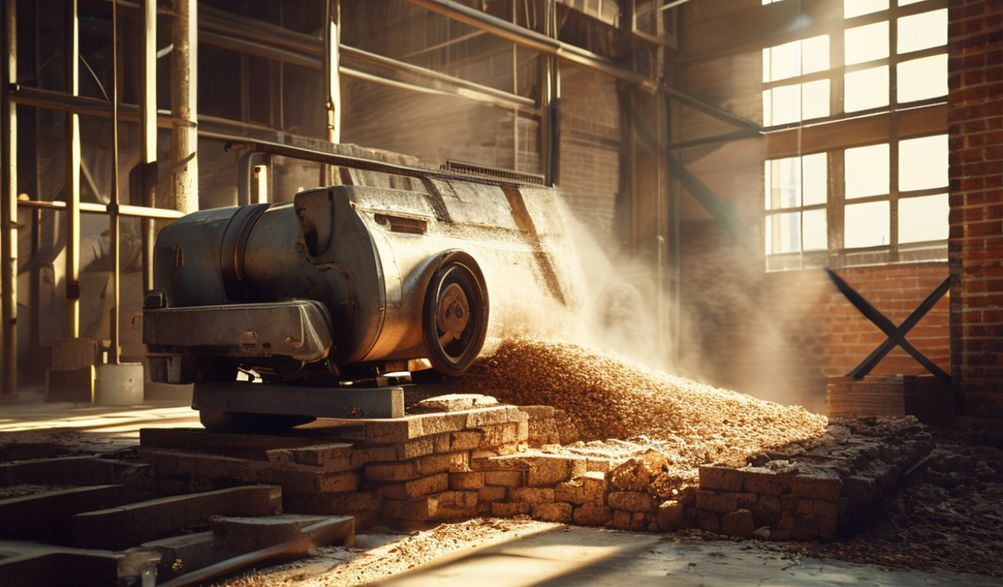
토일 시멘트 벽돌 제조 기계의 궁극적인 가이드 | 푸다 공장의 인사이트
소개
세계 건설 산업이 기로에 서 있습니다. 재료비 상승과 환경 의식 증가 속에서 지속 가능하고 경제적인 건축 솔루션에 대한 수요가 그 어느 때보다 커지고 있습니다. 이에 등장한 것이 흙-시멘트 벽돌입니다. 이 겸손하지만 혁명적인 건축 자재는 우리의 건축 방식을 재정립하고 있습니다.
압축 안정화 흙 블록(CSEB)으로도 알려진 이 벽돌은 친환경성, 비용 효율성, 그리고 놀라운 내구성을 매력적으로 조합하고 있습니다. 하지만 이 지속 가능한 혁신 뒤에 숨은 진정한 주인공은 바로 시멘트 흙 벽돌 제조 기계입니다.
15년 이상, FUDA 벽돌 제조 공장은 이 기술의 최전선에 서 있습니다. 우리는 단순히 기계를 제조하는 데 그치지 않고, 매일 직접 가동하여 전 세계 프로젝트에 수백만 개의 벽돌을 생산합니다. 이러한 실전 경험을 바탕으로경험우리에게 전례 없는전문성성공적인 흙-시멘트 벽돌 제작 작업을 위한 요소는 흙 선정부터 최종 양생까지의 과정에 있습니다.
이 포괄적인 가이드는 우리 공장 현장에서 직접 얻은 정보를 바탕으로 합니다. 우리의 목표는 여러분에게권위 있는그리고믿을 수 있는 knowledge, empowering you to understand the technology, its benefits, and how to choose the perfect machine for your needs.
토양 시멘트 벽돌 제작 기계란 무엇인가요?
At its core, a soil cement brick making machine is a device that automates and perfects an ancient building principle: using compacted earth to create strong, reliable structures. It transforms a simple mixture of soil, a small amount of cement, and water into dense, uniform building blocks through high-pressure compression.
핵심 기능과 원리
The operating principle is elegant in its simplicity. The machine hydraulically compresses a moist mixture of soil (typically 85-92%) and cement (5-10%) into a rigid mold. This compression, often at pressures exceeding 10 MPa, realigns the soil particles and activates the cementitious bonds, creating a brick of high compressive strength without the need for firing.
- Vs. Fired Clay Bricks: Unlike traditional clay bricks, CSEBs require no kiln, eliminating massive energy consumption, fuel costs, and associated air pollution.
- Vs. Concrete Blocks: While concrete blocks use aggregates (gravel, sand) and a higher cement ratio (typically 1:6 or 1:7), CSEBs utilize local soil as the primary aggregate, drastically reducing cement use and material transport costs.
주요 구성 요소와 그 역할
Understanding the machine’s anatomy reveals the engineering behind a quality brick.
- 호퍼: The entry point for the raw, dry mixture of soil and cement. A well-designed hopper ensures consistent feed without clogging.
- 혼합 챔버: Where water is added to the dry mix. Advanced machines feature a paddle mixer for a homogeneous, damp mix—critical for consistent brick quality.
- Compression Mold/Cylinder: The heart of the machine. A hydraulic ram forces the damp mixture into a steel mold, defining the brick’s shape (solid, interlocking, hollow) and applying the crucial compaction pressure.
- 유압 시스템: Comprising a pump, motor, valves, and cylinders, this system generates the immense, controlled force required for compression. Its quality directly determines machine reliability and brick strength.
- 제어판 Ranging from simple levers in manual machines to programmable logic controllers (PLCs) in automatic models. It governs the compression cycle, ejection, and safety functions.
- 이젝션 시스템: Once compressed, the fresh brick is gently ejected onto a pallet or conveyor belt for transport to the curing area.
Advantages of Using a Soil Cement Brick Machine (The “Why”)
Investing in this technology isn’t just about making bricks; it’s about embracing a smarter, more sustainable construction methodology.
Economic and Operational Benefits
- Exceptionally Low Raw Material Cost: The primary ingredient—soil—is often available on-site or locally for minimal cost. This slashes one of the largest expenses in construction.
- Reduced Cement Consumption: Using only 5-10% cement compared to concrete’s 15-20% delivers significant savings, insulating your project from volatile cement prices.
- High Production Output & Profitability: A single semi-automatic FUDA machine can produce 1,500-2,000 bricks in an 8-hour shift. This efficiency creates a clear path for business ventures or large-scale self-build projects.
- Low Energy Consumption: With no need for firing, energy use is limited to the machine’s motor, making operation cost-effective, especially with solar-powered options.
Environmental and Structural Benefits
- Dramatically Lower Carbon Footprint: Eliminating the firing process reduces CO2 emissions by up to 90% compared to fired bricks. It’s a cornerstone of green building.
- Superior Thermal Performance: Soil-cement bricks have excellent thermal mass. They absorb heat during the day and release it at night, naturally regulating indoor temperatures and reducing heating/cooling costs.
- Moisture Regulation (“Breathability”): They allow water vapor to pass through, preventing condensation and promoting healthier indoor air quality than impermeable concrete blocks.
- Proven Durability and Strength: When produced correctly, CSEBs can achieve compressive strengths of 7 MPa and above, meeting or exceeding standards for load-bearing construction in many regions (e.g., IS 1725, ASTM D1633). They are resistant to fire, pests, and weathering.
Types of Soil Cement Brick Machines
Choosing the right type is your first critical decision. Here’s a breakdown from our experience.
수동 vs 반자동 vs 완전 자동 기계
| Feature | Manual Press | Semi-Automatic Machine | Fully Automatic Machine |
| :— | :— | :— | :— |
| 생산 능력 | Low (300-500 bricks/day) | Medium-High (1,500-3,000 bricks/day) | Very High (5,000+ bricks/day) |
| 노동력 요구량 | High (2-3 operators) | Moderate (1-2 operators) | Low (mostly monitoring) |
| 투자 비용매우 낮음 | 보통 | 높음
| 전원 | Human-operated lever | Electric or Diesel Motor | Electric Motor |
| 이상적 | Micro-enterprises, NGOs, very small-scale projects. | Small-to-medium businesses, housing projects, community builds. | Large commercial plants, government infrastructure projects. |
| FUDA’s Insight | Excellent for proof-of-concept and training. Labor-intensive for scaling. | The “sweet spot” for most businesses. Optimal balance of output, cost, and control. | For maximum output with minimal labor. Requires higher capital and consistent raw material feed. |
모바일 대 고정식 기계
- 모바일 머신: Mounted on a trailer, these units are perfect for on-site production. They eliminate transport costs for finished bricks and are ideal for remote projects, disaster relief housing, or building directly where the soil is excavated.
- 고정식 기계 Set up in a fixed factory or yard. They allow for optimized workflow, shelter from the elements, and are typically paired with higher-capacity semi or fully automatic systems for centralized production.
The FUDA Factory Process: From Soil to Solid Brick
This is where our 경험 translates into your success. Quality bricks are not made by the machine alone, but by a meticulous process.
Step 1: Soil Selection and Testing (The Non-Negotiable Foundation)
Can you use any soil? The expert answer is a firm no. The soil is 90% of your brick. We rigorously test all soil before production begins.
* Ideal Composition: A well-graded mix of sand, silt, and clay (often called “loam”). Pure sand lacks cohesion; pure clay leads to excessive shrinkage.
* The FUDA Test Protocol: We perform simple field tests (sedimentation, ribbon) and recommend lab tests for particle size distribution and chemical composition. This determines the optimal cement percentage.
Step 2: Precise Proportioning and Mixing
Consistency is king. The dry soil and cement are measured by weight (not volume) for absolute accuracy. At FUDA, we use a mechanical mixer to blend the dry materials first, then add water gradually to achieve the perfect “damp earth” consistency—where the mixture holds its shape when squeezed but crumbles when poked.
Step 3: Compression and Molding
The damp mix is fed into the machine’s compression chamber. This is where the magic happens. Our hydraulic systems apply calibrated pressure (e.g., 20-40 tons) to the mixture in the mold. This pressure is what gives the brick its density and strength. The brick is then ejected with a smooth, finished surface.
Step 4: Curing and Quality Control
A freshly pressed brick is strong but not at its peak. Proper curing is vital.
* 경화 과정: Bricks are stacked in a shaded area and kept moist by sprinkling water and covering with plastic sheeting for 14-28 days. This allows the cement to hydrate fully and develop strength.
* FUDA’s QC: We perform regular spot-checks for dimensional accuracy, density, and conduct compressive strength tests on sample bricks using a block testing machine to ensure every batch meets our standards.
How to Choose the Right Machine for Your Needs
Let us guide you with 믿을 수 있는, actionable advice to avoid costly mistakes.
Assessing Your Project Scale and Budget
자문해 보세요:
* What is my daily or monthly brick requirement?
* Is this for a one-off project or an ongoing business?
* What is my total investment budget (including machine, foundation, and raw material setup)?
* What is my available labor and their skill level?
검토해야 할 주요 기계 사양
- 생산 능력 Don’t just look at “bricks per hour.” Consider the sustainable 8-hour shift output. A machine rated for 500 bricks/hour might realistically produce 3,500/day with operator breaks.
- Brick Size & Shape Flexibility: Can the machine produce different block sizes (e.g., standard, half-block) or interlocking shapes for mortar-less construction? Dies are interchangeable, but check availability.
- 전력 요구 사항 Electric motors are cleaner and cheaper to run where grid power is stable. Diesel engines offer independence for remote sites. Manual is only for minimal output.
- Build Quality & After-Sales Service: This is critical. Inspect the thickness of steel plates, the quality of hydraulic seals and pumps. Most importantly: Does the supplier offer installation guidance, operator training, and reliable spare parts support? This is a cornerstone of FUDA’s commitment.
Common Pitfalls to Avoid When Buying
- Skipping Soil Testing: Buying a machine before testing your soil is like buying a car without knowing if you have fuel. It will lead to failure.
- Choosing Based on Price Alone: The cheapest machine often has the highest long-term cost in repairs, downtime, and poor brick quality.
- Overestimating Labor Skill: A fully automatic machine requires less labor but more technical oversight. Match the machine to your team’s capabilities.
- Ignoring Supplier Reputation: Research the manufacturer. Look for a factory with proven experience, not just a trading company. Visit if possible, or request customer references and video proof of operation.
자주 묻는 질문 (FAQ)
Q: What is the typical cost range for a soil cement brick machine?
A: Prices vary widely based on type and automation. Manual presses can start from a few hundred dollars. Semi-automatic machines, like our most popular models, range from $5,000 to $20,000. Fully automatic production lines can be $30,000+. We provide detailed quotes based on your specific needs and never advertise a single misleading “lowest price.”
Q: Can I use any type of soil?
A: No. While many soils are suitable, they must be tested. Pure sand or expansive clay soils are problematic. Often, problematic soils can be amended by blending with another soil type—testing tells you how.
Q: What is the strength of soil-cement bricks compared to traditional bricks?
A: Well-produced CSEBs typically have a compressive strength between 7 and 10 MPa, which is more than adequate for 1-2 story load-bearing construction (per standards like IS 1725). This is comparable to or exceeds many fired clay bricks and is superior to traditional sun-dried adobe.
Q: How much maintenance does the machine require?
A: Daily: Clean the mold and hopper. Weekly: Check hydraulic oil levels and tighten bolts. Periodic: Replace hydraulic seals and wear parts based on usage. We provide a clear maintenance schedule with every FUDA machine. Proper care ensures a lifespan of 10+ years.
Q: Does FUDA provide training and technical support?
A: Absolutely. Every purchase includes detailed operation manuals, video tutorials, and direct access to our technical team via phone or WhatsApp. For larger orders, we offer on-site installation and training services to ensure your operation starts successfully.
결론
Soil-cement brick technology represents a powerful convergence of tradition and innovation, offering a practical path toward sustainable and economical construction. The right machine transforms local earth into a legacy of durable, comfortable, and environmentally responsible buildings.
At FUDA Brick Making Factory, we bridge the gap between 전문성 in machinery engineering and hands-on 경험 in brick production. We are more than a manufacturer; we are your partner in building a better future, one brick at a time.
Ready to take the next step?
* Primary CTA: Contact the FUDA team today for a personalized consultation. Share your project details, and we’ll help you select the perfect machine.
* Secondary CTA: Visit our website to view case study videos of our machines in action at projects worldwide, or schedule a visit to our factory to see the process firsthand.
Written by the FUDA Engineering Team, with over 15 years of specialized experience in sustainable construction machinery and soil-cement block production.
<