
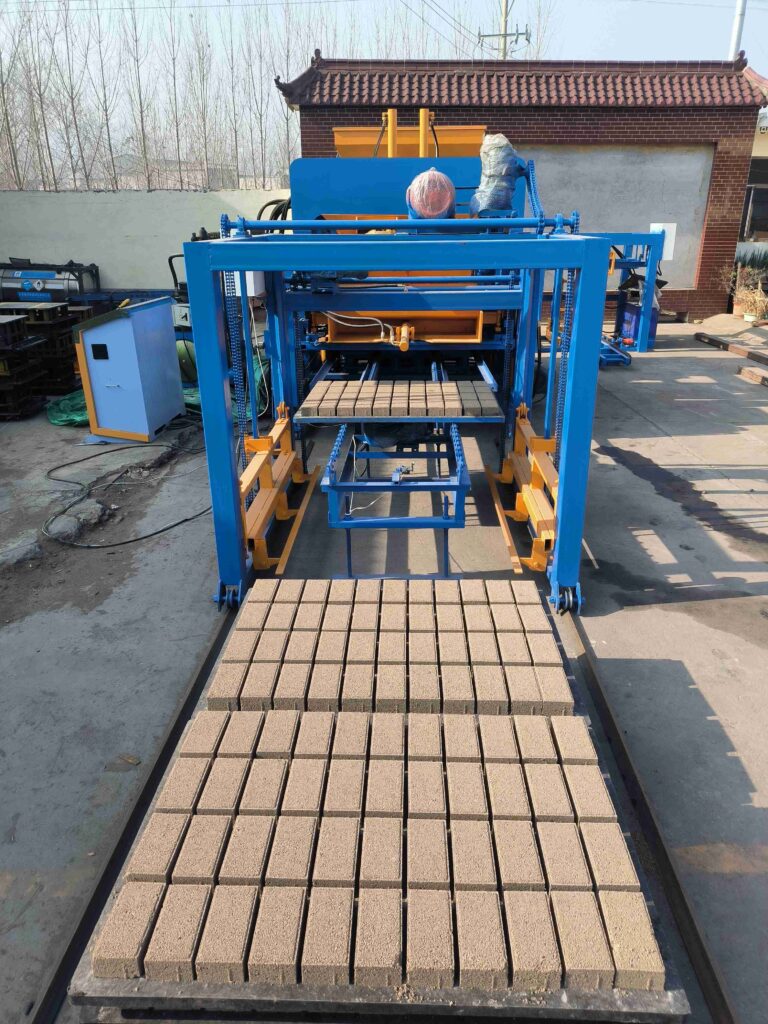
Fundamental Differences: Blocks vs. Pavers
While both are cement-based products formed under vibration and pressure, pavers have distinct technical and aesthetic requirements that demand production adjustments.
- 1.1. Dimensional Precision and Tolerances
Pavers require extremely tight dimensional tolerances, often more stringent than standard building blocks. This is because they are typically installed in interlocking patterns with very narrow joint spacing (1-3mm). Even minor size variation can cause pattern misalignment and installation difficulties. The precision of the mold and the consistency of the mix become paramount. - 1.2. Performance Under Different Stress
Unlike vertical wall blocks, pavers are subject to flexural strength (bending strength) as a primary performance metric, in addition to compressive strength. They must withstand point loads, vehicular traffic, and freeze-thaw cycles from the top surface down. This necessitates a high-density product with a low water-cement ratio. - 1.3. Aesthetic as a Primary Function
While construction blocks are often concealed, pavers are a finished surface. Color, texture, and finish are critical selling points. The production process must reliably deliver consistent color and surface quality across all units.
2. Necessary Machine Adaptations and Tooling
Converting a block machine for paver production focuses on three core areas: the mold, the mix handling, and the finishing stage.
- 2.1. The Critical Role of Paver-Specific Molds
The standard block mold must be replaced with a paver mold. These molds differ significantly:- Designatum They produce thinner units (typically 60mm, 80mm thick) in a wide array of shapes (rectangular, square, fan, cobble, etc.).
- Interlocking Features: Many paver molds include negative spaces to form knobs and grooves on the sides for mechanical interlock.
- Surface Texturing: Mold liners can be engineered to impart a specific surface texture directly during compaction, such as a smooth, exposed aggregate, or subtle stone-like finish.
- 2.2. Mix Design and Material Handling
Paver mix design is a specialized science focused on durability and appearance.- High-Strength, Low-Slump Mix: Pavers use a very dry, “zero-slump” concrete mix with a high cement content and low water-cement ratio to achieve the necessary density and early strength for rapid demolding and handling.
- Integratio Colorum Integral pigments are added to the base mix. This requires highly accurate color dosing systems and rigorous mixing to ensure batch-to-batch color consistency. Contamination from standard grey block mix must be meticulously avoided, often necessitating dedicated mixers or intensive cleaning procedures.
- Aggregate Selection: For exposed aggregate finishes, specially selected aggregates (like colored stones or crushed glass) are placed in the mold face-down before the base mix is added.
- 2.3. Curing and Post-Production Handling
Pavers are typically cured on specially designed racks or frames that allow air to circulate around all sides evenly, rather than being stacked on pallets immediately. This ensures uniform strength development and color. After initial curing, they may undergo secondary processing like application of a surface sealant to enhance color and resist staining.
3. Strategic Considerations for Production and Market Entry
Successfully adding pavers to a product line requires strategic planning beyond the technical adjustments.
- 3.1. Production Scheduling and Changeover Complexity
Switching from block to paver production is a major changeover, not a quick adjustment. It involves:- Changing the mold and potentially the pallet size.
- Thoroughly purging all equipment of the previous mix to prevent color contamination.
- Calibrating machine settings (vibration time, pressure) for the different product thickness and density.
Therefore, production is most efficient when scheduled in large, dedicated batches to amortize the downtime of changeover.
- 3.2. Quality Control and Certification
Pavers must meet specific performance standards (e.g., ASTM C936 for Solid Concrete Interlocking Paving Units). Rigorous in-plant QA/QC is essential, testing for:- Dimensional Uniformity
- Compressive and Flexural Strength
- Freeze-Thaw Durability
- Abrasion Resistance
Having certified test reports is crucial for gaining specification from landscape architects and acceptance by commercial contractors.
- 3.3. Market Positioning and Distribution Channels
The paver market has different dynamics:- Channels: Sales flow through hardscape distributors, masonry supply yards, and directly to large landscaping contractors and DIY retail.
- Marketing: Success relies heavily on visual samples, product catalogs, and demonstration kits. Color variety and pattern design are key selling tools.
- Competition: The market is often segmented between high-volume commodity pavers and higher-end architectural units, requiring a clear positioning strategy.
Conclusion
Utilizing an existing block machine to produce paving stones is a technically feasible and strategically sound method for diversifying a product portfolio. The conversion hinges on investing in precision paver molds, mastering specialized high-strength mix designs with integral color, and implementing stringent quality control for dimensional and aesthetic consistency. While the changeover process requires careful management, the ability to produce both structural and hardscape products provides significant market flexibility and resilience. For distributors and producers, this expansion represents an opportunity to capture greater value per unit, build deeper relationships with a broader client base, and establish a presence in the growing outdoor living and commercial paving sectors. The key to success lies in respecting the unique demands of paver production and committing to the quality standards that define the hardscape industry.
FAQ
Q1: Can I produce high-quality interlocking pavers on any block machine?
A: Not all machines are equally suited. The machine must have a high-frequency, high-amplitude vibration system and sufficient compaction pressure to achieve the very high density required for durable pavers. Older or lighter-duty machines designed only for hollow blocks may not produce pavers that meet ASTM strength and durability standards.
Q2: Is the profit margin better on pavers than on standard blocks?
A: Typically, yes. Pavers are a value-added product. The cost per unit of raw material may be higher (due to more cement and pigment), but the selling price per square foot is significantly higher than for basic construction blocks. The margin reflects the added complexity of production and the aesthetic value.
Q3: What is the biggest challenge in maintaining consistent paver color?
A: The primary challenge is preventing contamination and ensuring batch-to-batch consistency. This requires exact weighing of pigments, using the same source for all sand and cement (as color can be affected), and having a meticulous cleaning protocol for the mixer and hopper when switching colors or from block production.
Q4: Do we need a separate curing area for pavers?
A: It is highly recommended. Pavers cured on standard wooden pallets can develop moisture variations and “shadow” marks. Using open steel curing racks allows for uniform air circulation, resulting in more consistent strength and color. It also makes handling and packaging more efficient.
Q5: How many different paver shapes and colors should we start with?
A: As a new entrant, start with a focused range. Offer 2-3 of the most popular shapes (e.g., a rectangle, a square, and an interlocking shape like a “cobble”) in 3-5 high-demand colors (charcoal, tan, red, brown, beige). This allows you to supply most residential projects. You can expand the line based on market demand and production experience.
