
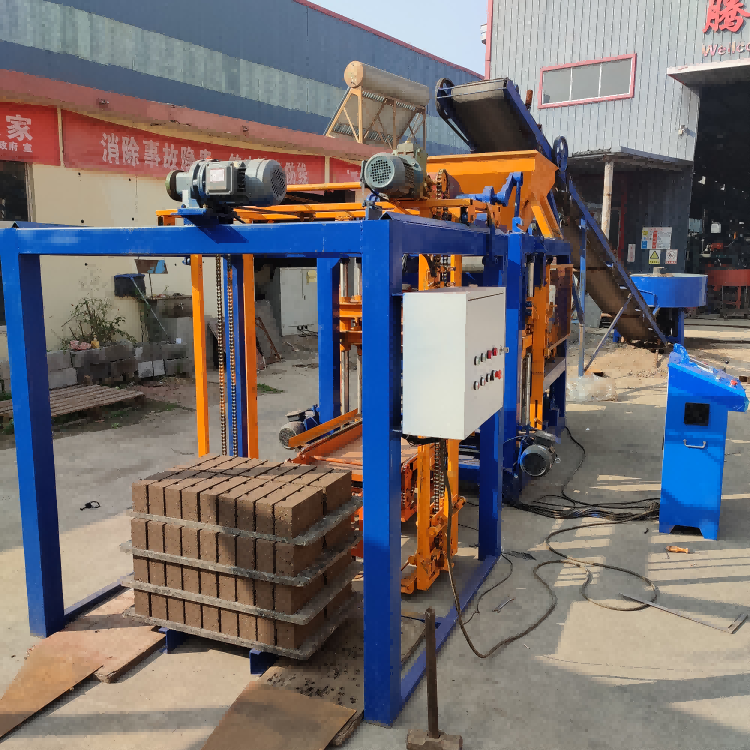
I. Deconstructing the Investment: The Total Capital Outlay
The initial purchase price is only the first component of the investment. A true ROI analysis begins with a complete understanding of the Total Capital Expenditure (CapEx).
A. The Direct Machine Costs
- Base Machine Price: The cost of the core machine itself, which varies dramatically by type (e.g., manual clay mold vs. fully automatic concrete block plant), capacity, and component quality.
- Essential Auxiliary Equipment: This is often overlooked. A functional production line requires more than just the press. Key items include:
- ມິກເຊີ: A pan or planetary mixer of appropriate capacity.
- Material Handling: Conveyors, feeders, and hoppers.
- Molds and Pallets: Initial sets for the desired product range.
- Power Generator: If grid power is unreliable.
B. Indirect and Installation Costs
- Shipping, Logistics, and Insurance: Costs for international freight, port clearance, and inland transportation to the site.
- Installation and Commissioning: Costs for foundation construction, electrical and hydraulic hookup, and potentially, technical supervision from the supplier.
- Initial Raw Material Inventory: Capital tied up in the first bulk purchases of cement, aggregates, pigments, or clay.
- Working Capital Reserve: Funds to cover initial operational expenses (labor, utilities) before revenue from sales begins to flow.
II. Modeling the Returns: Revenue Streams and Cost Savings
The return side of the equation consists of generated revenue and operational efficiencies that displace existing costs.
A. Primary Revenue Generation
- Sale of Manufactured Units: The core revenue stream. Accurate modeling requires:
- Realistic Production Capacity: Using operational capacity (75-85% of theoretical max) for a standard work shift.
- Sales Price per Unit: Based on detailed local market analysis for different products (hollow blocks, pavers, solid bricks).
- Market Absorption Rate: A conservative estimate of what percentage of your output can be sold at the target price. It is risky to assume 100% sales from day one.
- Value-Added Products: Revenue from specialized, higher-margin items like colored pavers, textured bricks, or custom shapes.
B. Operational Cost Displacement and Savings
For businesses already in construction, a key return is the saving on purchased materials.
- In-House Production Cost vs. Purchase Price: The profit is the difference between the cost to produce a block internally (raw materials + labor + overhead) and the prevailing market price for purchasing it from a third party. This margin can be substantial.
C. Strategic and Intangible Returns
While harder to quantify, these contribute significantly to business value:
- Supply Chain Control and Reliability: Eliminating dependence on external suppliers, ensuring on-time project completion.
- Business Diversification and Brand Development: Creating a manufacturing arm enhances company stature and opens new market opportunities.
- Asset Appreciation: A well-maintained machine retains residual value.
III. Calculating Ongoing Operational Costs (OpEx)
Profit is revenue minus all operational expenditures. A precise OpEx forecast is critical.
A. Variable Costs (Directly tied to production volume)
- Raw Materials: Cement, sand, aggregate, stabilizers, pigments. The largest ongoing cost.
- Direct Labor: Wages for machine operators and production line helpers.
- Energy Consumption: Electricity for the machine, mixer, and lighting.
- Wear Parts and Consumables: Hydraulic oil, filter changes, mold liner wear, and pallet repair/replacement.
B. Fixed and Semi-Fixed Costs
- Labor (Supervisory & Admin): Salaries for foremen, quality control, and administrative staff.
- Site Overheads: Rent or land amortization, utilities, security.
- Maintenance Contracts: Scheduled servicing by technicians.
- Marketing and Sales Costs: To promote and sell the output.
- Financing Costs: Interest payments if the machine is purchased with a loan or lease.
IV. The ROI Calculation Framework and Key Metrics
With the data gathered, several financial metrics can be calculated to assess viability.
A. Simple Payback Period
The most intuitive metric for many clients.
- Formula: Total Capital Investment / Annual Net Profit (or Annual Cash Flow Savings)
- Interpretation: This shows how many years it will take for the machine to “pay for itself” from its generated profits. In this industry, a payback period of 1.5 to 3 years is often considered attractive, indicating a robust investment. A period beyond 5 years may signal high risk or marginal profitability.
B. Annual Return on Investment (ROI%)
A standardized percentage metric.
- Formula: (Annual Net Profit / Total Capital Investment) x 100
- Interpretation: An annual ROI of 25% means the investment generates profits equal to a quarter of its cost each year. This allows for easy comparison with other potential investments (e.g., stock market, expanding a different business line).
C. Sensitivity and “What-If” Analysis
A sophisticated analysis tests the robustness of the ROI against changing conditions.
- Key Variables to Test:
- Sales Price Fluctuation: What if market competition forces a 10% price reduction?
- Raw Material Cost Increase: What if cement prices rise by 15%?
- Production Downtime: What if the machine operates at 60% capacity instead of 80%?
- Purpose: This identifies the project’s break-even points and major risks. It shows clients that the model has been stress-tested, building confidence.
V. Strategic Factors Influencing ROI Success
Beyond the numbers, several strategic decisions profoundly impact the outcome.
A. Machine Selection Alignment
Choosing the wrong machine is the fastest way to erode ROI. An oversized, fully automatic machine for a small market will never reach capacity, destroying the payback period. An underpowered, manual machine for large contracts will fail to generate sufficient volume. The machine must be the “Goldilocks” fit for the business plan.
B. Operational Excellence and Efficiency
ROI projections assume efficient operation. Poor raw material management, unskilled labor causing high waste, or inadequate maintenance leading to breakdowns will all decimate projected profits. Investment in training and process control is an investment in achieving the promised ROI.
C. Market Strategy and Sales Execution
The machine can produce, but can the business sell? A clear go-to-market strategy—whether supplying one’s own projects, securing contracts with local developers, or supplying retailers—is non-negotiable. The sales pipeline must be developed before the machine is commissioned.
ສະຫຼຸບ
The Return on Investment for a brick making machine is a dynamic and multifaceted projection, not a static number on a brochure. It is the financial narrative of a business venture, woven from the threads of capital costs, operational discipline, market acumen, and strategic planning. For the B2B professional, the greatest value lies in the ability to co-author this narrative with the client.
This involves moving from being a passive vendor to an active financial consultant. By providing a structured framework for CapEx and OpEx, helping model realistic revenue scenarios, and insisting on rigorous sensitivity analysis, you empower your client to make an informed decision. The most successful partnerships are forged when the distributor demonstrates a vested interest in the client’s profitability, proving that the machine’s success is the foundation of a mutually beneficial, long-term relationship. Ultimately, a well-calculated ROI does more than justify a purchase; it charts a credible path to business growth, stability, and market leadership.
Frequently Asked Questions (FAQ)
Q1: What is a “good” or acceptable ROI for a brick making machine?
A: While context-dependent, a Simple Payback Period of 2 to 4 years (implying an annual ROI of 25% to 50%) is generally considered strong in this industry. For lower-risk, lower-margin markets, a payback of up to 5 years might be acceptable. Investments with projected paybacks beyond 5-6 years are often viewed as high-risk unless they enable strategic advantages (like guaranteed self-supply for a large construction firm).
Q2: Can I achieve an ROI if I only use the machine for my own construction projects?
A: Absolutely. In this case, the “return” is primarily a cost avoidance or saving. Calculate the ROI by comparing the lifetime cost of purchasing bricks/blocks from suppliers against the lifetime cost of producing them yourself (machine CapEx + your OpEx). If the total cost of ownership for the machine is lower than the cost of buying, the investment has a positive return and improves your project margins.
Q3: How does financing (a loan or lease) affect the ROI calculation?
A: Financing adds a cost of capital (interest) but preserves cash flow. In your ROI model, include the loan’s interest payments as an operational cost (OpEx), which will reduce annual net profit. The Total Capital Investment in the payback formula remains the full machine price. Financing typically extends the payback period slightly due to interest but makes the investment accessible by reducing the initial cash outlay.
Q4: What are the most common mistakes that ruin projected ROI?
A: The top three mistakes are:
- Overestimating Sales Volume/Price: Assuming 100% capacity sale at top market price from day one.
- Underestimating Operational Costs: Neglecting maintenance, energy, labor inflation, and raw material price volatility.
- Ignoring the Working Capital Requirement: Not having enough cash on hand to run for 3-6 months before sales revenue stabilizes, leading to a cash crunch that halts production.
Q5: As a distributor, how can I help a client improve their potential ROI?
A: You add immense value by:
- Right-Sizing the Equipment: Preventing over- or under-investment.
- Providing Realistic Production Data: Sharing realistic capacity and mix design guidelines to control material costs.
- Offering Efficiency Training: Ensuring the client’s team can operate and maintain the machine optimally.
- Connecting to Best Practices: Advising on efficient plant layout and curing methods to reduce waste and energy use. Your support directly protects their profit margins.
