
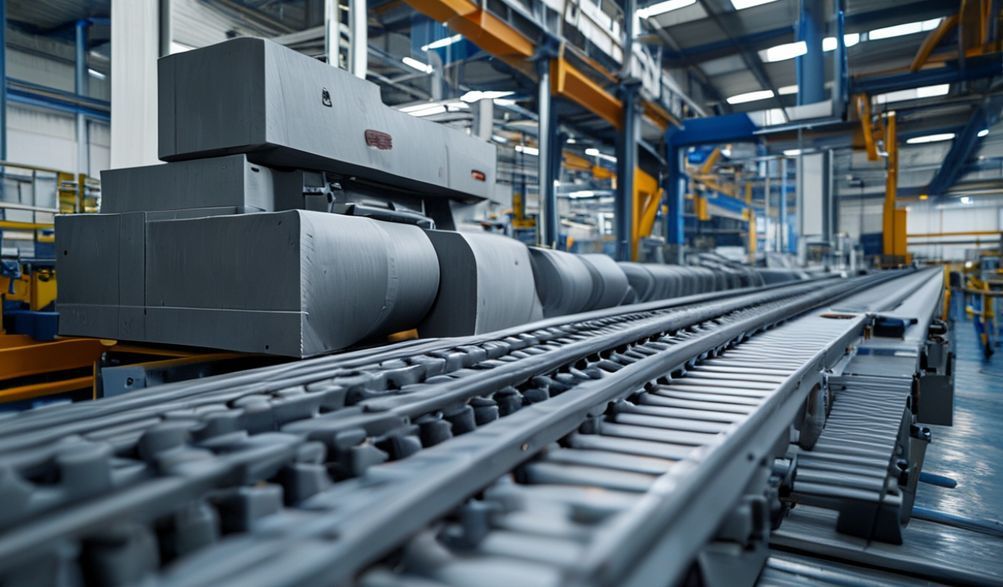
Panduan Muktamad untuk Mesin Bata Konkrit FUDA & Kilang Pembuatan Blok
Bagi profesional pembinaan, pemaju, dan usahawan, pencarian bekalan blok binaan yang boleh dipercayai dan menjimatkan kos merupakan cabaran berterusan. Sumber tradisional penuh dengan ketidakpastian—turun naik harga, kualiti tidak konsisten, dan kelewatan logistik—yang boleh mengganggu jadual projek dan belanjawan. Penyelesaian moden? Mengambil alih kawalan pengeluaran dengan mesin bata konkrit. Ini bukan sekadar tentang membuat bata; ia tentang menghasilkan kepastian, keuntungan, dan pertumbuhan untuk perniagaan anda.
Panduan muktamad ini memanfaatkan dekad pengalaman industri gabungan dalam jentera pembinaan dan pembuatan untuk memberikan tinjauan berwibawa dan mendalam tentang salah satu pemain utama sektor ini:Kilang pembuatan blok FUDAKami akan membedah teknologi di sebalik merekamesin bata konkritTerokai faedah nyata yang mereka tawarkan, dan sediakan rangka kerja yang jelas untuk membantu anda memilih model yang sempurna untuk usaha anda. Sama ada anda ingin menubuhkan halaman blok baharu, mengembangkan keupayaan syarikat pembinaan anda, atau melancarkan perniagaan pembuatan yang menguntungkan, sumber ini direka untuk memperkasakan keputusan pelaburan anda dengan keyakinan dan kejelasan.
Memahami Mesin Pembuatan Bata Konkrit: Teknologi Teras dan Jenis
Sebelum menyelami pengeluar tertentu, adalah penting untuk memahami mesin itu sendiri. Mesin pembuatan blok konkrit adalah sistem yang direka dengan kejituan untuk mengubah bahan mentah—simen, agregat, dan air—menjadi unit batu bata yang padat, seragam, dan berketahanan tinggi melalui proses pemadatan bermekanik.
Bagaimana Mesin Bata Konkrit Berfungsi?
Proses ini, meskipun canggih dalam pelaksanaannya, mengikuti urutan yang logis dan efisien:
- Mencampurkan:Bahan mentalah ditimbang dengan tepat dan dicampurkan untuk menghasilkan campuran konkrit separa kering yang homogen. Ketekalan di sini adalah kritikal untuk kekuatan blok akhir.
- Makan & Membentuk:Campuran itu dimasukkan ke dalam kotak acuan (atau "rongga acuan") pada mesin. Acuan ini menentukan bentuk blok—sama ada blok berongga, bata padu, atau pavar saling kunci.
- Pemadatan:Ini adalah inti prosesnya. Mesin menggunakan daya yang kuat untuk menghilangkan kantong udara dan memadatkan material.
- Getaran:Getaran frekuensi tinggi menyelesaikan campuran secara seragam di dalam acuan.
- Tekanan Hidraulik:Sebuah ram hidraulik mengenakan tekanan yang besar dari atas, seterusnya memadatkan konkrit kepada ketumpatan maksimumnya.
- Pengusiran (Penyingkiran):Blok yang dipadatkan, kini mengekalkan bentuknya, dikeluarkan dengan lembut dari acuan ke atas palet atau rak pengerasan.
- Penyembuhan:Blok hijau dipindahkan ke kawasan pengawetan. Pengawetan yang betul—biasanya melibatkan suhu dan kelembapan terkawal—membolehkan simen terhidrat sepenuhnya, mencapai kekuatan mampatan yang direka.
Jenis Mesin Pembuat Blok: Dari Manual ke Sepenuhnya Automatik
Tahap automasi berkorelasi secara langsung dengan keluaran, keperluan tenaga kerja, dan pelaburan.
- Mesin Manual:Dikendalikan terutamanya dengan tangan, dengan tuas untuk pemadatan dan pembentukan. Sesuai untuk projek berskala sangat kecil, volum rendah atau permulaan dengan modal minima. Output adalah rendah dan intensiti buruh adalah tinggi.
- Mesin Semi-Automatik:Ini mencapai keseimbangan. Proses teras seperti pemadatan dan acuan dimekanisasi (sering dengan sistem getaran dan hidraulik), tetapi tugas seperti memberi bahan mentah dan mengeluarkan blok siap mungkin dilakukan secara manual. Sesuai untuk perniagaan bersaiz kecil hingga sederhana.
- Mesin Sepenuhnya Automatik:Kemuncak kecekapan. Barisan pengeluaran yang dikawal komputer ini mengautomasikan keseluruhan proses daripada pembatchan dan pencampuran sehingga ke acuan, pemadatan, pemindahan blok, penumpukan, dan pemulangan palet. Ia menawarkan output tertinggi, konsistensi yang luar biasa, dan penggunaan tenaga manual yang minimum, mewakili pelaburan yang besar tetapi berbaloi tinggi.
Komponen Utama Mesin Bata yang Andal
Keberlanjutan dan prestasi mana-mana mesin bergantung pada kualiti komponen terasnya:
- Sistem Acuan: The soul of the machine. High-chromium, hardened steel molds ensure precise block dimensions, smooth surface finish, and withstand abrasion for thousands of cycles.
- Sistem Getaran: A robust, well-balanced vibration table with high-amplitude motors is essential for achieving optimal compaction and uniform block density.
- Sistem Hidraulik: The powerhouse. A reliable, energy-efficient hydraulic unit with precision valves and cylinders ensures consistent pressure and smooth operation with minimal downtime.
- Sistem Kawalan: From simple relay panels to advanced PLC (Programmable Logic Controller) interfaces, a user-friendly control system allows for easy operation, mode selection, and troubleshooting.
- Kerangka Struktur: A heavy-duty, welded steel frame provides the stability needed to handle constant vibration and pressure without distortion, ensuring long-term alignment and accuracy.
Spotlight on FUDA Block Making Factory: A Legacy of Engineering
In a market filled with options, the manufacturer’s pedigree matters. The Kilang pembuatan blok FUDA represents a synthesis of extensive engineering experience and a focused manufacturing philosophy.
Who is FUDA? Company History and Manufacturing Philosophy
FUDA has established itself as a prominent force in construction machinery manufacturing through a commitment to core principles. With a history spanning years of dedicated operation, the company has built its reputation not just on selling machines, but on providing production solutions. Their philosophy typically centers on:
- Ketahanan Diutamakan: Engineering machines for the harsh realities of industrial production.
- Innovation through Application: Developing features and models that solve real-world problems on construction sites and in block yards.
- Customer-Centric Support: Understanding that the sale is just the beginning of a long-term partnership.
This authoritative standing is often backed by international certifications (such as CE, ISO) that attest to standardized quality management and safety compliance in their manufacturing processes.
The FUDA Factory Advantage: Quality Control and R&D
The true measure of a manufacturer is in its factory. FUDA’s advantage lies in its integrated approach:
- Pembuatan Dalaman: Critical components are often fabricated and assembled under one roof, allowing for stringent quality control at every stage.
- Ujian Ketat: Machines and components undergo performance and endurance testing before leaving the factory, ensuring they meet specified output and reliability standards.
- Penyelidikan dan Pembangunan khusus: A focus on research and development means continuous improvement in machine efficiency, ease of use, and adaptability to new block designs and material mixes. This builds immense kebolehpercayaan with buyers investing in long-term assets.
FUDA’s Product Range: Matching Machine to Project Need
FUDA typically offers a spectrum of machines to cater to diverse business scales, a key aspect of their pengalaman in the market. Their range often includes:
- Small Mobile Block Machines: Ideal for on-site production, reducing transport costs for projects in remote locations.
- Stationary Semi-Automatic Machines: The workhorses for growing block manufacturing businesses, offering a great balance of output and affordability.
- Talian Pengeluaran Blok Sepenuhnya Automatik: High-capacity systems like the Siri QT for large-scale, commercial block yards requiring maximum output with minimal labor. These lines can produce thousands of blocks per shift, encompassing everything from hollow blocks and solid bricks to decorative paving stones and curbs.
Key Benefits of Choosing a FUDA Concrete Brick Machine
Investing in a FUDA machine translates into specific, measurable advantages for your business operations and bottom line.
Unmatched Productivity and Consistent Output
- High Cycle Counts: Engineered for speed, these machines can produce blocks in rapid succession, dramatically increasing your daily output compared to manual or outdated methods.
- Low Downtime: Reliable components and robust design minimize breakdowns, keeping your production schedule on track.
- Konsistensi Dimensi: Every block is identical. This uniformity speeds up construction, reduces mortar use, and results in straighter, stronger walls—a critical quality benchmark for professional projects.
Versatility in Block Production: Paving Stones, Hollow Blocks, and More
A single FUDA machine can be a multi-product factory. By simply changing the mold, you can switch production between:
* Hollow Blocks (various sizes)
* Solid Concrete Bricks
* Interlocking Pavers & Landscape Stones
* Batu Tepi Jalan dan Pembatas Tepi
* Specialty Shapes (e.g., grass pavers, chimney blocks)
This agility allows you to respond to market demand and diversify your product offering without major new investments.
Durability and Long-Term Cost Efficiency
The initial investment is balanced by a superior Return on Investment (ROI) over time:
* Bahan Premium: The use of hardened steel for molds and wear parts extends service life dramatically.
* Pembinaan Kukuh: The heavy-duty frame and components are built to endure years of demanding operation.
* Penyelenggaraan Rendah: Intelligent design simplifies routine maintenance, and the inherent durability reduces the frequency and cost of repairs.
Ease of Operation and After-Sales Support
FUDA'spengalaman shines in the total ownership package:
* User-Friendly Controls: Intuitive control panels, whether manual or PLC-based, reduce the learning curve for operators.
* Latihan Komprehensif: Proper training ensures your team can operate and perform basic maintenance safely and efficiently.
* Global Support Network: Access to readily available spare parts, detailed technical documentation, and remote or on-site service support minimizes potential disruptions, providing peace of mind.
How to Select the Right FUDA Machine for Your Business
Choosing the correct model is a strategic decision. Here’s a framework to guide your selection.
Assessing Your Production Requirements: Volume and Block Types
Start with the fundamentals:
* Output Harian/Mingguan: Calculate your current and projected near-future demand. Be realistic but allow for growth.
* Campuran Produk: What types of blocks are in highest demand in your market? Prioritize a machine whose standard or optional molds cover your core products.
Considering Space, Power, and Labor Constraints
- Factory Space: Measure your available floor space, including height for block stacking. Mobile and stationary models have different footprints.
- Bekalan Kuasa: Check the voltage and power (kW) requirements of the machine against your facility’s capacity. Fully automatic lines have higher demands.
- Buruh: Semi-automatic machines may require 3-4 operators, while a fully automatic line might run with 1-2. Factor in local labor costs and skill availability.
Budgeting: Initial Investment vs. Total Cost of Ownership
Look beyond the purchase price:
1. Kos Permulaan: The machine price, plus shipping, import duties, and installation.
2. Kos Operasi: Electricity, raw materials, and labor.
3. Nilai Jangka Panjang: Consider the machine’s expected lifespan, maintenance costs, and its ability to scale with your business. A slightly higher upfront cost for a more durable, automated machine often leads to lower cost-per-block over its lifetime.
The Investment Journey: From Inquiry to Production
Understanding the process demystifies purchasing industrial equipment from an international supplier.
Consultation and Customization Process with FUDA
Your journey begins with a dialogue. Reputable manufacturers like FUDA will have technical sales engineers to:
* Discuss your specific needs and constraints.
* Recommend the most suitable machine model and configuration.
* Provide detailed quotations and layout drawings.
* Discuss custom mold options for unique block designs.
Logistics, Installation, and Commissioning
- Logistics: FUDA typically handles export formalities and arranges shipping to your nearest port. Clear communication about Incoterms (e.g., FOB, CIF) is essential.
- Installation: While you provide the foundation and utilities, FUDA usually supplies comprehensive installation manuals and may offer the option for an engineer to supervise on-site installation.
- Pentauliahan: This is the final factory test on your site. The machine is assembled, powered up, and test blocks are produced to ensure everything operates perfectly before handover.
Training and Ongoing Technical Support
The relationship continues after the sale. A proper handover includes:
* Hands-On Training: For your operators and maintenance staff on safe operation, daily checks, routine maintenance, and basic troubleshooting.
* Support Structure: Clear points of contact for ordering spare parts and accessing technical assistance, which may include email, phone, and video call support.
Soalan Lazim (FAQ)
Q1: What is the average production output of a mid-range FUDA automatic block machine?
Output varies by model, but a typical semi-automatic or mid-range automatic machine can produce between 1,500 to 5,000 standard blocks (e.g., 400x200x200mm) in an 8-hour shift, depending on cycle time and block type.
Q2: Can FUDA provide custom molds for unique block designs?
Yes, FUDA’s factory has extensive in-house mold design and fabrication capabilities, allowing for customization to meet specific project requirements. You can provide a drawing or sample, and their engineering team can create a mold to match.
Q3: What kind of after-sales service and warranty does FUDA offer?
FUDA typically provides a comprehensive warranty (e.g., 12-18 months) on core components and offers a global network of service partners, along with readily available spare parts and remote technical assistance. Specific terms should be confirmed in your contract.
Q4: How does the quality of blocks from a FUDA machine compare to traditional methods?
Machine-made blocks provide superior compaction and consistency, resulting in blocks with higher compressive strength, uniform dimensions, and better surface finish than manual methods. This leads to stronger, more aesthetically pleasing construction.
Q5: What are the main raw materials needed, and can fly ash or other aggregates be used?
The primary materials are cement, aggregates (sand, gravel, crushed stone), and water. Most FUDA machines are designed to work efficiently with various mix designs, including those incorporating industrial by-products like fly ash or slag, which can reduce material costs and improve certain block properties.
Kesimpulan
Selecting a concrete brick machine is a pivotal decision that impacts your operational efficiency, product quality, and business scalability. This guide has outlined the critical technological considerations, the substantial benefits of automated production, and the strategic factors involved in choosing the right equipment. Opting for a machine from an established, engineering-focused Kilang pembuatan blok FUDA is more than a purchase—it’s a partnership built on a foundation of durability, innovation, and comprehensive support.
By prioritizing long-term reliability and total cost of ownership, you invest not just in a piece of machinery, but in the growth and resilience of your business. The control, consistency, and profitability that come with in-house block production are within reach.
Ready to transform your block supply chain? Take the next step with confidence. Contact the FUDA team today for a personalized consultation, request a detailed product catalog, or ask to speak directly with a technical sales engineer to discuss your specific project requirements and receive a tailored quotation.
<