
Panduan Muktamad untuk Mesin Pembuat Blok Berongga: Jenis, Kegunaan & Tip Membeli
Pengenalan
Industri pembinaan global dibina atas asas keperluan: keperluan untuk bahan binaan yang mampu dimiliki, tahan lama, dan mudah diperoleh. Di teras pelbagai projek perumahan, komersial, dan infrastruktur di seluruh dunia terletak satu komponen sederhana namun sangat diperlukan — blok berongga konkrit. Kepopularannya tidak dapat dinafikan, menawarkan nisbah kekuatan-berat yang sangat baik, penebat haba, dan keberkesanan kos. Walau bagaimanapun, kaedah tradisional pengeluaran blok secara manual penuh dengan cabaran yang menghalang kemajuan, daripada ketidakseragaman yang melumpuhkan dan tenaga kerja yang memenatkan sehingga pengeluaran yang sangat rendah.
Bagi usahawan, kontraktor, dan pembina yang ingin berkembang, halangan manual ini menimbulkan masalah yang besar. Di sinilah penyelesaian kejuruteraan muncul:mesin pembentuk blok beronggaPeralatan berkuasa ini adalah teras pengeluaran blok berskala kecil hingga sederhana moden, mengubah bahan mentah menjadi blok binaan berjurutera tepat dengan kecekapan yang luar biasa.
Panduan komprehensif ini direka untuk menjadi sumber paling dipercayai anda. Disusun daripada kepakaran industri yang mendalam, spesifikasi teknikal, dan pandangan operasi praktikal, matlamat kami adalah untuk melengkapkan anda dengan pengetahuan yang diperlukan untuk membuat keputusan yang sempurna dan berinformasi. Kami akan menerangkan dengan jelas tentangmesin pembentuk blok beronggameneroka pelbagai jenisnya, prinsip operasi, manfaat yang tidak dapat dinafikan, dan menyediakan senarai semak pembeli yang terperinci langkah demi langkah untuk memastikan pelaburan anda mendorong pertumbuhan dan kejayaan.
Apakah itu Mesin Pembuat Blok Berongga? Fungsi Teras & Prinsip
Sebelum menyelami jenis dan model, adalah penting untuk memahami apa mesin ini dan kejuruteraan asas di sebalik operasinya.
Mendefinisikan Tujuan Mesin
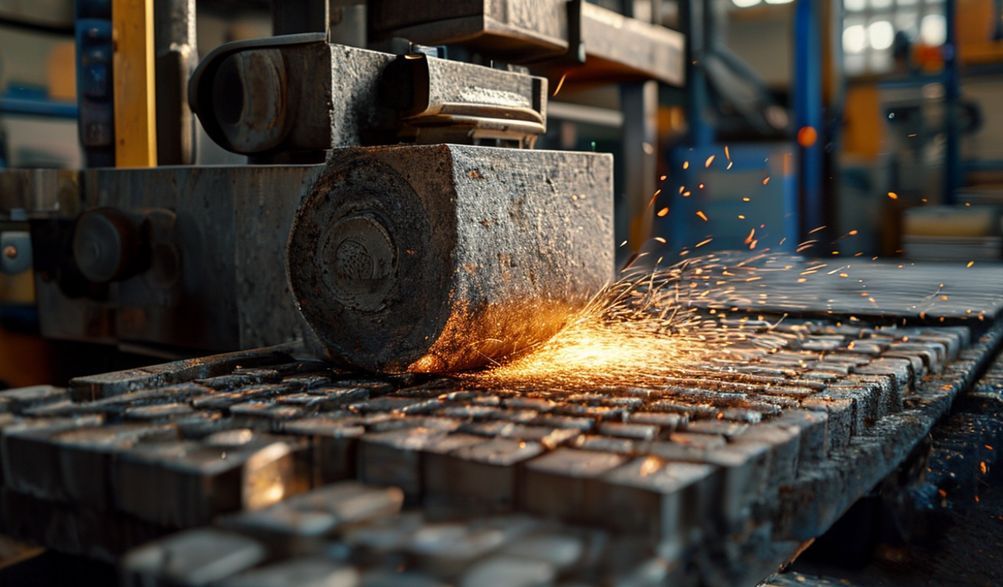
Mesin pengacuan blok berongga adalah peranti mekanikal khusus yang direka untuk memadatkan campuran konkrit separa kering—biasanya gabungan simen, pasir, dan agregat seperti batu hancur—ke dalam rongga acuan keluli. Proses ini membentuk blok berongga dengan dimensi piawai tertentu (contohnya 4″, 6″, 8″) dan corak rongga yang tepat. Rongga ini mengurangkan berat dan penggunaan bahan sambil mengekalkan integriti struktur, menjadikan blok lebih mudah dikendalikan serta meningkatkan sifat penebatannya.
Prinsip Kerja Asas
Walaupun reka bentuk berbeza-beza, prinsip kerja teras kebanyakan mesin acuan blok mengikuti kitaran konsisten yang berpusat pada pemadatan dan getaran:
- Pemberian Makan:Campuran konkrit separa kering yang disediakan dimasukkan secara manual atau automatik ke dalam kotak acuan mesin.
- Compaction/Vibration: This is the critical phase. A hydraulic ram or mechanical press applies downward pressure, while simultaneously, an electric motor drives a high-frequency vibration system. This dual action forcefully compresses the mix, eliminating air pockets and ensuring maximum particle interlock.
- Pembentukan: Under this intense pressure and vibration, the mix takes the exact shape of the mold, including the core pins that form the hollow cavities.
- Pengusiran: The mold box is lifted or opened, and the freshly formed, highly compacted block is ejected onto a pallet or the floor, ready for curing.
The role of high-frequency vibration cannot be overstated. It is the key to achieving the dense, strong, and dimensionally stable blocks that are essential for quality construction.
Types of Hollow Block Molding Machines
The market offers a range of machines categorized by their level of automation. Your choice will directly impact your production capacity, labor requirements, and initial investment.
Mesin Acuan Blok Manual
- Penerangan: These are the simplest type, operating entirely on human power. An operator uses a lever mechanism to compress the mix within a stationary mold. No electricity or engine is required.
- Terbaik Untuk: Micro-enterprises, individual builders, very low-budget startups, or remote project sites with no reliable power supply.
- Kebaikan & Keburukan:
- Kelebihan: Extremely low cost, highly portable, zero energy costs, simple to understand.
- Keburukan: Extremely labor-intensive, very low output (100-300 blocks/day), produces blocks of inconsistent density and strength, causes significant physical strain on operators.
Mesin Membuat Blok Semi-Automatik
- Penerangan: This is the most popular category for growing businesses. An electric motor powers the vibration and compaction mechanisms, ensuring consistent force. The operator handles feeding the mix and removing the finished block, but the core strength-forming process is automated.
- Terbaik Untuk: Small to medium-sized block manufacturing businesses. It offers the optimal balance between affordable investment and substantially increased, reliable production.
- Kebaikan & Keburukan:
- Kelebihan: Good production rate (800-2500 blocks/8-hour shift), consistent block quality due to machine-controlled vibration, moderate capital investment, relatively easy to maintain.
- Keburukan: Still requires a dedicated operator per machine, typically produces one block per cycle (single block machine), output is limited by operator speed.
Mesin Pembuat Blok Sepenuhnya Automatik
- Penerangan: These are industrial-grade production lines. Controlled by programmable logic controllers (PLCs), they automate the entire process: concrete batching and feeding, simultaneous molding of multiple blocks, curing, stacking, and pallet return.
- Terbaik Untuk: Large-scale commercial block yards, major construction companies supplying large projects, and businesses focused on maximum output with minimal manual labor.
- Kebaikan & Keburukan:
- Kelebihan: Very high output (10,000+ blocks/day), minimal labor requirements, superior consistency across every block, can include integrated curing systems.
- Keburukan: Very high initial capital cost, requires skilled technical personnel for maintenance and operation, needs a large, dedicated factory space, higher energy consumption.
Key Advantages of Using a Professional Molder Machine
Investing in a machine moves you from artisanal craft to controlled manufacturing. The benefits are transformative for any serious operation.
Unmatched Production Efficiency & Scale
The difference in output is staggering. While a team of manual laborers might produce 500 blocks in a full day, a single semi-automatic mesin pembentuk blok berongga operated by one person can produce 1,500+ in the same timeframe. This scalability is the foundation for fulfilling larger contracts and growing your business.
Kualiti Blok yang Unggul dan Konsisten
Machine-made blocks are defined by their uniformity. Every block has:
* Identical dimensions for perfect alignment during construction.
* Consistent density and high compressive strength, ensuring structural safety.
* Smooth, professional finishes on all faces.
This consistency reduces material waste on-site and eliminates the need for rework due to poorly fitting or weak blocks.
Significant Cost Reduction & ROI
While there is an upfront cost, the long-term savings are substantial:
* Labor Cost: One machine replaces multiple manual laborers.
* Kecekapan Bahan: Precise compaction reduces cement “slump” and waste.
* Reduced Rework: Consistent quality blocks prevent costly construction delays and repairs.
This leads to a strong and often rapid Return on Investment (ROI).
Operational Versatility
A single machine is rarely limited to one product. By simply changing the mold, most hollow block making machines can produce:
* Different hollow block sizes (4-inch, 6-inch, 8-inch).
* Solid blocks for specific applications.
* Paving stones, interlocking blocks, and curb stones.
This allows you to diversify your product line and respond to market demand without major new investments.
Critical Factors to Consider Before Buying
Purchasing a machine is a significant decision. This checklist will guide you toward the right choice for your specific needs.
Menilai Keperluan Pengeluaran Anda
Start by asking yourself these foundational questions:
* What is my expected daily or monthly output? Be realistic about current needs and near-future growth.
* What block types and sizes does my market demand? (e.g., standard 6″ hollow blocks, pavers).
* What is my available workspace? Do I have a covered shed or open yard for operation and curing?
* What is my power supply? (Single-phase or three-phase electricity?).
Machine Specifications & Build Quality
Never compromise on these core technical aspects. Inspect:
* Kuasa Motor & Sistem Getaran: Rated in HP or KW. A more powerful motor ensures better compaction for stronger blocks.
* Bahan Acuan: Molds should be made from hardened, high-quality steel to withstand constant abrasion and pressure.
* Frame Robustness: The chassis should be heavy-duty steel, welded (not bolted) at critical stress points to handle constant vibration without cracking.
* Komponen Hidraulik: For automatic machines, the quality of cylinders, valves, and hoses is paramount for reliable, leak-free operation.
Supplier Reputation & After-Sales Support (The Most Critical Factor)
Di sinilahE-E-A-T (Experience, Expertise, Authoritativeness, Trustworthiness) becomes non-negotiable. You are not just buying a machine; you are entering a partnership.
* Expertise & Authoritativeness: Choose a supplier/manufacturer with proven industry experience. They should be able to answer deep technical questions and provide verifiable case studies.
* Kebolehpercayaan: Research the company’s history. Read client testimonials and, if possible, visit an existing client’s operation. Can you inspect the factory? A transparent supplier is a trustworthy one.
* Critical After-Sales Services: Confirm the availability of:
* Installation guidance or supervision.
* Comprehensive operator training.
* A clear warranty policy (at least 1 year on core parts).
* Ready availability of spare parts (molds, vibration motors, springs) locally or with short lead times.
Operation, Maintenance & Safety Best Practices
Proper operation and care maximize your machine’s lifespan and ensure operator safety.
Step-by-Step Operational Guide
- Penyediaan Campuran: Use a correct ratio of cement, sand, and aggregate (e.g., 1:3:5). The mix should be semi-dry—it should hold its shape when squeezed but crumble when dropped.
- Machine Setup: Ensure the machine is on a level base. Install the desired mold and check all bolts are tight.
- Operation Cycle: Feed the mix into the mold, activate the machine for the recommended vibration time (usually 10-30 seconds), and eject the block onto a pallet.
- Proses Penyembuhan: Keep the freshly molded blocks under a plastic sheet or in a curing chamber for 24 hours before demolding. Then, water-cure them for 14-28 days to achieve full strength.
Essential Routine Maintenance Checklist
- Daily: Clean the machine thoroughly after use to prevent concrete buildup. Check for loose bolts or nuts.
- Weekly: Lubricate all moving parts as per the manual. Inspect the vibration table and springs for wear.
- Monthly: Check the motor mounts and electrical connections. Inspect the mold for excessive wear or damage.
Paramount Safety Protocols
- Peralatan Perlindungan Diri (PPD): Operators must wear safety gloves, steel-toe boots, and hearing protection (vibration can be loud).
- Electrical Safety: Ensure proper grounding and use circuit breakers. Keep the machine and cables away from water.
- Handling Safety: Never place hands in the mold area during the vibration cycle. Use proper lifting techniques when handling blocks or molds.
FAQ Section
Q1: What is the average production capacity of a standard semi-automatic hollow block machine?
A: A typical semi-automatic single-block machine can produce between 800 to 1,500 blocks in an 8-hour shift. This range depends heavily on the block size (smaller blocks are faster) and the speed/efficiency of the operator.
Q2: Can one machine produce different sizes of blocks?
A: Yes, absolutely. The core feature of most machines is interchangeable molds. You can purchase separate molds for 4″, 6″, and 8″ blocks, pavers, etc., and swap them on the same machine, making it a versatile production asset.
Q3: What is the typical “curing time” for machine-made hollow blocks?
A: Blocks should remain in their molds on the pallet for about 24 hours to set. After demolding, they require careful curing—keeping them moist through water spraying or steam for 14 to 28 days—to reach their specified full compressive strength.
Q4: How much power (electricity) does a semi-automatic machine consume?
A: Consumption is based on the motor. For example, a machine with a 5 HP (3.7 kW) motor running for 8 hours would consume approximately 30 kWh per day. Actual cost depends on your local electricity rates.
Q5: What is the most common maintenance issue and how to prevent it?
A: The most common issues are wear on the mold faces and the rubber vibration pads. Prevention is straightforward: use a clean, well-graded concrete mix (avoid oversized aggregate that scratches the mold) and perform regular cleaning and visual inspections as part of your maintenance routine.
Kesimpulan
Choosing the right mesin pembentuk blok berongga is a pivotal decision that can redefine the productivity and profitability of your construction or block manufacturing venture. It represents a shift from variable, labor-heavy methods to reliable, scalable, and quality-focused production.
As we’ve emphasized, this decision hinges not only on the machine’s specifications but profoundly on the expertise and trustworthiness of the supplier you partner with. A reputable partner provides the technical knowledge, training, and long-term support that transforms a capital purchase into a durable, high-return investment.
Use this guide as your benchmark. Approach potential suppliers with confidence, armed with detailed questions about production capacity, build quality, and after-sales service. We strongly advise requesting a live demonstration to see the machine in action. By making an informed, careful choice, you invest not just in equipment, but in the future strength and growth of your business.
<