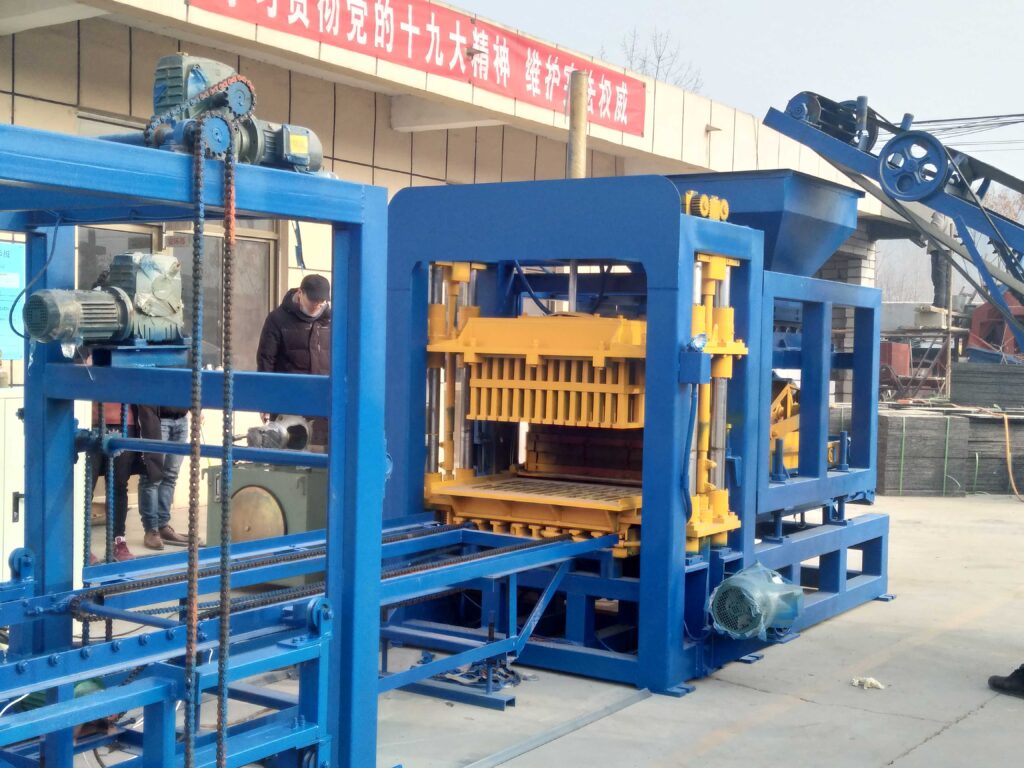
1. Seni Bina Sebuah Kilang Pembuatan Sepenuhnya Automatik
Sebuah kilang pembuatan bata abu terbang sepenuhnya automatik mewakili ekosistem perindustrian lengkap dan bukannya mesin tunggal. Memahami sifat komprehensifnya adalah asas untuk menghargai struktur harganya. Sistem-sistem ini mengintegrasikan pelbagai operasi tersegerak:
- Sistem Pengendalian Bahan Automatik:Termasuk silo untuk penyimpanan bahan mentah, sistem penimbangan tepat, dan tali sawat yang mengangkut bahan tanpa campur tangan manusia.
- Unit Pencampuran Pintar:Stesen pencampuran dikawal komputer yang memastikan komposisi bahan konsisten dan kandungan lembapan optimum.
- Modul Mampatan Ketepatan Tinggi:Komponen teras yang menampilkan sistem hidraulik boleh aturcara dengan keupayaan tekanan antara 80 hingga 400 tan, bergantung kepada keperluan pengeluaran.
- Sistem Pengendalian dan Penimbunan Robotik:Pengendali maju yang memindahkan bata hijau dari mesin penekan ke kawasan pengawetan dengan kerosakan produk yang minimum.
- Sistem Kawalan Kualiti Bersepadu:Sensor dan peranti pemantauan yang sentiasa memeriksa dimensi, ketumpatan, dan konsistensi produk.
- Pusat Kawalan Terpusat:Sistem komputer perindustrian dengan pengawal logik boleh aturcara (PLCs) dan antara muka manusia-mesin (HMIs) yang menyelaraskan semua operasi.
Integrasi subsistem-subsistem ini ke dalam aliran pengeluaran yang lancar mewakili satu pencapaian kejuruteraan yang signifikan yang memberi kesan langsung kepada penetapan harga.
Penentu Utama Penetapan Harga Kilang Pembuatan
2.1. Kapasiti Pengeluaran dan Spesifikasi Output
Kapasiti pengeluaran mewakili pemboleh ubah paling penting dalam penentuan harga.
- Sistem Skala Kecil (6,000-12,000 bata setiap syif 8 jam):Direka untuk pasaran serantau atau barisan produk khusus, sistem ini mewakili automasi peringkat permulaan dengan harga biasanya bermula dari $85,000.
- Kilang Kapasiti Sederhana (12,000-25,000 bata setiap syif):Konfigurasi paling lazim untuk operasi komersial, menampilkan pembinaan teguh dan automasi seimbang, dengan harga antara $130,000 hingga $220,000.
- Talian Pengeluaran Berkapasiti Tinggi (25,000-45,000+ bata setiap syif): Industrial-scale systems designed for continuous operation, incorporating advanced robotics and redundant systems, with prices beginning at $250,000 and extending beyond $500,000 for custom configurations.
2.2. Technological Sophistication and Automation Level
- Basic Automation: Systems with sequential operations and standard PLC controls offer fundamental automation at lower price points.
- Advanced Integration: Plants featuring real-time process adjustment, predictive maintenance algorithms, and remote monitoring capabilities command premium pricing.
- Custom Engineering Solutions: Specialized configurations for unique product specifications or specific raw material characteristics involve additional engineering costs that influence final pricing.
2.3. Component Quality and Sourcing
- Sistem Hidraulik: The choice between standard industrial components and premium, high-efficiency systems can create price variations of 25-40%.
- Sistem Kawalan: Basic relay logic versus sophisticated PLCs with SCADA integration represents a substantial price differentiation.
- Structural Materials: The grade of steel, quality of welding, and precision of machining directly correlate with both durability and cost.
- Wear Parts and Molds: Tool steel quality and hardening processes for high-wear components significantly affect both initial price and long-term operating costs.
3. Market Pricing Tiers and Value Propositions
The market for fully automatic manufacturing plants segments into distinct tiers, each offering different value propositions:
3.1. Economy Tier ($85,000 – $140,000)
- Ciri-ciri: Based on standardized designs with domestic components, simplified automation, and moderate production speeds.
- Target Market: First-time automation adopters, markets with price sensitivity, or operations with intermittent production schedules.
- Tawaran Nilai: Basic automation benefits with accessible pricing and simpler maintenance requirements.
3.2. Commercial Tier ($140,000 – $280,000)
- Ciri-ciri: Incorporates reliable international components, comprehensive automation, and balanced performance features.
- Target Market: Established brick manufacturers expanding capacity, entrepreneurs targeting commercial markets, and operations requiring consistent quality output.
- Tawaran Nilai: Optimal balance of performance, reliability, and operational efficiency for serious commercial applications.
3.3. Industrial Tier ($280,000 – $600,000+)
- Ciri-ciri: Engineered for maximum productivity and uptime, featuring premium global components, advanced robotics, and sophisticated process control.
- Target Market: Large-scale manufacturers, industrial operations with continuous production requirements, and businesses prioritizing lowest total cost of ownership.
- Tawaran Nilai: Superior productivity, minimized operational costs, and maximum reliability for high-volume production environments.
4. Financial Analysis: Beyond Initial Purchase Price
For distributors and their clients, understanding the complete financial picture is crucial:
4.1. Total Cost of Ownership Analysis
- Kecekapan Tenaga: Premium systems with variable frequency drives and optimized hydraulic circuits can reduce power consumption by 20-35%, saving thousands annually in operating costs.
- Pengoptimuman Tenaga Kerja: Fully automatic plants typically require 70-85% less direct labor than semi-automatic operations, representing the most significant financial advantage.
- Maintenance Requirements: Systems designed with preventive maintenance in mind and using higher-quality components typically experience 40-60% fewer unscheduled downtime events.
- Konsistensi Produk Automated systems produce bricks with dimensional variations under 1%, reducing material waste and improving product marketability.
4.2. Return on Investment Calculations
A comprehensive ROI analysis must consider:
- Production Capacity Utilization: Most plants achieve profitable operation at 60-70% capacity utilization.
- Local Market Conditions: Brick pricing, raw material costs, and labor rates significantly influence payback periods.
- Kecekapan Operasi: Well-managed plants typically achieve ROI within 24-36 months, with high-performing systems sometimes reaching break-even in 18-24 months.
- Scalability Considerations: Systems designed for future expansion protect initial investments and extend productive lifespans.
5. Strategic Procurement Considerations for Distributors
5.1. Supplier Evaluation and Qualification
- Technical Capability Assessment: Evaluate engineering expertise, manufacturing facilities, and quality control processes.
- Component Traceability: Verify sourcing of critical components and availability of technical documentation.
- Testing and Validation Protocols: Ensure comprehensive factory acceptance testing and performance validation.
- Reference Validation: Contact existing clients with similar systems to verify performance claims and after-sales support quality.
5.2. Commercial Negotiation Strategies
- Total Package Evaluation: Negotiate complete systems including essential auxiliaries rather than individual components.
- Payment Structure Optimization: Consider phased payments tied to manufacturing milestones and performance validation.
- Service and Support Agreements: Negotiate comprehensive commissioning, training, and initial maintenance packages.
- Spare Parts Strategy: Establish initial spare parts inventories and ongoing supply agreements as part of the purchase negotiation.
5.3. Market Positioning and Value Communication
- Client Education: Develop materials that explain the long-term value proposition beyond initial price considerations.
- Demonstration Strategy: Utilize video documentation, virtual reality simulations, or factory visit programs to demonstrate system capabilities.
- Financial Modeling Tools: Provide clients with customizable ROI calculators and business planning templates.
- After-Sales Support Structure: Build local technical support capabilities that complement manufacturer support services.
Kesimpulan
The pricing of fully automatic fly ash brick manufacturing plants represents a complex intersection of engineering capability, component quality, production requirements, and market dynamics. For industry professionals, success requires moving beyond simple price comparisons to a comprehensive understanding of value delivery across the entire equipment lifecycle. The most economically sound investment is typically not the lowest-priced system, but rather the plant that offers the optimal balance of productivity, reliability, and operational efficiency for specific market conditions and business objectives.
Distributors and procurement specialists who develop expertise in analyzing total cost of ownership, evaluating technological sophistication, and communicating long-term value propositions will be positioned to guide their clients toward investments that deliver sustainable competitive advantages. As the construction industry continues its shift toward sustainable materials and automated production, the ability to navigate the complexities of manufacturing plant pricing will become increasingly valuable, creating opportunities for knowledgeable professionals to build lasting partnerships and profitable businesses in this dynamic sector.
FAQ
Q1: What is the typical price range for a complete fully automatic manufacturing plant?
A: Complete systems range from approximately $12,000 for basic entry-level configurations to over $60,000 for high-capacity, custom-engineered plants. Most commercial operations invest between $15,000 and $28,000 for balanced systems producing 15,000-25,000 bricks per shift. Prices vary based on capacity, automation level, component quality, and customization requirements.
Q2: How does production capacity specifically affect pricing?
A: Pricing does not increase linearly with capacity. A system producing 20,000 bricks per shift typically costs 40-60% more than one producing 10,000 bricks, but may deliver 100% more output. The premium reflects larger components, more powerful systems, and enhanced automation to maintain quality at higher speeds. This creates economies of scale in operational costs that justify the higher initial investment.
Q3: What additional costs should be anticipated beyond the machine price?
A: Significant additional investments include: factory building or modifications ($10,000-$50,000+), electrical infrastructure upgrades ($5,000-$30,000), raw material handling equipment ($10,000-$40,000), curing and storage infrastructure ($5,000-$10,000), installation and commissioning ($1,000-$3,000), and initial raw material inventory ($5,000-$20,000). Comprehensive planning should account for 25-40% beyond the base machine price.
Q4: What warranty and support typically accompanies these systems?
A: Standard warranties range from 12-24 months on major components, with shorter periods on wear parts. Comprehensive support typically includes on-site installation supervision, operator training (1-2 weeks), and remote technical support. Premium systems often include extended warranties and more comprehensive support packages. Specific terms should be clearly defined in purchase agreements.
Q5: How long does installation and commissioning typically require?
A: From delivery to full production, most systems require 4-8 weeks for installation, depending on site preparation completeness and system complexity. This includes foundation work, mechanical assembly, electrical connections, system calibration, and personnel training. Proper site preparation before delivery can reduce this timeline by 30-50%.
Q6: What are the key differences between similarly priced systems from different suppliers?
A: At similar price points, key differentiators include: component brands and quality, structural design and manufacturing precision, control system sophistication, energy efficiency features, ease of maintenance design, availability of local technical support, and the supplier’s reputation for after-sales service. Thorough due diligence should evaluate all these factors, not just specifications on paper.
Q7: Can these systems be financed, and what are typical payment terms?
A: Most reputable suppliers offer financing options through partnerships with financial institutions. Typical payment structures include 30-40% advance payment, 50-60% against shipping documents, and 10% after successful commissioning. Lease-to-own options are increasingly available, with terms typically ranging from 24-60 months. Local government incentives for green technology may also provide financing advantages in some regions.