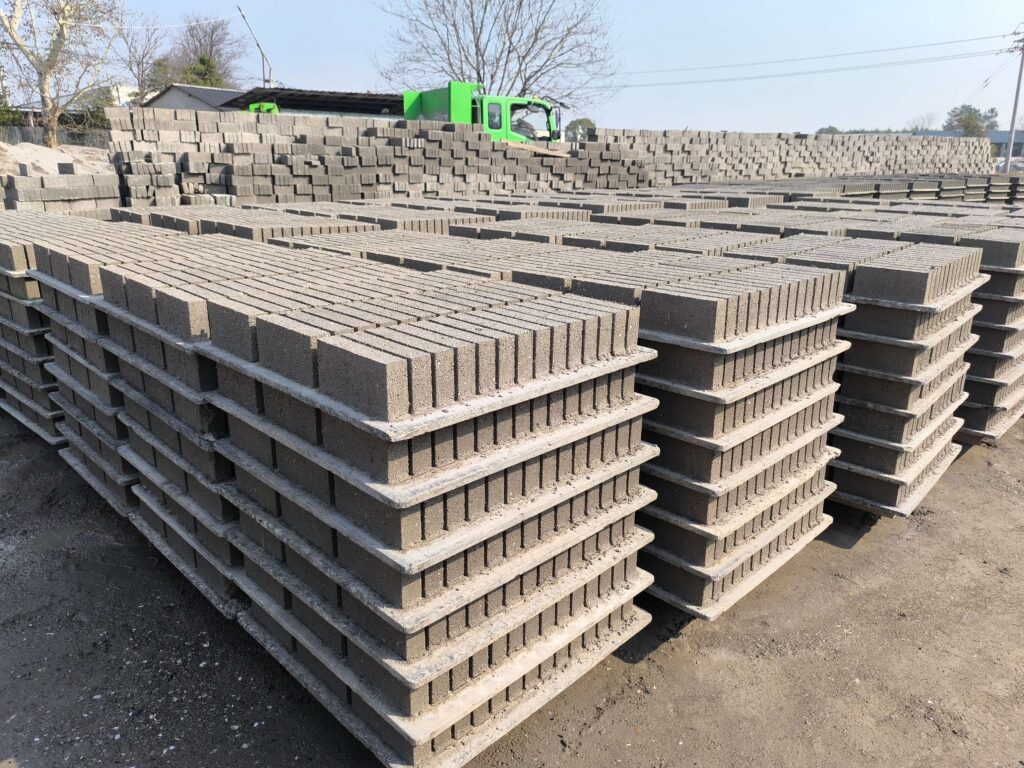
The Role of Modern Brick Machines in Utilizing Recycled Materials
The Technical Evolution: Engineering Machines for Material Diversity
The successful incorporation of recycled materials requires more than just feeding waste into a standard machine. It demands a holistic re-engineering of the production process, from feedstock preparation to final compaction, ensuring consistent quality and machine integrity.
1. The Spectrum of Suitable Recycled Feedstocks
Modern machinery is engineered to handle two primary categories of recycled content, each with unique processing requirements.
- Industrial By-Products (Pre-Consumer): These are consistent, homogeneous materials from other industrial processes.
- Abu Terbang: A fine powder from coal-fired power plants, acting as an excellent pozzolan that enhances long-term strength in concrete bricks and blocks when used in high percentages (often 30-70%).
- Relau Letup Sangga: A granular material from steel production, used as a partial replacement for cement or fine aggregate, contributing to durability and reduced weight.
- Quarry Dust & Stone Crusher Fines: By-products of aggregate processing, effectively used as fine aggregate, minimizing waste from quarries.
- Foundry Sand: Properly processed sand from metal casting can be incorporated into certain brick mixes.
- Construction and Demolition (C&D) Waste (Post-Consumer): This is a more complex stream, requiring advanced pre-processing.
- Crushed Concrete and Masonry: The most valuable component, serving as a high-quality recycled aggregate after careful crushing, sieving, and removal of contaminants like wood and metal.
- Processed Glass: Finely ground glass (cullet) can act as a flux in some clay bricks or as an inert filler in concrete products.
- Certain Plastic and Rubber Fines: When processed into fine, uniform particles, some polymers can be encapsulated in a cementitious or clay matrix for specialized, non-structural products, though this requires precise formulation.
2. Critical Machine Adaptations and Supporting Systems
To manage these varied materials, specific technological upgrades are essential.
- Robust Material Handling and Pre-Processing: The journey begins before the mixer. Effective systems integrate:
- Secondary Crushers and Pulverizers: To reduce C&D waste to a consistent, usable grain size.
- Advanced Screening and Air Classification: To separate fines from coarse aggregate and remove lightweight contaminants like paper or plastic film.
- Magnetic Separators and Eddy Current Systems: For automatic removal of ferrous and non-ferrous metals from the feedstock stream, protecting downstream machinery.
- Enhanced Mixing Technology: Achieving a homogeneous blend is paramount when materials have different densities and moisture affinities.
- High-Shear, Paddle, or Turbine Mixers: These provide more aggressive and thorough mixing than simple drum mixers, ensuring even distribution of binders (like cement or lime) around recycled particles.
- Precise Moisture and Additive Dosing Systems: Recycled aggregates are often more absorbent and irregular. Automated systems with moisture sensors dynamically adjust water and admixture (e.g., plasticizers) input to achieve the exact consistency required for optimal compaction.
- Adaptive Compaction and Molding Systems: The forming press must accommodate less predictable material behavior.
- Adjustable Vibration Profiles: Machines with programmable, multi-axis vibration allow operators to fine-tune frequency and amplitude to compact lightweight or irregular recycled aggregates effectively without segregation.
- Increased Compaction Force Capability: To achieve target densities with sometimes less ideal particle shapes, modern presses offer higher pressure ranges. This ensures the final product meets compressive strength standards even with significant recycled content.
- Wear-Resistant Componentry: Recycled materials, especially C&D aggregate, can be more abrasive than virgin sand. Critical wear parts like mold liners, augers, and mixer blades are now manufactured from hardened alloys, carbide composites, or feature replaceable wear plates, drastically extending service life and reducing maintenance downtime.
The Compelling Value Proposition for Stakeholders
Integrating recycled materials is not merely an environmental statement; it builds a powerful business case for manufacturers and a strong sales narrative for distributors.
1. Economic Incentives and Risk Mitigation
- Direct Cost Reduction: Recycled feedstocks, particularly industrial by-products like fly ash or processed C&D aggregate, are often available at a fraction of the cost of virgin materials, especially when sourced locally. This significantly lowers the bill of materials.
- Diversification of Supply Chain: Reducing reliance on mined virgin aggregates insulates production from price volatility, supply shortages, and logistical disruptions associated with traditional quarries.
- Access to Incentives and Avoidance of Levies: Many jurisdictions offer tax benefits, grants, or lower waste disposal fees for industries utilizing recycled content. Conversely, landfill taxes on C&D waste are rising globally, making recycling a cost-avoidance strategy.
2. Market Differentiation and Regulatory Compliance
- Creation of “Green” Certified Products: Bricks with high recycled content can qualify for credits under major green building certification systems such as LEED, BREEAM, and Green Star. This allows clients to sell into lucrative public sector and high-end commercial projects where such certifications are mandated.
- Meeting Corporate Sustainability Goals: Major construction firms and developers have ambitious ESG (Environmental, Social, and Governance) targets. Supplying them with bricks that demonstrably lower embodied carbon and support circularity creates a powerful partnership alignment.
- Future-Proofing Against Regulation: Legislation increasingly favors recycled content in construction. The European Union’s Circular Economy Action Plan and similar initiatives worldwide are pushing for mandatory recycled content levels in building products. Equipment that enables compliance today is a strategic investment for the future.
Implementation Considerations and Best Practices
Successfully operating a plant based on recycled materials requires careful planning and management.
- Feedstock Consistency is Key: The largest technical challenge is variability in the recycled material supply. Establishing strict quality control protocols with suppliers or investing in more sophisticated on-site pre-processing (washing, precise grading) is essential for consistent end-product quality.
- Formulation Expertise is Critical: There is no universal “recipe.” Optimal mixes must be developed through testing for each local recycled material source. Partnering with material scientists or leveraging the R&D support of advanced equipment manufacturers is crucial.
- Plant Layout and Logistics: The system requires more space for pre-processing (crushing, sorting, stockpiling) compared to a plant using ready-mix concrete or pure clay. Logistics for receiving and handling bulk waste materials must be carefully planned.
Conclusion
The ability to manufacture high-quality bricks from recycled materials has moved from experimental curiosity to a core competency of advanced brick making machinery. For the astute distributor or procurement expert, this represents a fundamental expansion of the value proposition. The conversation with clients now transcends machine output and durability to encompass material sourcing strategy, brand positioning in a green market, and long-term regulatory resilience. The latest generation of machines, equipped with intelligent processing, adaptive compaction, and wear-resistant designs, are not just brick makers—they are central nodes in a circular economic system, transforming local waste streams into valuable community assets. By championing this technology, B2B stakeholders do more than sell equipment; they empower clients to build profitably and responsibly, turning environmental imperatives into tangible competitive advantage and contributing to the sustainable transformation of the built environment.
Frequently Asked Questions (FAQ)
Q1: Do bricks made with recycled materials meet official building codes and strength standards?
Absolutely. When produced correctly on appropriate machinery with proper mix design and quality control, bricks and blocks incorporating recycled content can meet and often exceed relevant international standards (e.g., ASTM, EN, IS). The key is systematic testing to certify the final product, not just assuming compliance based on the feedstock. Reputable equipment suppliers provide technical support for this certification process.
Q2: What is the typical percentage of recycled content achievable without compromising quality?
This varies by material and product type. For concrete blocks using fly ash as a cement replacement, contents of 50-70% are common and well-proven. For products using processed C&D aggregate as a replacement for virgin stone, replacement rates of 30-100% in the aggregate fraction are achievable, with the higher end requiring more precise processing and mix design. The optimal percentage is determined through structured testing.
Q3: Does using abrasive recycled materials like crushed concrete significantly increase machine wear and maintenance costs?
While recycled aggregates can be more abrasive, this is precisely addressed by the design of modern machines. The use of hardened steel, chromium carbide overlays, and easily replaceable wear parts in high-abrasion zones is standard. While maintenance schedules may be more rigorous than with pure clay, the increased costs are marginal compared to the substantial savings in raw material procurement. The total cost of ownership remains highly favorable.
Q4: Are there any materials that should NOT be used in brick making machines?
Yes, certain materials pose operational or environmental risks. These include untreated organic matter (which will decompose), hazardous substances (asbestos, lead-based paint residues from old buildings), and unsorted, contaminated mixed waste. Effective pre-processing must remove these. Furthermore, some plastics may not bind properly or could release toxins if used incorrectly. A rigorous feedstock quality assurance program is non-negotiable.
Q5: Is the production process slower when using recycled materials?
Not necessarily. With optimized mix design and correctly calibrated machinery—particularly moisture control and vibration settings—cycle times can be identical to those using virgin materials. Any potential slowdown would occur in the pre-processing stage (crushing, sorting), not in the actual molding and compaction cycle within the brick machine itself. A well-designed plant integrates this pre-processing seamlessly into the material flow.