
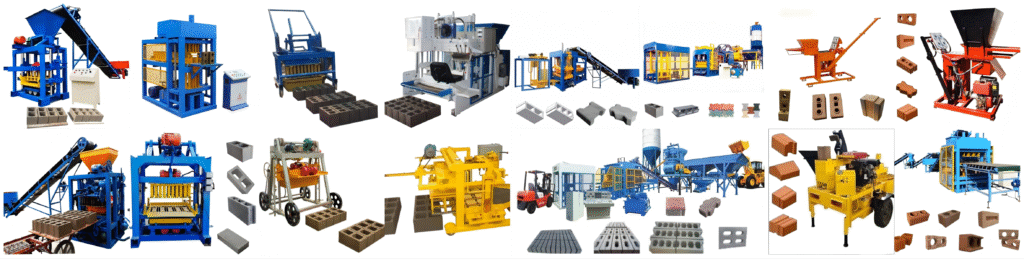
1 Key Factors Shaping Blocks and Bricks Making Machine Prices
A blocks and bricks making machine’s price is determined by a complex interplay of technical, functional, and market factors. Ignoring these variables can lead to misinformed purchases—either overinvesting in a high-capacity machine that sits idle or underinvesting in a low-cost model that fails to meet production demands. Below are the most impactful factors:
2.1.1 Production Capacity
Production capacity (measured in blocks/bricks per hour or day) is the single largest driver of price. Machines are engineered to handle specific volume ranges, and higher capacity requires more robust components (e.g., larger mixers, stronger pressing systems, faster conveyors).
- Small-Scale Capacity (500–2,000 blocks/day): These machines are designed for local producers or small distributors serving rural markets. They use basic mechanical components and require manual feeding, limiting output. Prices range from $2,000–$5,000. For example, a machine producing 1,000 standard 240mm×115mm×53mm bricks per day typically costs $8,000–$12,000.
- Medium-Scale Capacity (2,000–8,000 blocks/day): Targeted at regional distributors or mid-sized producers, these machines include semi-automatic features (e.g., automatic mixing, hydraulic pressing) to boost efficiency. They require more powerful motors and larger hoppers, pushing prices to $5,000–$10,000. A 5,000-block-per-day machine, suitable for supplying small commercial projects, usually costs $25,000–$35,000.
- Large-Scale Capacity (8,000+ blocks/day): Industrial-grade machines for national distributors or large producers, these feature full automation (from raw material weighing to stacking) and heavy-duty construction. They often integrate multiple production lines and smart monitoring systems, with prices ranging from $12,000–$50,000+. A 12,000-block-per-day machine, used for infrastructure projects like highways or high-rises, can cost $80,000–$120,000.
2.1.2 Automation Level
Automation reduces labor costs and improves consistency—but it also increases upfront prices. Machines are categorized by automation to cater to different labor availability and efficiency needs:
- Manual Machines: Require operators to handle feeding, mixing, and demolding. They have no electronic controls, relying on mechanical levers. Prices are the lowest, at $1,000–$8,000, but they are only suitable for micro-scale production (300–500 blocks/day) and have high labor costs long-term.
- Semi-Automatic Machines: Automate core processes (mixing, pressing) but need manual intervention for raw material loading and block stacking. They include basic PLC (Programmable Logic Controller) panels for parameter adjustment. Prices range from $6,000–$10,000, making them a balance between cost and efficiency for small-to-medium operations.
- Fully Automatic Machines: Integrate all processes—automatic raw material weighing (via load cells), mixing, molding, curing, stacking, and even quality inspection. They use advanced PLC systems with touchscreens and remote monitoring capabilities. Prices start at $10,000 for medium-capacity models and exceed $50,000 for large-scale, industrial units. The premium pays off in labor savings (1–2 operators vs. 5–8 for manual machines) and 24/7 operation potential.
2.1.3 Raw Material Compatibility
Blocks and bricks can be made from cement, fly ash, clay, or recycled materials—and machines optimized for specific materials cost more due to specialized components:
- Cement/Concrete Block Machines: The most common type, designed for cement-sand-gravel mixtures. They use standard molds and pressing systems, with prices aligned with capacity (as outlined in 2.1.1).
- Fly Ash Brick Machines: Require modified mixers and molds to handle fine fly ash particles (which tend to clump) and higher pressing pressure (to ensure density). They often include moisture sensors to adjust water dosage, adding 10–20% to the base price of a comparable cement block machine. For example, a medium-scale fly ash brick machine costs $28,000–$42,000 (vs. $25,000–$35,000 for a cement block machine).
- Clay Brick Machines: Need kiln integration for firing clay, a energy-intensive process. Kilns (electric or gas-powered) add significant cost—small clay brick machines start at $1,000, while large-scale models exceed $20,000.
- Recycled Material Machines: Optimized for crushed concrete or plastic aggregates, these include heavy-duty crushers and sieves to prepare raw materials. They cost 15–25% more than standard cement block machines; a medium-scale recycled block machine typically ranges from $30,000–$45,000.
2.1.4 Build Quality and Component Durability
A machine’s lifespan and maintenance costs depend on its build quality—and this is reflected in the price. Low-cost machines often use inferior materials, leading to frequent breakdowns, while premium models invest in durable components:
- Frame and Structure: Low-cost machines use thin steel (4–6mm) frames that vibrate excessively during pressing, reducing mold life. Premium machines use thick steel (8–12mm) frames with welded joints, adding 5–10% to the price but extending service life from 3–5 years to 10–15 years.
- Pressing System: Mechanical pressing systems (used in low-cost machines) are cheaper but less adjustable, with prices 20–30% lower than hydraulic systems. Hydraulic systems (used in premium machines) provide uniform pressure (15–40 MPa) for stronger blocks and have fewer moving parts, reducing maintenance costs. A hydraulic pressing unit adds $2,000–$5,000 to the machine price.
- Molds: Standard molds (made of mild steel) cost $500–$1,000 but wear out after 10,000–20,000 cycles. Premium hardened steel molds (HRC 55–60) cost $,500–$1,500 but last 50,000–100,000 cycles. Machines sold with multiple molds (for different block sizes) have higher upfront prices but offer versatility.
- Electrical Components: Low-cost machines use generic motors and PLCs that are prone to overheating. Premium models use energy-efficient IE3/IE4 motors and branded PLCs (e.g., Siemens, Mitsubishi), adding $1,000–$2,000 but reducing energy consumption by 15–20% and minimizing downtime.
2.1.5 Additional Features and Customization
Optional features and customization can significantly increase a machine’s price, but they may be worth the investment for specific use cases:
- Curing Chambers: Integrated climate-controlled curing chambers (for consistent block strength) add $3,000–$15,000 to the price. They are essential for regions with extreme weather (e.g., high humidity, freezing temperatures) where outdoor curing is unreliable.
- Dust Collection Systems: Required for compliance with environmental regulations in Europe, North America, and other strict markets. These systems cost $2,000–$5,000 and reduce operator exposure to concrete/fly ash dust.
- Mobile/Portable Design: Mobile machines (mounted on trailers) cost 20–30% more than stationary models of the same capacity. They include diesel generators for off-grid use and are ideal for on-site production (e.g., remote construction projects). A mobile medium-scale machine costs $30,000–$50,000 (vs. $25,000–$35,000 for stationary).
- Customization: Custom mold sizes, language support for PLC panels, or modified power supply (e.g., 110V for North America) can add 5–15% to the price. For example, a machine with a custom mold for interlocking paving bricks may cost $3,000–$5,000 more than a standard model.
2.2 Detailed Price List Breakdown by Machine Type
To help distributors, distributors, and buyers compare options, below is a categorized price list for the most common blocks and bricks making machine types. Prices reflect global market averages (as of 2024) and exclude shipping, installation, and taxes (which add 10–30% to the total cost).
2.2.1 Small-Scale Blocks and Bricks Making Machines (500–2,000 blocks/day)
| Machine Type | Capacity (Blocks/Day) | Automation Level | Key Features | Price Range | Ideal For |
|---|---|---|---|---|---|
| Manual Cement Block Machine | 500–800 | Manual | Mechanical pressing, manual feeding/mixing | $3,000–$6,000 | Micro-producers, rural distributors |
| Semi-Automatic Cement Block Machine | 800–1,500 | Semi-Automatic | Automatic mixing, manual stacking | $5,000–$10,000 | Small distributors, local construction |
| Semi-Automatic Fly Ash Brick Machine | 1,000–2,000 | Semi-Automatic | Modified mixer for fly ash, hydraulic pressing | $10,000–$15,000 | Small producers using local fly ash |
| Mobile Mini Block Machine | 600–1,200 | Semi-Automatic | Trailer-mounted, diesel generator option | $1,000–$2,000 | On-site small projects (e.g., village homes) |
2.2.2 Medium-Scale Blocks and Bricks Making Machines (2,000–8,000 blocks/day)
| Machine Type | Capacity (Blocks/Day) | Automation Level | Key Features | Price Range | Ideal For |
|---|---|---|---|---|---|
| Semi-Automatic Concrete Block Machine | 2,000–4,000 | Semi-Automatic | PLC control, automatic feeding, hydraulic press | $5,000–$10,000 | Regional distributors, mid-sized producers |
| Fully Automatic Fly Ash Brick Machine | 3,000–6,000 | Fully Automatic | Automatic stacking, integrated curing chamber | $10,000–$50,000 | Producers supplying commercial projects |
| Semi-Automatic Clay Brick Machine | 2,000–5,000 | Semi-Automatic | Small electric kiln, manual loading | $5,000–$20,000 | Local clay brick producers |
| Recycled Block Machine | 2,500–5,000 | Semi-Automatic | Integrated crusher, sieve for recycled materials | $20,000–$40,000 | Eco-conscious producers, green building projects |
2.2.3 Large-Scale Blocks and Bricks Making Machines (8,000+ blocks/day)
| Machine Type | Capacity (Blocks/Day) | Automation Level | Key Features | Price Range | Ideal For |
|---|---|---|---|---|---|
| Fully Automatic Concrete Block Machine | 8,000–12,000 | Fully Automatic | Dual mixing units, robotic stacking, remote monitoring | $10,000–$60,000 | National distributors, infrastructure projects |
| Industrial Fly Ash Brick Machine | 10,000–15,000 | Fully Automatic | High-pressure hydraulic press (40 MPa), large curing chamber | $20,000–$80,000 | Large-scale fly ash brick manufacturers |
| Fully Automatic Clay Brick Machine | 8,000–12,000 | Fully Automatic | Continuous gas kiln, automatic clay feeding | $10,000–$20,000+ | Industrial clay brick producers |
| Multi-Functional Block Machine | 12,000–20,000 | Fully Automatic | Interchangeable molds (blocks, bricks, paving stones), dust collection | $20,000–$70,000 | Diversified producers, large distributors |
2.3 Strategies to Optimize Costs When Using a Price List
A blocks and bricks making machine price list is a starting point—not a final decision tool. Distributors, distributors, and buyers can optimize costs by focusing on total cost of ownership (TCO) rather than just upfront price. Below are actionable strategies:
2.3.1 Match Machine Capacity to Actual Demand
Overbuying a high-capacity machine leads to idle time and wasted energy, while underbuying leads to missed sales. To avoid this:
- Conduct Demand Analysis: For buyers, calculate monthly/annual block demand based on current and projected projects. For example, a producer supplying 50,000 blocks/month needs a machine with 2,000–2,500 blocks/day capacity (accounting for maintenance downtime).
- Choose Scalable Models: Opt for machines that can be upgraded (e.g., adding a second mixer, expanding the curing chamber) instead of replacing the entire unit. A medium-scale machine with upgrade options ($25,000–$35,000) is more cost-effective than buying a large-scale machine upfront ($60,000+).
- Avoid Overcapacity: A machine operating at 70–80% capacity is optimal. Operating at less than 50% capacity increases TCO due to fixed costs (e.g., energy, storage) outweighing revenue.
2.3.2 Negotiate with Suppliers for Better Terms
Suppliers often offer flexibility on price, especially for bulk orders or long-term partnerships:
- Bulk Discounts: Distributors buying multiple machines (e.g., 5+ small-scale models) can negotiate 5–10% discounts. For example, a supplier may reduce the price of a $10,000 small-scale machine to $9,000 for an order of 10 units.
- Package Deals: Request packages that include essential accessories (e.g., extra molds, maintenance tools) at no additional cost. A $30,000 medium-scale machine package with free molds ($1,500 value) reduces TCO.
- Payment Terms: Negotiate extended payment plans (e.g., 50% down, 50% after 6 months) to improve cash flow. Some suppliers offer 0% interest for 12 months on orders above $50,000.
2.3.3 Factor in Hidden Costs
Upfront price is only 60–70% of TCO. Hidden costs include:
- Shipping and Installation: International shipping adds 10–20% to the machine price (e.g., $5,000–$10,000 for a $50,000 machine from China to Africa). Installation costs $2,000–$8,000 for large-scale machines.
- Maintenance and Spare Parts: Annual maintenance costs 2–5% of the machine price (e.g., $1,000–$2,500 for a $50,000 machine). Wearing parts (mixer blades, hydraulic seals) cost $500–$2,000/year and need replacement every 6–12 months.
- Energy and Labor: Fully automatic machines have higher upfront prices but lower labor costs (1–2 operators vs. 5–8 for manual machines). A fully automatic machine ($30,000) saves $15,000–$20,000/year in labor costs compared to a manual machine ($5,000).
2.3.4 Leverage After-Sales Support to Reduce Downtime
Downtime due to machine breakdowns costs $500–$2,000/day (depending on capacity). Choosing a supplier with strong after-sales support reduces this risk—even if it means a slightly higher upfront price:
- Warranty Coverage: Prioritize machines with 1–3 year warranties on the main unit and 6–12 months on wearing parts. A $35,000 machine with a 2-year warranty is better than a $30,000 machine with a 6-month warranty (avoids $5,000–$10,000 in repair costs).
- Local Spare Parts: Suppliers with regional spare parts warehouses reduce delivery time (3–5 days vs. 2–4 weeks), minimizing downtime. This is especially critical for remote regions.
- Training: Suppliers offering free operator training reduce human error-related breakdowns. A $30,000 machine with free training ($1,000 value) is more cost-effective than a $28,000 machine requiring paid training.
2.4 Market Trends Affecting Blocks and Bricks Making Machine Prices in 2024
Blocks and bricks making machine prices are not static—they are influenced by global market trends. Distributors, distributors, and buyers need to stay informed to anticipate price changes and make timely purchases:
2.4.1 Raw Material Costs for Machine Manufacturing
The cost of steel (used for frames and molds) and electronic components (PLCs, motors) directly impacts machine prices. In 2024:
- Steel Prices: Global steel prices have stabilized after 2022–2023 volatility, but regional shortages (e.g., in Europe due to energy costs) can increase machine prices by 5–8%.
- Electronic Components: Shortages of semiconductors (used in PLCs) have eased, but prices remain 10–15% higher than pre-2020 levels. This affects fully automatic machines more than manual models.
2.4.2 Demand for Sustainable Machines
As governments push for green construction (e.g., China’s “Dual Carbon” goals, EU’s Green Deal), demand for fly ash and recycled block machines has increased. This trend has:
- Raised Prices for Sustainable Models: Fly ash brick machines now cost 10–20% more than comparable cement block machines (up from 5–10% in 2020) due to high demand.
- Lowered Prices for Traditional Models: Cement block machine prices have decreased by 3–5% as suppliers compete for market share.
2.4.3 Technological Advancements
The integration of smart technology (remote monitoring, AI-based predictive maintenance) has increased prices for premium models but improved TCO:
- Smart Machines: Fully automatic machines with remote monitoring cost 15–20% more than standard fully automatic models, but they reduce maintenance costs by 25–30% by predicting breakdowns.
- Energy Efficiency: IE4 motors and variable-frequency drives (VFDs) add 5–10% to the price but reduce energy consumption by 15–25%, leading to long-term savings.
3. Conclusion
A blocks and bricks making machine price list is a powerful tool— but only when interpreted through the lens of value, not just cost. For distributors, understanding pricing dynamics allows them to match clients with machines that balance affordability and performance; for distributors, it helps optimize supply chain margins and avoid overstocking expensive models; for buyers, it ensures they invest in a machine that meets their production needs while minimizing long-term costs.
Throughout this guide, we’ve broken down the key factors shaping prices—from production capacity and automation level to raw material compatibility and build quality—showing how each variable contributes to a machine’s value. We’ve also provided a detailed price list for different machine types, giving industry professionals a benchmark to compare options. Importantly, we’ve emphasized strategies to optimize costs by focusing on TCO, negotiating with suppliers, and leveraging market trends—ensuring that every dollar spent delivers maximum return.
As the construction industry continues to evolve, blocks and bricks making machine prices will adapt to new technologies, sustainability demands, and global market conditions. By staying informed and using the strategies outlined here, distributors, distributors, and buyers can navigate price lists with confidence, making decisions that drive profitability and long-term business success. Ultimately, the best machine is not the cheapest or the most expensive—it’s the one that aligns with your specific needs and delivers the lowest TCO over its lifespan.
4. FAQ
4.1 How much do shipping and installation add to the total cost of a blocks and bricks making machine?
Shipping and installation costs vary by machine size, destination, and complexity:
- Shipping: For international orders, shipping costs 10–20% of the machine price. For example, a $30,000 medium-scale machine shipped from China to India costs $3,000–$6,000 (sea freight). Air freight is faster but more expensive (30–50% of the machine price) and is only used for small parts or urgent orders.
- Installation: Small-scale machines ($5,000–$15,000) require basic installation (leveling, electrical connection) costing $500–$1,500. Medium-scale machines ($15,000–$40,000) need professional installation ($2,000–$5,000) to align components like conveyors and mixers. Large-scale machines ($40,000+) require specialized teams and cost $5,000–$10,000 to install, including system testing and commissioning.Many suppliers offer discounted or free installation for large orders (e.g., 3+ machines) or long-term partnerships.
4.2 Are there any additional costs after purchasing a blocks and bricks making machine?
Yes—key additional costs include:
- Spare Parts: Wearing parts (mixer blades, hydraulic seals, mold inserts) cost $500–$2,000/year and need replacement every 6–12 months. Non-wearing parts (PLCs, motors) last 3–5 years and cost $1,000–$5,000 to replace.
- Maintenance: Annual preventive maintenance (lubrication, filter changes, calibration) costs 2–5% of the machine price. For example, a $50,000 machine requires $1,000–$2,500/year in maintenance.
- Energy: Small-scale machines use 5–10 kWh/hour, medium-scale use 10–20 kWh/hour, and large-scale use 20–40 kWh/hour. At $0.10/kWh, a medium-scale machine running 8 hours/day costs $8–$16/day in energy.
- Labor: Manual machines need 3–5 operators ($10–$15/hour each), while fully automatic machines need 1–2 operators—saving $20–$50/hour in labor costs.
4.3 Can I negotiate the price of a blocks and bricks making machine with suppliers?
Yes—suppliers are often open to negotiation, especially in the following scenarios:
- Bulk Orders: Ordering 5+ small-scale machines or 2+ large-scale machines can lead to 5–10% discounts. For example, a supplier may reduce the price of a $10,000 small-scale machine to $9,000 for an order of 10 units.
- Off-Season Purchases: Suppliers may offer 3–7% discounts during slow periods (e.g., Q4 for Northern Hemisphere construction).
- Long-Term Partnerships: Agreeing to be a regional distributor or placing repeat orders can secure 5–15% discounts and priority service.
- Package Deals: Requesting to bundle the machine with accessories (e.g., extra molds, maintenance kits) often leads to free or discounted add-ons, reducing overall costs.
4.4 How often do blocks and bricks making machine prices change?
Blocks and bricks making machine prices change 2–4 times per year, driven by:
- Raw Material Costs: Steel and electronic component prices fluctuate quarterly, leading to 3–5% price adjustments. For example, a 10% increase in steel prices may raise machine prices by 3–4%.
- Demand Cycles: Prices increase by 5–8% during peak construction seasons (e.g., Q2–Q3 in North America, Q1–Q2 in Asia) due to high demand.
- Technological Updates: New models with advanced features (e.g., smart monitoring) are released annually, with prices 10–15% higher than older models. Older models may see 5–10% price reductions to clear inventory.To avoid price hikes, consider placing orders during off-seasons or locking in prices with suppliers via 3–6 month quotes.
4.5 Is it cheaper to buy a used blocks and bricks making machine instead of a new one?
Used machines cost 30–50% less than new ones, but they come with risks:
- Pros: Lower upfront price (e.g., a 1-year-old medium-scale machine costing $30,000 new may sell for $15,000–$21,000 used). Suitable for startups or temporary projects.
- Cons: Shorter remaining lifespan (3–5 years vs. 10–15 years for new machines). Higher maintenance costs due to worn components. No warranty (most used machines are sold “as-is”). Limited customization options.If buying used, inspect the machine in person (or hire a third-party inspector) to check for frame damage, hydraulic leaks, and PLC functionality. 优先选择 machines with detailed maintenance records and from reputable sellers (e.g., manufacturers selling demo units). For long-term operations, new machines are more cost-effective due to lower TCO.
