
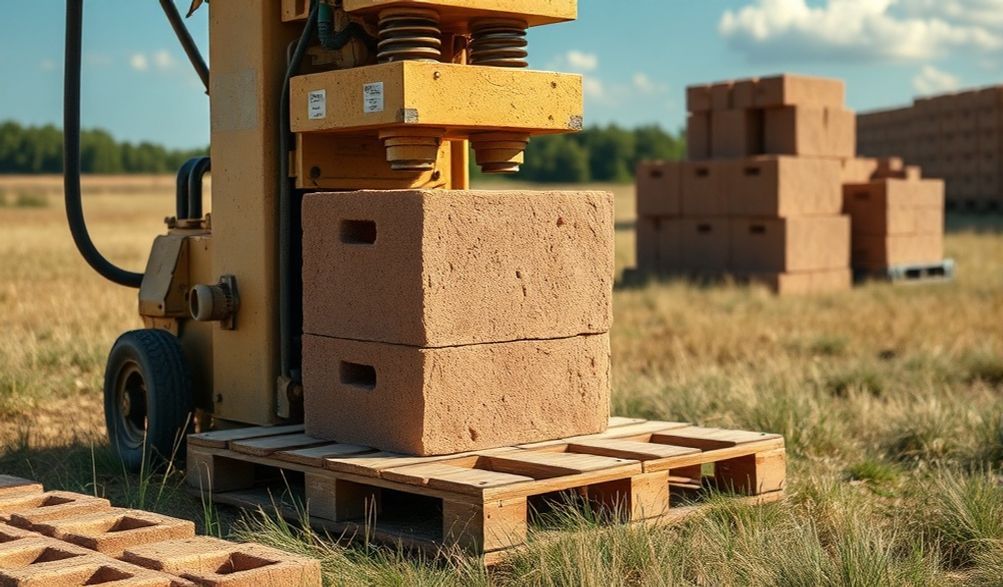
O Guia Definitivo para Máquinas de Terra Comprimida: Construindo de Forma Sustentável desde a Base
Introdução
Em uma era de urgência climática e crises habitacionais, a indústria global da construção está em uma encruzilhada. A demanda por métodos de construção sustentáveis, acessíveis e duráveis nunca foi tão alta, levando arquitetos, construtores e comunidades a olhar para trás para avançar. Essa busca reacendeu o interesse pelo material de construção mais antigo da humanidade: a terra. Mas não se trata de um simples retorno às cabanas de barro. Hoje, o conhecimento ancestral está sendo fundido com a engenharia moderna para criar estruturas profundamente ecológicas e tecnicamente superiores. No centro desse renascimento está uma ferramenta poderosa: a máquina de terra comprimida.
A construção tradicional, dependente de concreto, aço e tijolos queimados, carrega um fardo pesado: custos exorbitantes, uma enorme pegada de carbono e um desperdício significativo de materiais. Os Blocos de Terra Comprimida (BTCs) surgem como uma solução convincente, oferecendo resistência, beleza e eficiência térmica. No entanto, seu verdadeiro potencial é desbloqueado não manualmente, mas por maquinário especializado que transforma o solo bruto em blocos de construção precisos e de alto desempenho, de forma eficiente e em larga escala.
Este guia foi concebido para ser seu recurso definitivo. Sintetizamos conhecimentos dos princípios da engenharia estrutural, décadas de experiência prática de construtores e do campo em evolução da arquitetura sustentável. Nosso objetivo é fornecer uma visão geral confiável e abrangente que equilibre entusiasmo com realidade prática. Exploraremos o que são as máquinas de terra comprimida, como funcionam, seus benefícios inegáveis, os fatores críticos a considerar antes de investir e como essa tecnologia está pavimentando o caminho para um ambiente construído mais resiliente.
O que é uma Máquina de Terra Comprimida?
Uma máquina de terra comprimida é uma prensa mecânica, operada manualmente ou motorizada, projetada para compactar solo úmido e adequado em blocos de construção densos e uniformes. Pense nela como um molde de alta pressão que substitui a queima tradicional em fornos. Ao aplicar uma força imensa — frequentemente medida em toneladas — a uma mistura precisa de terra, ela produz blocos estabilizados ou não estabilizados que estão prontos para construção após um período de secagem ao ar.
Do Solo ao Bloco: O Princípio Básico
O processo é elegantemente simples, mas depende de um preparo cuidadoso:
- Seleção e Preparação do Solo:A mistura correta do solo é primordial. Ele é escavado, peneirado para remover grandes detritos e matéria orgânica, e às vezes misturado com outros solos ou agregados para alcançar a composição ideal.
- Condicionamento de Umidade:Adiciona-se água para atingir o teor de umidade ideal — geralmente entre 8% e 12%. Isso é crucial; se estiver muito seco, o bloco não se aglomera; se estiver muito úmido, ele se deforma. Na prática, os construtores descrevem a mistura perfeita como aquela que mantém sua forma quando apertada na mão sem gotejar água.
- Compressão:A mistura úmida é alimentada em uma câmara ou molde. Um pistão, acionado por uma alavanca, cilindro hidráulico ou prensa mecânica, aplica uma pressão intensa e constante.
- Ejeção e Cura:O bloco recém-formado é ejetado em um palete. Ele adquire imediatamente "resistência verde", mas deve então curar por secagem ao ar por várias semanas, ganhando resistência ao longo do tempo. Esse processo de cura ao ar, em oposição aos fornos alimentados por combustíveis fósseis, é onde uma enorme quantidade de energia incorporada é economizada.
É vital entender que essas máquinascomprimiras partículas do solo em uma massa coesa; eles nãoassar the blocks. The resulting block’s strength comes from mechanical interlock and the natural bonding properties of clay, often enhanced with a small percentage of stabilizer.
A Brief History: Modernizing an Ancient Practice
Building with earth is as old as civilization itself, from the rammed earth sections of the Great Wall to the iconic adobe pueblos of the American Southwest. However, these methods were labor-intensive and could be inconsistent.
The modern compressed earth block revolution began in the 1950s with the invention of the Cinva Ram, a manually operated press developed in Chile. This innovation provided a way to produce strong, uniform blocks with relatively low effort, making the technique accessible for community-led and development projects worldwide. This pivotal moment marked the transition from a purely vernacular craft to a reproducible, engineered building system, setting the stage for today’s advanced hydraulic and motorized presses.
Types of Compressed Earth Machines
Choosing the right machine depends entirely on your project’s scale, budget, and context. They are broadly categorized by their power source and mobility.
Manual Presses (e.g., Cinva Ram, TerraBlocks)
These are the workhorses of small-scale and community-driven projects.
- Melhor Para: Owner-builders, NGOs, community housing initiatives, educational workshops, small outbuildings, and low-budget projects.
- Prós:
- Low Cost: Minimal initial investment.
- Independência Energética: Requires no fuel or electricity.
- Portability & Simplicity: Easy to transport and operate with basic training.
- Baixa Manutenção: Robust design with few moving parts.
- Contras:
- Trabalho-Intensivo: Production is physically demanding, typically yielding 100-300 blocks per day with a dedicated team.
- Lower Production Rate: Not suitable for tight commercial deadlines.
- Consistência: Block quality can vary more with operator fatigue.
Motorized/Hydraulic Presses
These machines bring CEB production into the realm of commercial and large-scale construction.
- Melhor Para: Medium to large-scale housing developments, commercial buildings, professional block-making enterprises, and any project requiring high volume.
- Prós:
- Alta Capacidade de Produção: Can produce 500 to over 2,000 blocks per day.
- Consistência Superior: Hydraulic pressure ensures every block has nearly identical density and strength.
- Mão de Obra Reduzida: Automates the most strenuous part of the process.
- Adjustable Settings: Allow for precise control over compression force for different soil mixes or block strengths.
- Contras:
- Higher Initial Investment: Significant upfront cost.
- Custos Operacionais: Requires fuel, electricity, or a tractor PTO (Power Take-Off).
- Necessidades de Manutenção: More complex mechanics require regular servicing.
- Limited Portability: While some are trailer-mounted, they are less agile than manual presses.
Mobile vs. Stationary Units
This is a critical logistical consideration.
- Mobile Presses: Mounted on a trailer or skid, these can be brought directly to the construction site. This eliminates the cost and carbon emissions of transporting heavy blocks, as only the raw soil (often already on-site) and the lightweight machine need to move. It’s a game-changer for remote projects.
- Stationary Units: Set up in a dedicated block yard, these are ideal for a business selling blocks to multiple clients or for a large project with centralized material staging. They allow for optimized, assembly-line production.
Core Benefits of Using a CEB Machine
The advantages of building with compressed earth blocks, enabled by these machines, span environmental, economic, and structural domains.
Unmatched Sustainability & Environmental Credentials
- Baixa Energia Incorporada CEBs cure by evaporation, not by burning fossil fuels in a kiln at over 1,000°C. This can reduce the energy footprint of walling material by over 90%.
- Local & Abundant Materials: The primary ingredient is often available directly underfoot. Using on-site soil slashes the transport emissions associated with conventional bricks, cement, and steel.
- Fully Recyclable & Non-Toxic: At end-of-life, a CEB wall can be crushed, re-moistened, and repressed into new blocks, creating a true cradle-to-cradle material cycle. It also contains no volatile organic compounds (VOCs).
- Massa Térmica Superior: Earth has a high capacity to absorb, store, and slowly release heat. This natural “thermal battery” moderates indoor temperatures, reducing reliance on heating and cooling systems and delivering significant long-term energy savings.
Economic Advantages for Builders & Communities
- Dramatic Material Cost Savings: While stabilizers (like cement) are a cost, the bulk material—soil—is typically free or very low-cost. This can reduce wall material costs by 30-50% compared to conventional masonry.
- Local Labor & Skill Development: CEB production and construction are labor-intensive but not skill-exclusive. They create local employment opportunities and can build community capacity, keeping financial resources within the local economy.
- Long-Term Value & Low Maintenance: A properly designed and rendered CEB structure is exceptionally durable and resistant to pests and fire. This translates to minimal maintenance costs over a lifespan that can span centuries.
Structural Integrity and Durability
Contrary to common misconception, a well-made CEB is a robust building material. Historical examples, like portions of the Alhambra in Spain, stand testament to its longevity.
- Alta Resistência à Compressão: Depending on soil and compression, CEBs typically achieve strengths between 2 and 10 Megapascals (MPa), well within the range required for one- to three-story load-bearing walls. For comparison, a standard fired clay brick is around 10-20 MPa.
- Weather Resistance: The key is in the detailing. While the block itself can be susceptible to erosion from direct, driving rain, this is mitigated by a properly applied render (plaster) and by ensuring large roof overhangs, a solid foundation plinth, and effective drainage—principles true for any masonry construction.
Key Considerations Before You Buy or Use a Machine
This is where due diligence separates a successful project from a costly lesson. Demonstrating real-world expertise means addressing these practical hurdles.
Soil Suitability: The Most Critical Factor
Not all dirt is building material. The ideal soil is a mix of sand (the skeleton), silt (the filler), and argila (the binder).
- Simple Field Tests: Start with the ribbon test (rolling moist soil to see how long a ribbon it forms) and the jar/sedimentation test (shaking soil and water in a jar to see how the components settle). These give a rough estimate of clay content.
- Professional Lab Analysis: For any serious project, a geotechnical lab analysis is non-negotiable. It will provide precise percentages of sand, silt, and clay, and can recommend stabilization needs. This small upfront cost prevents massive failures later.
- The Role of Stabilizers: For increased strength, durability, and water resistance, a small percentage (often 5-10%) of a stabilizer like Portland cement or hydrated lime is added to the soil mix. Cement stabilization is common but adds embodied carbon; lime is more ecological but cures more slowly. The choice depends on climate, soil chemistry, and project goals.
Machine Specifications to Scrutinize
Look beyond the marketing brochure. Key technical specs include:
- Força de Compressão: Measured in PSI or MPa. Higher force generally creates denser, stronger blocks, but must be matched to your soil type. A machine offering 10-20 MPa of compacting pressure is suitable for most applications.
- Block Size & Shape: Standard rectangular blocks are common, but many machines offer interlocking block molds. Interlocking blocks can reduce or eliminate the need for mortar, speed up construction, and enhance seismic performance through mechanical connection.
- Production Rate: Be realistic about your needs. A manual press might produce 120 blocks in an 8-hour day with a two-person team. A hydraulic press could produce that in under an hour.
- Fonte de Energia: Diesel for remote sites, electric for stationary yards, or PTO-driven to leverage a farm tractor.
- Qualidade de Construção: Inspect the frame, weld quality, and accessibility of parts for maintenance. A heavier frame usually indicates less vibration and longer machine life.
The Total Cost of Ownership
The purchase price is just the beginning. A responsible budget must include:
- Soil testing and potential soil import/blending.
- Cost of stabilizers (cement, lime).
- Machine transportation and setup.
- Comprehensive operator training.
- Routine maintenance (filters, hydraulic fluid, wear parts).
- Availability and lead time for spare parts—a critical factor often overlooked.
FAQ: Your Compressed Earth Machine Questions Answered
Q1: How strong are compressed earth blocks?
A: Unstabilized CEBs typically range from 2 to 4 MPa. Stabilized blocks (with 5-10% cement) commonly achieve 4 to 10 MPa or more. This is sufficient for one- and two-story load-bearing walls in most international building codes. While often lower than fired clay brick, the strength is more than adequate when used correctly in compression-based wall systems.
Q2: Are earth-built homes safe in earthquakes and floods?
A: This requires a nuanced answer. For earthquakes: Raw, unreinforced earth masonry performs poorly. However, a well-designed and properly reinforced CEB structure—using horizontal and vertical rebar, bond beams, and seismic mesh—can meet modern seismic codes. Organizations like the Auroville Earth Institute have developed proven reinforcement techniques. For floods: As with any masonry, prolonged saturation is the enemy. Safety depends on excellent site drainage, a high, impermeable concrete or stone plinth (foundation stem wall) above the flood level, and moisture-resistant renders. Always consult local codes and a qualified engineer.
Q3: Can I build a multi-story building with CEBs?
A: Yes, absolutely. There are documented examples of CEB buildings reaching three stories and higher. The University of Kassel in Germany, for instance, has multi-story earth buildings. The critical factor is professional structural design. Load calculations, reinforcement schedules, and foundation design must be completed by a structural engineer experienced in earth construction. It is not a DIY endeavor at this scale.
Q4: Where can I get training to use a CEB machine?
A: Hands-on training is invaluable. Seek workshops from:
* Specialized institutes like the Auroville Earth Institute (India), CalEarth (USA), or CRATerre (France).
* Equipment manufacturers, who often offer training with purchase.
* Experienced practitioners or sustainable building collectives in your region.
Training covers not just machine operation, but soil selection, mix design, block curing, and basic construction principles.
The Future of Construction with CEB Technology
The trajectory of CEB technology points toward greater integration, precision, and impact.
- Technological Innovations: We are seeing the advent of machines with automated soil feed and block handling, digital pressure monitoring for quality control, and even the integration of CEB wall systems into Building Information Modeling (BIM) software, allowing for precise digital design and resource planning.
- Addressing Global Challenges: CEB machines are increasingly viewed as vital tools for solving interconnected problems. They enable affordable housing by cutting material costs, provide a model for disaster-resilient reconstruction using local resources, and offer a clear path for climate-adaptive architecture through their ultra-low carbon footprint and passive thermal benefits.
- Mainstream Green Building Integration: The principles of earth building align perfectly with rigorous green building standards like LEEDoLiving Building ChallengeePassivhaus. As the network of certified earth builders and engineers grows, and as carbon accounting becomes stricter, CEB construction is poised to move from the alternative fringe to a mainstream, preferred choice for conscious development.
Conclusão
A compressed earth machine is more than a piece of farm or workshop equipment. It is a catalyst for a fundamental shift in how we think about building. It represents a bridge between our heritage and our future, enabling us to construct homes, schools, and communities that are rooted in place, gentle on the planet, and resilient by design.
This guide underscores a simple but profound idea: the most sustainable building material may not need to be manufactured in a distant factory and shipped across continents. It might already be beneath our feet. The choice of building material has cascading effects on our environment, our economies, and our health.
Your Next Steps:
* For the Curious: Seek Experiência. Visit a CEB project, feel the blocks, and talk to the builders. Attend a workshop to get your hands in the soil.
* For the Serious: Invest in Expertise and Authoritativeness. Begin with a professional soil test. Before breaking ground, consult with a structural engineer who understands earth masonry. Your local building department can be an ally—engage them early.
* For All: Build Confiabilidade in your knowledge. Continue learning through reputable organizations like UNESCO’s Earthen Architecture programme, academic research, and the growing body of literature from experienced practitioners. The future of building is not just about new technology, but about wisely applying technology to our oldest, most abundant resource.