
Guia Completo para a Fabricação de Máquinas de Tijolos de Argila: Da Argila à Construção
Por milênios, os tijolos formaram a base literal e figurativa da civilização humana. Das antigas muralhas da Babilônia aos arranha-céus modernos de nossas cidades, sua durabilidade e versatilidade são incomparáveis. No entanto, o ofício de fabricá-los passou por uma revolução profunda. Acabaram-se os dias da moldagem puramente manual e trabalhosa. Hoje,máquina de fazer tijolos de barroé a espinha dorsal da produção eficiente, consistente e escalável de materiais de construção. Este guia é construído não apenas na teoria, mas naprincípios de engenharia do mundo real e experiência no chão de fábricaque definem a fabricação bem-sucedida. Seja você um futuro empresário avaliando um empreendimento, um profissional da construção em busca de uma visão mais aprofundada sobre seus materiais, ou um engenheiro fascinado pelo processo, este panorama abrangente iluminará o mundo da produção mecanizada de tijolos. Exploraremos os tipos de máquinas, desmistificaremos o processo de produção, delinearemos os componentes-chave e forneceremos uma estrutura prática para escolher o equipamento certo, a fim de transformar argila bruta em blocos de construção confiáveis.
Compreendendo a Fabricação de Tijolos de Barro: Um Ofício Atemporal Modernizado
Antes de nos aprofundarmos nas máquinas, é crucial entender a evolução e os princípios fundamentais que tornam possível a fabricação moderna de tijolos.
Uma Breve História: Da Moldagem Manual à Automação
Por séculos, a fabricação de tijolos foi um ofício manual sazonal e altamente especializado. A argila era escavada, amassada com os pés ou as mãos, lançada em moldes de madeira e seca ao sol antes de ser queimada em fornos rudimentares ou simples. Esse processo era lento, dependia do clima e produzia tijolos de tamanho e resistência variáveis. A Revolução Industrial introduziu as primeiras máquinas a vapor, mas a verdadeira transformação veio com o desenvolvimento, no século XX, da extrusão automatizada e dos fornos túnel. Essa mudança transformou a fabricação de tijolos de um ofício artesanal em um processo industrial preciso e contínuo durante todo o ano, preparando o terreno para as máquinas de alta tecnologia que temos hoje.
Por Que a Produção Mecanizada? Principais Vantagens
A mudança paramáquina de fazer tijolos de barronão se trata apenas de velocidade; é uma atualização fundamental em qualidade e economia.
* Consistência e Qualidade:Máquinas produzem tijolos com dimensões uniformes, densidade e integridade estrutural, lote após lote.
* Alta Resistência à Compressão:Processos modernos, como a desaeração a vácuo, removem bolsas de ar, aumentando significativamente a resistência e a resistência ao gelo do tijolo.
* Volume Massivo de Saída:Plantas automatizadas podem produzir milhares de tijolos por hora, atendendo às demandas da construção em grande escala.
* Economia de Mão de Obra e Custos:A automação reduz drasticamente o trabalho manual necessário, diminuindo os custos de produção a longo prazo e melhorando a segurança dos trabalhadores.
* Eficiência de Materiais:O controle preciso sobre a mistura e a extrusão minimiza o desperdício de matéria-prima.
Matéria-Prima Central: A Ciência da Argila Adequada
A máquina é tão boa quanto a argila que processa. Nem toda argila é igual. Para um desempenhomáquina fazendoa argila deve possuir:
* Plasticidade:A capacidade de ser moldado e manter sua forma quando extrudado. Esta é a propriedade mais crítica.
* Composição Viável:Uma mistura de diferentes tamanhos de partículas (argila, silte, areia fina) é ideal. Argila pura e fina pode ser muito pegajosa e encolher excessivamente.
* Baixo Teor de Impurezas:Pedras, nódulos de calcário ou matéria orgânica podem danificar a maquinaria e causar defeitos no tijolo final. A preparação adequada é fundamental.
Types of Clay Brick Making Machines
The market offers a range of machines, from simple to sophisticated, to match different scales of operation.
Máquinas de Tijolos Manuais e Semiautomáticas
Ideal for small-scale projects, startups, or regions with lower labor costs, these machines require more hands-on operation.
* Prensas Manuais: Operated by a lever, they compress clay in a mold to form a single brick at a time. Output is very low but requires minimal investment.
* Semi-Automatic “Egg-Laying” Type: These mobile machines mold bricks and deposit (“lay”) them directly onto the ground. They are electrically or diesel-powered for the mixing and molding process, but bricks are handled manually for setting and drying. They offer a good balance of output and affordability for small businesses.
Fábricas de Tijolos Totalmente Automáticas
This is the pinnacle of máquina de fazer tijolos de barro for large-scale production. These are integrated systems where the raw material enters one end, and finished, stacked green bricks emerge at the other.
* The process is fully synchronized: mixing, extruding, cutting, and stacking.
* They feature high-level automation with Programmable Logic Controller (PLC) systems, requiring minimal human intervention.
* Output can reach 20,000+ bricks per shift. They represent a significant capital investment but offer the lowest per-unit cost and highest consistency.
Specialized Machines: Extruders vs. Presses
The core forming technology defines the machine’s purpose.
* Máquinas de Extrusão: The most common type for clay. A rotating auger inside a barrel pushes the plastic clay mix through a shaped die, creating a continuous column of clay which is then wire-cut into individual bricks. Vacuum extruders remove air for stronger bricks. This method is perfect for:
* Tijolos maciços
* Perforated bricks
* Hollow blocks
* Máquinas de Prensa Hidráulica These use immense hydraulic pressure to compact semi-dry or dry clay powder into a mold. They produce very high-density, precision bricks (like engineering bricks or pavers) but are less common for standard building bricks from plastic clay.
The Clay Brick Machine Making Process: Step-by-Step
Understanding the journey from raw clay to a finished brick is essential to appreciate the machine’s role.
Stage 1: Raw Material Preparation & Mixing
The process begins long before the clay reaches the molding machine.
1. Crushing & Screening: Lumps of raw clay are crushed and passed through screens to remove stones and achieve a uniform particle size.
2. Blending & Tempering: The clay is then blended with additives (like sand to reduce shrinkage, or fly ash for certain properties) and the correct amount of water in a mixer or pugmill. This creates a homogeneous, plastic mass ready for extrusion.
Stage 2: Forming and Molding – The Heart of the Machine
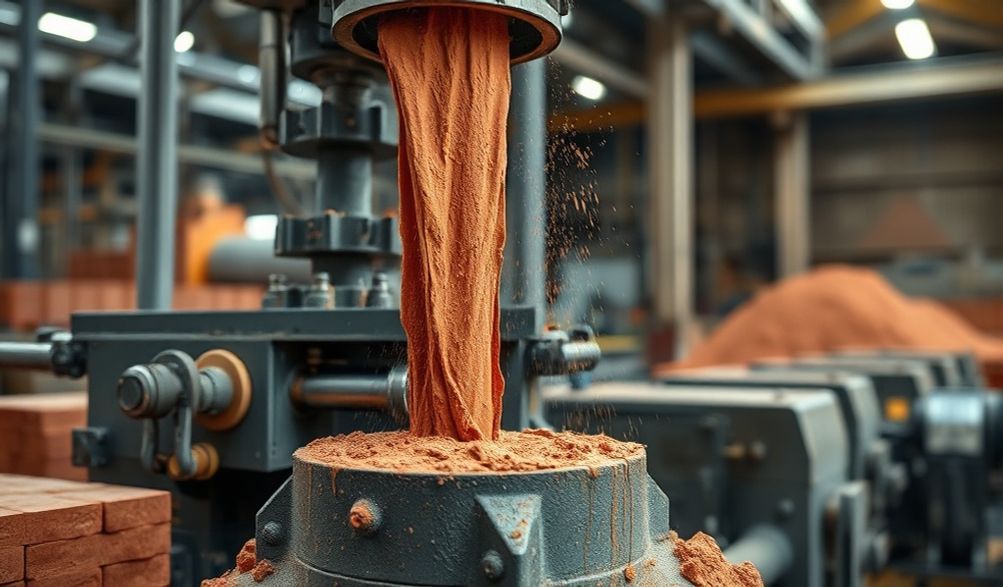
Aqui é onde oclay brick machine performs its core function.
* The prepared clay is fed into the extrusion chamber.
* In a vacuum extruder, the clay enters a sealed chamber where air is extracted. This de-airing is crucial for increasing density and strength by up to 25%.
* The auger then forces the clay through the extrusion barrel and out through a precision-engineered die. The die’s shape defines the brick’s profile (solid, hollow, etc.).
Stage 3: Cutting and Setting
The continuous clay column exiting the die is now cut into individual bricks.
* Wire-Cut Systems: A frame with taut wires slices through the clay column at precise intervals. This can be a simple manual rack or a fully automatic synchronized cutter.
* The soft, “green” bricks are then carefully transferred onto dryer cars or setting racks by hand, robot, or automatic stacker, preparing them for the next critical phase.
Stage 4: Drying and Firing (Post-Machine Process)
While not part of the machine itself, these steps are vital and often integrated into a complete plant.
* Secagem: Green bricks contain 15-20% moisture. They must be slowly and evenly dried in chamber or tunnel dryers to prevent cracking. This can take 24-48 hours.
* Demissão: The dried bricks are then fired in a kiln (like a Tunnel Kiln or Hoffman Kiln) at temperatures between 900°C and 1200°C. This process vitrifies the clay, giving the brick its permanent strength, hardness, and color.
Key Components of a Quality Brick Making Machine
The durability and performance of your operation hinge on these critical parts.
The Extrusion Auger & Barrel: Design and Materials
- This is the highest-wear component. It must be made from high-chromium alloy steel for abrasion resistance.
- The helix design affects mixing efficiency and extrusion pressure. A worn auger will lead to poor quality and low output.
- Maintenance Tip: Regular inspection and timely hardfacing or replacement are non-negotiable for continuous production.
Hydraulic System & Power Unit
- In hydraulic press machines, this system provides the molding pressure. Its reliability is paramount.
- Look for robust pumps, valves, and cylinders from reputable brands. System pressure (measured in psi or bar) directly correlates to brick density.
- Energy-efficient systems can significantly reduce long-term operational costs.
Mold & Die Design: Determining Brick Shape and Size
- The die is the “cookie cutter” of the extrusion process. Precision machining ensures dimensional accuracy.
- Quality machines offer interchangeable dies to produce different brick profiles (solid, perforated, hollow block) from the same base equipment.
- Die liners should be wear-resistant to maintain tolerances over time.
Control System: From Manual Levers to PLC Automation
- Basic machines use manual levers and switches.
- Semi and fully automatic machines utilize PLC panels for controlling extrusion speed, cutter timing, and stacker sequences. A user-friendly PLC interface simplifies operation and troubleshooting.
Choosing the Right Clay Brick Machine: A Buyer’s Guide
Selecting equipment is a major decision. Here’s how to approach it like an expert.
Assessing Your Production Needs: Capacity & Output
Pergunte a si mesmo:
* What is my target output in bricks per hour or per day?
* Is this for a specific project or an ongoing business?
* What type of bricks does my local market demand (solid, hollow)?
* Industry Practice Shows: It’s often better to buy a machine with 20-30% more capacity than your initial need to allow for business growth.
Fonte de Energia e Custos Operacionais
- Elétrico: Clean, quiet, and efficient for fixed installations with reliable grid power.
- Diesel: Essential for sites without electricity. Higher fuel costs and maintenance.
- Híbrido: Offers flexibility. Consider the total cost of ownership, including power consumption, wear parts, and labor.
Machine Durability and After-Sales Support
This is the cornerstone of confiabilidade in your purchase.
* Qualidade de Construção: Inspect the frame thickness, weld quality, and component brands. A heavier machine is often more stable and durable.
* Manufacturer Reputation: Choose established companies with a proven track record.
* Disponibilidade de Peças de Reposição: Ensure critical spare parts (augers, dies, hydraulic seals) are readily available. Long lead times for parts can shut down your operation for weeks.
* Suporte Técnico: Does the manufacturer offer installation guidance, training, and troubleshooting support?
Safety Features and Ease of Maintenance
- Look for proper guarding on moving parts, emergency stop buttons, and lock-out/tag-out points.
- A machine designed for easy maintenance (with good access panels, grease points, and simple component removal) will save you time and money over its lifespan.
Maximizing Efficiency and Brick Quality
Owning the machine is just the start. Optimal operation is key.
Optimal Clay Preparation Techniques
- Ensure clay is properly weathered and free of impurities.
- Consistently monitor moisture content. Too wet leads to deformation; too dry causes cracking and extrusion strain.
- Use a pugmill for thorough, homogeneous mixing.
Routine Maintenance Checklist for Your Machine
Preventative care prevents catastrophic downtime.
* Diário: Grease all bearings, check oil levels, clean the machine, inspect wires on the cutter.
* Semanal: Check auger and liner for wear, inspect hydraulic hoses for leaks, tighten bolts and fasteners.
* Mensalmente: Perform a comprehensive inspection of electrical connections, calibrate sensors (on automatic machines), and test safety systems.
Troubleshooting Common Machine Issues
- Cracking Bricks: Usually caused by improper clay mix (too dry, uneven tempering) or too-rapid drying after extrusion.
- Poor Extrusion/Low Output: Often a sign of a worn auger/liner, incorrect die design, or overly stiff clay.
- Power Loss in Hydraulic System: Check for pump issues, valve blockages, or low hydraulic fluid.
FAQ Section
Q1: What is the average production capacity of a standard clay brick machine?
Capacity varies wildly. A small manual press might make 500-1000 bricks per day, a semi-automatic egg-layer 2000-5000 per day, and a fully automatic plant 15,000-40,000 bricks per 8-hour shift.
Q2: Can one machine produce different types and sizes of bricks?
Yes, but with limitations. The core extruder can produce different profiles by changing the extrusion die. However, significant changes in brick height or a switch from solid to hollow block may require adjustments to the cutter and handling systems.
Q3: What is the approximate investment required for a small-scale clay brick making unit?
For a basic semi-automatic setup (machine, mixer, simple dryer), investment can start from $15,000 to $50,000, excluding land and kiln infrastructure. Fully automatic plants begin at $100,000+.
Q4: How important is the “de-airing” or vacuum process in the extruder?
Critically important for quality building bricks. De-airing increases density, strength, and durability while reducing water absorption and improving frost resistance. It’s a key feature for producing bricks that meet modern construction standards.
Q5: What are the main differences between fly ash brick machines and traditional clay brick machines?
Fly ash bricks use a non-plastic mixture of fly ash, cement, and sand, compacted under high pressure in a hydraulic press. Traditional máquinas de tijolos de barro process plastic clay through an extruder. The raw materials, forming process, and curing (chemical vs. firing) are fundamentally different.
Q6: What kind of after-sales service should I expect from a reputable manufacturer?
Expect detailed installation manuals, operator training (on-site or at their facility), a comprehensive parts catalog, availability of critical spares, and access to technical support via phone or video call. A warranty on parts and workmanship is standard.
Conclusão
The journey from understanding the history of brick making to selecting the right clay brick machine is one of connecting timeless material science with modern engineering. We’ve explored how mechanization brings consistency, strength, and scale to this ancient craft, examined the machines that make it possible, and broken down the process into clear, actionable stages. The key to success lies in applying this foundational knowledge practically: by thoroughly assessing your needs, prioritizing machine durability and manufacturer support, and committing to diligent operation and maintenance. Clay brick machine making is more than just equipment; it’s a partnership between robust engineering and skilled operation, forming a sustainable, efficient, and profitable cornerstone for the future of construction. Use this guide as your starting point, consult with technical experts, and always insist on demonstrations from suppliers to make the most informed decision for your venture.
<