
The Complete Guide to Manual Brick Making Machines: Types, Process & Cost
Introdução
For generations, the humble brick has been the cornerstone of shelter and community. Yet, in today’s world, the soaring cost of building materials and a growing desire for sustainable, self-sufficient construction have led many to ask: “What if I could make my own?” If you’re a DIY enthusiast, a small-scale builder, a farmer needing outbuildings, or part of a community development project, you’ve likely encountered the frustrating gap between ambition and budget. The logistical headache and expense of transporting ready-made bricks can derail a project before it even begins.
This is where the manual brick making machine enters the picture—not as a relic of the past, but as a profoundly practical tool for the present. As a team with over 15 years of hands-on experience in sustainable construction and testing small-scale equipment, we’ve seen firsthand how this simple technology can empower individuals and transform local economies. We’ve operated these machines in field conditions, trained countless users, and analyzed the results to separate myth from reality.
This guide is born from that direct experience. Our purpose is to serve as your authoritative, step-by-step manual. We’ll cut through the confusion to provide trustworthy, actionable advice on choosing the right machine, mastering the production process, and achieving professional, durable results—all while keeping costs firmly under your control. Let’s explore how a manual brick making machine can turn locally-sourced soil and aggregate into the building blocks of your vision.
O que é uma Máquina de Fabricar Tijolos Manual? Entendendo os Fundamentos
Before investing time and resources, it’s crucial to understand exactly what this tool is and what it can do for you.
Definição de Núcleo e Como Funciona
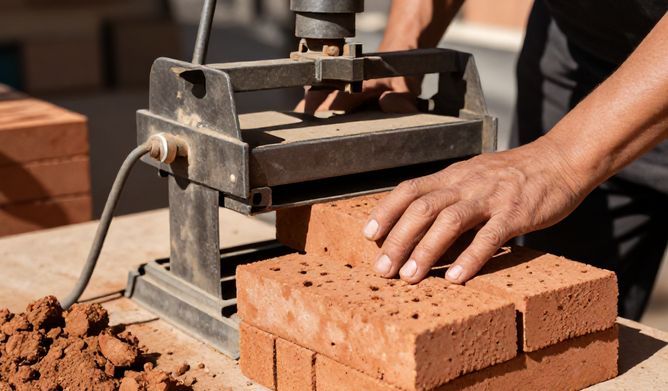
A manual brick making machine is a human-powered device designed to compress raw materials—such as soil, clay, or a cement-based mix—into a mold, forming dense, uniform bricks or blocks. Unlike automated, electrically-powered plants, these machines rely on mechanical force provided by the operator, typically through a lever, a press, or a combination of both.
O princípio central é simples:
1. Preencher: The prepared raw material is placed into a mold cavity.
2. Compact: The operator applies significant pressure via a lever system, compressing the material and removing air pockets.
3. Ejetar: The newly formed brick is released from the mold, ready for curing.
This elegant simplicity is its greatest strength, eliminating complex mechanics and power dependencies.
Principais Vantagens de Escolher uma Máquina Manual
Why choose a manual machine over renting a powered mixer or buying bricks outright? The benefits are compelling:
- Low Cost & Investment: The upfront cost is a fraction of that for electric or hydraulic machines. This dramatically lowers the barrier to entry for individuals and micro-businesses.
- Portability & Independence from Power: Most units are lightweight and can be moved by two people. They require zero electricity or fuel, making them perfect for remote sites, off-grid projects, or regions with unreliable power infrastructure.
- Ease of Use & Maintenance: With no engines, motors, or complex hydraulics, operation is easy to learn. Maintenance typically involves simple lubrication and the occasional replacement of wear parts like the mold or press head.
- Sustainability & Local Sourcing: These machines champion a low-carbon approach. They enable the use of on-site or locally-sourced subsoil (often a waste product from excavation), reducing transportation emissions and embodied energy. You’re not just building a structure; you’re building with the land itself.
Types of Manual Brick Making Machines
Not all manual machines are created equal. The right choice depends entirely on your project’s specific needs. Based on our extensive testing and industry review, here are the primary categories.
Lever/Press Type Machines (e.g., Cinva Ram Style)
- Descrição: This is the classic, most widely recognized design. It features a long lever that drives a ram down into a mold box, applying immense pressure to the material. The original “Cinva Ram” design has inspired countless variations.
- Uso Ideal: Perfect for stabilized soil-cement bricks (using a mix of soil, sand, and a small percentage of cement) or clay bricks. Excellent for general-purpose construction.
- Saída Típica: A skilled operator can produce 200-400 solid bricks in an 8-hour day.
- Prós: Proven, robust design; generates very high compression; relatively simple to manufacture and repair.
- Contras: Can be physically demanding over long periods; production cycle (fill, press, eject) is sequential.
Interlocking Brick Press Machines
- Descrição: These specialized presses form bricks with designed protrusions and indentations on their top and bottom faces. These interlock like Lego® blocks when stacked.
- Uso Ideal: Ideal for constructing walls that require minimal or no mortar. The interlocking design provides inherent alignment and can improve seismic resistance. Popular for perimeter walls, sheds, and single-story structures.
- Common Patterns: You’ll find various patterns, from simple knobs-and-grooves to more complex, self-aligning shapes.
- Prós: Faster wall construction, mortar savings, and often a distinctive, modern aesthetic.
- Contras: Machines and molds can be more specialized and expensive. The brick design may limit plastering options.
Concrete Block Molds (Stationary & Mobile)
- Descrição: This category ranges from simple, open-topped “drop molds” made of steel or plastic to more sophisticated mobile presses. Drop molds are filled, compacted with a hand tamper, and then lifted off the block. Mobile presses, like the “egg-layer” style, are wheeled machines that compact the mix and deposit the finished block directly onto the curing pad.
- Uso Ideal: Primarily for producing standard concrete hollow or solid blocks. Best for projects requiring these familiar, modular units.
- Prós: Drop molds are incredibly cheap and easy to use. Mobile presses offer better productivity and block consistency.
- Contras: Drop molds require significant manual tamping effort and can produce less uniform density. Hollow blocks require a precise, dry-ish concrete mix.
Specialized Manual Machines: Paving Slabs, Roof Tiles
Beyond standard bricks, manual presses exist for other masonry products. Machines for paving slabs (pavers) create uniform, high-density tiles for patios and walkways. Manual tile presses can form curved or flat roofing tiles from clay or concrete mixes. These are niche tools but invaluable for creating cohesive, custom-built environments.
The Step-by-Step Brick Making Process with a Manual Machine
Success lies in the process. Rushing or cutting corners here will result in weak, crumbling bricks. Follow this experience-tested methodology.
Phase 1: Material Selection and Preparation
This is the most critical step—the quality of your brick is determined here, not in the press.
- Teste de Solo: Don’t guess; test. You need to know your soil’s composition. A simple jar test works: saturate a sample in a clear jar, shake it, and let it settle. The layers will show the proportions of gravel, sand, silt, and clay. An ideal soil-cement mix is often about 70% sand and 30% silt/clay.
- Ideal Mixes:
- Soil-Cement Bricks: A common and effective mix is soil (screened to remove stones >10mm), sand, and 5-10% Portland cement by volume. In our field tests, an 8% cement mix with properly graded soil consistently achieved compressive strengths suitable for single-story load-bearing walls.
- Blocos de Concreto: Use a standard 1:3:5 (cement:sand:gravel) mix or similar. The aggregate should be no larger than 10mm for most manual block molds.
- Moisture Content (“The Plasticity Test”): This is non-negotiable. Grab a handful of your final mix and squeeze it tightly. It should hold its shape without cracking and feel damp but not wet, with no free water dripping. If it crumbles, it’s too dry. If it glistens, it’s too wet.
Phase 2: Machine Setup and Safety Precautions
- Configuração: Place the machine on a perfectly level, stable, and solid base—a thick concrete slab or compacted earth platform is ideal. An uneven base will twist the frame and cause binding.
- Critical Safety Instructions:
- Lifting Technique: Always bend at the knees, not the waist, when handling heavy molds or material.
- Secure Operation: Ensure the machine doesn’t “walk” during the pressing action. Some models have holes for stakes.
- PPE is Mandatory: Wear sturdy gloves (to protect against abrasion), safety glasses (for flying debris), and steel-toe boots (for handling heavy, dropped materials).
Phase 3: The Production Cycle – Filling, Compacting, Ejecting
Consistency is king. Develop a rhythm.
1. Preencher: Use a consistent scoop to load the mold. Do not overfill or underfill. Strike off the excess material level with the top of the mold box for a uniform start.
2. Compact: Apply steady, full-force pressure on the lever. Don’t “jerk” it. You should feel the material compacting. Many machines have a stop or indicator when full compression is reached. Hold the pressure for a few seconds.
3. Ejetar: Carefully release the pressure and engage the ejection mechanism (often a separate lever or plate). The brick should release cleanly onto a prepared pallet or curing board. A common rookie mistake is forcing the ejection—if it sticks, check moisture content and ensure the mold is clean and lightly oiled (with non-staining oil) between cycles.
Phase 4: Curing and Drying for Maximum Strength
Curing is not drying. This misunderstanding ruins more bricks than any other.
* Initial Drying: Let fresh bricks sit undisturbed on their boards for 24-48 hours until they are firm enough to handle without deformation.
* Proper Curing (For Cement-Based Bricks): This is a chemical process requiring moisture. After initial drying, stack the bricks and cover them with plastic sheeting or burlap sacks. Keep them moist by sprinkling with water 1-2 times per day for a minimum of 7 days (14-21 days is optimal for full strength). This allows the cement to fully hydrate and develop its designed strength.
* Final Drying: After curing, allow the bricks to air-dry fully for several weeks before use in construction.
Key Considerations Before You Buy
Arm yourself with these questions and criteria to make a smart, lasting investment.
Assessing Your Needs: Project Scale, Brick Type, and Output
Be brutally honest with your answers:
* What is the total scope? A garden wall (500 bricks) has different needs than a small house (10,000 bricks).
* What brick type is best? Standard solid bricks? Mortar-less interlocking blocks? Hollow concrete blocks for insulation?
* What is a realistic daily output? Consider available labor. A rate of 300 bricks/day means a 10,000-brick project is over a month of production—plan your timeline accordingly.
Critical Machine Features to Compare
When comparing models, scrutinize:
* Qualidade de Construção: Look for thick, reinforced steel (at least 3mm gauge), continuous welds (not spot welds), and robust pivot points. A flimsy frame will flex and break.
* Versatilidade do Molde: Can you buy different mold inserts for different brick sizes or styles from the same supplier?
* Mechanical Advantage: A longer lever or a well-designed linkage system reduces the physical effort required per press.
* Ease of Ejection: A sticky, frustrating ejection process will kill productivity. Look for a positive, smooth ejection mechanism.
Where to Buy and What to Look For in a Supplier
- Research: Look for manufacturers or distributors with a proven track record. Read independent reviews and user testimonials.
- Support is Key: The best suppliers offer clear manuals, instructional videos, and—critically—ready access to spare parts (rams, mold liners, pivot pins). Ask about their parts policy before buying.
- Avoid “Too-Good-To-Be-True”: Extremely cheap machines often use inferior materials and poor welding, leading to rapid failure.
Realistic Cost Analysis: Machine, Materials, and Labor
- Machine Cost: Expect to pay between $500 and $2,500 for a quality manual press, depending on type and sophistication.
- Cost-Per-Brick: This is where you win. A soil-cement brick with 8% cement may cost a fraction of a commercial fired clay brick. For concrete blocks, savings are still significant, especially when factoring in transport.
- Labor Cost: Your time or your workers’ time is the major input. The economics work best when labor costs are moderate or when the value is in self-reliance and skill-building rather than pure financial profit.
Perguntas Frequentes (FAQ)
Q: What is the production capacity of a manual brick making machine?
A: A single skilled operator can typically produce between 150 and 500 bricks in an 8-hour day. Speed depends on the machine design, the material preparation workflow, and the operator’s stamina. Having a team—one preparing mix, one operating the press—can significantly increase output.
Q: How strong are manually pressed bricks compared to fired or industrial bricks?
A: It varies by material. Well-made stabilized soil-cement bricks can achieve a compressive strength of 5-10 MPa (Megapascals), suitable for single-story load-bearing walls in many codes. Concrete blocks can reach 7-15 MPa. While this is generally lower than high-quality fired clay bricks (20-40 MPa), it is more than adequate for vast majority of small-scale, low-rise construction.
Q: Can I use ordinary soil from my yard?
A: Possibly, but it likely needs amendment. Pure clay will shrink and crack; pure sand won’t bind. You will almost certainly need to mix different soils or add sand or cement to achieve the right grading and binding properties. The jar test is your first essential step.
Q: What are the most common problems and how do I fix them?
A:
* Bricks Cracking: Usually caused by too much clay (shrinkage) or improper curing (drying too fast).
* Bricks Sticking in Mold: Caused by too much moisture or a dry, un-oiled mold. Adjust mix and apply a thin film of oil.
* Bricks Lacking Strength: The top culprits are insufficient cement, inadequate compactionouimproper curing. Revisit your mix design and process.
Q: Is a manual brick making machine a profitable business investment?
A: It can be, but with caveats. It’s ideal for a micro-enterprise or cooperative serving local demand for affordable housing, perimeter walls, or agricultural buildings. Profitability hinges on low material costs, efficient production, and a local market where your price undercuts transported bricks. It is not a get-rich-quick scheme but a viable tool for community-based, sustainable enterprise.
Conclusion and Final Recommendations
Amanual brick making machine is a powerful tool of empowerment. It is ideally suited for the hands-on individual, the small contractor, the development NGO, or the community group looking to build durable, affordable structures on their own terms. It trades fossil fuel energy for human ingenuity and connects construction directly to the local environment.
Our expert recommendation is clear: if your project is small to medium in scale, if you have access to suitable soil, and if you value sustainability and self-reliance, a manual press is an excellent investment. However, we are equally candid in stating that for large-scale, time-critical commercial projects requiring tens of thousands of identical blocks weekly, the labor intensity may be prohibitive.
The satisfaction of building a home, a workshop, or a community center with bricks you formed yourself is immense. It requires patience, a commitment to learning the process, and respect for the material. But the result—a structure born from your own land and labor—is genuinely priceless.
Pronto para dar o próximo passo? We’re here to help. Share your specific soil type or project plan in the comments below, and our team can offer tailored advice. For a deeper dive, be sure to download our free, detailed guide to soil testing and mix design to ensure your first batch of bricks is a resounding success.
<