
O Guia Definitivo para Máquinas de Bloco por Vibração de Moldes: Eficiência, Tipos e Seleção
Introdução
No mundo da construção e fabricação de blocos, um desafio se destaca consistentemente acima dos demais: como produzir de forma confiável blocos de concreto que sejam densos, duráveis e dimensionalmente perfeitos. A qualidade inconsistente leva a falhas estruturais, atrasos nos projetos e erosão das margens de lucro. A solução projetada para esse problema universal é amáquina de blocos por vibração de moldeEste equipamento sofisticado aplica vibração precisamente controlada para compactar a mistura de concreto dentro de um molde, expelindo forçosamente os vazios de ar e criando um produto de excepcional integridade estrutural.
Este guia não é apenas uma coleção de especificações. É um recurso abrangente, destilado de anos de aplicação em engenharia mecânica e experiência prática em fábricas de produção de blocos. Seja você um empresário que busca escalar a produção, um gerente de fábrica que visa aumentar a qualidade ou um especialista em compras encarregado de um grande investimento, as percepções aqui apresentadas foram elaboradas para ajudá-lo a tomar uma decisão que aprimore tanto seu produto quanto sua lucratividade. Iremos além do catálogo para explicar ospor quee ocomogarantindo que seu investimento seja informado, estratégico e bem-sucedido.
O que é uma Máquina de Bloco de Vibração de Molde? Princípios Fundamentais Explicados
Em sua essência, uma máquina de vibração para moldes é um dispositivo projetado para consolidar concreto fresco em um formato específico usando vibração mecânica controlada. Ela transforma uma mistura solta e granular em um bloco homogêneo e de alta densidade, pronto para a cura. Compreender os princípios por trás de seu funcionamento é fundamental para apreciar seu valor.
A Ciência da Compactação por Vibração
A eficácia dessas máquinas depende da física fundamental. Eis o que acontece dentro do molde:
- Rearranjo de Partículas:A máquina gera forças oscilantes que se propagam através da massa de concreto. Essas forças reduzem o atrito interno entre as partículas de cimento, areia e agregados.
- Redução do Vazio:À medida que o atrito diminui, as partículas se movem com mais liberdade, deslizando umas sobre as outras para se acomodar em um arranjo de empacotamento mais compacto e eficiente. Esse processo expulsa o ar aprisionado e o excesso de água para a superfície.
- Parâmetros-Chave:A qualidade da compactação é governada por dois fatores:
- Frequência (Hertz):A velocidade da vibração. A frequência ideal para concreto está tipicamente na faixa de 3000 a 6000 vibrações por minuto (50-100 Hz), garantindo uma consolidação completa.
- Amplitude:A "distância" do movimento de vibração. Uma amplitude maior fornece uma força maior, necessária para misturas mais rígidas com agregados maiores.
Em nossos testes de campo, alcançar o equilíbrio correto entre frequência e amplitude para uma determinada formulação de concreto é o fator mais crítico para a densidade perfeita do bloco.
Componentes Principais e Suas Funções
Cada máquina de vibração para moldes é construída em torno de vários componentes essenciais, cada um desempenhando um papel vital:
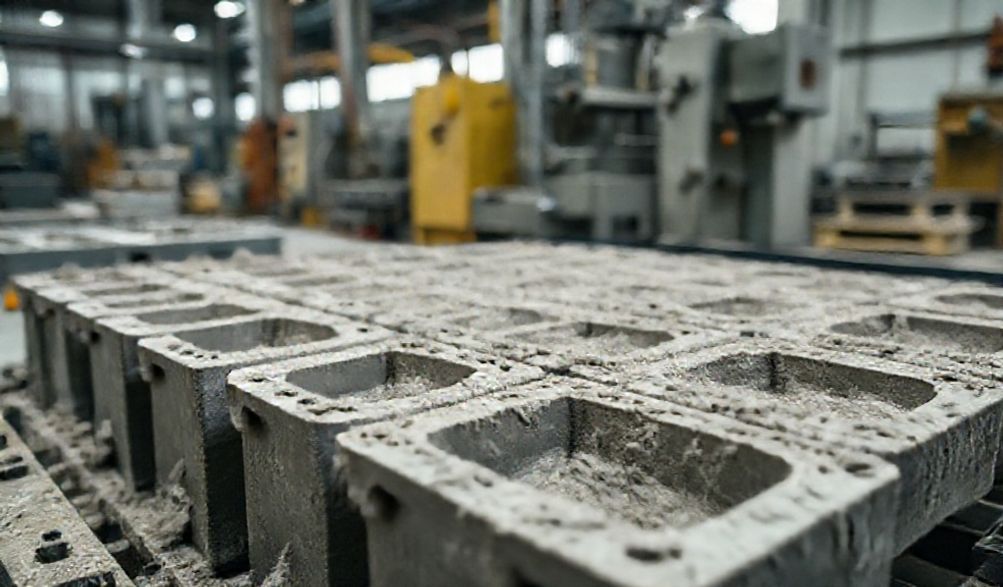
- Caixa de Molde:O coração da máquina. Esta é uma cavidade de aço temperado soldada com precisão que define a forma do bloco (oco, sólido, pavimentador, etc.). Sua rigidez evita deformações durante a vibração de alta pressão.
- Mecanismo de Vibração:O sistema que gera a força de compactação. Normalmente, é um motor elétrico com pesos excêntricos acoplados ao seu eixo. Quando o motor gira, os pesos descentralizados criam uma força centrífuga, que se traduz em uma vibração potente e direcional.
- Mesa/Plataforma de Compactação:A superfície robusta sobre a qual o molde é montado. Ela transmite a vibração uniformemente por toda a área do molde, garantindo densidade consistente em cada cavidade do bloco.
- Sistema de Controle:Varia de simples partidas manuais a painéis avançados de CLP (Controlador Lógico Programável). Ele controla a duração da vibração, a sequência e, nos modelos automáticos, todo o ciclo de produção.
- Estrutura e Estrutura: The heavy-duty steel frame that must withstand constant dynamic loads without flexing, ensuring long-term alignment and operational stability.
Outcome: Superior Block Quality
This precise engineering translates directly into tangible, superior product benefits:
- Maior Resistência à Compressão: Reduced voids mean a denser matrix, dramatically increasing the block’s load-bearing capacity, often exceeding standards like ASTM C90 with ease.
- Excellent Dimensional Accuracy: Precise moulds and uniform compaction produce blocks with consistent length, height, and width, simplifying bricklaying and reducing mortar use.
- Smoother Surface Finish: Effective compaction brings a fine paste of cement to the surface, resulting in a closed, aesthetically pleasing finish that is highly desirable in the market.
- Tempo de Cura Reduzido: A denser block with lower water content gains strength faster, allowing for earlier handling and shipping, which accelerates inventory turnover.
Types of Mould Vibration Block Machines: Choosing the Right Technology
The term “mould vibration block machine” encompasses a range of technologies. Selecting the right type is your first major decision, dictated by your production goals, budget, and operational scale.
Máquinas Estacionárias para Fabricação de Blocos
In these systems, the mould vibrates in a fixed position.
* Como Funciona: Concrete is fed into the stationary mould, compacted via vibration, and then the finished block is lifted and transferred onto a pallet or curing rack, often by a mechanical stripper head.
* Melhor Para: High-volume, factory-style production environments.
* Característica Principal: They are typically integrated with pallet conveyors and stackers, enabling fully automated production lines with outputs reaching thousands of blocks per shift.
Mobile Block Making Machines (Egg-Layers)
These are self-contained units that move along a flat concrete slab.
* Como Funciona: The machine travels forward, fills and vibrates its mould, then lifts to “lay” the freshly made blocks directly onto the casting surface before moving to the next position—hence the “egg-layer” name.
* Melhor Para: On-site production, smaller businesses, or regions with lower labor costs. They require a lower initial investment and less infrastructure.
* Consideração: Production is generally lower than stationary lines, and blocks must cure in place before being collected.
Manual, Semi-Automatic, and Fully Automatic Systems
This categorization refers to the level of human intervention required.
- Manual: All actions—filling the mould, starting vibration, demoulding—are performed by an operator. Lowest cost, lowest output (e.g., 300-500 blocks per 8-hour shift).
- Semiautomático: The core compaction cycle (vibration and demoulding) is powered and controlled via a panel, but an operator may feed mix or remove finished blocks. Offers an excellent balance of productivity and affordability for growing businesses.
- Totalmente Automático: The entire process from raw material feeding to block stacking is automated via PLC controls. Maximizes output (e.g., 2000+ blocks per hour) and consistency while minimizing labor, but represents the highest capital investment.
Specialized Moulds for Different Products
Versatility is a major advantage. By changing the mould box, a single machine can produce a diverse product line:
* Blocos Vazados (várias espessuras)
* Blocos de Concreto Maciço
* Lajes de Pavimentação e Pavers Intertravados
* Curbstones and Landscape Edging
* Special Shapes for Architectural Features
This flexibility allows manufacturers to adapt to market demands without investing in entirely new machines.
Critical Advantages of Using a Professional Vibration Block Machine
Investing in professional-grade equipment is a strategic business decision backed by clear, quantifiable returns.
Unmatched Product Quality and Consistency
Manual tamping or inferior equipment leads to variable density. A professional vibration machine delivers repeatable precision. Every block in every batch meets the same high standard, allowing you to confidently certify your products and build a reputation for reliability that commands premium pricing.
Dramatic Increase in Production Efficiency
Compare outputs:
* Trabalho Manual: A highly skilled worker might produce 100-150 high-quality blocks in a day.
* Máquina Semiautomática: The same worker operating a machine can produce 800-1500 blocks in an 8-hour shift.
This 10x increase in throughput allows you to take on larger contracts and grow your business without a linear increase in labor costs.
Significant Reduction in Material Waste
Optimal compaction means fewer defective blocks. You eliminate breakage from weak corners and reduce the number of blocks that fail to meet strength specs. This direct saving on cement, aggregates, and water directly improves your material cost margin.
Long-Term Operational Cost Savings
While the upfront cost is higher than rudimentary methods, the total cost of ownership is lower. Savings are realized through:
* Reduced direct labor costs per block.
* Lower material waste.
* Less rework and fewer customer rejections.
* The ability to sell a higher-quality product at a better price point.
How to Select the Best Machine for Your Operation: A Buyer’s Checklist
Navigating the market requires a methodical approach. Use this checklist to evaluate your options.
Assess Your Production Requirements
Begin with an honest internal audit:
* Resultado Diário/Semanal: How many blocks do you need to produce? Build in 20-30% growth capacity.
* Product Mix: What percentage will be hollow blocks, pavers, etc.? Ensure the machine can handle your required mould sizes.
* Espaço Disponível: Do you have a large shed for a stationary line with pallet circulation, or only a casting yard for an egg-layer?
* Labor Scenario: What is your access to skilled operators? This influences the choice between manual and automatic systems.
Evaluate Machine Specifications
Compare these hard numbers across suppliers:
* Vibration Force/Frequency: Measured in kN or Hz. More force is needed for thicker blocks and stiffer mixes.
* Potência do Motor: Indicates overall machine capability and durability.
* Tempo de Ciclo: How many seconds to produce one mould of blocks? Faster cycles mean higher output.
* Mould Size & Cavities: A 4-cavity mould for standard blocks produces 4 blocks per cycle.
* Requisitos de Energia: Voltage (e.g., 380V/3-phase) and total connected load.
Prioritize Build Quality and Durability
Look beyond the paint. Inspect:
* Construção da Estrutura: Is it made from heavy-duty channel/box section steel, fully welded?
* Vibrator Quality: Are they branded, industrial-grade vibrator motors with sealed bearings?
* Mould Steel: Is it high-carbon, abrasion-resistant steel, precision-machined for easy release?
* Welding & Finish: Clean, continuous welds and anti-rust treatment indicate careful manufacturing.
Consider After-Sales Support and Service
This is a critical trust factor. Your relationship with the supplier begins after purchase.
* Garantia: What is covered and for how long (e.g., 12 months on parts)?
* Disponibilidade de Peças de Reposição: Are wear parts (mould liners, vibration mounts) readily available?
* Suporte Técnico: Is there a direct phone line or service team for troubleshooting?
* Instalação & Treinamento: Does the price include on-site commissioning and operator training?
A machine is a long-term asset. A reliable supplier is your partner in ensuring it remains productive for years.
Operational Best Practices and Maintenance
To protect your investment and ensure peak performance, adhere to these practical guidelines drawn from operational experience.
Optimal Concrete Mix Design
The machine can only compact what you feed it. The ideal mix is a “semi-dry” or “zero-slump” concrete.
* Proportions: A standard mix is 1 part cement, 3-6 parts aggregate (a blend of sand and 3/8″ stone), with just enough water for hydration.
* Critical Ratio:Awater-cement (w/c) ratio is paramount. In our experience, a w/c ratio between 0.40 and 0.45 typically yields the best balance of workability for feeding and final strength after compaction. Too much water reduces strength; too little prevents proper consolidation.
* Consistência: The mix should hold its shape when squeezed in your hand but crumble when poked.
Daily Startup and Shutdown Procedures
Startup:
1. Visually inspect the machine for loose parts or obstructions.
2. Check oil levels in any gearboxes.
3. Ensure the mould and table are clean.
4. Run the machine empty for 30 seconds to listen for unusual noises.
Shutdown:
1. Stop feeding material.
2. Run the last cycle to clear the mould.
3. Thoroughly clean all concrete residue from the mould, table, and feed hopper.Isso não é negociável.
4. Power down and lock out the main electrical disconnect.
Essential Routine Maintenance Schedule
- Diário: Clean machine, check and tighten key bolts/nuts, inspect for wear.
- Semanal: Lubricate all grease points (bearings, pivot points), inspect vibration motor mounts for cracks.
- Mensalmente: Check electrical connections for tightness, inspect hydraulic hoses (if applicable), measure wear on mould liners.
- Annually: Perform a comprehensive inspection, replace worn wear parts, and have a technician check motor currents and alignment.
Solução de Problemas Comuns
- Problem: Inconsistent Block Density.
- Cause: Uneven concrete feed, incorrect vibration time, or worn/damaged vibrators.
- Solution: Standardize feeding procedure, calibrate vibration timer, test/replace vibrators.
- Problem: Blocks Sticking in Mould.
- Cause: Worn or damaged mould liners, insufficient taper on mould walls, or a concrete mix that is too wet.
- Solution: Polish or replace mould liners, verify mix design (reduce w/c ratio).
- Problem: Excessive Machine Vibration or Noise.
- Cause: Loose mounting bolts, failed vibration isolation pads, or unbalanced eccentric weights.
- Solution: Tighten all foundation and frame bolts, replace isolation pads, have a technician check vibrator balance.
FAQ Section
Q: What is the typical production capacity of a semi-automatic mould vibration block machine?
A: Capacity varies by model and mould configuration. A typical semi-automatic machine with a 4-cavity mould for standard blocks can produce between 800 and 2,000 blocks in an 8-hour shift, depending on cycle time and operator efficiency.
Q: Can one machine produce different block sizes and shapes?
A: Yes, absolutely. This is a key feature. By changing the mould box—a process that can often be done in under an hour—the same machine can produce hollow blocks, solid blocks, pavers, and curbstones. Always confirm compatibility with your machine supplier.
Q: How important is the vibration frequency, and can it be adjusted?
A: It is critically important, as it directly affects compaction quality. On many professional machines, the frequency is fixed at an optimal setting by the manufacturer. Some advanced models offer adjustable frequency controls to fine-tune performance for different mix designs or products.
Q: What is the expected lifespan of a well-maintained machine?
A: With proper operation, regular maintenance, and timely replacement of wear parts (like mould liners), a high-quality machine can have a productive lifespan of 10 to 20 years. The robust steel frame and motors will last for decades.
Q: Are there specific power requirements (electrical) for these machines?
A: Most industrial-grade machines require a 380-415 Volt, 3-phase, 50/60 Hz electrical supply. Smaller, manual models may run on standard single-phase power. Always verify the specific requirements before purchase and ensure your facility can support it.
Q: What safety precautions are essential when operating this equipment?
A: Always follow lock-out/tag-out procedures during maintenance. Operators should wear safety glasses, hearing protection (vibration can be loud), and steel-toe boots. Keep hands clear of moving parts like the mould and stripper head, and never attempt to clear a jam while the machine is powered on.
Conclusão
The mould vibration block machine is far more than a piece of factory equipment; it is the foundational technology for any concrete block manufacturer serious about quality, efficiency, and long-term profitability. It transforms raw materials into reliable, high-performance building components that form the backbone of modern construction.
Selecting the right machine is a strategic decision that hinges on two pillars: a clear, honest assessment of your own production needs and partnering with a trustworthy supplier who offers not just a machine, but expertise, robust engineering, and unwavering after-sales support. In an industry where product integrity is paramount, this technology is your most reliable partner. View it as the investment that will build the competitive and sustainable future of your business.
Ready to specify the right machine for your project? The next step is to request detailed specification sheets and a consultation with an engineering team that can translate your requirements into a concrete production solution.
<