
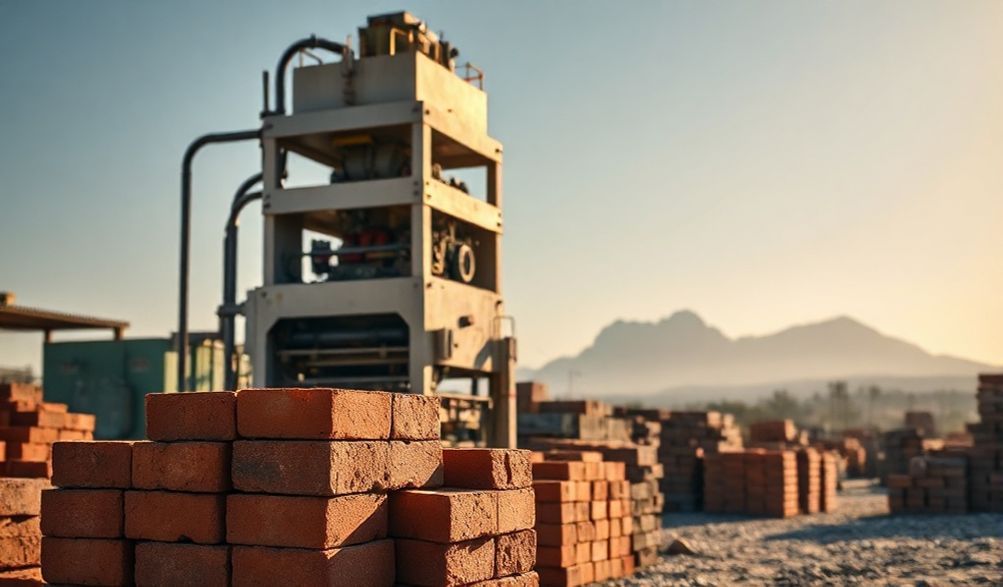
Your Complete Guide to Brick Making Machines in South Africa (2024)
Introdução
Picture this: you’re a contractor in Johannesburg, and your project timeline is slipping. The reason? Unreliable brick deliveries and soaring material costs are eating into your margins. Or perhaps you’re an entrepreneur in the Eastern Cape, seeing the constant demand for housing and infrastructure, and wondering how to build a tangible, profitable business from the ground up.
Across South Africa, from major urban developments to rural housing projects, bricks remain the fundamental building block of construction. Yet, the traditional supply chain is often fraught with delays, inconsistent quality, and high costs.
This is where the modern brick making machine steps in—not just as a piece of equipment, but as a strategic solution. It represents control, self-sufficiency, and a direct path to quality and profitability. For the savvy builder, contractor, or business owner, it can be the most important investment they ever make.
But navigating the market can be complex. How do you choose the right machine for South African conditions? What about load-shedding, local materials, and after-sales support?
Built on industry insights and practical knowledge, this definitive 2024 guide is designed to be your trusted resource. We’ll cut through the noise to explore the types of machines available, the critical factors for the local market, reputable suppliers, and the operational know-how you need to succeed. Let’s build a solid foundation for your decision.
Compreendendo as Máquinas de Fabricação de Tijolos: Tipos e Tecnologias
Before investing, it’s crucial to understand the different categories of machines. Your choice will fundamentally shape your production capacity, labor needs, and business model.
Máquinas Manuais para Fabricação de Tijolos
These are the simplest and most entry-level machines, relying entirely on human power for operation. A mixture is manually loaded into a mold, and then a lever is used to apply intense pressure to compact the brick before it is ejected.
- Ideal Para: Small-scale projects, DIY builders, community initiatives, or entrepreneurs starting with very low capital. They are perfect for producing bricks on-site for a single house or a small wall.
- Prós:
- Extremely low upfront cost.
- Zero operating costs (no power required).
- Simple to maintain and repair.
- Highly portable.
- Contras:
- Very labor-intensive and slow.
- Low daily output (typically 300-500 bricks).
- Brick consistency heavily depends on the operator’s skill and strength.
Máquinas Semi-Automáticas para Fabricação de Tijolos
This category offers a smart balance, automating the most strenuous parts of the process. Typically, an operator feeds the raw mix into a hopper, but the compression (via a mechanical or hydraulic system) and brick ejection are automated.
- Ideal Para: Small to medium-sized block yards, growing construction businesses, and entrepreneurs serious about commercial production. They offer a significant upgrade from manual machines without the full cost of automation.
- Prós:
- Greatly increased production output (1,000 – 3,000 bricks per day).
- More consistent brick quality due to uniform pressure.
- Reduced physical strain on operators.
- Good balance between investment and return.
- Contras:
- Requires a power source (usually single-phase electricity).
- Custo inicial mais alto do que máquinas manuais.
- More complex maintenance than manual types.
Máquinas de Fabricação de Tijolos Totalmente Automáticas
These are the powerhouses of brick production. From feeding raw material and mixing to compaction, ejection, and even stacking, the process is fully mechanized and often controlled by a Programmable Logic Controller (PLC).
- Ideal Para: Large-scale commercial operations, established block manufacturers supplying major contractors, and industrial projects requiring vast, consistent brick quantities.
- Prós:
- Very high-volume output (5,000 – 20,000+ bricks per day).
- Consistência e controle de qualidade excepcionais.
- Drastically reduced direct labor costs.
- Maximum efficiency and production speed.
- Contras:
- Alto investimento de capital.
- Requires reliable three-phase electricity and significant space.
- Complex maintenance requiring specialized technical knowledge.
- Higher running costs (power, wear parts).
Máquinas Móveis de Fabricação de Tijolos
Built on a trailer or a truck bed, these machines bring the factory to the site. They can be manual, semi-, or fully-automatic, but their key feature is mobility.
- Ideal Para: Large remote construction sites (like mining camps or rural developments), disaster relief housing projects, and businesses that want to produce directly where the bricks are needed, eliminating heavy transport costs for finished products.
- The SA Context: In a country with vast distances and sometimes challenging infrastructure, mobile machines solve a critical logistics problem. Producing bricks on-site can slash project costs and delays.
Key Considerations When Choosing a Machine in South Africa
Your success depends on more than just picking a machine type. Local conditions demand specific considerations.
Avaliando Suas Necessidades e Escala de Produção
Start by asking the right questions:
* What is my actual brick requirement? Is it for a one-off project (calculate total bricks needed) or for an ongoing business (estimate daily/weekly demand)?
* What is my growth plan? Are you planning to stay small or scale up? Buying a machine with slightly more capacity than you currently need can be a wise move.
* What is my labor situation? How many reliable operators do I have or can I hire?
Matching your answers to the machine types above is the first step to a sound investment. Don’t over-capitalize on a giant machine for a small need, and don’t stifle your business with a machine that can’t keep up with demand.
Raw Material Compatibility (A Critical Factor for SA)
This is where local expertise is non-negotiable. Not all machines work well with all soils.
- Soil is Key: The quality and composition of your locally available soil (or crusher dust) are paramount. A good supplier should ask for a sample or guide you on testing.
- Versatility Matters: Look for machines that can handle a range of mix designs—from soil-cement to fly ash blends (where available from power stations). The ability to adjust compression and moisture settings is crucial.
- Cement Ratio: Understand the standard cement ratios for durable bricks in your region. A machine must be able to properly mix and compact these ratios to produce a strong, SABS-compliant product.
Power Supply & Operational Environment
South Africa’s energy landscape requires a practical strategy.
- Load-Shedding Plans: For semi- and fully-automatic machines, a backup generator is not a luxury—it’s a business continuity essential. Factor this into your total cost.
- 3-Phase vs. Single-Phase: Know your available power. Most high-output automatic machines require a stable 3-phase connection. Verify this with your local municipality.
- Workshop Setup: Ensure you have a level, solid concrete floor, adequate space for raw material storage, brick curing, and safe operation. Good drainage for wash-down water is also important.
Budget: Total Cost of Ownership
Vá além do preço inicial. O custo real inclui:
- Delivery & Installation: Transport costs within South Africa can be significant, especially for heavy machinery.
- Moldes: The machine alone doesn’t make bricks; molds do. Each brick type (stock brick, maxi, paving, interlocking) requires its own mold set. This is a major additional cost.
- Training & Support: Does the price include proper training for your operators?
- Peças de Reposição: Inquire about the cost and local availability of common wear parts like liners, springs, and hydraulic seals. Downtime is lost money.
- Preventative Maintenance: Budget for regular service costs.
Frame your purchase as a Return on Investment (ROI) calculation: (Projected Revenue from Bricks) – (Material + Labor + Maintenance + Finance Costs) = Your Profit.
The South African Brick Machine Market: Suppliers and Support
Navigating the supplier landscape is critical to a successful purchase.
Overview of Local Manufacturers vs. International Importers
- Local Manufacturers: A significant advantage is their understanding of South African conditions—our soils, our power challenges, and our business environment. After-sales support, spare parts, and technician call-outs are typically faster and more straightforward.
- International Importers: They may offer access to globally recognized brands with advanced technology. However, be mindful of potential challenges: import duties, longer lead times for parts, and the possibility that support relies on international communication.
What to Look for in a Reliable Supplier
Use this checklist to vet potential suppliers:
- Physical Presence: Do they have a showroom, workshop, or office you can visit? This is a strong trust signal.
- Client References: Can they provide contact details for past customers, preferably with similar needs to yours, who you can speak to directly?
- Demonstration: A reputable supplier will insist on a live demonstration, either at their facility or (better yet) at an existing client’s site.
- Clear Warranty: What does the warranty cover, for how long, and what are the terms? Get it in writing.
- Training Offer: Comprehensive training should be a standard part of the package.
Red Flags: Suppliers with only a P.O. Box address, those who avoid giving references, those who pressure for a quick deposit, or those making unrealistic production or profit promises.
Importance of After-Sales Service and Parts Availability
The machine is just the beginning. The service relationship is what ensures your investment pays off for years.
- Downtime is Costly: When a critical part fails, you need it within days, not weeks or months. A supplier with a well-stocked local parts inventory is invaluable.
- Suporte Técnico: Is there a dedicated, knowledgeable technician you can call? Do they offer service contracts?
- Long-Term Partnership: Choose a supplier interested in your success, not just a once-off sale. They should be a resource you can rely on.
Operating Your Brick Making Machine for Success
Owning the machine is one thing; operating it profitably is another.
Essential Maintenance for Longevity
A simple, consistent routine prevents major breakdowns, especially in our dusty environment.
- Diário: Clean the machine thoroughly at the end of each shift. Check for loose bolts and nuts. Lubricate all moving parts as per the manual.
- Semanal: Inspect hydraulic hoses for leaks. Check the pressure settings. Clean the mixer blades and hopper thoroughly.
- Mensalmente: Perform a more detailed inspection of wear parts like mold liners and compression plates. Tighten all major structural bolts.
Optimizing Mix Design and Brick Quality
Consistent quality builds your reputation.
- Test Your Mix: Start with a standard mix (e.g., 1 part cement to 6 parts soil/crusher dust) and make test bricks. Adjust for strength and workability.
- Curing is Crucial: Bricks gain strength through proper curing. In South Africa’s varied climates:
- Water Curing: Keep bricks moist under a plastic sheet for at least 7 days. Ideal for most regions.
- Steam Curing: Used in some industrial settings for faster strength gain.
Safety Protocols for Operators
Safety cannot be compromised.
- PPE is Mandatory: Safety boots, gloves, eye protection, and dust masks must be worn at all times.
- Lock-Out/Tag-Out: Before any cleaning or maintenance, the machine must be powered off and locked in the “off” position to prevent accidental startup.
- Treinamento: Never allow untrained personnel to operate or clean the machine.
FAQ: Brick Making Machines in South Africa
Q: What is the average price range for a brick making machine in South Africa?
A: Prices vary dramatically. A basic manual machine can start from around R15,000. A quality semi-automatic machine may range from R80,000 to R250,000. Fully automatic, high-capacity plants can start from R500,000 and go into the millions. Always get a detailed, itemized quote.
Q: Can I get a loan or financing for a brick making machine in SA?
A: Yes, options exist. Some equipment suppliers offer in-house financing or partnerships with financial institutions. You can also explore SME funding from major banks, the National Empowerment Fund (NEF), or the Small Enterprise Finance Agency (sefa). A solid business plan will be required.
Q: How profitable is a brick making business in South Africa?
A: Profitability is not guaranteed; it depends on your business acumen. Key factors include your machine’s efficiency, your control over material costs, local market demand, your pricing strategy, and managing overheads. It is a viable and potentially lucrative business, but it requires hard work, good quality, and smart marketing.
Q: What are the most popular brick types made with these machines?
A: The most common are:
* Standard Stock Brick: For general wall construction.
* 6″ Maxi Block / 440x140x215mm Block: For faster, larger-scale building.
* Paving Bricks (Interlocking & Rectangular): For driveways, patios, and walkways.
* Interlocking Building Blocks: Designed to lock together without mortar, speeding up construction.
Q: Do I need special training to operate the machine?
A: Absolutely. Reputable suppliers must provide comprehensive training. This should cover safe operation, daily procedures, basic troubleshooting, routine maintenance, and brick mix preparation. Never operate a machine without proper training.
Conclusão
Choosing and operating a brick making machine in South Africa is a significant step, whether you’re aiming to secure your construction supply chain or launch a manufacturing business. We’ve explored the journey from understanding the core technologies—manual, semi-automatic, automatic, and mobile—to navigating the critical local considerations of material compatibility, power resilience, and total cost of ownership.
The South African market offers opportunities through both local manufacturers and importers, but your due diligence on supplier reliability and after-sales support is what will protect your investment. Remember, the machine is a powerful tool, but your success is built on informed selection, diligent maintenance, and an unwavering commitment to quality and safety.
This guide was created to empower you with trustworthy, practical information. Use it as your foundation. Your logical next step is to contact a shortlist of reputable suppliers, discuss your specific project or business plan in detail, and insist on seeing their machines in action. With the right knowledge and the right partner, you’re ready to build something solid.
<