
The Complete Guide to Automatic Hollow Block Machines in the Philippines (2026)
Introdução
The skyline of the Philippines is transforming. From the rapid rise of condominiums in Metro Manila to the sprawling subdivisions in emerging provinces, the nation’s construction industry is in the midst of an unprecedented boom. This growth, however, hinges on a critical, often overlooked foundation: the steady, reliable supply of high-quality concrete hollow blocks (CHB).
For entrepreneurs, contractors, and construction business owners, this demand presents a golden opportunity. Yet, the traditional methods of block production—reliant on manual labor and inconsistent semi-automatic machines—are struggling to keep pace. They are plagued by high labor costs, variable quality, and output limitations that can cripple project timelines and profitability.
This is where strategic technology investment becomes your greatest competitive edge. An máquina automática de blocos vazados is more than just a piece of equipment; it’s a transformative asset for your business. This comprehensive guide is designed to be your definitive resource. We’ll cut through the technical jargon, analyze the unique realities of the Philippine market, and provide the actionable insights you need to make a confident, informed investment that delivers lasting returns.
Understanding Automatic Hollow Block Machines
Before diving into investment decisions, it’s crucial to understand exactly what you’re considering. An automatic hollow block machine represents the pinnacle of efficiency in block manufacturing technology.
O que é uma Máquina Automática de Blocos Vazios?
At its core, an automatic hollow block machine is a fully integrated system designed to automate the entire process of producing concrete blocks, from raw material mixing to the final curing stage.
- Core Function: It automates the precise proportioning of raw materials (cement, sand, gravel), the mixing process, the high-pressure molding of the blocks, and their systematic transfer for curing.
- Diferenciador Principal: The level of human intervention. Unlike manual or semi-automatic machines that require constant operator attention for feeding, molding, and removal, an automatic system is controlled via a programmable logic controller (PLC). Operators primarily monitor the process, manage raw material input, and handle the stacked final product. This shift is what drives unparalleled consistency and output.
Componentes Principais e Como Funcionam
Understanding the machine’s anatomy demystifies its operation and highlights its engineering sophistication.
- Sistema de Loteamento e Mistura: A precise feeder delivers cement, sand, and aggregates into a pan or planetary mixer, ensuring a homogenous concrete mix every cycle.
- Sistema de Transportador: Transports the mixed concrete to the molding area without segregation of materials.
- Estação de Moldagem: The heart of the machine. A hydraulic system exerts immense, calibrated pressure (measured in tons) to compact the concrete into steel molds, forming blocks of precise dimensions and density.
- Alimentador de Paletes/Sistema de Circulação: Automatically feeds empty pallets (steel plates) into the mold and carries away the freshly pressed blocks.
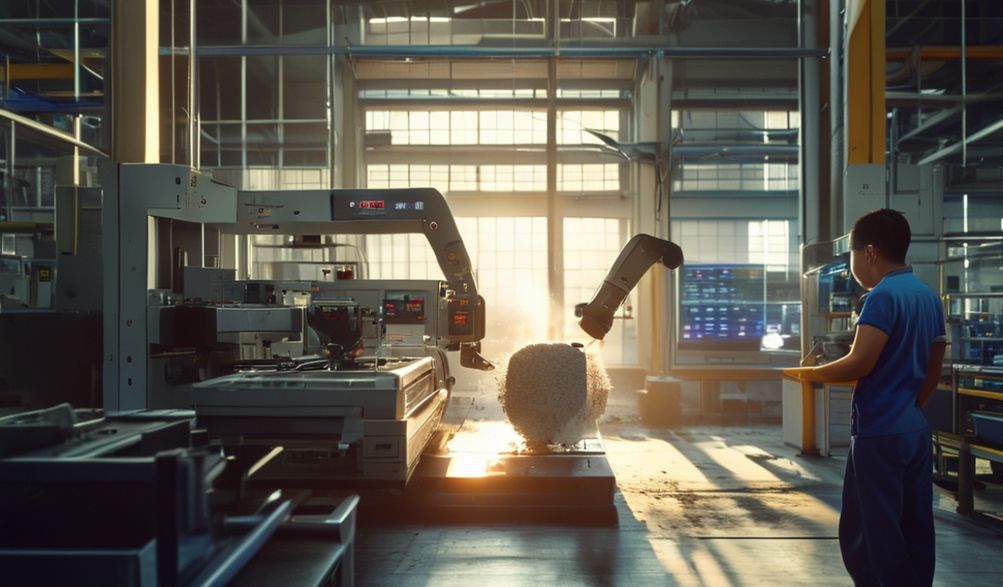
- Stacker/Robot Arm: Gently lifts the green (uncured) blocks from the pallet and stacks them onto curing carts, ready for the curing yard.
- Painel de Controle (PLC): The brain of the operation. Allows operators to set parameters, monitor production, and diagnose issues.
O Ciclo Automatizado: The process is a continuous, synchronized loop: Mix → Convey → Mold → Eject → Stack → Repeat. This cycle can produce a block every 10-30 seconds, depending on the model.
Tipos de Blocos Produzidos
A significant advantage of modern automatic machines is their versatility. With a simple mold change, a single machine can produce:
- Blocos Vazados Padrão: The industry workhorses: 4″, 5″, and 6″ thicknesses.
- Blocos Sólidos: For applications requiring higher load-bearing capacity or fill-in work.
- Blocos de Pavimentação & Blocos Intertravados: For landscaping, driveways, and modern construction techniques.
- Blocos Especializados: Such as curb stones or chimney blocks.
Crucially, a quality machine must produce blocks that comply with the Philippine National Standards (PNS) for concrete hollow blocks (PNS 156:2020). This ensures your products meet the structural requirements for both load-bearing and non-load-bearing walls, as mandated by the Department of Public Works and Highways (DPWH) and local building codes.
Why Invest in an Automatic Machine for Your Philippine Business?
The investment in automation is substantial, but the returns—especially in the context of the Philippine construction market—are compelling and multi-faceted.
Unmatched Efficiency & High Volume Output
The output gap between automation and traditional methods is staggering.
- Quantitative Leap: A semi-automatic machine might produce 400-800 blocks per 8-hour shift with a full crew. A standard automatic machine can produce 2,000 to 5,000 blocks in the same timeframe, with far fewer personnel.
- Escalabilidade do Projeto This capacity allows you to reliably supply large-scale projects like subdivision developments, commercial complexes, or government infrastructure projects without becoming a bottleneck. You can meet tight deadlines consistently.
Qualidade de Bloco Superior e Consistente
Automation removes human variability from the production equation.
- Every block receives the exact same amount of material, mixing time, and hydraulic pressure. This results in uniform dimensions, weight, and—most importantly—compressive strength.
- Integridade Estrutural: Consistent quality directly translates to safer, more reliable buildings. It minimizes the risk of weak points in masonry walls.
- Brand Reputation: Delivering batch-after-batch of perfect blocks builds an unbeatable reputation for reliability among contractors and engineers.
Economias de Custos Significativas a Longo Prazo
While the upfront cost is higher, the total cost of ownership tells a different story.
- Redução de Custos com Mão de Obra: An automatic system may require only 2-4 personnel (for feeding, monitoring, and stacking) versus the 8-12 needed for equivalent manual output. In a market with rising labor costs, this is a decisive advantage.
- Lower Operational Cost per Block: Higher output spreads fixed costs (machine depreciation, power, rent) over more units, reducing the cost per block.
- Estrutura de ROI: A proper business plan can show an ROI period of 18-36 months, after which the machine becomes a significant profit center. Reduced waste from rejected batches further improves margins.
Enhanced Worker Safety and Ease of Operation
- Redução do Esforço Físico: The machine handles the heaviest and most repetitive tasks—mixing, pressing, and transporting.
- Recursos de Segurança Modern machines include emergency stops, safety guards, and sensors to protect operators.
- Facilidade de Operação: With proper training from the supplier, operating the PLC control panel is manageable. The focus shifts from labor to skilled machine supervision and maintenance.
Critical Factors When Choosing a Machine in the Philippines
Selecting the right machine requires a clear assessment of your needs and the local environment. Here are the non-negotiable factors to consider.
Production Capacity & Your Business Scale
Don’t buy more machine than you need, but always plan for growth.
- Small Yard/Starter Business: A machine producing 1,500-2,500 blocks per 8-hour shift may suffice.
- Medium Enterprise/Expanding Contractor: Aim for 3,000-5,000 blocks per shift to supply multiple projects.
- Large Plant/Supplier: Look at high-capacity models producing 6,000+ blocks per shift, possibly with multiple production lines.
- Match to Demand: Analyze your current project pipeline and local market demand. It’s better to have slight excess capacity than to constantly run at maximum stress.
Power Requirements & Philippine Utility Considerations
Power is a critical and often overlooked practical concern.
- Electrical Specs: Most industrial automatic machines require a stable 3-phase power supply. Verify the voltage (typically 220V/380V or 440V) and ensure your site can support it.
- Opções de Combustível: Some models offer diesel-powered hydraulics, which can be a lifesaver in areas with frequent brownouts, but factor in the ongoing cost of diesel fuel.
- Power Stability: Voltage fluctuations can damage sensitive electronics (like the PLC). Invest in a proper voltage regulator or stabilizer. A backup generator is highly recommended for uninterrupted production.
Machine Durability & After-Sales Support
This is arguably the most important consideration for the Philippine market.
- Built for the Tropics: The machine must withstand high humidity, dust, and continuous operation. Look for robust frames, corrosion-resistant coatings, and high-quality hydraulic components.
- NON-NEGOTIABLE: Local After-Sales Support. A machine is useless if it breaks down and you wait months for a spare part from abroad. Prioritize suppliers with a proven service network in Luzon, Visayas, and Mindanao. Ask for their location and response time commitment.
- Warranty & Parts: Get a clear, written warranty (at least 1 year on critical parts). Inquire about the inventory of common wear parts (molds, seals, hydraulic hoses) kept locally in the Philippines.
Flexibilidade de Matérias-Primas
Your machine must work with what’s available locally.
- Ensure it can effectively mix and mold using a range of locally sourced aggregates—from river sand and crushed gravel to, potentially, fly ash (a cost-effective cement substitute).
- The control system should allow you to easily adjust mix ratios to optimize for strength requirements and material costs.
Budget & Total Cost of Ownership
Look beyond the sticker price.
- Custo Inicial: Automatic machines in the Philippines can range from ₱1.5 million to over ₱7 million, depending on capacity, brand, and automation level.
- Custos Ocultos: Always budget for:
- Shipping and handling to your site.
- Import duties and taxes (if the supplier is not a local distributor who has already absorbed these).
- Site preparation and concrete foundation.
- Installation and commissioning fees.
- Initial operator training.
Top Considerations for the Philippine Market & Supplier Selection
Your choice of supplier is as important as your choice of machine. Conduct thorough due diligence.
Navigating Local Suppliers vs. Direct Import
- Reputable Local Distributor (Recommended):
- Prós: Handles importation, provides local warranty, stocks spare parts, offers faster technical service, understands local regulations.
- Contras: May have a higher upfront price due to value-added services.
- Direct Import:
- Prós: Potentially lower initial equipment cost.
- Contras: High logistical complexity, hefty import duties and VAT, no local support, language/time zone barriers, massive risk if machine arrives damaged or faulty.
Compliance with Philippine Standards
Your supplier must understand and guarantee compliance.
- Explicitly ask: “Can this machine produce blocks that will pass PNS 156:2020eDPWH material standards?”
- Request to see test reports or certificates from previous clients who have had their blocks tested at DPWH-accredited labs.
Requesting a Live Demonstration or Site Visit
Never buy based on brochures or videos alone.
- Live Demo: Insist on seeing the exact model (or a very similar one) running under load at the supplier’s showroom or warehouse.
- Client Site Visit: Ask the supplier for references and, if possible, visit an existing customer’s block yard. Speak directly to the operator and owner about their experience, machine performance, and the supplier’s service responsiveness.
Key Questions to Ask Your Supplier
Come prepared with a checklist:
- What is the exact warranty coverage and duration?
- Where is your service center located, and what is your guaranteed response time?
- Do you keep a local inventory of common spare parts? Can I see a list and price list?
- Do you provide comprehensive operator and maintenance training? Is it on-site?
- What is the lead time from order to delivery and installation?
- Can you provide a detailed, all-inclusive quotation (machine, shipping, installation, foundation guide)?
- Can you connect me with 2-3 of your current clients in the Philippines?
Operational Setup and Best Practices
A successful investment depends on proper setup and care.
Site Preparation and Foundation
- Espaço: Allocate sufficient area for the machine, raw material storage, curing yard, and finished block storage. A covered, well-ventilated shed for the machine is ideal.
- Fundação: This is critical. The supplier must provide detailed foundation drawings. A proper reinforced concrete foundation absorbs vibration, ensures machine leveling, and prevents premature wear and misalignment.
Routine Maintenance for Longevity
Preventive maintenance is cheap compared to major repairs.
- Daily: Clean the machine, check hydraulic oil levels and for leaks, inspect molds for wear or concrete buildup.
- Weekly: Grease all bearings and pivot points, check electrical connections for tightness, inspect conveyor belts.
- Monthly: Change or clean hydraulic and oil filters, perform a more thorough inspection of wear parts.
- Climate Note: In high-humidity environments, pay extra attention to preventing rust on unpainted surfaces and ensure electrical panels are kept dry.
Optimizing Your Raw Material Mix
The best machine cannot compensate for a poor mix design.
- Standard Mix: A common starting point is a 1:6:4 ratio (1 part cement, 6 parts sand, 4 parts gravel). This must be adjusted based on your aggregate quality and target block strength.
- Controle de Qualidade: Perform simple on-site tests:
- Drop Test: A properly cured block should not break when dropped from waist height onto a solid surface.
- Absorção de Água: A good block should not absorb excessive water quickly.
- For official compliance, regularly send samples to a DPWH-accredited or private construction materials testing laboratory for compressive strength testing.
Perguntas Frequentes (FAQ)
Q1: What is the average price range for an automatic hollow block machine in the Philippines?
A: Prices vary widely based on capacity and brand. Entry-level models can start around ₱1.5 million, while full-scale, high-output plants can exceed ₱7 million. Always remember that the cheapest option often carries hidden costs in maintenance, downtime, and poor support. Focus on value and total cost of ownership.
Q2: How many workers are needed to operate an automatic machine?
A: A well-organized setup typically requires 2 to 4 workers: one to oversee the control panel and overall process, one or two to manage raw material feeding (cement, aggregates), and one to manage the stacking and movement of cured blocks. This is a drastic reduction from manual operations.
Q3: Can I use an automatic machine to start a hollow block business?
A: Absolutely. An automatic machine provides the efficient, high-quality production foundation a new business needs. However, success also requires a solid business plan, a clear understanding of your local market and competition, reliable raw material suppliers, and a strategy for sales and distribution.
Q4: How do I ensure the blocks pass DPWH or local engineering standards?
A: First, use the correct mix design with quality materials. Second, ensure proper curing (keeping the blocks moist for at least 7 days). Most importantly, you must have your blocks tested. Produce samples from your machine and submit them to a DPWH-accredited or reputable private construction materials testing laboratory for official compressive strength certification.
Q5: What is the typical lead time for receiving a machine after ordering?
A: This varies significantly. If the model is in local stock, delivery could take 2-4 weeks for site preparation and scheduling. If it needs to be imported, lead times can range from 8 to 16 weeks, accounting for manufacturing, sea freight, and customs clearance. Always get a written delivery timeline from your supplier.
Conclusão
Investing in an máquina automática de blocos vazados in the Philippines is more than a capital expenditure; it’s a strategic commitment to the future of your business and the nation’s built environment. It represents a shift from labor-intensive struggle to technology-driven growth, from inconsistent quality to market-leading reliability, and from limited capacity to scalable opportunity.
The path to a successful investment is built on diligent research and prudent decision-making. By prioritizing unwavering local after-sales support, guaranteed compliance with PNS standards, and a clear alignment between machine capacity and your business goals, you secure not just a machine, but a reliable partner in profitability for the next decade.
Take the next step with confidence. Engage with reputable suppliers, ask the hard questions, visit existing installations, and make the choice that will position you as a cornerstone of quality and efficiency in the Philippine construction industry.
Aviso Legal: This guide is for informational purposes based on industry expertise. Specifications, prices, and standards are subject to change. Always conduct your own due diligence and consult with technical and financial advisors before making a capital investment.
<