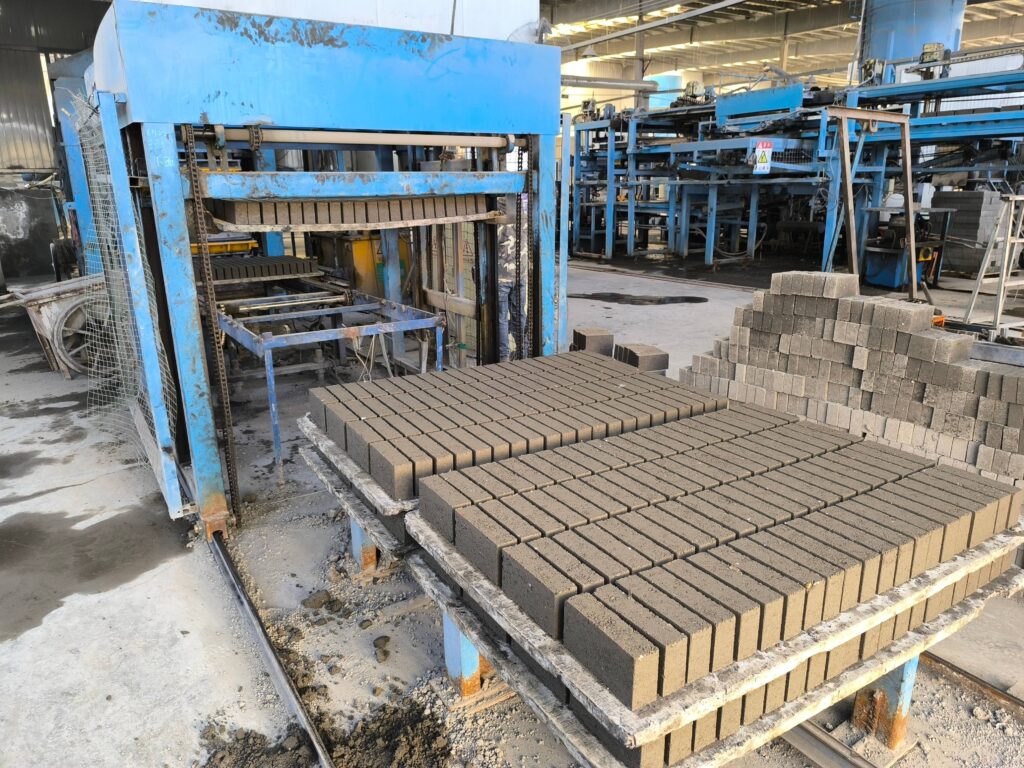
Unmatched Logistical and Supply Chain Efficiency
Large projects are often crippled by logistical delays and material shortages. Integrated block production fundamentally re-engineers this vulnerability.
- Elimination of Transport Dependency and Cost: Transporting millions of heavy blocks from a distant plant incurs enormous cost, fuel consumption, and scheduling risk. On-site production converts bulk shipments of raw aggregates, cement, and sand into finished blocks at the point of use, slashing freight expenses by up to 70% for this material stream and insulating the project from fuel price volatility and trucking shortages.
- Just-in-Time Production and Inventory Control: The project gains ultimate control over its material flow. Blocks can be produced to match the exact daily pace of the masonry crews, eliminating the need for vast, capital-intensive storage yards prone to damage and reducing on-site clutter and handling. Production can be instantly adjusted in response to schedule changes, design modifications, or unforeseen site conditions.
- Guaranteed Material Availability: The project is no longer at the mercy of a third-party supplier’s production schedule, labor disputes, or allocation decisions. This de-risks the critical path, ensuring that masonry work is never delayed waiting for the next truckload of material.
II. Enhanced Economic Performance and Cost Certainty
The financial benefits extend far beyond saved freight costs, impacting both direct costs and soft costs.
- Predictable, Locked-In Material Costs: While the price of delivered blocks can fluctuate with market demand and transport costs, the raw materials for concrete (aggregates, cement) are generally more stable commodities. On-site production allows for accurate, long-term cost forecasting for the block component of the project.
- Reduction of Waste and Breakage: The traditional chain of block handling—from plant to truck, truck to yard, yard to pallet, pallet to wall—results in significant breakage, often estimated at 5-15%. On-site production with direct, gentle transfer from machine to pallet to point-of-use minimizes handling steps, dramatically reducing material waste and associated costs.
- Optimization of Labor: A steady, reliable supply of materials right at the wall line allows masonry crews to work at maximum efficiency without unproductive downtime. Furthermore, the potential to produce custom blocks on demand can simplify complex detailing, reducing skilled labor time for cutting and fitting.
III. Superior Quality, Design Flexibility, and Project Control
This model transforms the block from a purchased commodity into a tailored project component.
- Guaranteed Quality and Consistency: The project team has direct control over the mix design, compaction, and curing process. This ensures every block meets the exact project specifications for strength, density, and absorption, eliminating variability from multiple supplier batches and enhancing structural performance.
- Unprecedented Design and Customization Agility: Architects are often constrained by the standard sizes and finishes offered by regional suppliers. An on-site machine can be fitted with multiple molds, enabling the production of custom blocks for unique architectural features, special bonding patterns, or integrated insulation cores without exorbitant cost or lead time. Changes can be implemented rapidly.
- Expedited Project Timelines: By collapsing the supply chain and eliminating procurement lead times for blocks, the overall project schedule can be accelerated. Foundation and wall construction phases can proceed with greater certainty and pace, potentially reducing the overall construction loan period and enabling earlier occupancy.
IV. Sustainability and Resilience Advantages
Modern projects are increasingly evaluated on their environmental and social governance (ESG) footprint.
- Dramatically Reduced Carbon Footprint: The elimination of long-distance heavy trucking represents a major reduction in the project’s Scope 3 (supply chain) emissions. This is a tangible and easily quantified sustainability benefit for green building certifications and corporate sustainability reports.
- Local Economic Benefits and Community Relations: On-site production typically sources bulk raw materials locally and can utilize local labor to operate the machine, keeping more of the project’s budget within the community and minimizing disruptive truck traffic in surrounding neighborhoods.
- Enhanced Project Resilience: The self-contained production capability makes the project more resilient to external disruptions, be they pandemics, trade disputes, or extreme weather events affecting distant suppliers. It provides a crucial level of operational independence.
Conclusão
For large construction projects, the decision to integrate block production is a strategic move from a transactional purchasing model to a holistic operational strategy. The benefits are not incremental; they are transformative, impacting the core pillars of project management: logistics, cost, schedule, quality, and sustainability. For equipment distributors and industry consultants, articulating this comprehensive value proposition is key. It positions the block machine not as a simple piece of manufacturing equipment, but as a central component of a lean, agile, and resilient construction methodology—a tool that empowers large-scale projects to build smarter, faster, greener, and with greater financial certainty.
FAQ
Q1: Is on-site production feasible for projects in dense urban areas with limited space?
A: Yes, through modular and compact plant designs. Solutions exist that integrate the mixer, block machine, and curing system into a small footprint. Furthermore, a “near-site” model—where a production yard is established within a few miles of the project—captures most logistical benefits while alleviating extreme space constraints.
Q2: What level of technical expertise is required to operate a production setup for a major project?
A: It requires dedicated, trained personnel. However, this is a manageable investment. Equipment suppliers typically provide comprehensive training for machine operators, batching technicians, and maintenance staff. For multi-year projects, this skilled team becomes a valuable project asset, often operating with greater efficiency than a remote commercial plant.
Q3: How do we handle the initial capital investment versus traditional purchasing?
A: The analysis must be total-cost-based. While there is an upfront capital or rental cost for the equipment, this is offset by the dramatic and continuous savings in transport, waste, and procurement overhead. For projects requiring over 500,000 standard block equivalents, the total cost savings typically justify the investment. Financing, leasing, and rental models make this accessible without major capital outlay.
Q4: Can we produce different types of blocks (e.g., standard, decorative, split-face) for the same project?
A: Absolutely. This is one of the key advantages. By investing in additional mold sets, a single machine can produce the full range of blocks required—from high-strength foundation units to architectural split-face veneers—ensuring perfect color and texture matching across all project elements and providing ultimate design flexibility.
Q5: Does this approach complicate quality assurance and compliance with building codes?
A: It centralizes and simplifies it. The project’s quality control (QC) team can institute a rigorous, daily testing protocol for raw materials and finished blocks, maintaining complete records. Every block is produced to the project’s own approved standard, ensuring consistent compliance. This often results in higher and more reliable quality than sampling batches from an external supplier.