
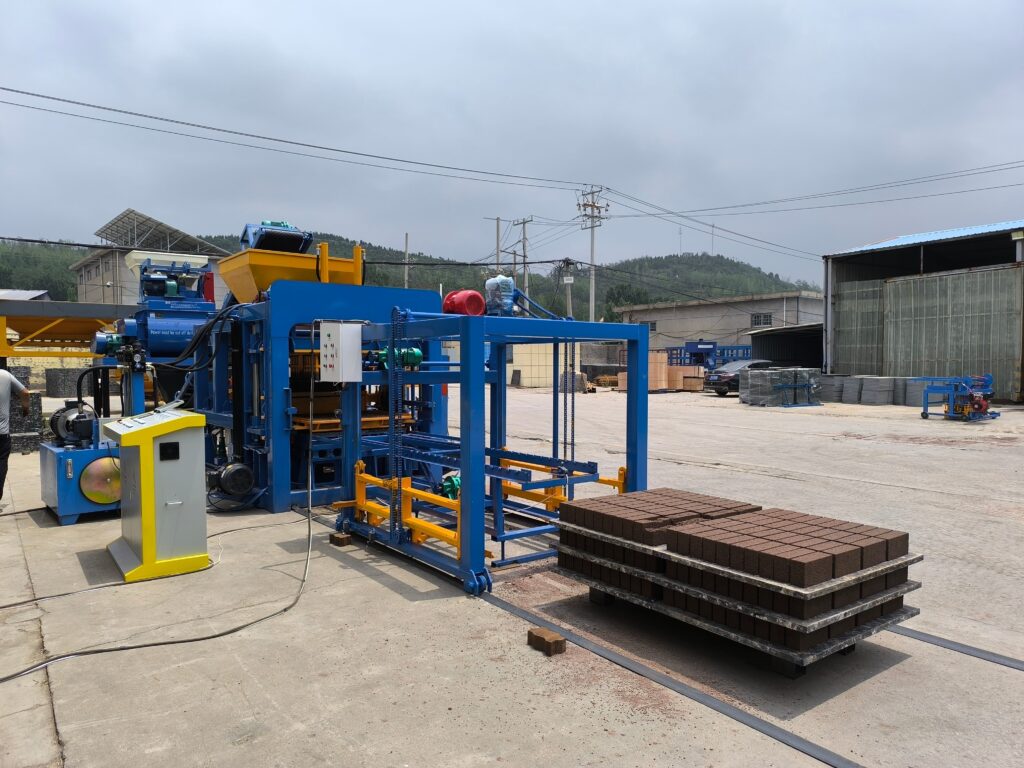
Defining Block Brick Compressive Strength and Its Critical Role
Compressive strength quantifies a material’s resistance to forces that aim to crush or shorten it. For concrete blocks, this translates to their ability to support the weight of the structure above—from roof loads and upper floors to internal contents and environmental pressures like wind.
- The Engineering Imperative: In structural design, engineers calculate the cumulative loads (dead loads, live loads, environmental loads) that a wall must sustain. The specified blocks must have a proven compressive strength exceeding these calculated demands, with a significant safety factor incorporated. Using blocks with insufficient strength risks catastrophic structural failure.
- Beyond Load-Bearing: A Proxy for Durability: While primarily a structural metric, compressive strength is also a reliable indicator of overall quality and durability. A densely compacted, high-strength block typically has lower permeability to water, leading to better resistance against freeze-thaw damage, efflorescence, and chemical attack. It signifies a well-manufactured product.
II. Measurement and Reporting: The Science Behind the Number
The stated strength of a block is the result of a standardized destructive test, providing an objective, comparable value.
- Standardized Test Methodology: The definitive procedure is outlined in standards such as ASTM C140 (Standard Test Methods for Sampling and Testing Concrete Masonry Units and Related Units) or EN 772-1 (Methods of test for masonry units – Part 1: Determination of compressive strength).
- Sample Preparation: Units are dried to a constant mass, then their net bearing area is calculated. To ensure a perfectly level load-bearing surface, the top and bottom faces are capped with a sulfur or high-strength gypsum-based compound.
- Testing: The capped block is placed in a hydraulic compression testing machine. A steadily increasing load is applied until the unit fails. The maximum load sustained (in pounds-force or newtons) is recorded.
- Calculation: Compressive strength is calculated by dividing the maximum load by the net area (the actual cross-sectional area of the solid concrete, excluding voids). The result is reported in pounds per square inch (psi) or megapascals (MPa), where 1 MPa ≈ 145 psi.
- Understanding Strength Ratings: Net Area vs. Gross Area: It is crucial to note that reputable standards report strength based on net area. Some manufacturers may misleadingly quote “gross area” strength (load divided by the overall footprint including voids), which yields a much higher but technically inaccurate number. Always confirm the basis of the reported strength.
III. Factors Determining Compressive Strength in Production
The strength achieved by a block is not accidental; it is the direct result of controlled production variables.
- Raw Material Quality and Mix Design:
- Cement Content and Type: The quantity and quality of cement are primary determinants. Higher cement content generally increases strength, up to a point.
- Aggregate Properties: Hard, dense, and well-graded aggregates (crushed stone, gravel) produce stronger blocks than soft or poorly graded ones.
- Water-Cement (w/c) Ratio: This is arguably the most critical factor in the plant’s control. A lower w/c ratio yields a denser, stronger concrete matrix. However, the mix must retain enough workability for proper compaction in the machine.
- Manufacturing Process:
- Compaction Energy: The synergy between vibration frequency, amplitude, and applied hydraulic pressure is vital. Inadequate compaction leaves voids and weak points, drastically reducing final strength.
- Curing Regimen: Proper curing under controlled temperature and humidity allows the cement to fully hydrate and develop its design strength. Blocks moved too early or cured poorly will never achieve their potential strength.
- Block Design and Density Class:
- Oco vs. Sólido: Solid blocks naturally have a higher load-bearing capacity per unit area than hollow blocks of the same mix, as they have more concrete mass.
- Density Classifications: Standards categorize blocks by their oven-dry density (e.g., lightweight, normal weight). Normal-weight blocks, made with dense aggregates, typically achieve higher compressive strengths than lightweight aggregate blocks, though lightweight blocks have other advantages (insulation, lower weight).
IV. Interpreting Strength for Specification and Sales
For industry professionals, translating a strength number into a commercial and technical recommendation is key.
- Common Strength Ranges and Applications:
- Standard Non-Load-Bearing (Partition) Blocks: May have strengths as low as 500-700 psi (3.5-5 MPa). Used for interior walls that support only their own weight.
- General Purpose Load-Bearing Blocks: Typically range from 1500 to 2500 psi (10.3 to 17.2 MPa) net. Suitable for most residential and low-rise commercial foundation and above-grade walls.
- High-Strength/Foundation Grade Blocks: Often specified at 3000 psi (20.7 MPa) net and above. Used in demanding applications such as high-load foundations, retaining walls, and multi-storey construction.
- Pavimentação Intertravada: For vehicular traffic, strengths often exceed 8000 psi (55 MPa) due to their small bearing area and need for extreme durability.
- The Role of Standards and Testing Frequency: Reliable manufacturers test compressive strength frequently (often daily or per production batch) as part of their quality assurance. Compliance with standards like ASTM C90 ensures that blocks meet not only a minimum average strength but also that no individual unit falls below a specified threshold, guaranteeing consistency.
Conclusão
Compressive strength is the unambiguous language of structural performance for concrete blocks. It is a quantifiable guarantee that bridges the gap between engineering design and physical reality. For those responsible for sourcing and supplying these materials, a deep comprehension of how strength is measured, what influences it, and what values are required for specific applications is indispensable. This knowledge enables informed dialogue with engineers and contractors, ensures the selection of fit-for-purpose products, and upholds the highest standards of safety and quality in the built environment. Ultimately, specifying and supplying blocks with verified compressive strength is not just a transaction; it is an act of professional stewardship over the structures that define our communities.
FAQ
Q1: A supplier quotes a compressive strength of 3500 psi. Is this sufficient for a two-story house foundation?
A: While 3500 psi is a high strength, sufficiency is determined by the project’s structural engineer based on local building codes, soil conditions, and exact design loads. This strength rating is an excellent starting point and likely meets or exceeds typical residential requirements, but final approval must come from the project’s engineered specifications.
Q2: Why do blocks from the same plant sometimes show strength variation?
A: Minor variations are normal and expected due to subtle changes in raw material moisture, ambient temperature, and the concrete mixing process. A robust quality control system minimizes this. Standards account for this by requiring a minimum average strength and a higher minimum for individual units from a sample.
Q3: Can you increase the strength of blocks after they are produced?
A: No. Compressive strength is fundamentally determined during the mixing and curing phases. Once the cement has hydrated and the block is cured, its strength is fixed. Proper long-term curing can allow it to reach its maximum potential strength, but it cannot be increased beyond that inherent potential.
Q4: Is higher compressive strength always better?
A: Not necessarily. While higher strength correlates with durability, it often comes with trade-offs: increased material cost, higher weight (requiring more robust foundations), and potentially reduced thermal insulation properties. The guiding principle is to select a block that meets or exceeds the specified strength requirement for the application without paying a premium for unnecessary over-performance.
Q5: How can we verify a manufacturer’s claimed compressive strength?
A: Request the manufacturer’s most recent third-party certification report and their internal quality control test records. For high-stakes projects, consider independent testing of samples taken from a delivered batch at an accredited laboratory. Reliable manufacturers are transparent with this data.
