
The Complete Guide to Robot Stacking Machines for Brick: Efficiency, Types & ROI
Introdução
The construction materials industry is at a crossroads. A recent report from the Associated General Contractors of America highlights that 85% of construction firms struggle to fill hourly craft positions, a crisis that ripples back to block yards and brick manufacturers. Meanwhile, the relentless pressure to control costs and improve safety has never been greater. For decades, the final, critical step of stacking bricks onto pallets has relied on manual labor—a process synonymous with slow throughput, crushing physical strain, and inconsistent results that lead to damaged goods and logistical headaches.
Introduza a solução transformadora: orobot stacking machine for brick. This is not a futuristic concept but a present-day operational powerhouse, redefining the palletizing station in plants worldwide. It represents a strategic leap from human-dependent handling to precise, programmable automation.
This guide is engineered for decision-makers—plant managers, business owners, and operations engineers—who need more than just sales brochures. We’ve synthesized insights from automation integrators, plant efficiency case studies, and mechanical engineering principles to provide a trustworthy, comprehensive resource. Our goal is to arm you with the knowledge to evaluate this technology confidently.
By the end of this guide, you will understand exactly how these robotic systems work, their tangible benefits, the different types available, and the critical factors for selecting the right one. Most importantly, you’ll see a clear framework for justifying the investment through a compelling return on investment (ROI).
What is a Robot Stacking Machine for Brick and How Does It Work?
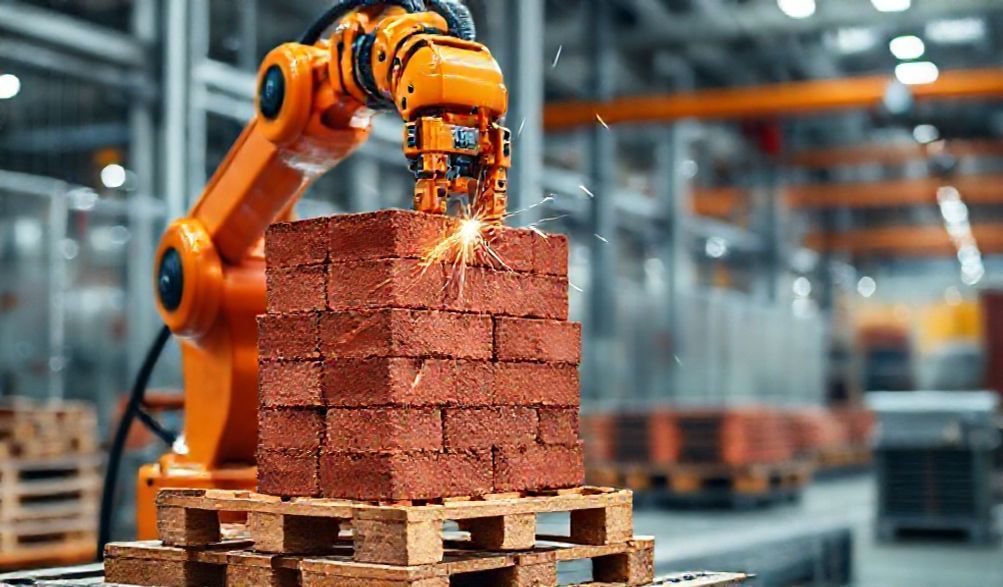
At its core, a robot stacking machine for brick is an automated material handling system. Its primary function is to pick individual bricks or blocks from a production conveyor and arrange them into stable, uniform stacks on a pallet or slip sheet, ready for wrapping, storage, and shipment. It replaces the repetitive, physically demanding work of manual palletizing with unwavering precision and endurance.
Definição e Função Principal
Think of it as a tireless, ultra-precise bricklayer for your pallets. The system is typically built around an industrial robotic arm, governed by sophisticated software. It takes the raw, often hot, output from your kiln or block machine and transforms it into a secure, transport-ready load. This automation ensures every pallet is identical, maximizing safety and efficiency downstream in the supply chain.
Key System Components
A successful system is a symphony of integrated components, each playing a vital role:
-
The Robotic Arm: This is the workhorse. The most common types are:
- Articulated Robots: These resemble a human arm with rotary joints, offering exceptional flexibility within a large work envelope. Ideal for complex stacking patterns or cells where space is at a premium around the conveyor.
- Gantry (Cartesian) Robots: Built on a three-axis linear frame, these provide immense stability and precision for handling very heavy loads, such as large concrete blocks or dense brick packs.
- Palletizing-Dedicated Robots: Often four-axis robots, these are engineered specifically for high-speed, repetitive pick-and-place tasks, offering optimized speed for high-volume production lines.
-
Ferramentas de Extremidade de Braço (EOAT): This is the critical interface with your product. Standard grippers won’t suffice. Specialized EOAT for bricks includes:
- Mechanical Grippers: Custom fingers that clamp securely onto the brick’s sides without crushing.
- Vacuum Grippers: Arrays of suction cups that lift bricks from the top surface. These often use rugged, abrasion-resistant materials to handle the harsh brick texture.
- Sistemas Híbridos: Some tools combine mechanisms to handle different brick formats or to ensure a supremely secure grip during high-speed movement.
-
Vision Guidance Systems: This is the “eyes” of the operation. Cameras and sensors perform several key tasks:
- Locating each brick’s exact position and orientation on the infeed conveyor.
- Performing basic quality checks (e.g., identifying grossly broken pieces).
- Ensuring the robot places each brick in the correct position to build a perfect pattern.
-
Conveyor Integration & Pallet Handling: The system is not an island. It includes:
- Infeed conveyors that present bricks at the correct rate and spacing.
- Pallet dispensers that supply empty pallets automatically.
- Pallet conveyors or turntables that index the pallet after each layer is complete.
- Outfeed conveyors to remove finished, loaded pallets.
The Automated Stacking Cycle
The process is a continuous, efficient loop:
- Presentation: Bricks are singulated and spaced on the infeed conveyor.
- Scan: The vision system captures the position of the next brick(s) to be picked.
- Escolha: The robotic arm, with its specialized EOAT, acquires the brick.
- Place: The robot moves to the pallet location and places the brick in its pre-programmed position with millimeter accuracy.
- Index: Once a layer is complete, the pallet is lowered or the head is raised, and the pallet conveyor shifts slightly for the next layer.
- Repeat & Remove: The cycle repeats until the pallet is complete. The full pallet is then conveyed away for wrapping, and an empty pallet is introduced.
Key Benefits of Automating Brick Stacking with Robots
The shift from manual to robotic stacking delivers a cascade of operational advantages that directly impact the bottom line and workplace culture.
Dramatically Increased Productivity and Throughput
Robots don’t take breaks, get tired, or shift change. They operate 24/7 at a consistent, optimal speed. This can increase palletizing output by 30% to 200%, depending on the previous manual process. They eliminate the natural slowdown at the end of a shift, turning your palletizing station from a bottleneck into a high-flow asset.
Enhanced Workplace Safety and Ergonomics
Manual brick stacking is a leading cause of workplace injuries in the industry, including:
* Repetitive strain injuries (RSIs) to the back, shoulders, and wrists.
* Musculoskeletal disorders from constant heavy lifting.
* Crush injuries or accidents in pinch-point areas.
By removing personnel from this repetitive, heavy-lifting task, you create a safer environment, reduce absenteeism, and lower workers’ compensation costs. It also allows you to redeploy skilled labor to more valuable, less hazardous tasks like machine oversight and quality control.
Superior Stack Quality and Reduced Product Damage
Human fatigue leads to inconsistency. A wobbly stack is a major risk during forklift handling and transportation, leading to broken bricks and customer rejections. Robotic systems:
* Place every brick in an identical, pre-engineered position.
* Create perfectly vertical, dense, and interlocked pallet patterns.
* Dramatically reduce in-transit damage and product loss, protecting your revenue and brand reputation.
Significant Labor Cost Savings and Operational Consistency
While the initial investment is notable, the long-term savings are substantial. Automation provides a predictable operating cost, insulating you from rising wages, labor shortages, and turnover. The consistency of output also means you get the same high-quality pallets on the night shift as you do on the day shift, ensuring reliable delivery to your customers.
Improved Space Utilization and Logistics
Robotically stacked pallets are uniform and optimally arranged. This consistency allows for:
* Tighter, more stable storage in your warehouse.
* Maximized space utilization in shipping containers and trucks.
* Safer, faster loading and unloading processes for your logistics partners.
Types of Robot Stacking Systems for Brick and Block
Not all robotic solutions are created equal. The right choice depends on your specific product mix, speed requirements, and facility layout.
Articulated Robot Cell Systems
- Prós: Unmatched flexibility. Their jointed design allows them to work around obstacles and handle a wide variety of brick sizes and complex stacking patterns from a fixed base.
- Contras: Require safeguarded floor space around their work envelope. May have slightly lower absolute speed for simple, high-volume tasks compared to dedicated palletizers.
Gantry (Cartesian) Robot Systems
- Prós: Superior stability and precision for extremely heavy loads (e.g., large patio slabs, dense concrete blocks). Ideal for applications where the weight of the product is the primary challenge.
- Contras: The overhead gantry structure requires significant headroom and can be less flexible if you need to frequently change product types or patterns.
Palletizing-Dedicated Robots
- Prós: Built for one job: fast, reliable palletizing. They often offer the highest cycles-per-minute rates for standard brick formats and simple layer patterns.
- Contras: Can be less adaptable to significant changes in product dimensions or highly complex, interlocking patterns without major re-tooling.
Choosing the Right Type for Your Product
Use this simple matrix to guide initial discussions:
| Factor | Favors Articulated | Favors Gantry | Favors Dedicated Palletizer |
| :— | :— | :— | :— |
| Product Weight | Medium to High | Very High | Low to Medium |
| Pattern Complexity | High | Low to Medium | Low to Medium |
| Required Speed | High | Medium | Very High |
| Floor Space | Moderate Cell | Large Footprint | Compact Cell |
| Product Mix Variety | High | Low | Low |
Critical Factors to Consider Before Investing
A successful implementation hinges on thorough upfront analysis. Rushing this stage is the most common pitfall.
Assessing Your Production Line and Product Mix
Start with the basics. Document:
* Brick dimensions, weight, and surface texture.
* Your current and desired production rate (units per hour/shift).
* The variety of stacking patterns required (e.g., different patterns for different customers).
* The temperature of bricks at the point of stacking (e.g., right out of the kiln).
Integration Complexity with Existing Machinery
The robot must communicate with your world. Key considerations include:
* Conveyor heights and line speeds.
* Compatibility with existing Programmable Logic Controllers (PLCs).
* Physical factory layout—is there space for the cell, fencing, and maintenance access?
Custo Total de Propriedade (TCO) vs. Preço Inicial
Look beyond the robot’s sticker price. A complete TCO analysis includes:
* Robot and controller.
* Custom End-of-Arm Tooling (EOAT).
* Safety fencing, light curtains, and interlocks.
* System integration, programming, and simulation.
* Installation, commissioning, and staff training.
* Long-term spare parts, preventive maintenance, and service support.
Supplier Expertise and Support (A Major E-E-A-T Factor)
This is perhaps the most critical decision. You are not just buying a machine; you are entering a partnership. Vet potential suppliers rigorously on Google’s E-E-A-T principles—especially crucial for this “Your Money or Your Life” industrial investment:
- Experiência: Do they have a proven track record in the brick, block, and construction materials industry? Ask for specific client references and visit installations if possible.
- Especialização: Do their engineers understand the unique challenges of handling abrasive, brittle materials? Can they design grippers that won’t damage your product?
- Autoridade: Are they a recognized leader? Do they contribute to industry standards, publish case studies with verifiable data, and have a strong reputation among peers?
- Confiança: What do their after-sales service and support look like? Do they offer comprehensive training, clear maintenance contracts, and guaranteed parts availability? Read reviews and talk to their long-term clients.
Implementing Your Robot Stacking System: A Step-by-Step Overview
A professional implementation follows a structured, phased approach to de-risk the project.
Phase 1: Consultation and Feasibility Study
A reputable supplier will start by analyzing your production data, visiting your facility, and defining the project scope, including a preliminary ROI calculation.
Phase 2: System Design and Simulation
Engineers will create a detailed 3D layout and use simulation software to model the robot’s movements, cycle times, and interactions. This virtual testing identifies and solves potential issues before metal is cut.
Phase 3: Factory Acceptance Test (FAT)
Before shipment, you are invited to the integrator’s facility to see the complete system run under test conditions. This is your chance to verify performance against the agreed specifications.
Phase 4: Installation, Commissioning, and Staff Training
The system is installed in your plant, connected to utilities and conveyors, and fine-tuned. Crucially, your maintenance and operations staff receive hands-on training for daily operation, basic troubleshooting, and safety procedures.
Phase 5: Ongoing Maintenance and Support
The relationship continues with scheduled preventive maintenance, remote support, and access to spare parts to ensure the system delivers peak performance for its entire lifespan.
Perguntas Frequentes (FAQ)
What is the typical ROI period for a brick stacking robot?
The payback period typically ranges from 1 to 3 years. Key variables include the number of labor shifts it replaces, local wage rates, the achieved increase in throughput, and the reduction in product damage. A detailed feasibility study will provide a project-specific calculation.
Can one robot handle multiple brick sizes and patterns?
Yes, absolutely. Modern systems are designed for flexibility. Through the robot’s teach pendant or HMI, operators can select different programs for various brick sizes and pallet patterns. Some systems feature quick-change tooling to handle vastly different product shapes.
How reliable are these systems in a dusty industrial environment?
Industrial robots are built for harsh conditions. Key protections include:
* High IP (Ingress Protection) ratings (e.g., IP67) for dust and water resistance.
* Positive pressure cabinets for the robot controller to keep dust out.
* Sealed joints and ruggedized components. Regular preventive maintenance (cleaning filters, etc.) is still essential for longevity.
Do we need highly skilled programmers to operate it?
No. Daily operation is designed to be simple, often involving selecting a pre-loaded program from a menu. The initial complex programming is done by the integrator. Effective training from your supplier is key to empowering your existing staff to run, pause, and perform basic troubleshooting on the system.
What safety standards do these cells comply with?
Reputable systems are designed and safeguarded in full compliance with international robotics safety standards, primarily ISO 10218eANSI/RIA R15.06. A complete cell will include risk-assessed safety fencing, interlocked access gates, safety-rated light curtains, and emergency stop buttons to ensure safe coexistence with human workers.
Conclusão
The integration of a robot stacking machine for brick is far more than a simple equipment upgrade; it is a strategic realignment of your operations towards greater efficiency, safety, and quality. As we’ve explored, the benefits—from dramatic throughput increases and labor savings to the elimination of debilitating workplace injuries and product damage—present a compelling case for automation.
In today’s competitive landscape, where labor is scarce and margins are tight, automating the palletizing process is no longer a luxury for the largest players. It is a necessary step for any forward-thinking brick or block manufacturer seeking to future-proof their business, build resilience, and ensure sustainable growth.
This journey, however, hinges on partnership. The importance of selecting a supplier with deep experiência, proven especialização, industry autoridadee inabalávelconfiabilidade cannot be overstated. Your success depends on their capability to deliver a robust, integrated solution that works seamlessly in your unique environment.
Ready to explore how a robot stacking machine can revolutionize your brickyard operations? Contact our team of automation specialists for a confidential, no-obligation review of your production line and a detailed ROI analysis based on decades of industry experience.
<