1. Definição da Máquina Automatizada de Fabricação de Tijolos e Blocos
Uma máquina automatizada de fabricação de tijolos e blocos é um sistema de produção integrado projetado para fabricar uma ampla gama de produtos de concreto — incluindo tijolos maciços, blocos vazados, paralelepípedos e blocos de encaixe — por meio de um processo coordenado de forma contínua e controlado por computador. O termo “automatizada” representa um salto fundamental em relação à mecanização, onde os operadores humanos são removidos do ciclo de produção direto e realocados para funções de supervisão, manutenção e controle de qualidade.
1.1. O Princípio Central da Automação Integrada:
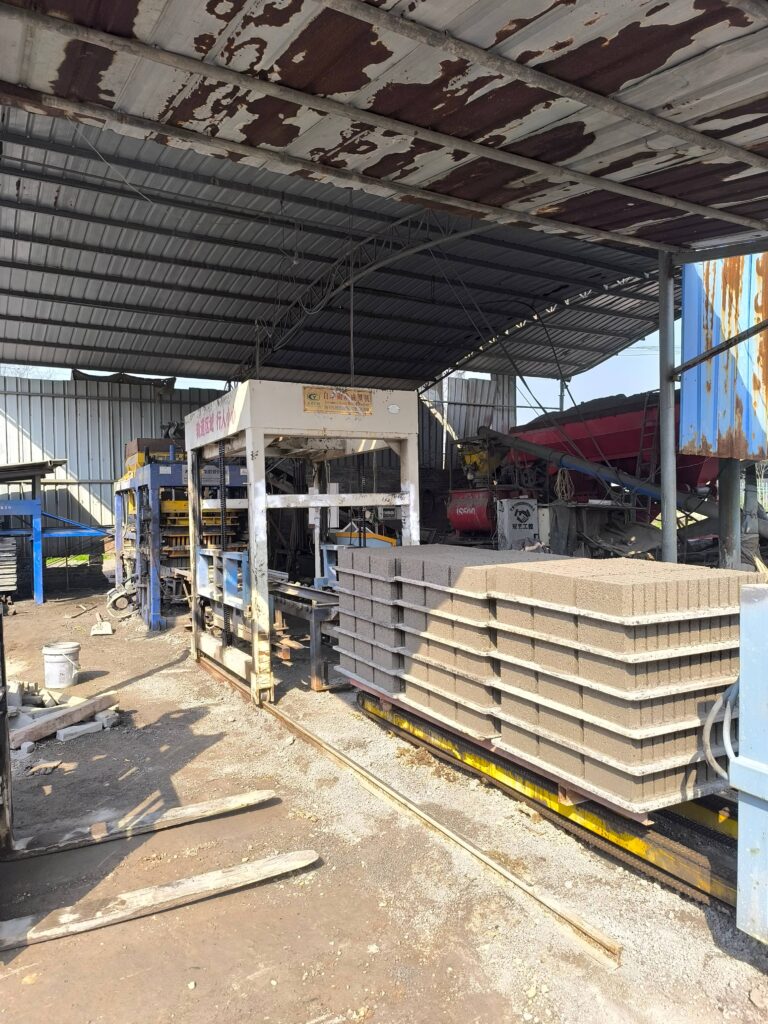
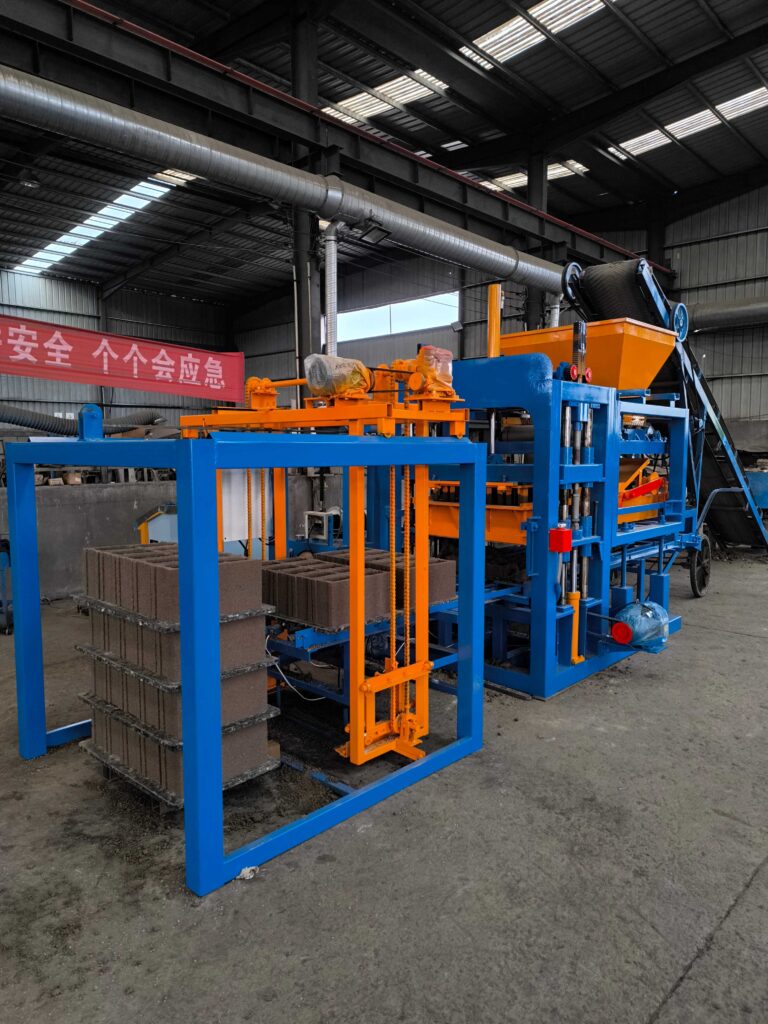
A operação é um sistema contínuo e em circuito fechado. Começa com a dosagem automatizada de matérias-primas (cimento, agregados, cinzas volantes, água e pigmentos), que são então transportadas para um misturador. O concreto misturado é levado até o funil da máquina, que alimenta quantidades precisas na cavidade de moldagem. O processo de formação do núcleo envolve:
- Vibração de Alta Intensidade:As mesas de vibração multidirecionais garantem que o concreto seja compactado densamente, eliminando vazios.
- Pressão Hidráulica Controlada:Cilindros hidráulicos precisamente calibrados aplicam pressão imensa, resultando em produtos com alta precisão dimensional, acabamento superficial superior e resistência à compressão excepcional.
Os blocos recém-formados são então ejetados automaticamente sobre paletes, que são transportados por um transportador de corrente ou sistema de transferência cruzada até um empilhador automático. O empilhador organiza os produtos em camadas sobre carrinhos de cura, prontos para a câmara de cura a vapor. Este processo de ponta a ponta é gerenciado por um Controlador Lógico Programável (CLP) central.
1.2. A Superioridade do Produto Final:
Produtos de uma linha automatizada são caracterizados por sua qualidade invariável, que é um resultado direto da precisão inerente à maquinaria.
- Consistência Dimensional:Cada bloco é idêntico, resultando em tempos de construção mais rápidos e menor uso de argamassa.
- Alta e Previsível Resistência:Processos controlados garantem que cada produto atenda ou supere os padrões de resistência especificados (por exemplo, ASTM C90).
- Versatilidade de Design:Sistemas de troca rápida de moldes permitem que uma única linha de produção fabrique um portfólio diversificado de produtos para atender às demandas variáveis do mercado.
2. Uma Taxonomia Detalhada da Automação e Suas Correlações de Preço
O mercado de máquinas automatizadas é estratificado. Compreender essas camadas é crucial para alinhar as ofertas de produtos com segmentos específicos de clientes, desde pátios de blocos em crescimento até fabricantes em escala industrial.
2.1. Máquinas Semiautomáticas com Recursos Automatizados: A Ponte para a Automação Total
Esses sistemas representam um nível avançado de produção, mas mantêm um componente manual fundamental, tipicamente o manuseio de paletes ou produtos acabados.
- Principais Características:
- Operação: The brick forming cycle—feeding, compacting, and ejecting—is fully automated. However, the removal of filled pallets and their placement onto curing racks is done manually.
- Controle: Often feature a simple PLC or relay-based control system.
- Saída: A significant step up from manual machines, with outputs ranging from 4,000 to 8,000 standard blocks per 8-hour shift.
- Pricing Range: This category serves as the entry point into automated production, with prices typically between $5,000 and $9,000.
- Direcionadores de Custos:
- Core Machine Robustness: The quality of the hydraulic system and the structural integrity of the machine frame.
- Level of Control: The sophistication of the control panel.
- Included Auxiliaries: Whether a basic mixer and conveyor are included in the price.
2.2. Fully Automatic Single Production Lines: The Standard for Commercial Scale
This is the most prevalent model for serious, high-volume manufacturers. These are turnkey systems where every step from material feeding to product stacking is automated.
- Principais Características:
- Operação: Integrated pallet circulation system, automatic product stacking, and often a color feeder for surface-layer coloring of paving stones.
- Controle: A central PLC with a user-friendly Human-Machine Interface (HMI) touchscreen allows for recipe storage and production monitoring.
- Saída: Designed for continuous operation, with production capacities from 10,000 to 30,000 blocks per 8-hour shift.
- Pricing Range: This is the core of the automated market, with a broad price band of $15,000 to $40,000.
- Direcionadores de Custos:
- Capacidade de Produção: The physical size and speed of the machine (cycle time) are primary cost factors.
- Level of Sophistication: Features like an automatic mold change system, robotic pallet brush/oiler, and advanced diagnostics add cost.
- Auxiliary Integration: The cost and scale of the required cement silo, aggregate bins, mixer, and conveyor network.
2.3. Fully Automatic Plant with Curing System: The Industrial-Grade Solution
For the largest investors, the automation extends beyond production to include the curing process, creating a truly continuous, 24/7 manufacturing operation.
- Principais Características:
- Operação: Includes a fully automatic production line integrated with an automated curing system, such as a rack transfer system or a tunnel curing chamber with automatic loading and unloading.
- Controle: A sophisticated industrial computer or SCADA system that manages both production and the curing cycle (temperature, humidity, duration).
- Saída: Massive output capabilities, from 30,000 to over 100,000 blocks per day.
- Pricing Range: These are multi-million-dollar capital projects. Prices start from $40,000 and can exceed $80,000.
- Direcionadores de Custos:
- Curing System Technology: The type and capacity of the automated curing system is a major investment.
- Material Handling Scale: The size and automation level of the raw material storage and handling system.
- Overall Plant Footprint and Civil Works: The required building and foundation work.
3. The Investment Rationale: Analyzing Total Cost of Ownership and Return on Investment
The high capital expenditure for an automated line must be justified by a compelling financial return. Distributors must be equipped to articulate this value proposition clearly.
3.1. Deconstructing Operational Efficiency:
- Labor Cost Minimization: A fully automatic line might require only 4-6 personnel for a multi-shift operation, whereas achieving similar output with semi-automatic machines could require 30-40 workers. The labor savings alone can be transformative.
- Otimização de Materiais: Precision batching and mixing eliminate human error, ensuring the optimal mix design is used consistently, reducing cement waste and raw material costs.
- Consumo de Energia: Modern machines are designed with energy-efficient hydraulics and motors. While total power usage is high, the cost per block produced is often lower than in less efficient, fragmented operations.
3.2. Quantifying the Value of Quality and Consistency:
- Redução de Rejeições: Automated processes ensure a near-zero defect rate, maximizing the yield from raw materials.
- Market Premium: Consistently high-quality blocks can command a higher price in the market and are preferred by large contractors and government tenders.
- Brand Reputation: Supplying a market with uniform, reliable products builds a strong brand, leading to customer loyalty and repeat business.
3.3. The ROI Calculation Framework:
The payback period for an automated line can be surprisingly short—often between 1.5 to 3 years for a well-utilized machine. The calculation hinges on:
- Receita Aumentada: Higher output and potentially higher selling prices.
- Custos Operacionais Reduzidos: Drastic cuts in labor, waste, and energy per unit.
- Investimento Inicial: The total cost of the machine, auxiliaries, installation, and commissioning.
4. Strategic Procurement and Partnership Considerations
Sourcing automated machinery is a long-term partnership that extends far beyond the initial sale.
4.1. Evaluating the Manufacturer’s Capability:
- Technical Support and Training: The manufacturer must provide extensive training for both maintenance engineers and machine operators. Look for comprehensive documentation and on-site commissioning support.
- R&D and Innovation: A partner with a strong R&D department will ensure the machinery you offer remains competitive and can adapt to new market trends and materials.
- Global Service Network: For high-value equipment, the availability of remote diagnostics and a network of service engineers is critical for minimizing downtime.
4.2. Key Technical Questions for Procurement:
- What is the machine’s “up-time” guarantee? Reliability is more important than peak speed.
- What is the lead time and cost for critical spare parts? This includes hydraulic pumps, PLCs, and specialized sensors.
- How scalable is the system? Can the line be upgraded in the future with additional modules?
Conclusion: Securing a Leadership Position in the Industrialized Construction Era
The transition towards automated brick and block production is an irreversible global trend. For distributors and procurement agents, this category represents not just a product line, but a strategic gateway to serving the most ambitious and profitable segment of the construction materials market. The pricing of these machines is a direct reflection of their transformative potential—their ability to lower the cost per block, ensure unrivalled quality, and create a defensible competitive moat for their owners.
Success in this arena requires a shift from being a simple equipment vendor to becoming a solutions partner. This entails a deep understanding of the technology, a clear-eyed analysis of the financials, and a commitment to providing the lifecycle support that ensures your clients’ factories run at peak efficiency. By mastering the intricacies of automated brick block making machines, your business can position itself at the forefront of the construction industry’s future, driving growth and building lasting value for your partners.
Perguntas Frequentes (FAQ)
Q1: What is the single most significant factor that differentiates a $200,000 automated line from a $400,000 one with a similar output claim?
The difference typically lies in durability, precision, and long-term reliability. The higher-priced machine will likely feature a more robust frame construction, industrial-grade hydraulic components from top-tier suppliers, a more sophisticated and user-friendly PLC system, and higher-precision machining for core components like the mold and press head. This translates to lower long-term maintenance costs, higher consistency, and less downtime over a 15-20 year lifespan.
Q2: How critical is the after-sales service and technical support for this level of equipment?
It is absolutely paramount. An automated production line is the heart of a client’s business. Any unscheduled downtime results in significant financial loss. Therefore, the manufacturer’s ability to provide rapid, expert technical support—either through remote diagnostics or by dispatching qualified engineers—is a non-negotiable criterion. The quality of after-sales service is often a more important differentiator than a marginal difference in the initial purchase price.
Q3: What are the typical infrastructure requirements for installing a fully automatic line?
The requirements are substantial. Clients will need a large, covered production hall with a high, clear ceiling. The foundation must be a massive, reinforced concrete slab designed to handle the dynamic loads of the vibrating machine. A reliable and powerful electrical connection (typically 3-phase) is essential, and access to a consistent water supply is necessary. The cost and feasibility of this civil work must be factored into the total project budget.
Q4: Can these automated lines produce different products, and how complex is the changeover?
Yes, product versatility is a key advantage. However, the changeover complexity varies. Switching between similar block heights may be a quick adjustment on the HMI. Changing to a completely different product type (e.g., from a hollow block to a paving stone) requires a physical mold change. Higher-end machines feature quicker mold change systems, but this process still requires trained personnel and can take from 30 minutes to a few hours.
Q5: What is the typical lead time from order placement to commissioning for a large automated plant?
Lead times can be lengthy due to the custom engineering and manufacturing involved. For a standard fully automatic line, expect a lead time of 3 to 5 months. For a complete turnkey plant with an integrated curing system, the lead time can extend from 6 to 9 months or more. Clear communication with the manufacturer about the project timeline is essential.
Q6: Beyond the machine itself, what auxiliary equipment is the client responsible for?
The client must budget for and manage the entire ecosystem. This includes:
- Raw material storage (cement silo, aggregate bunkers).
- Material handling (conveyors, screw feeders).
- A water supply system.
- A powerful mixer (usually a pan mixer for stiff concrete).
- Curing infrastructure (racks, carts, and possibly a boiler for steam curing).
- A substantial generator for backup power is also highly recommended.