
The Ultimate Guide to Fully Automatic Red Earth Block Machines: Efficiency, Quality & Sustainability
Introdução
The global construction industry is at a crossroads. With a staggering 30% of global raw material consumption attributed to building products, the demand for sustainable, durable, and cost-effective materials has never been more urgent. For decades, builders have grappled with the inherent challenges of traditional brick-making: a labor-intensive process plagued by inconsistent quality, high material waste, and painfully slow production rates. Even semi-automatic machines, while an improvement, often leave significant room for human error and operational bottlenecks.
Enter the fully automatic red earth block machine—the intelligent, modern solution revolutionizing the production of Compressed Earth Blocks (CEBs). This guide is designed to cut through the noise. As a professional resource grounded in industry knowledge, technical analysis, and practical application, we will provide a comprehensive overview. Our purpose is to equip builders, contractors, and entrepreneurial visionaries with the expert insights needed to make a truly informed decision about this transformative technology. By understanding the capabilities of a red earth block machine fully automatic system, you can unlock new levels of efficiency, quality, and ecological responsibility in your projects.
What is a Fully Automatic Red Earth Block Machine?
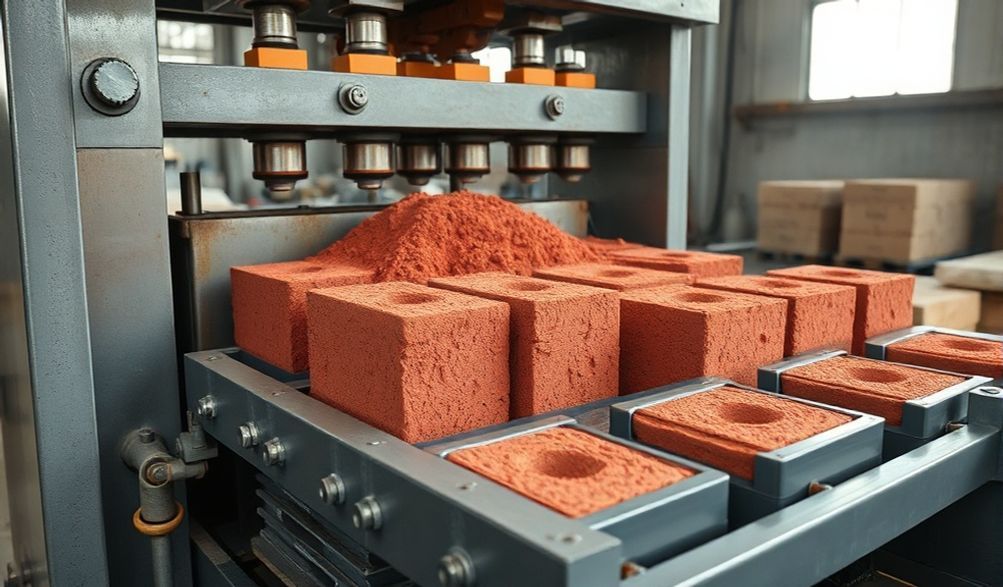
At its core, a fully automatic red earth block machine is a sophisticated, programmable manufacturing system. It is engineered to automate the entire CEB production cycle—from raw material feeding to finished block stacking—with minimal human intervention. This represents a fundamental leap from manual labor and operator-dependent semi-automatic models.
Definição do Núcleo e Princípio de Funcionamento
A fully automatic machine is a self-contained production line. It takes prepared soil (red earth), precisely mixes it with a stabilizer like cement or lime if required, and subjects it to extreme, calibrated pressure within a mold. The process is governed by a central computer, ensuring every block is an identical twin to the last in dimension, density, and strength. The principle is one of high-force compression, mechanically bonding the soil particles to create a block of exceptional durability, not through firing, but through immense, controlled force.
Componentes Principais e Suas Funções
Understanding the machine’s anatomy is key to appreciating its capabilities:
- Hopper and Automated Feeder System: This is the starting point. A large hopper holds the raw soil, and an automated feeder (often a conveyor or auger system) consistently delivers a measured volume of material to the mixing chamber, eliminating guesswork and uneven feeding.
- Precision Mixing Chamber: Here, soil is homogenously blended with the correct percentage of water and stabilizer (e.g., 5-10% cement). Automated dosing systems ensure the mix is perfect every time, which is critical for final block strength.
- Unidade de Compressão Hidráulica de Alta Pressão: The heart of the machine. Hydraulic rams exert tremendous force—often ranging from 20 to 100+ tons—onto the soil within a steel mold. This pressure is what gives the block its structural integrity.
- Programmable Logic Controller (PLC) and Human-Machine Interface (HMI): The machine’s brain and control panel. The PLC automates the entire sequence (feed, mix, compress, eject). The HMI, usually a touchscreen, allows operators to input parameters (pressure, cycle time), monitor operations, and diagnose issues.
- Conveyor System and Block Stacker: Once ejected, blocks are gently transported via conveyor to an automatic stacker or palletizer. This ready-to-cure output streamlines workflow and dramatically reduces handling labor and damage.
Advantages of Investing in a Fully Automatic System
The shift from manual or semi-automatic to fully automatic is an investment in operational transformation. The benefits are tangible and directly impact your bottom line and project quality.
Eficiência e Produção Inigualáveis
Fully automatic machines are productivity powerhouses. Where a manual operation might produce a few hundred blocks per day with a large crew, a mid-range automatic system can reliably produce 1,500 to 3,000 blocks per 8-hour shift, with just 1-2 operators. High-capacity models can exceed 10,000 blocks daily. This 24/7 operational potential, with minimal supervision, turns block production from a bottleneck into a predictable, scalable resource.
Qualidade de Bloco Superior e Consistente
Automation is the enemy of inconsistency. Human variables in mixing, filling, and compression are eliminated. Every block receives the identical amount of material and the exact same calibrated pressure. The result is a product with uniform dimensions, density, and most importantly, compressive strength. This consistency simplifies construction, reduces mortar use, and ensures structural calculations are reliably met, block after block.
Significant Labor and Long-Term Cost Savings
While the initial capital outlay is higher, the total cost of ownership tells a different story. Consider the ROI:
* Redução Drástica de Mão de Obra: A crew of 10+ can be reduced to a small supervisory team.
* Resíduos Minimizados: Precise dosing and compression lead to near-zero material waste.
* Lower Training Costs: Operating a PLC interface is simpler than mastering the artisanal nuances of manual block making.
* Reduced Error & Rework: Consistent quality means fewer rejected blocks and no construction delays due to sub-par materials.
Enhanced Operational Safety and Ease of Use
These machines are designed with integrated safety features—emergency stops, safety guards, and interlocked systems. The heavy, repetitive, and high-risk tasks (lifting, pressing) are handled by the machine. The operator’s role shifts to monitoring and management via the user-friendly HMI, creating a safer, less physically demanding work environment.
Key Technical Specifications to Evaluate Before Buying
Purchasing a fully automatic machine is a major decision. Focusing on these critical technical specs will ensure you select a model perfectly aligned with your needs.
Production Capacity: Matching Output to Your Project Scale
Don’t just look at the “blocks per hour” peak rating. Assess the sustainable, daily output that accounts for maintenance and material loading. A machine producing 2,000 blocks/day is ideal for a large housing project or commercial supply, while a 5,000+ blocks/day machine suits industrial-scale production.
Block Dimensions, Shapes, and Mold Customization Options
Standard block sizes (e.g., 300mm x 150mm x 100mm) are common, but versatility is a key advantage. Inquire about interchangeable molds for producing different sizes, interlocking blocks for dry-stack construction, or even specialty shapes for landscaping. A supplier offering custom mold fabrication is a significant plus.
Power Requirements: Electrical vs. Diesel Options
Your site’s infrastructure is crucial.
* Electrical Models: Require a stable, high-capacity three-phase connection. They are cleaner, quieter, and ideal for fixed installations with grid power.
* Modelos a Diesel: Offer complete mobility and are perfect for remote sites without reliable electricity. Factor in fuel costs and ventilation.
Soil Preparation Requirements: Moisture Content, Sieve Size, and Stabilizers
The machine is only as good as the soil you feed it. Optimal soil has a consistent, granular structure. Key preparation steps include:
* Peneiração: Removing stones and organic matter (typically using a 5-10mm sieve).
* Teor de Umidade: Usually between 8-12% for optimal compaction. Too little or too much water drastically weakens the block.
* Estabilização: Most red earth requires a stabilizer like Portland cement (5-10%) or lime to achieve weather resistance and higher strength. The machine’s mixer must be able to incorporate this evenly.
Critical Machine Metrics: Pressure Force (Tons), Cycle Time, and Automation Level
- Força de Pressão: Directly correlates to block strength. For load-bearing walls, machines exerting 40 tons and above are typical, producing blocks with compressive strengths suitable for multi-story buildings.
- Tempo de Ciclo: The time to produce one block (e.g., 15-20 seconds). Faster cycles mean higher output.
- Nível de Automação: Confirm what “fully automatic” includes. True top-tier systems automate feeding, mixing, compression, ejection, and stacking.
Applications of Fully Automatic Red Earth Blocks
The high-quality, consistent blocks produced by these machines open doors to diverse, prestigious, and impactful construction applications.
Sustainable Housing Projects and Residential Construction
This is the primary application. The blocks offer excellent thermal mass, regulating indoor temperatures and reducing energy costs. Their natural aesthetic and proven durability make them ideal for eco-villages, suburban homes, and high-end, architect-designed sustainable residences.
Large-Scale Commercial and Institutional Buildings
Schools, clinics, office complexes, and warehouses benefit from the speed of construction and the material’s fire resistance and acoustic insulation properties. The ability to produce large volumes of identical blocks is critical for these projects.
Landscape Architecture: Retaining Walls, Pavers, and Garden Features
Interlocking and specially shaped CEBs are perfect for durable, permeable, and aesthetically pleasing retaining walls, garden borders, and pedestrian pavers. Their natural color blends seamlessly with outdoor environments.
Disaster-Resilient and Low-Cost Community Housing Initiatives
Organizations focused on humanitarian and community development use these machines for rapid, cost-effective construction. The resulting buildings are non-combustible, resilient to extreme weather when properly stabilized, and utilize locally sourced materials, keeping resources and benefits within the community.
How to Choose the Right Manufacturer and Supplier
Your relationship with the manufacturer is as important as the machine itself. This is where due diligence pays lifelong dividends.
Evaluating Manufacturer Reputation and Industry Experience
Look for a company with a verifiable history. How long have they been building these specific machines? Request a detailed client list and seek out independent testimonials or case studies. Certifications (ISO, CE) for manufacturing quality are strong indicators of professionalism.
The Non-Negotiable: After-Sales Service, Warranty, and Parts Availability
This is the most critical part of your investment. A machine breakdown without support can be catastrophic. Insist on clarity about:
* Warranty Coverage: What is covered (parts, labor) and for how long (typically 1-2 years)?
* Parts Inventory: Does the supplier stock critical spare parts (hydraulic seals, PLC components) for immediate dispatch?
* Rede de Serviço: Do they have trained technicians available for on-site service, or do they offer comprehensive remote diagnostic support?
The Importance of Installation Support, Training, and Technical Documentation
A proper commissioning process is vital. The supplier should provide:
* On-site Installation & Calibration: Sending an engineer to set up the machine ensures it runs correctly from day one.
* Treinamento Abrangente de Operadores: Hands-on training for your team on operation, routine maintenance, and basic troubleshooting.
* Manuais Detalhados: Clear, well-illustrated operation and maintenance manuals in your language.
Requesting a Live Demo or Site Visit (if possible)
If feasible, visit the factory to see the machine being built or, even better, visit an existing customer’s site. A live demonstration under real working conditions is the best way to verify performance claims, build quality, and noise levels.
Perguntas Frequentes (FAQ)
Q1: What is the typical cost range for a fully automatic red earth block machine?
Prices vary widely based on capacity, automation level, and brand. Entry-level systems start around $50,000, while high-output, industrial-grade lines can exceed $200,000. Focus on the total value, including service and parts, not just the initial price tag.
Q2: Can I use locally available soil directly, or does it need special treatment?
You can use local soil, but it sempre requires testing and preparation. A simple soil composition test (clay, silt, sand ratio) is essential. It will almost certainly need sieving and moisture adjustment, and most soils require stabilization with cement or lime for durable construction.
Q3: How does the block quality from an automatic machine compare to fired clay bricks?
Automated CEBs offer comparable or superior compressive strength to many fired bricks. They excel in thermal and acoustic performance. While fired bricks have higher water resistance, a properly stabilized and rendered CEB wall is completely weatherproof. The environmental advantage of CEBs (near-zero embodied energy) is decisive.
Q4: What is the maintenance schedule like for these machines?
Maintenance is routine but crucial. Daily tasks include cleaning and visual checks. Weekly lubrication of moving parts is key. Hydraulic systems require periodic fluid and filter changes (e.g., every 1,000-2,000 hours). The PLC system is largely maintenance-free. A disciplined schedule prevents major downtime.
Q5: Are fully automatic machines suitable for small businesses or startups?
Yes, but the business model must support it. For a startup, consider partnering on a shared-resource model or securing a project with high, guaranteed block offtake. The investment is significant, so a clear market demand and financial plan are prerequisites. A mid-range machine can service multiple small-to-medium projects efficiently.
Conclusão
The fully automatic red earth block machine represents more than just a piece of construction equipment; it is a gateway to a smarter, more sustainable, and more profitable building methodology. By automating the core process of CEB production, it delivers unmatched efficiency, robotic consistency in quality, and profound long-term savings.
Investing in this technology is an investment in the future resilience and growth of your construction business or project. It moves you from being subject to the variables of manual labor to being in command of a predictable, high-output manufacturing process.
Equip yourself with the right knowledge. We recommend using the criteria outlined here to contact 3-4 reputable manufacturers. Present them with your specific soil reports and project requirements to request detailed quotations and technical consultations. The future of construction is being built on a foundation of automation and sustainability, and with the right fully automatic red earth block machine, you can be at the forefront of this transformative movement.
<