
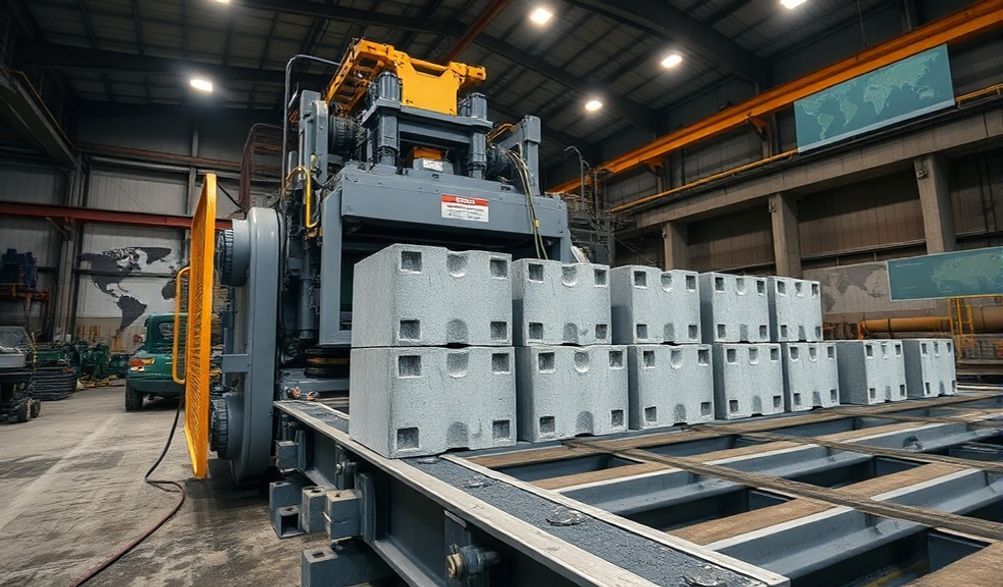
O Guia Definitivo para o Comércio de Máquinas de Blocos de Concreto: Um Manual para Compradores e Vendedores
Introdução
Desde arranha-céus imponentes até infraestruturas essenciais, o ambiente construído moderno repousa, literalmente, sobre o humilde bloco de concreto. Conhecidos tecnicamente como Unidades de Alvenaria de Concreto (CMUs), esses blocos são a espinha dorsal da construção global. Por trás de sua produção está uma indústria sofisticada e frequentemente negligenciada: o comércio de máquinas para fabricação de blocos de concreto. Este mercado—que abrange a compra, venda, intermediação e exportação desses equipamentos pesados—é uma arena de alto risco, onde capital significativo encontra logística complexa e nuances técnicas.
Para empreendedores que estão lançando um pátio de blocos, empresas de construção que estão expandindo suas capacidades internas ou investidores de olho no setor de máquinas pesadas, navegar por esse comércio pode ser desafiador. Erros são caros, tanto financeiramente quanto nos cronogramas dos projetos. Este guia serve como seu manual abrangente e confiável. Com base em experiência prática direta no comércio global de máquinas pesadas, vamos desmistificar o processo, destacar as armadilhas e fornecer as estratégias acionáveis que você precisa para operar com confiança. Seja você está adquirindo sua primeira máquina ou buscando otimizar a venda de uma frota inteira, considere este seu recurso fundamental.
Compreendendo o Panorama do Mercado de Máquinas de Blocos de Cimento
Para negociar com sucesso, você deve primeiro compreender as forças que moldam o mercado. Esta não é uma indústria estática; ela é impulsionada por correntes econômicas globais e ondas de desenvolvimento regional.
Principais Impulsionadores do Mercado e Tendências da Demanda Global
A demanda por máquinas de blocos é um indicador direto da atividade de construção. Os principais impulsionadores incluem:
- Urbanização Rápida:À medida que as populações se deslocam para as cidades, a necessidade de habitação, espaços comerciais e edifícios municipais dispara. Isso é particularmente forte em regiões em desenvolvimento.
- Projetos de Infraestrutura Governamental:Investimentos em larga escala em estradas, pontes, portos e serviços públicos exigem vastas quantidades de materiais de construção, incluindo blocos de concreto (CMUs).
- Reconstrução Pós-Desastre e Conflito:Os esforços de reconstrução criam uma demanda súbita e concentrada pela produção de materiais de construção locais e de baixo custo.
Atualmente, os principais pontos de comércio incluem:
* Sudeste Asiático:Nações como Vietnã, Indonésia e Filipinas estão passando por booms de construção sustentados.
* África:Com algumas das economias e centros urbanos que mais crescem no mundo, países como Nigéria, Quênia e Gana são importadores-chave.
* O Oriente Médio:Embora maduro em alguns setores, a diversificação contínua e os megaprojetos em nações como a Arábia Saudita e os Emirados Árabes Unidos sustentam a demanda.
Tipos de Máquinas no Comércio: De Manuais a Totalmente Automáticas
O termo "máquina de bloco de concreto" abrange um vasto espectro de tecnologia. Sua estratégia depende inteiramente do tipo com o qual você está lidando.
- Máquinas de Blocos Estacionárias:Máquinas de alta produção que fabricam blocos em um local fixo, os quais são então transportados para uma área de cura. Ideais para pátios de blocos de grande escala e dedicados.
- Máquinas de Blocos Móveis (Tipo Pôr Ovos):Essas máquinas produzem blocos diretamente no solo ou sobre um palete e, em seguida, avançam para colocar o próximo lote, "depositando" os blocos como um ovo. Perfeitas para produção no local para um projeto específico.
- Totalmente Automático vs. Semi-Automático vs. Manual:
- Manual:Menor custo, maior intensidade de mão de obra. Adequado para operações de muito pequena escala ou iniciantes.
- Semi-Automático:Um equilíbrio entre custo e eficiência. É necessário um operador para alimentar os materiais e remover os blocos, mas o processo central de compactação é motorizado.
- Totalmente Automático:Controlado por computador, com alimentação de material, moldagem, cura e empilhamento automatizados. Oferece a maior produção (frequentemente milhares de blocos por hora) com mão de obra mínima, mas possui um preço premium.
Capacidade é Rei: A machine’s price and target market are dictated by its output, measured in blocks per hour (BPH) or per 8-hour shift. A small manual machine might produce 800 BPH, while a fully automatic line can exceed 10,000 BPH.
Primary Channels for Trade: Direct, Brokers, and Auctions
Where you buy or sell dramatically impacts price, risk, and support.
- Direct from Manufacturer: Buying new or used directly from the original equipment manufacturer (OEM).
- Prós: Access to latest technology, full warranty, training, and genuine spare parts.
- Contras: Highest cost. May be less flexible on price for used equipment.
- Through Established Brokers/Dealers: Intermediaries who connect buyers and sellers, often holding inventory.
- Prós: Market expertise, curated selection, often handle logistics. Can simplify the process for first-time buyers.
- Contras: Broker fees are baked into the price. Quality and honesty of brokers vary widely.
- Used Machinery Auctions (Online & Physical): Platforms like Euro Auctions or online industrial marketplaces.
- Prós: Potential for significant bargains. Transparent, competitive bidding.
- Contras: Machines are almost always sold “as-is, where-is” with no warranty. Requires high expertise to assess condition remotely. High risk for the uninformed.
A Strategic Buyer’s Guide to Acquiring Machinery
Approach this not as a simple purchase, but as a strategic capital investment that will define your operational capacity.
Defining Your Needs: Capacity, Automation, and Budget
Before searching, answer these questions:
- What is my target daily/weekly block output? (Be realistic about market demand).
- What block sizes and types do I need to produce? (Standard, hollow, interlocking pavers?).
- What is my labor situation and budget? (Can I afford/do I want to minimize labor with automation?).
- What is my total budget, including machine, shipping, installation, and initial spare parts? (A common mistake is allocating 100% of budget to the machine price alone).
The Due Diligence Checklist: Inspecting a Machine Before Purchase
Never buy sight-unseen. If you cannot inspect personally, hire a third-party inspector. Key inspection points:
Physical Inspection:
* Mold/Core: Check for wear, cracks, or deformation. Replacing molds is a major cost.
* Sistema Hidráulico: Look for leaks, check hose condition, and inspect the hydraulic oil for contamination.
* Mesa de Vibração e Motores: Ensure motors are functional and the table provides even, powerful vibration.
* Estrutura e Estrutura: Look for cracks, welds, or significant rust that compromises structural integrity.
* Control Panel & Wiring: Check for outdated or damaged components, burnt smells, or messy wiring.
Operational Test (Non-Negotiable):
* Trial Run: Request a test production run with the materials you plan to use.
* Block Quality: Assess the finished blocks for consistent density, sharp edges, and smooth surfaces.
* Noise & Vibration: Excessive noise or shaking can indicate bearing or balance issues.
* Tempo de Ciclo: Time the cycle to ensure it meets the claimed production speed.
Documentation Review:
* Maintenance & Service Logs: A well-documented history is a sign of a cared-for machine.
* Technical Data Sheets & Manuals: Ensure you have the correct electrical and hydraulic diagrams.
Navigating Logistics, Customs, and Installation
The deal isn’t done when you pay. Getting the machine to your site is a project in itself.
- Shipping & Incoterms: Understand terms like FOB (Livre a Bordo)eCIF (Custo, Seguro e Frete). FOB means you own and control the machine once it’s loaded on the ship; you arrange and pay for main shipping. CIF means the seller arranges and pays for shipping to your port.
- Containerization: Most machines are shipped in 40ft open-top or flat-rack containers. Ensure the seller provides professional packing and securing.
- Desalfandegamento: You or your agent will need to handle import duties, taxes, and clearance at the destination port. Have all documents (Commercial Invoice, Packing List, Bill of Lading, Certificate of Origin) ready.
- Site Preparation: This is often overlooked. Your site needs a level, reinforced concrete foundation, proper electrical hookups (often 3-phase), and access for a heavy forklift or crane for unloading and placement.
A Seller’s Perspective: Maximizing Value in the Trade
Selling industrial equipment requires a different skill set than selling consumer goods. Presentation and transparency are everything.
Preparing Your Machine for Sale: Appraisal and Presentation
First, know its worth.
* Appraisal: Use depreciation models (straight-line over a 15-20 year lifespan is common), but the real value is in comparable sales. Research recent sales of similar make, model, year, and condition on global platforms.
* Refurbishment: A small investment can yield a high return.
* Perform essential mechanical servicing.
* Replace visibly worn hoses or belts.
* Give the machine a thorough, professional steam cleaning. A clean machine sells faster and for more money.
Effective Marketing for Industrial Equipment
Your listing is your global salesperson.
* Professional Photography: Use good lighting. Capture all angles, the control panel, the mold, and serial number plates. Show it in operation if possible.
* Detailed Specification Sheet: Include make, model, year, serial number, production capacity, motor power, electrical requirements, weight, and dimensions.
* Video Demonstration: A 2-3 minute video showing the machine starting up, cycling, and producing a perfect block is incredibly powerful.
* Platform Selection: List on industry-specific marketplaces:
* Global: MachineryTrader, TradeKey, Alibaba, Mascus.
* Regional/Local: Don’t ignore local industrial classifieds.
Managing the Sales Process and Negotiation
Protect yourself and ensure a smooth transaction.
* Secure Payments: For international sales, insist on secure methods. Letters of Credit (LC) through reputable banks or escrow services specialized in heavy machinery (e.g., Escrow.com) protect both parties.
* Clear Contract Terms: The sales agreement must be explicit:
* State the machine is sold “As-Is, Where-Is” unless offering a warranty.
* Define the exact Incoterm (e.g., FOB Port of Los Angeles).
* Specify who is responsible for dismantling and loading.
* Limit liability post-sale.
Mitigating Risks and Ensuring a Successful Trade
Acknowledging and planning for risk is the mark of a savvy trader.
Common Pitfalls and Scams in the Machinery Trade
Stay vigilant for these red flags:
* Prices “Too Good to Be True”: They almost always are. This is a classic bait for advance fee fraud.
* Pressure Tactics: “This offer expires today!” is a major warning sign in a considered purchase.
* Vague Sellers: Inability or refusal to provide specific details, serial numbers, or additional photos.
* “Ghost” Machines: The machine doesn’t exist, or the seller doesn’t own it. Always verify physical possession.
* Payment Scheme Fraud: Requests for wire transfers to personal accounts, unusual payment methods, or complex overpayment scams.
The Critical Role of Verification and Third-Party Services
Don’t be penny-wise and pound-foolish.
* Independent Inspection Services: For high-value purchases, especially cross-border, hire a firm like SGS, Bureau Veritas, or Intertek. For a fee, they will conduct a professional, unbiased inspection and provide a detailed report. This is the single best investment a buyer can make.
* Verify Company Legitimacy: Check business registration numbers, VAT numbers, and physical addresses. Ask for and actually contact 2-3 trade references.
After-Sales Support and Spare Parts Considerations
The true cost of a machine includes its upkeep.
* Suporte Técnico: Does the manufacturer or seller offer remote or on-site support? What are the response times?
* Disponibilidade de Peças de Reposição: Are parts readily available locally or must they be shipped from overseas? What is the lead time and cost for critical components like hydraulic pumps or control boards?
* Local Service Agents: For imported machines, having a local technician familiar with the brand is invaluable. Investigate this antes you buy.
Seção de Perguntas Frequentes
Q: What is the average price range for a used, semi-automatic cinder block machine?
A: Providing a single average is misleading due to extreme variance. A used, mid-capacity (2,000-5,000 BPH) semi-automatic machine can range from $15,000 to $50,000+ USD. The final price is dictated by age, brand reputation, physical condition, production capacity, and geographic location. Focus on the total cost of ownership and value, not just the sticker price.
Q: Which brands are considered the most reliable in the industry?
A:Marcas comoZenith (Germany), Hess Group (Germany), and Prensoland (Spain) have longstanding global reputations for engineering and durability. However, reliability is also a function of maintenance. A poorly maintained top-tier machine can be less reliable than a well-cared-for budget model. Crucially, research the availability of technical support and spare parts for your chosen brand in your region.
Q: Is it better to buy a new machine from China or a used one from Europe/America?
A: This is a core strategic decision. New Chinese machines often offer modern features, automation, and attractive pricing but require extremely diligent supplier vetting to ensure quality and after-sales support. Used European/American machines typically feature robust, time-tested designs and a potentially verifiable service history but may use older technology and parts can be expensive. The “better” choice hinges on your access to technical expertise, spare parts logistics, and total budget.
Q: What are the most important documents to request from a seller?
A: Insist on:
1. Original Bill of Sale/Invoice (proving ownership chain).
2. Full Technical Data Sheet and Parts Manual.
3. Electrical and Hydraulic Circuit Diagrams.
4. Complete Maintenance and Service Records.
5. Certificate of Origin (for export/import customs).
6. A recent, independent inspection report (highly recommended).
Q: How do I calculate the potential ROI (Return on Investment) on a block machine?
A: Use this simplified framework:
1. Revenue: (Local Selling Price per Block) x (Machine’s Daily Output Capacity x Operational Days/Year).
2. Costs: Subtract (Cost of Raw Materials per Block + Labor + Electricity + Maintenance + Depreciation).
3. Investimento: Divide the annual profit by the total investment (Machine + Shipping + Installation + Foundation).
This is a complex business model calculation. Factor in market demand volatility, competition, and financing costs. Conservative estimates are always safer.
Conclusão
Navigating the cinder block machine trade successfully is an exercise in blending detailed market intelligence with rigorous, operational due diligence. It’s a field where significant opportunity exists for those who respect its complexities. Whether you are a buyer seeking to build a profitable block production business or a seller aiming to maximize asset value, treat every transaction as a major industrial investment—not merely a purchase order or a sales listing.
The thread running through every successful trade is verified information. From independent inspections to authenticated documentation and verified payment channels, the tools to de-risk your deal are available. The ultimate, authoritative advice is this: Whether you’re a first-time buyer or a seasoned trader, partnering with verified experts and never skipping the inspection phase is the surest foundation for a profitable deal.
About the Author: With over 15 years of experience in the international heavy machinery and construction equipment sector, the author has facilitated the trade of hundreds of industrial assets across six continents. This hands-on expertise in logistics, negotiation, and technical evaluation forms the basis of this practical guide.
<