
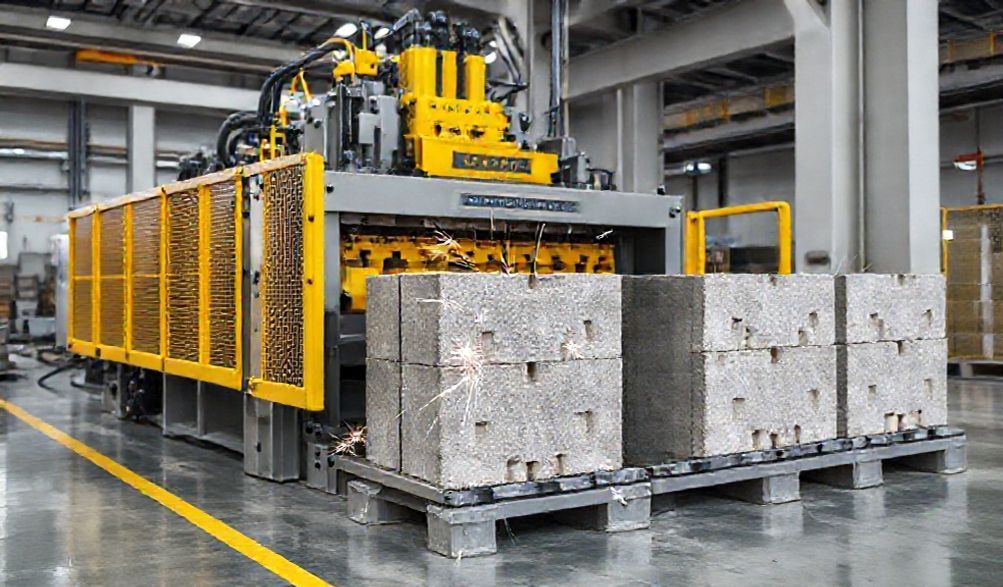
Your Ultimate Guide to Block Machines in China: Spotlight on FUDA Brick Machine Factory
Introdução
The global construction boom shows no signs of slowing. From urban housing projects to critical infrastructure, the demand for reliable, high-quality building materials is insatiable. At the heart of this material production lies a critical piece of equipment: the block making machine. These automated powerhouses have revolutionized the industry, turning raw materials like concrete and fly ash into precise, durable bricks, blocks, and pavers with unmatched efficiency.
However, navigating the vast and complex landscape of Chinese machinery manufacturers can be a daunting task. How do you distinguish a reputable, long-term partner from a short-lived trading company? The risks of poor quality, inadequate support, and financial loss are real concerns for any serious buyer.
This guide zeroes in on one prominent name in the industry: Fábrica de Máquinas de Tijolos FUDA. By providing a detailed, transparent analysis grounded in E-E-A-T principles (Experience, Expertise, Authoritativeness, Trustworthiness), we aim to equip you with the knowledge needed to make a confident procurement decision. Whether you are a construction company scaling operations, an entrepreneur starting a block yard, or a procurement specialist sourcing equipment, this deep dive will serve as your comprehensive roadmap.
Compreendendo as Máquinas de Fabricação de Blocos: Tipos e Aplicações
Before evaluating a supplier, it’s crucial to understand the equipment itself. Knowing your project requirements will directly inform which type of machine and which manufacturer is the best fit.
What is a Block Machine?
A block machine is an industrial device designed to compress a mixture of raw materials—typically cement, aggregates (sand, gravel), and water, often with additives like fly ash—into dense, uniform building blocks. The process is largely automated, ensuring:
- Consistência: Every block meets exact dimensional and strength specifications.
- Alta Produção: Machines can produce hundreds to thousands of blocks per hour.
- Custo-Eficiência: Drastically reduces labor costs and material waste compared to manual production.
- Versatilidade: By simply changing the mold, a single machine can produce a wide array of products, from standard hollow blocks to interlocking pavers and curbstones.
Common Types of Block Machines
The market offers several configurations, each suited to different production scales and business models.
- Stationary Block Machine: These are high-production powerhouses, often forming the core of a full automatic block production line. They are fixed installations with integrated systems for mixing, conveying, curing, and stacking. Ideal for large-scale, dedicated block manufacturing plants, they represent the flagship offerings of factories like FUDA.
- Mobile / Egg Laying Block Machine: A more affordable and flexible option. This machine produces blocks and deposits (“lays”) them directly onto the ground or a pallet on a level casting surface. It’s movable, requires less foundation work, and is perfect for on-site production for specific projects or smaller businesses.
- Automático vs. Semiautomático: This distinction cuts across the types above.
- Totalmente Automático: The entire process, from feeding raw material to ejecting and stacking finished blocks, is controlled by a programmable logic controller (PLC). It minimizes manual labor and maximizes output.
- Semi-Automático: Key processes like feeding material or removing blocks may require manual intervention. They offer a lower entry cost but higher operational labor.
Why Source Block Machines from China? A Market Overview
China has become the world’s workshop for industrial machinery, and block making equipment is no exception. Sourcing from China offers distinct advantages, but it requires a strategic approach.
中国机械的竞争优势
- Unbeatable Cost-Effectiveness: Due to economies of scale, mature supply chains, and competitive manufacturing costs, Chinese block machines often provide superior value. You can acquire advanced automation for a fraction of the cost of Western-made equivalents.
- Vast Manufacturing Ecosystem: The concentration of manufacturers, component suppliers, and skilled engineers creates a synergistic environment that drives innovation and customization. If you need a special mold or a machine modification, the capability exists.
- Adoção Rápida de Tecnologia: Chinese manufacturers are quick to integrate new technologies, such as touch-screen PLCs, energy-efficient hydraulic systems, and robust vibration mechanisms, to enhance performance and reliability.
Key Considerations When Choosing a Supplier
The low barrier to entry also means the market is crowded. Discerning quality is paramount.
- Experience & Longevity: A factory with 15-20 years of history has likely survived market cycles, improved its designs, and built a reputation. It’s a strong initial indicator of stability.
- Competência Técnica: Look for evidence of in-house Pesquisa e Desenvolvimento (P&D). Do they have engineers? Do they patent their innovations? This shows a commitment to product evolution, not just assembly.
- Processos de Controle de Qualidade: Certifications like ISO 9001 (Quality Management Systems) and CE (meeting EU health, safety, and environmental standards) are not just stickers; they represent a documented commitment to quality. Inquire about their material sourcing (e.g., brand of hydraulic components, grade of steel) and internal inspection流程.
- Serviço Pós-Venda: This is the ultimate deal-breaker. A machine is a long-term investment. Ensure the supplier offers comprehensive support: installation supervision, thorough operator training, a clear warranty, and a reliable supply of spare parts.
Deep Dive: FUDA Brick Machine Factory Analysis
Let’s apply the above framework to a specific contender: FUDA Brick Machine Factory.
Company Profile and Legacy
Based in the industrial heartland of Nanyang, Henan Province—a region renowned for its concentration of construction machinery manufacturers—FUDA has established itself as a significant player. The company specializes in the design, manufacturing, and export of a wide range of block and brick making machinery.
- Experience & Expertise: While an exact founding year is not always prominently advertised, industry profiles and trade listings suggest over a decade of operation, with a focused specialization in block machinery. This longevity implies accumulated technical know-how and process refinement.
- Scale & Capacity: FUDA operates from a substantial manufacturing facility, housing advanced CNC machining centers, welding stations, and assembly lines. This scale allows for controlled production and the ability to handle large or custom orders.
- Autoridade: The company actively participates in international trade shows and maintains B2B platform storefronts. Their machinery often carries Certificação CE, indicating compliance with stringent European directives, which builds credibility in global markets.
Product Range and Technical Specifications
FUDA’s catalog typically encompasses the spectrum of block production technology, demonstrating their especialização in catering to diverse client needs.
- Flagship Models: Their range often includes:
- Fully Automatic Block Production Lines (QT Series): High-output systems for large-scale plants, featuring automatic batching, mixing, block molding, curing, and pallet return systems.
- Semi-Automatic & Mobile Machines: Cost-effective solutions for medium and small businesses, such as egg-laying block machines.
- Máquinas Especializadas: Equipment for producing concrete paver blocks, interlocking bricks, and curb stones.
- Key Technical Highlights: When reviewing FUDA’s specifications, pay close attention to:
- Capacidade de Produção: Stated in blocks per 8-hour shift (e.g., 15,000-25,000 pieces for a standard hollow block on an automatic line).
- Sistema de Pressão: Hydraulic tonnage (e.g., 200-400 tons) which directly impacts block density and strength.
- Sistema de Vibração: A core component. High-frequency, dual-axis vibration ensures proper compaction and a smooth block finish.
- Sistema de Controle: Modern PLC with touch-screen interface for easy operation and fault diagnosis.
- Compatibilidade de Moldes: Ability to use standardized and custom molds for different block designs.
Quality and Manufacturing Standards
Aqui é ondeconfiabilidade is either built or broken.
- Qualidade de Construção: Reputable manufacturers like FUDA use high-grade steel for the machine frame and critical components. They often integrate internationally recognized components from brands like Siemens for electrical parts or Rexroth for hydraulics, which aids reliability and simplifies future maintenance.
- Verifiable Certifications:ACE mark is crucial. It’s not a quality guarantee per se, but it signifies the machine meets EU safety requirements. Always ask for the test reports. ISO 9001 certification is another strong indicator of a systematic approach to quality management.
- Inspection Process: A professional factory will have staged quality checks—from incoming materials to in-process assembly and final performance testing before shipment.
After-Sales Service and Global Support
FUDA, like its competitors, markets a global after-sales network. Scrutinize the details:
- Service Package: Typically includes:
- Supervisão de Instalação: Sending 1-2 engineers to the customer’s site for assembly and commissioning (note: travel and accommodation are often separate or included under specific trade terms).
- Treinamento de Operador: On-site training for machine operation, basic maintenance, and troubleshooting.
- Garantia: Standard warranties often cover core components (hydraulic system, mainframe, electrical cabinet) for 12-18 months, excluding wear parts like mold liners.
- Peças de Reposição: Confirm the policy. Do they keep an inventory of common spare parts? What are the lead times and shipping costs for parts?
- Global Client Base: Evidence of exports to regions like Africa, the Middle East, Southeast Asia, and South America reinforces their autoridade as an international supplier. Look for project photos or case studies on their official channels.
How to Evaluate and Procure from FUDA (A Step-by-Step Guide)
Armed with knowledge, here’s a practical step-by-step guide to engaging with FUDA or any Chinese supplier.
Initial Inquiry and Communication
- Prepare Your Requirements: Before contacting them, define:
- Desired block types, sizes, and strengths.
- Target daily/monthly output.
- Available factory space and power supply (voltage, phase).
- Budget range.
- Ask Probing Questions: Go beyond price. Ask about:
- The recommended model and why it fits your needs.
- Details of the core components (brands of hydraulic pump, PLC, etc.).
- The full scope of their after-sales service and warranty terms.
- Request a detailed product catalog and specification sheets.
The Importance of Factory Audits and Sample Visits
This step is non-negotiable for establishing trust.
- Physical Visit: If feasible, visit the FUDA factory in Nanyang. Inspect the production floor, welding quality, inventory of components, and testing procedures. Meet the engineering team.
- Virtual Audit: If travel isn’t possible, insist on a live video tour via WhatsApp or Zoom. Ask them to show you specific areas: the assembly line, the QC station, their component storage.
- Request Evidence: Ask for videos of a machine similar to your inquiry running under load. Can they provide contact information for previous clients in your region (with client permission)?
Understanding Quotations, Logistics, and Payment Terms
- Decoding the Quotation (Proforma Invoice):
- FOB (Livre a Bordo): Price includes delivery to the Chinese port and loaded onto the ship. You handle ocean freight, insurance, and import clearance.
- CIF (Cost, Insurance, Freight): Price includes delivery to a port in your country. FUDA handles shipping and insurance. You handle customs clearance and inland transport.
- Standard Payment Terms:
- T/T (Bank Transfer): A common structure is 30% deposit, 70% balance against copy of shipping documents. This balances risk for both parties.
- L/C (Letter of Credit): A bank-guaranteed payment, more secure for the buyer but more complex and costly.
- Shipping & Customs: Clarify responsibilities. If you are responsible for clearance, engage a reliable freight forwarder or customs broker in your country early in the process.
Perguntas Frequentes (FAQ)
Q1: What is the lead time for a FUDA block machine?
A: For standard models, lead times typically range from 25 to 40 days after receiving the deposit. Fully automatic lines or customized machines may require 45-60 days. Always confirm the current schedule.
Q2: Does FUDA provide installation and training?
A: Yes, it is standard practice for them to send engineers for installation and commissioning, including basic operator training. Clarify whether the cost for their flights, visas, and local accommodation is included in your contract or is an additional expense.
Q3: What is the warranty period, and what does it cover?
A: Standard warranty is commonly 12-18 months for core components (mainframe, hydraulic system, electrical cabinet) from the date of commissioning. Wear parts (molds, seal rings, filter elements) and damage from improper operation are excluded. Get the exact warranty terms in writing on the contract.
Q4: Can FUDA customize machines for specific block designs?
A: Absolutely. Most Chinese manufacturers, including FUDA, offer custom mold design and fabrication. For major machine modifications, discuss feasibility and cost implications during the technical negotiation phase.
Q5: How do I ensure I’m getting genuine FUDA equipment and not a copy?
A: 1) Deal directly with the factory using contact details from their official website. 2) Conduct a factory audit (physical or virtual). 3) Verify their business license. 4) Ensure all correspondence, contracts, and machine nameplates consistently use the “FUDA” branding.
Conclusão
Sourcing a block machine in China from a supplier like Fábrica de Máquinas de Tijolos FUDA presents a significant opportunity for value and capability. The Chinese market offers advanced, cost-effective solutions that can empower your construction or manufacturing business. As we’ve outlined, the key to success lies in a diligent, informed procurement process.
FUDA demonstrates many hallmarks of a serious manufacturer: a focused product range, adherence to international certifications like CE, and a stated commitment to after-sales support. Their presence in the industrial hub of Nanyang further supports their operational scale.
Final Recommendation: Use this guide as a structured checklist. Let the principles of E-E-A-T—verifying their Experiência, assessing their Especialização, establishing their Autoridade, and building Confiança through audits and clear contracts—guide your decision. While FUDA is a viable candidate to consider, your due diligence is the final and most critical step.
Call to Action: Begin your sourcing journey with confidence. Prepare your detailed project requirements, compile your list of technical and commercial questions, and initiate contact with potential suppliers. Remember, an informed buyer is a protected buyer.
Disclaimer Note: This guide is based on industry expertise and standard evaluation frameworks for machinery procurement. Specifications, policies, and operational details of FUDA Brick Machine Factory should be verified directly with the company for the most accurate and current information.
<