
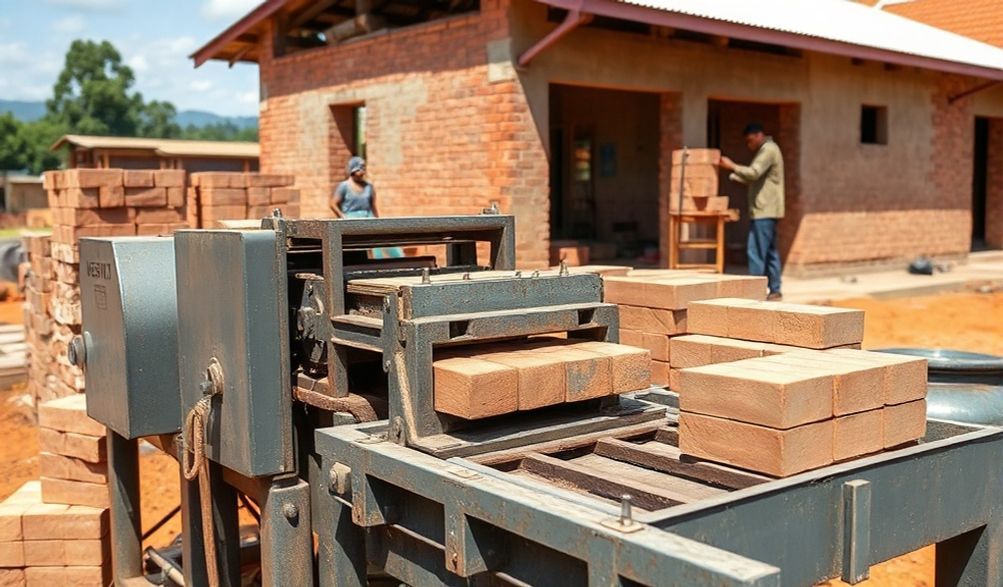
Полное руководство по станкам для производства кирпича в Руанде: типы, цены и лучшие поставщики (2026)
Введение
Руанда меняет свой облик. Движимая амбициозными национальными целями, такими как «Видение 2050» и Национальная стратегия трансформации (NST1), страна переживает устойчивый строительный бум. По данным Жилищного управления Руанды, для удовлетворения потребностей урбанизации и роста населения, особенно в расширяющихся городах, таких как Кигали, необходимо сотни тысяч новых жилых единиц. В основе каждого нового дома, школы, больницы и дороги лежит фундаментальный строительный элемент: кирпич.
Однако для многих строителей, подрядчиков и предпринимателей сохраняется критическое узкое место. Зависимость от традиционного ручного производства кирпича приводит к нестабильному качеству, непредсказуемым срокам реализации проектов и росту затрат на рабочую силу. Как может Руанда строить своё будущее, если её основные материалы нестабильны, а производство идёт медленно?
Решение произвело революцию на строительных площадках по всей стране: современный станок для производства кирпича. Это руководство создано, чтобы отсечь лишнее. Как отраслевые эксперты с практическим опытом работы на рынке Восточной Африки, мы даем профессиональные, объективные и практические советы. Наша цель — дать вам возможностьстроительные компании, девелоперы недвижимости, амбициозные местные предприниматели и государственные менеджеры проектовв Руанде, чтобы сделать уверенные, обоснованные инвестиции, которые повышают качество, эффективность и прибыльность.
Почему стоит инвестировать в оборудование для производства кирпича в Руанде?
Инвестиции в технологию производства кирпича больше не являются роскошью; это стратегическое решение, соответствующее траектории роста Руанды. Понимание местного контекста является ключом к осознанию всей ценности предложения.
Руандийский строительный ландшафт: рост, спрос и государственные инициативы
Экономика Руанды демонстрирует устойчивый рост, сопровождаемый значительными государственными и частными инвестициями в инфраструктуру и недвижимость. Темпы урбанизации растут, а такие правительственные инициативы, как пилотный проект «Зелёный город Кигали» и Программа доступного жилья, создают беспрецедентный спрос на стандартизированные качественные строительные материалы.
这一政策驱动的需求,加上私营部门的发展,直接转化为砖块市场的蓬勃发展。传统的手工制砖方式已无法满足现代项目及挑剔买家对规模、速度和品质标准的要求。制砖机将您置于这一经济引擎的核心位置。
Ключевые преимущества по сравнению с ручным производством кирпича
- Высокое и стабильное качество:Машины оказывают точное, повторяемое давление и вибрацию. Это позволяет производить кирпичи и блоки одинакового размера, плотности и прочности на сжатие, обеспечивая соответствиеRwanda Standards Board (RSB) guidelines. Consistent quality minimizes structural issues and reduces waste on-site.
- Dramatically Increased Production Speed: While a skilled artisan might produce 500-800 bricks per day, a basic manual machine can produce 2,000-3,000. Semi-automatic models can output 5,000-10,000 blocks daily. This speed is crucial for meeting tight project deadlines and scaling output.
- Долгосрочная экономическая эффективность: Although the initial investment is higher, the Return on Investment (ROI) is compelling. You drastically reduce per-unit labor costs and material waste. Over a single large project or a year of operation, the machine often pays for itself, turning a cost center into a profit center.
- Предпринимательская возможность: This isn’t just for self-use. A reliable machine allows you to start a commercial brick supply business, catering to the vast demand from smaller builders and individual homeowners, creating jobs and building a sustainable enterprise.
Types of Brick Making Machines Suitable for Rwanda
Choosing the right type of machine is the most critical decision. The “best” machine depends entirely on your scale, budget, and business model.
Ручные станки для производства кирпича
These are lever-operated or simple hydraulic presses that require significant human effort to feed, compress, and eject blocks. They are not automated but provide a massive upgrade over hand-molding.
- Операция: An operator fills the mold with raw material (soil-cement mix), manually applies pressure via a lever, and releases the formed block.
- Лучше всего подходит для: Individual homeowners, very small-scale projects, startups with minimal capital, and community co-ops in rural areas where labor is available but capital is limited.
- Плюсы: Lowest upfront cost, simple to understand and repair, no electricity needed.
- Минусы: High physical labor requirement, lower output, quality can vary with operator fatigue.
Полуавтоматические машины для производства кирпича
This is the sweet spot for many growing Rwandan businesses. They use an electric or diesel engine to power a hydraulic system and vibratory table, automating the compaction and vibration process. The operator primarily feeds raw material and removes finished blocks.
- Операция: The operator places the mix in the hopper. The machine automatically feeds the mold, compresses the block with vibration and high pressure, and ejects it onto a pallet. The operator stacks the pallets.
- Лучше всего подходит для: Small to medium-sized construction companies, dedicated brick-making SMEs, and housing development projects requiring a steady, reliable supply.
- Плюсы: Excellent balance of output and cost, consistent quality, reduces heavy labor, versatile in product types.
- Минусы: Higher initial investment than manual machines, requires a power source, needs basic technical knowledge for maintenance.
Полностью автоматические машины для производства кирпича
These are industrial production lines. They feature automated material feeding, mixing, molding, curing, and stacking, often controlled by a programmable logic controller (PLC). Human intervention is minimal, primarily for monitoring.
- Операция: Raw materials are loaded into a feeder, and the entire process—from mixing to palletizing—is automated. Output can be directed to a curing chamber.
- Лучше всего подходит для: Large construction firms, industrial-scale brick manufacturing plants, and suppliers aiming for major government or commercial contracts requiring vast, consistent output.
- Плюсы: Maximum output with minimal labor, unparalleled consistency, highest efficiency for very large volumes.
- Минусы: Very high capital investment, requires significant space and stable three-phase power, complex maintenance requiring specialist technicians.
Мобильные станки для производства кирпича
A game-changer for specific projects, these are compact, trailer-mounted units (often semi-automatic) that can be towed directly to a construction site.
- Операция: Similar to a semi-automatic machine but designed for portability and quick setup on relatively flat ground.
- Лучше всего подходит для: Large, remote infrastructure projects (e.g., roads, dams, rural schools), developers building on large tracts of land where transporting bricks is costly. In our experience, projects in the hilly terrain of Rwanda’s Western and Northern Provinces can see significant logistical savings with this model.
- Плюсы: Eliminates brick transport costs, allows on-site production tailored to daily needs, reduces brick damage from handling.
- Минусы: Output is typically lower than stationary semi-automatic models, requires on-site raw material and fuel/power management.
Key Features to Consider Before Buying
Beyond the machine type, these features will determine your long-term satisfaction and profitability.
Production Capacity (Blocks per Hour/Day)
Don’t just buy the biggest machine. Match capacity to your realistic demand.
* For on-site project use: Calculate your peak daily brick requirement and add a 20-30% buffer.
* For a commercial supply business: Start with a realistic sales forecast for Year 1 and choose a machine that can meet 70-80% of that. You can scale up later.
Разнообразие типов и размеров кирпича
The ability to produce multiple products future-proofs your investment. Look for machines that can easily interchange molds for:
* Пустотелые блоки: Standard for wall construction, reducing weight and material use.
* Сплошные блоки: For foundations and high-load areas.
* Взаимосцепляющиеся кирпичи: Crucial for Rwanda’s sloped terrain and seismic considerations. They require no mortar for laying, are ideal for retaining walls, and align with modern building techniques.
* Брусчатка: For driveways, walkways, and landscaping, a high-margin add-on product.
Power Source: Electric, Diesel, or Hybrid?
This decision hinges on your location and Rwanda’s infrastructure.
* Электрический: Cleaner, quieter, and lower operating cost если you have a reliable grid connection. Essential for automatic machines. Consider a generator backup for areas with intermittent supply.
* Дизель: Full independence from the grid. Preferred for remote sites or mobile operations. Factor in fuel costs, noise, and emissions.
* Гибрид: Offers the flexibility to switch between power sources, providing valuable redundancy. Ideal for areas where grid reliability is a concern.
Долговечность и послепродажная поддержка
This is non-negotiable. A machine is a long-term asset.
* Прочность: Look for robust frames, high-quality hydraulic cylinders, and hardened steel molds. Thicker steel and reputable component brands (e.g., Siemens, Mitsubishi for electronics) indicate longevity.
* Послепродажная поддержка: This is the most critical factor for success in Rwanda. Prioritize suppliers who offer:
* A clear warranty (1+ years on core parts).
* Available local technicians or training for your staff.
* Аphysical warehouse of spare parts in Kigali or East Africa (Nairobi, Dar es Salaam).
* Proven service contracts with other clients in the region.
Cost Analysis and Supplier Insights for Rwanda
Transparent financial planning prevents unexpected setbacks.
Understanding the Price Range
Prices vary widely based on type, capacity, and brand. Here are estimated brackets in Rwandan Francs (RWF) as of 2026 projections:
* Ручные станки: RWF 1.5 million – RWF 4 million.
* Полуавтоматические станки: RWF 8 million – RWF 25 million.
* Полностью автоматические машины: RWF 40 million – RWF 150 million+.
* Мобильные машины: RWF 15 million – RWF 35 million.
Always clarify what’s included: Installation, on-site training, a starter set of spare parts (filters, seals), and mold for one block type should be part of the negotiation.
Evaluating Suppliers: Local Dealers vs. International Manufacturers
- Local/Regional Dealers (based in Kigali or East Africa):
- Плюсы: Easier communication, faster delivery and parts logistics, understanding of local market conditions, potential for quicker service calls.
- Минусы: May have a limited range of models, prices may include their markup.
- Direct International Manufacturers (e.g., from China, India, Turkey):
- Плюсы: Potentially lower FOB prices, widest selection of models and customization.
- Минусы: Complex logistics, import duties, language/time zone barriers, major after-sales challenges if no local representative.
Trust Verification Checklist: Ask any supplier for:
1. Client references from Rwanda, Kenya, Uganda, or Tanzania. Call them.
2. Proof of a physical office or warehouse in the region.
3. A detailed service and warranty contract in writing.
4. Documentation of conformity with relevant international or RSB standards.
Hidden Costs to Budget For
Failing to plan for these can cripple your project:
1. Import Duties & Taxes: Consult the Rwanda Revenue Authority (RRA) for the latest HS codes and rates for construction machinery. Budget 15-25% of the CIF value for duties and VAT.
2. Транспортировка и логистика Includes sea freight, port clearance in Dar es Salaam or Mombasa, and trucking to Kigali/your site. Get a detailed quote from a freight forwarder.
3. Установка и ввод в эксплуатацию: Some suppliers include this, others charge extra.
4. Обучение операторов: Essential for efficiency and safety.
5. Maintenance Fund: Set aside 3-5% of the machine’s cost annually for spare parts and routine servicing.
Operational Tips and Maintenance for Longevity
Your machine’s performance depends on how you operate and care for it.
Setting Up Your Operation
- Site: Choose a level, well-drained area with enough space for raw material storage, production, and block curing (a critical 7-14 day process for strength).
- Сырье: Rwanda’s local soil can be effective, but a soil test is highly recommended to determine the optimal cement-soil ratio. Inconsistent soil quality is a primary cause of poor bricks. Source quality Portland cement from reliable suppliers.
Routine Maintenance Checklist
- Ежедневно: Clean the machine thoroughly after use, especially the mold and hopper. Check hydraulic oil levels and for leaks. Grease all moving points (pivots, bearings).
- Weekly: Inspect bolts and nuts for tightness. Check vibration motor mounts. Clean the hydraulic oil filter.
- Monthly: Change hydraulic oil and filters as per manual. Inspect mold liners for wear. Check electrical connections for tightness.
Устранение распространённых проблем
- Blocks are weak or crumbly: Incorrect water-cement-soil ratio. Conduct a mix test.
- Blocks stick in the mold: Mold needs lubrication (use a recommended release agent) or is damaged/worn.
- Poor surface finish: Vibration time or pressure is insufficient, or the mix is too dry.
- Machine vibrates excessively: Loose bolts on the vibration motor or frame.
- Hydraulic system is slow/weak: Low oil level, clogged filter, or worn pump.
Frequently Asked Questions (FAQ)
Q1: What is the most popular type of brick making machine in Rwanda for a small business?
A: The semi-automatic machine is the most popular choice. It offers the ideal balance of affordable automation, significant output (enough to supply a business), and manageable technical complexity for a growing enterprise.
Q2: Can these machines use Rwanda’s local soil effectively? Do I need a soil test?
A: Yes, they are designed for local soils. However, a soil test is strongly advised. It determines the clay, silt, and sand composition, telling you the exact percentage of cement needed to produce strong, durable blocks, saving you money on cement and preventing production failures.
Q3: What are the import regulations and average duty for bringing a machine into Rwanda?
A: You will need a Certificate of Conformity (from PVoC agent at origin), commercial invoice, packing list, and bill of lading. Duties vary; consult the RRA. Generally, expect a total tax and duty burden of 15-25% of the CIF value. A reliable freight forwarder is essential.
Q4: How do I find a reliable technician to service my machine in Rwanda?
A: This is why supplier choice is key. Choose a supplier who provides training for your staff и has a local service network. Alternatively, established mechanical workshops in Kigali that service heavy equipment can often be trained on specific machines.
Q5: What is the typical payback period for a medium-sized brick making machine investment in Rwanda?
A: For a semi-automatic machine running a commercial supply business, the payback period can range from 12 to 24 months, depending on management, market demand, and pricing. For on-site use on a large project, it can pay for itself on that single project by eliminating purchased brick costs.
Q6: Are there any government incentives or financing options for this equipment?
A: While there is no direct subsidy for brick machines, initiatives like the Business Development Fund (BDF) and various commercial bank loans target SME growth in manufacturing and construction. Presenting a solid business plan for a brick-making enterprise can help you access such financing. Always check with RDB (Rwanda Development Board) for the latest support programs.
Заключение
Investing in a brick making machine in Rwanda is more than a purchase; it’s a strategic commitment to quality, efficiency, and growth. The journey involves carefully matching the machine type to your needs, prioritizing durable build quality and—above all—ensuring robust after-sales support within East Africa. By understanding the total costs, from import duties to maintenance, you can build a realistic and profitable business plan.
This investment empowers you to build better, contribute to Rwanda’s infrastructure goals, and create sustainable economic value. As you move forward, conduct thorough due diligence: visit supplier operations if possible, speak to their existing clients, and consult with fellow builders and entrepreneurs.
The future of Rwandan construction is not only about building up but building smart. Embracing efficient technology like brick making machines, and exploring sustainable trends such as incorporating recycled materials into your blocks, positions you at the forefront of the nation’s green growth journey. Your next step is to turn this knowledge into action.
<