
The Complete Guide to Concrete Block Manufacturing: Processes, Machines, and Best Practices
Concrete blocks are the unassuming heroes of the built environment. From foundational walls to decorative facades, their durability, versatility, and cost-effectiveness make them indispensable. Yet, the journey from a pile of raw materials to a precision-engineered building unit is a complex dance of chemistry, physics, and mechanical engineering. This comprehensive guide pulls back the curtain on professional block making, synthesizing decades of industry knowledge into a single, authoritative resource.
Whether you are a contractor specifying materials, a civil engineer designing systems, or an entrepreneur evaluating a plant investment, this guide moves beyond simple definitions. We will explore the nuanced manufacturing processes, dissect the critical machinery, and unpack the expert best practices that distinguish high-quality, reliable production from substandard output. Consider this your foundational text on the science and business of creating the literal building blocks of modern construction.
Understanding Concrete Blocks: Types and Specifications
Before delving into как blocks are made, it’s crucial to understand что is being made. The term “concrete block” encompasses a family of products, each engineered for specific performance criteria.
Hollow vs. Solid Concrete Blocks
The primary distinction lies in their cross-section.
-
Пустотелые бетонные блоки: These have one or more large holes (called “cores”) that typically make up 50-75% of their total area.
- Properties & Applications: Lighter weight reduces structural load and makes handling easier. The cores provide space for vertical steel reinforcement and concrete grout, creating immensely strong load-bearing walls. They also offer better fire resistance and inherent insulation value due to the air pockets.
- Common Use: Standard load-bearing and non-load-bearing walls in residential, commercial, and industrial construction.
-
Твердые бетонные блоки: As the name implies, these have a solid cross-section with no large cores, though they may have small indentations (“frogs”).
- Properties & Applications: Denser and heavier, offering higher compressive strength and superior sound insulation. They are often used where maximum mass and stability are required.
- Common Use: Foundations, retaining walls, paving, and applications where high point loads or severe abrasion are expected.
Standard Sizes and Grades (ASTM C90/C140)
Consistency is key in construction. In the United States, the ASTM International standards provide the benchmark.
- Nominal vs. Actual Dimensions: A block with a nominal size of 8″ x 8″ x 16″ is designed to fit in a wall with 8″ of mortar. Its фактический dimensions are typically 7 5/8″ x 7 5/8″ x 15 5/8″, allowing for a 3/8″ mortar joint.
- Compressive Strength Grades: ASTM C90 defines minimum strength requirements for load-bearing concrete masonry units.
- Grade N (Normal): Minimum compressive strength of 1,700 psi (11.7 MPa). Suitable for general use above and below grade, provided it is protected from moisture.
- Grade S (Special): Minimum compressive strength of 2,000 psi (13.8 MPa). Used where higher strength or resistance to moisture penetration is needed.
Specialized Block Types
Beyond the standard hollow and solid units, specialized blocks serve unique functions.
- Легковесные блоки: Manufactured using lightweight aggregates like expanded clay, shale, or slate. They offer easier handling and significantly improved thermal insulation.
- Брусчатка (Тротуарная плитка): Dense, solid blocks designed for durability and freeze-thaw resistance. Used in driveways, walkways, and patios.
- Взаимосцепляющиеся блоки: Designed to fit together without mortar, often used for retaining walls and some construction systems.
- Architectural/Faced Blocks: Feature textured, scored, or colored faces for aesthetic appeal, serving as both structure and finish.
The Concrete Block Manufacturing Process: A Step-by-Step Breakdown
The transformation of raw materials into a finished block is a linear, highly controlled process. Each stage is interdependent; a flaw in one compromises the final product.
1. Raw Material Selection and Batching
Quality begins here. Consistent, specification-grade raw materials are non-negotiable.
- Portland Cement: The binder. Type I/II is common. It must be fresh and stored properly to prevent pre-hydration.
- Агрегаты: Typically a blend of fine (sand) and coarse (gravel or crushed stone) aggregates. They must be clean, hard, and durable, with controlled particle size distribution for optimal packing and strength.
- Вода: Potable water is standard. Impurities can affect setting time and cause surface efflorescence (white, powdery deposits).
- Admixtures: Chemical additives can be used to modify properties. Examples include:
- Пигменты: For integral color.
- Water Reducers: To achieve a workable mix with less water, increasing final strength.
- Accelerators: To speed up early strength gain.
Batching is done by weight (not volume) for extreme precision, using computerized systems to ensure the exact same mix formula for every batch.
2. Mixing and Consistency
The goal is a completely homogeneous, “no-slump” or “low-slump” concrete—a damp mixture that holds its shape when molded.
- Mixer Types:
- Pan Mixers: The industry standard for block making. Fixed blades rotate in a stationary pan, creating a shearing action ideal for stiff mixes.
- Planetary Mixers: Blades rotate on their own axes while orbiting the mixer, offering intense, thorough mixing.
- Mixing Time: Sufficient time is critical to coat every aggregate particle with cement paste, ensuring uniform strength.
3. Molding and Compaction: The Heart of Block Making
This is where the block takes form. The mixed concrete is fed into a block making machine.
- Процесс: The mix is dropped into a mold box (the negative shape of the block) sitting on a steel pallet.
- Vibration & Pressure: The machine subjects the mix to intense, high-frequency vibration combined with simultaneous hydraulic pressure from above (tamping or pressurizing head). This dual action drives out entrapped air, consolidates the material, and forces it into every corner of the mold, achieving high density and sharp, detailed edges.
- Стриптиз: After compaction, the mold box is lifted vertically, leaving the freshly formed “green” block on the pallet. The block is now self-supporting but has minimal strength.
4. Curing: Achieving Strength and Durability
Curing is not simply drying; it’s the controlled process of cement hydration where the block gains its engineered strength.
- Steam Curing (Kiln Curing): The most efficient method for high-volume plants.
- Pre-Steaming (Resting): Green blocks are rolled into a curing chamber (kiln) and allowed to rest, preventing thermal shock.
- Heating: Saturated steam is introduced, raising the temperature to ~140-180°F (60-80°C) over several hours.
- Holding: The temperature is maintained for 12-18 hours. This accelerated hydration gives blocks about 70-80% of their ultimate strength in less than a day.
- Охлаждение: Temperature is reduced gradually before the blocks are removed.
- Water Curing: Blocks are immersed in or sprayed with water for several days. Effective but slower and less energy-efficient for large-scale production.
- Air Curing: Blocks are left to cure naturally in a protected environment. This can take 28 days to reach full strength and is highly dependent on ambient weather conditions.
5. Cubing and Palletizing for Storage & Shipment
The final step prepares the product for the job site.
- Cubing: An automated cuber collects blocks from the curing pallets and assembles them into a stable cube (e.g., 6 blocks wide x 4 blocks high x 2 blocks deep).
- Strapping/Wrapping: The cube is strapped with steel or plastic bands and often wrapped in plastic for weather protection during outdoor storage and transport.
- Storage: Cubes are stored in the yard, ready to be shipped via flatbed truck.
Essential Machinery for Modern Block Making Plants
A block plant is a symphony of interconnected machines. Reliability and compatibility are paramount.
The Core Machine: Concrete Block Making Machines
- Стационарные против мобильных:
- Стационарные установки: High-output machines (1,000 – 10,000+ blocks per hour) fixed in a factory setting. They are fully automated, integrating mixers, conveyors, and cubers.
- Мобильные машины: Smaller, self-contained units that can be towed to a job site. Ideal for on-site production for large projects or small businesses, with outputs from 500 – 2,000 blocks per hour.
- Ключевые компоненты: A modern machine is defined by its robust гидравлическая система (for pressure), its high-frequency вибрационная система (often with multiple synchronized vibrators), and a programmable logic controller (PLC control panel) for precision and repeatability.
Supporting Equipment for an Efficient Plant
The block machine is the star, but it cannot perform without its supporting cast.
- Материально-техническое обеспечение: Aggregate bins with feeders, belt conveyors, cement silos with screw conveyors, and bucket elevators move raw materials to the batching area.
- Batching Plant & Mixer: The computerized batching system and the industrial mixer form the “heart” feeding the block machine.
- Система циркуляции паллет: A closed-loop system that feeds clean, level pallets into the machine and cycles used pallets from the curing chambers back to the start.
- Cubing and Stacking Line: Automates the collection, cubing, and strapping of finished blocks.
- Forklifts & Yard Equipment: For handling raw material deliveries and moving finished block cubes.
Quality Control in Block Manufacturing: Ensuring Consistent Performance
A trustworthy manufacturer’s reputation is built on relentless quality control (QC).
In-Process Quality Checks
QC is proactive, not just reactive.
- Mix Consistency: Regular checks on the moisture content and workability of the fresh mix.
- Green Strength: Simple tests on a freshly molded block to ensure it can withstand handling.
- Dimensional Checks: Verifying the height and width of green blocks against gauges.
- Curing Chamber Monitoring: Logging temperature and humidity throughout the steam cycle.
Laboratory Testing for Compliance
Samples are regularly pulled for destructive testing to verify compliance with standards like ASTM C90.
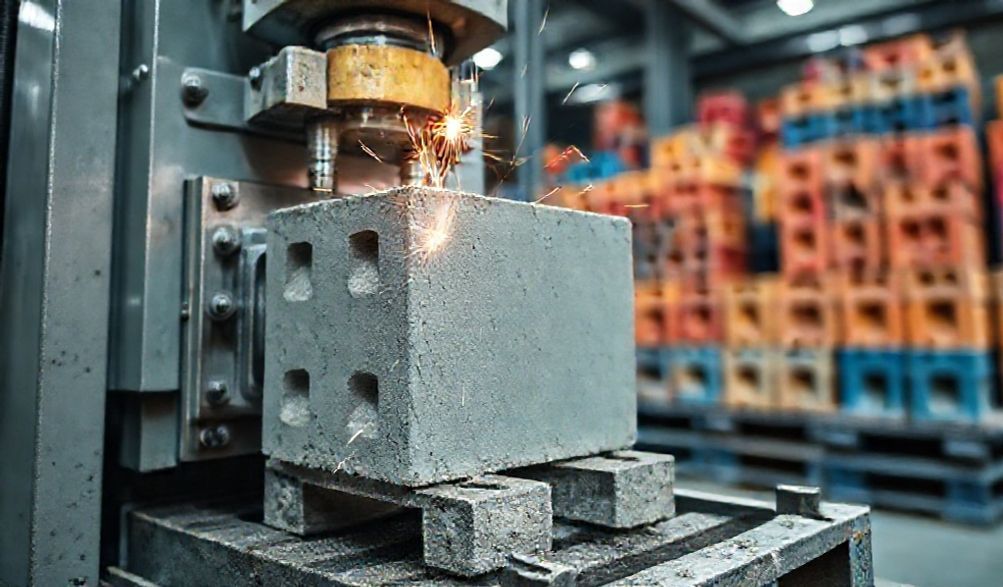
- Compressive Strength Test: The definitive test. Blocks are capped and crushed in a press to measure their failure load.
- Water Absorption Test: Measures the porosity of the block, which affects durability and weather resistance.
- Density Test: Ensures the block meets the specified weight classification.
- Dimensional Tolerances: Precise measurement of length, height, and width.
Visual and Dimensional Inspection
Every block cube is subject to visual scrutiny for common defects, which are process indicators:
- Chips & Broken Edges: Often from improper handling or stripping from the mold.
- Cracks: Can result from improper curing cycles, poor mix design, or excessive vibration.
- Discoloration: Inconsistent raw materials or mixing.
- Surface Scaling: Usually a curing or mix water issue.
Starting a Concrete Block Manufacturing Business: Key Considerations
Turning block making into a business requires strategic planning beyond technical knowledge.
Market Research and Feasibility
- Demand Analysis: Study local construction activity, growth trends, and the density of competing block plants.
- Competitor Analysis: Identify their strengths, weaknesses, product range, and pricing.
- Gap Analysis: Can you compete on price, quality, service, or by offering a specialized product (e.g., colored blocks)?
Plant Setup: Location, Layout, and Investment
- Location: Proximity to both raw material sources (to minimize freight costs) and your target market is ideal. Ensure access to reliable utilities (3-phase power, water) and good transportation routes.
- Layout: Design the plant for a logical, efficient material flow: raw material storage -> batching -> mixing -> block machine -> curing -> cubing -> finished goods yard.
- Инвестиции: Capital costs vary wildly. A small mobile operation may start under $100,000. A fully automated stationary plant requires a multi-million dollar investment in land, buildings, and machinery.
Operational Costs and Profitability Drivers
Understanding your cost structure is critical.
- Major Cost Components: Raw materials (~60-70% of cost), labor, energy (especially for steam curing), maintenance, and logistics.
- Key Profitability Drivers:
- Производственная эффективность: Maximizing machine uptime and output.
- Curing Efficiency: Optimizing steam cycles to reduce energy use per block.
- Material Yield: Minimizing waste in batching and handling.
- Качество: Reducing reject rates and building a reputation that commands a fair price.
Sustainability and Innovation in Block Production
The industry is evolving to meet demands for greener construction.
Using Recycled Materials
- Supplementary Cementitious Materials (SCMs): Replacing a portion of Portland cement with industrial by-products like зола-унос (from coal plants) or slag cement (from steel production) reduces the carbon footprint and can improve long-term strength and durability.
- Recycled Concrete Aggregate: Crushed, old concrete can be used as a partial replacement for virgin aggregate.
Energy-Efficient Curing and Production
- High-Efficiency Burners & Kiln Insulation: Reducing natural gas consumption in steam boilers.
- Heat Recovery Systems: Capturing waste heat from the kiln for other plant uses.
- Alternative Curing Methods: Research into using solar energy or microwave-assisted curing.
The Future of Block Making
- Automation & IoT: Fully automated, “lights-out” plants with sensors monitoring machine health, predicting maintenance, and optimizing production in real-time.
- High-Performance Formulas: Development of blocks with ultra-high strength, enhanced insulation (autoclaved aerated concrete – AAC blocks), or integrated photocatalytic properties to clean air.
FAQ Section
Q1: What is the typical compressive strength of a standard concrete block?
А: For load-bearing units per ASTM C90, standard grades are 1,700 psi (11.7 MPa) for Grade N (normal) and 2,000 psi (13.8 MPa) for Grade S (special). Non-load-bearing blocks have lower requirements. Always check the manufacturer’s spec sheet for certified values.
Q2: How long does it take to manufacture a concrete block from start to finish?
А: In a modern plant using steam curing, a block can go from raw materials to a palletized, full-strength product in about 24 hours. The molding process takes seconds, but the controlled curing cycle (including heating, holding, and cooling) typically takes 12-18 hours.
Q3: What is the main difference between a concrete block and a cinder block?
А: Historically, “cinder blocks” used coal cinders as aggregate, making them lighter and less strong. Modern “concrete blocks” use sand, gravel, or stone. Today, the terms are often used interchangeably, but all commercially produced masonry units are concrete blocks meeting specific ASTM standards.
Q4: Can I start a small-scale block making business?
А: Yes. Mobile or small stationary block machines allow for lower-volume production. Success depends heavily on local market demand, access to consistent raw materials, and a solid understanding of the curing process to ensure product quality. A detailed business plan is essential.
Q5: How do I choose a reliable concrete block supplier?
А: Ask for proof of compliance with ASTM/EN standards (test reports), visit the plant to observe their processes and quality controls, check the consistency of block dimensions and color, and assess their reputation with local contractors and builders.
Conclusion
Concrete block manufacturing is far more than pouring mix into a mold. It is a sophisticated, integrated system where materials science, mechanical precision, and rigorous process control converge. Successful block making hinges on mastering this entire ecosystem—from the geology of aggregates and the chemistry of cement to the thermodynamics of curing and the mechanics of automation.
This guide has provided a foundation built on industry ОпытиЭкспертиза. For construction professionals, this knowledge is power—enabling you to specify materials intelligently and hold suppliers to a high standard. For aspiring manufacturers, it underscores that an АвторитетныйиДоверенный business is forged through an unwavering commitment to consistency, quality, and continuous improvement. The strength of a wall, and ultimately a structure, begins with the integrity of each individual block.
Next Steps: Use this knowledge as a benchmark. Audit your current block sources, ask deeper questions, and prioritize quality over the lowest bid. If you’re embarking on a manufacturing venture, proceed with detailed feasibility studies and partner with reputable equipment suppliers. By championing excellence in this fundamental process, we contribute to safer, more durable, and more sustainable construction for everyone.
<