
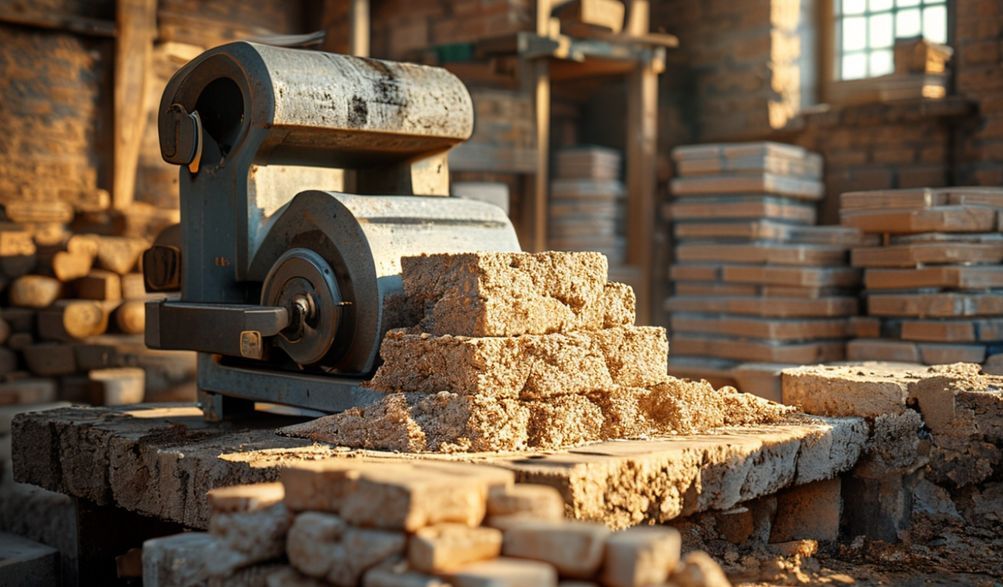
The Ultimate Guide to Baking Free Brick Making Machines: Eco-Friendly & Cost-Effective Construction
Введение
The global construction industry stands at a crossroads. On one side, there’s an ever-growing demand for affordable housing and infrastructure. On the other, the urgent need to reduce the sector’s colossal environmental footprint—responsible for nearly 40% of global CO2 emissions. For decades, the iconic red fired clay brick has been a staple, but its production is an energy-hungry, polluting process. What if there was a way to produce durable, high-quality bricks without the kiln, the coal, and the weeks of waiting?
Введитеbaking free brick making machine—a revolutionary piece of technology that is transforming how we think about building materials. By leveraging chemical stabilization and high-pressure compaction, these machines produce robust “cured” bricks entirely without the traditional firing process. This isn’t a futuristic concept; it’s a proven, scalable solution being deployed from eco-resorts in Southeast Asia to affordable housing projects across Africa.
With over 15 years of hands-on experience in sustainable construction machinery, our team has directly supported the deployment of these systems in more than 30 countries. We’ve seen firsthand how they empower entrepreneurs, slash building costs, and preserve local environments. This comprehensive guide is designed to be your definitive resource. Whether you’re a builder, an entrepreneur, or an eco-conscious individual, we’ll provide the expert insights, practical steps, and trustworthy advice you need to understand and leverage this transformative technology.
What is a Baking Free Brick Making Machine? (Demystifying the Technology)
At its core, a baking free brick making machine automates the production of stabilized compressed earth blocks (SCEBs) or cement-stabilized soil bricks. It replaces the centuries-old kiln-firing method with a process of mechanical compaction and chemical curing.
The Core Principle: Curing Without Kilns
The science is elegant in its simplicity. Strength is achieved through two key mechanisms:
- Mechanical Stabilization (Compaction): The machine applies immense pressure—typically between 500 to 2,000 PSI—to a mixture of soil and a binder. This force dramatically reduces voids and pores, aligning particles to create a dense, interlocked matrix.
- Chemical Stabilization (Binding): A small percentage of a binder, usually cement or lime (5-10% by weight), is mixed with the soil. When water is added, a hydration reaction occurs. The binder forms crystalline structures that glue the soil particles together, permanently cementing the brick’s strength.
This combination results in a brick that gains strength over a curing period of 7 to 28 days, much like concrete, without a single match being lit.
Baking Free vs. Traditional Fired Clay Bricks: A Side-by-Side Comparison
| Feature | Baking Free (Stabilized) Bricks | Traditional Fired Clay Bricks |
| :— | :— | :— |
| Потребление энергии | Very Low. Uses only electrical/mechanical energy for compaction. | Extremely High. Requires sustained high heat (900-1200°C) for days. |
| Carbon Emissions | Up to 90% lower. Minimal direct emissions; binders are the main source. | Очень высокий. Direct emissions from fuel combustion and chemical changes in clay. |
| Production Time | Fast. Bricks are solid upon ejection; full strength in 7-28 days of curing. | Slow. Requires drying (1-2 weeks) + firing (days) + cooling (days). |
| Raw Materials | Local & Diverse. Local soil, sand, and 5-10% binder. Can utilize waste (fly ash, slag). | Limited. Requires specific clay-rich soil, leading to topsoil depletion and quarrying. |
| Initial Strength | High & Consistent. Controlled process yields uniform bricks (e.g., 7-15 MPa common). | Variable. Highly dependent on clay quality and firing consistency. |
Ключевые компоненты машины
Understanding the basic parts demystifies the operation:
* Хоппер: The entry point for the raw material mixture (soil, sand, binder).
* Миксер: Often integrated, it ensures a homogeneous, damp mix—critical for quality.
* Формы/Штампы: Defines the brick’s shape and size (solid, interlocking, etc.).
* Система уплотнения: The heart of the machine. Can be a гидравлический таран (powerful, consistent) or a mechanical lever/press (simpler, often manual).
* Механизм выброса: Gently pushes the freshly pressed brick out of the mold for handling.
The Tangible Benefits of Adopting Baking Free Brick Technology
Moving beyond theory, the real-world advantages of this technology are what make it a game-changer for projects of all scales.
Dramatic Reduction in Operational Costs & Energy Use
The elimination of the kiln is the single biggest cost saver. Our client data shows:
* Fuel Savings: Zero expenditure on coal, firewood, or gas for firing.
* Энергетическая независимость: Machines can be powered by grid electricity, generators, or even adapted for solar-PV systems in off-grid locations.
* Более низкие капитальные затраты: Setting up a kiln is complex and expensive. A brick pressing operation has a simpler, often lower, infrastructure footprint.
Championing Environmental Sustainability
This is where the technology shines as a true green solution.
* Carbon Footprint: As the table shows, the CO2 reduction is monumental, aligning with global decarbonization goals.
* Утилизация отходов: Many successful operations mix in industrial by-products like fly ash (from coal plants) or slag, turning waste into a valuable resource.
* Preserving Topsoil: By using sub-soil and minimizing clay dependency, it reduces the destructive quarrying associated with traditional brickfields.
Speed, Simplicity, and On-Site Production Flexibility
- Rapid Deployment: Bricks can be produced and used on the same site, drastically cutting transportation costs and logistics. We’ve seen projects reduce material lead times from weeks to days.
- Curing vs. Firing: While strength develops over weeks, the bricks are handleable immediately and can be stacked for curing on-site, freeing up the machine for continuous production.
- Адаптивность: From manual machines for community-led building to fully automatic lines for commercial plants, the technology scales to need.
Producing Consistent, High-Quality Bricks
Precision engineering leads to precision building.
* Точность размеров: Machine-made bricks are uniform, leading to thinner mortar joints (saving mortar up to 50%), faster bricklaying, and a better aesthetic finish.
* Контролируемая сила: The mix design and pressure are controlled variables, yielding predictable, reliable compressive strength for engineers to design with.
How to Choose the Right Baking Free Brick Machine for Your Project
Selecting the correct machine is the most critical step to success. Here is our field-tested framework for decision-making.
Assessing Your Production Needs: Scale & Output
Be realistic about your brick demand.
* Small Scale (Community, Self-Build): 500 – 2,000 Bricks Per Day (BPD). A manual or semi-automatic machine is ideal.
* Medium Scale (Small Business, Housing Project): 2,000 – 10,000 BPD. A semi-automatic or fully automatic stationary machine is required.
* Large Scale (Commercial Plant, Major Development): 10,000+ BPD. A fully automatic line with conveyor systems and palletizing is necessary.
Understanding Different Machine Types & Automation Levels
- Ручные станки: Operated by a hand lever. Lowest cost, zero energy need, but labor-intensive and lower output. Perfect for remote locations.
- Полуавтоматический: Electrically powered for compaction; operator feeds mix and removes bricks. Excellent balance of output, cost, and simplicity. The most popular choice for startups.
- Полностью автоматический: Integrated mixing, feeding, compaction, and stacking. Highest output and consistency, but higher investment and power needs.
- Мобильные против стационарных: Consider if you need to move the machine between multiple sites (mobile trailer option) or will set up a fixed production yard.
Critical Technical Specifications to Scrutinize
Don’t just buy a “brick machine.” Understand its DNA.
* Brick Size & Mold Compatibility: Ensure it produces a standard, market-accepted size. Can molds be changed for different products (e.g., solid vs. interlocking blocks)?
* Compaction Pressure (PSI): Higher pressure generally means denser, stronger bricks. For structural walls, aim for machines capable of at least 1,000 PSI.
* Требуемая мощность: Match the voltage and phase (single/three-phase) to your available power supply.
* Качество сборки: Look for a robust steel frame, quality hydraulic components (if applicable), and hardened steel molds. Weight can be a good proxy for durability.
Supplier Vetting: Ensuring Quality and Reliability
Your relationship with the supplier is a long-term partnership. Our checklist for clients always includes:
* Reputation & History: How long have they been in business? Look for verifiable project portfolios.
* After-Sales Service & Spare Parts: This is non-negotiable. Do they offer installation supervision, operator training, and have a ready supply of wear parts (like mold liners)?
* Гарантия: A clear, written warranty on the machine frame and core components is a sign of confidence.
* Client Testimonials & Site Visits: Ask for contacts of previous buyers, preferably in a similar region or climate to yours.
A Step-by-Step Guide to Operating Your Machine for Optimal Results
Proper operation is what turns a good machine into a great business. Here’s the proven methodology from our training programs.
Raw Material Preparation: The Foundation of a Good Brick
The machine can only compact what you feed it. Start right.
* Soil Selection: Not all soil is equal. A good mix is roughly:
* 60-75% Sand (provides skeleton)
* 15-25% Silt (fills voids)
* 10-15% Clay (provides initial cohesion)
* Binder Ratio: For general purpose bricks, 5-8% cement is standard. In clay-rich soils, 3-5% lime can be used. Always conduct small test batches first.
* Влажность: This is critical. The mix should be “damp, not wet”—holding its shape when squeezed without dripping water. Typically 8-12% moisture.
The Production Cycle: From Mixing to Curing
- Кормление: Load the prepared mix into the hopper.
- Смешивание: If integrated, the mixer cycles to ensure uniformity.
- Уплотнение: The ram presses the mix into the mold at high pressure. You’ll hear a distinct change in sound when full pressure is achieved.
- Выброс: The brick is gently pushed onto a pallet or rack.
- Укладка и отверждение: Stack bricks on a level surface, cover with plastic sheeting, and cure for a minimum of 7 days, keeping them moist by sprinkling water.
Essential Curing and Quality Control Practices
Curing is not “waiting”; it’s actively managing a chemical process.
* Keep it Wet: The hydration reaction requires moisture. Spray bricks twice daily for the first week.
* Keep it Covered: Plastic sheeting prevents rapid moisture loss from sun and wind.
* On-Site Testing: Perform simple drop tests (a cured brick shouldn’t break when dropped from waist height) and use a simple field slump test for consistency. For official compliance, samples must be sent to a lab for compressive strength testing (ASTM C67 / IS 3495).
Addressing Common Challenges & Maximizing Profitability
Anticipating hurdles is the mark of a savvy operator.
Troubleshooting Frequent Production Issues
- Brick Breaks on Ejection: Usually indicates 低水分含量. The mix is too dry and lacks cohesion.
- Brick Sticks in Mold: Often caused by excess moisture or a worn/damaged mold that needs cleaning or replacement.
- Poor Surface Finish/Soft Brick: Likely insufficient compaction pressure or an incorrect soil mix (too much clay or silt). Check machine pressure settings and re-test your soil.
Calculating Your ROI and Business Model Potential
A simplified framework:
1. Cost per Brick: (Cost of Soil + Binder + Labor + Power + Machine Depreciation) / Number of Bricks.
2. Break-Even Analysis: (Total Investment Cost) / (Sale Price per Brick – Cost per Brick) = Bricks to Break Even.
3. Markets: Don’t just think housing. Paving stones, landscaping blocks, and partition walls for commercial buildings are lucrative niches.
Navigating Regulations and Building Code Compliance
This is crucial for market acceptance.
* Get Certified: Have your brick samples tested at a national or independent construction materials laboratory. They will provide a report on compressive strength, water absorption, and durability.
* Know Your Code: In many regions, stabilized earth blocks are covered under codes like the International Building Code (IBC) or national standards like IS 1725 (India). Present your test report to local engineers and authorities to gain approval.
Frequently Asked Questions (FAQ) About Baking Free Brick Machines
Q: Are baking free bricks as strong as traditional fired bricks?
А: Yes, when produced correctly. They typically achieve compressive strengths between 5 and 15 Megapascals (MPa), which meets or exceeds the requirements for load-bearing walls in single and multi-story residential buildings (often requiring 5-7 MPa). High-pressure machines can produce bricks over 20 MPa.
Q: What is the typical lifespan of these machines?
А: With proper maintenance, a well-built machine can last 8-15 years. The wear parts like mold liners and rams will need periodic replacement, which is why supplier support is vital.
Q: Can I use any type of soil?
А: Not ideally. Very sandy or pure clay soils are problematic. A basic sieve and sedimentation jar test can tell you your soil’s composition. Most soils can be adapted by adding sand or clay to achieve the ideal blend.
Q: What is the learning curve for operating the machine?
А: For basic semi-automatic models, a competent operator can be trained in 2-3 days. Mastery of mix design and troubleshooting comes with a few weeks of practice. Reputable suppliers always include on-site training.
Q: Are there successful real-world projects using these bricks?
А: Absolutely. This is a well-established appropriate technology. Notable examples include large-scale low-cost housing projects across Rwanda and Kenya, eco-lodges and schools in India built with interlocking stabilized blocks, and disaster-resilient reconstruction in the Philippines. Organizations like UN-Habitat and various NGOs actively promote their use.
Заключение
The baking free brick making machine represents more than just a piece of equipment; it embodies a smarter, more sustainable approach to construction. It directly tackles the dual challenges of affordability and environmental impact, turning local earth into durable building blocks. The path to success lies in informed machine selection, meticulous raw material preparation, and a commitment to quality control.
The future of green construction will be built on innovations like this—technologies that are accessible, efficient, and in harmony with our planet. If you’re ready to explore how this technology can transform your project or business, our team of experts is here to help. With decades of combined experience, from machine specification to mix design optimization, we provide end-to-end support.
Take the next step towards sustainable, cost-effective construction. Contact us today for a personalized consultation and a detailed quote tailored to your specific production goals and local conditions.
<