Стратегическое руководство по уровням автоматизации в оборудовании для производства кирпича
Введение
В сфере оборудования для производства кирпича различие между автоматическими и ручными машинами представляет собой нечто гораздо большее, чем просто выбор стиля работы; оно определяет всю бизнес-модель, масштабируемость и рыночную позицию производственного предприятия.
Определение спектра: от систем с ручным управлением до полностью автономных
Классификация оборудования для производства кирпича лучше всего понимается как континуум автоматизации, где человеческое участие постепенно заменяется механическими и электронными системами.
- Ручные станки для производства кирпича: Человеческий труд как основной движущий фактор
- Это, по сути, механические устройства, которые на каждом этапе работы полностью зависят от физической силы и управления человека. Оператор вручную подает сырье в форму, приводит в действие рычаг или маховик для создания уплотняющего усилия, а затем вручную извлекает сформированный кирпич и размещает его для просушки. Сама машина не имеет независимого источника энергии для выполнения своих основных функций. Весь ритм процесса, стабильность качества и объем выпуска напрямую зависят от навыков, силы и выносливости оператора.
- Полуавтоматические машины для производства кирпича: точка гибридного перехода
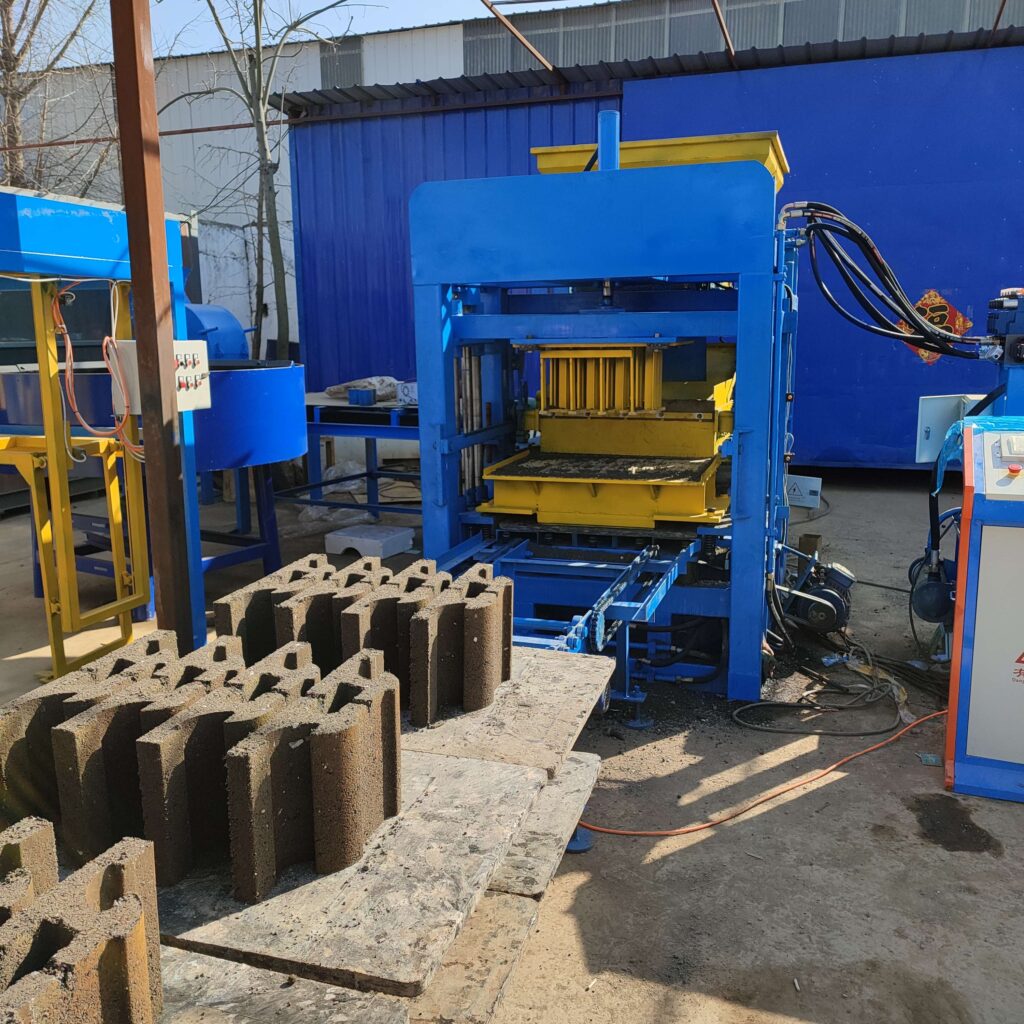
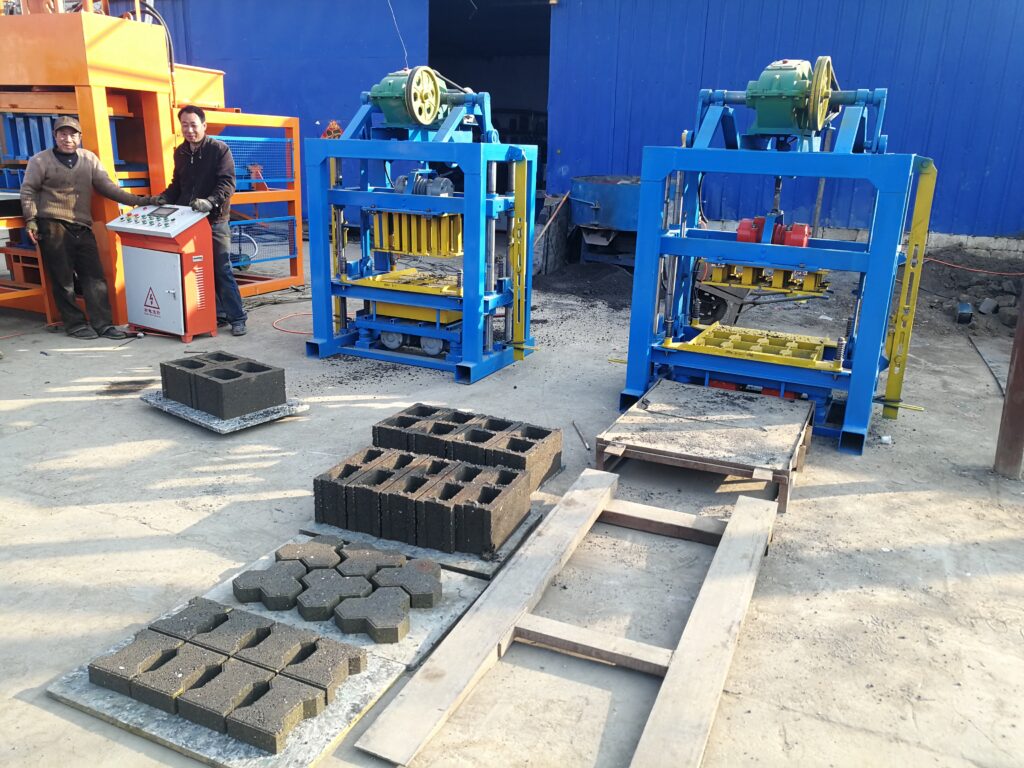
- This category introduces mechanized power to the most strenuous part of the cycle—compaction—typically through an electric motor driving a hydraulic pump or mechanical press. The operator’s role shifts from providing force to managing the process. They manually feed the machine (or a small hopper) and often initiate the compaction cycle with a button or lever. The machine then automatically performs the press and ejection sequence. The operator remains integral for material handling, pallet placement (if used), and brick removal. This tier offers a balance, reducing physical strain while maintaining a lower entry cost than full automation.
- Fully Automatic Brick Machines: Integrated System Automation
- These are complete production systems where human intervention is limited to supervision, monitoring, and routine maintenance. They integrate several automated subsystems:
- Automated Material Feeding: From a large overhead hopper via conveyors or feeders.
- Automated Pallet Circulation: A closed-loop system moves pallets into the press, positions them, and transfers out loaded pallets.
- Programmable Control: A PLC manages the entire synchronized cycle—filling, pressing, ejecting, and stacking—often with a single operator monitoring from a control panel.
- Integrated Product Handling: Automated stackers, robotic arms, or conveyor lines transfer green bricks to curing areas.
- The operator’s role transforms into that of a machine tender and process controller.
- These are complete production systems where human intervention is limited to supervision, monitoring, and routine maintenance. They integrate several automated subsystems:
Comparative Analysis: A Multi-Dimensional Evaluation
The choice between these systems involves trade-offs across several critical business and operational parameters.
- Labor Requirement and Skill Profile
- Инструкция: High labor intensity. Requires multiple unskilled or semi-skilled laborers for meaningful output. Productivity is directly proportional to crew size and stamina.
- Полуавтоматический: Reduced physical labor but still requires consistent operator attendance. May need 1-2 operators per machine for feeding and product handling. Basic machine operation skills are needed.
- Полностью автоматический: Drastically reduced direct labor. A single skilled operator can oversee multiple machines or an entire line. The required skill set shifts towards basic mechatronics, PLC interface literacy, and preventative maintenance.
- Production Capacity and Output Consistency
- Инструкция: Very low and highly variable output (e.g., 200-500 bricks per 8-hour shift, per machine). Consistency in brick weight, density, and dimensions depends entirely on the operator’s consistent technique, which is difficult to maintain.
- Полуавтоматический: Moderate and more stable output (e.g., 800-2,500 bricks per 8-hour shift). The machine ensures consistent compaction pressure and cycle time, but variations in manual feeding can still cause some product variance.
- Полностью автоматический: High and extremely consistent output (e.g., 3,000-15,000+ bricks per 8-hour shift). The automated, repetitive cycle guarantees near-identical product quality for every unit, batch after batch. Output is predictable and scalable.
- Initial Capital Investment and Operational Economics
- Инструкция: Very low initial capital outlay. The primary cost is the machine itself. However, the cost-per-brick is high when factoring in intensive labor costs and low output.
- Полуавтоматический: Moderate capital investment. Offers a favorable balance for small to medium enterprises (SMEs) by increasing output without a quantum leap in price. Operational costs include power and moderate labor.
- Полностью автоматический: High initial capital investment. However, the cost-per-brick is typically the lowest in the long run due to high output, minimal labor costs, and optimized material use. Justification is based on volume and return on investment (ROI) calculations.
- Product Quality and Technological Sophistication
- Инструкция: Quality is artisan-like and variable. Suitable for niche, non-standardized products but risky for contracts requiring strict adherence to engineering specifications.
- Полуавтоматический: Good and reliable quality for standard bricks. Capable of meeting common commercial standards, as key parameters are machine-controlled.
- Полностью автоматический: Excellent and precise quality. Essential for high-specification products like precision interlocking pavers, engineered masonry units, or where certification (e.g., ASTM, ISO) is required. Often includes data logging and quality monitoring features.
Strategic Selection Criteria for Client Advisory
Choosing the appropriate level of automation is a strategic decision. Key client assessment points include:
- Market Demand and Project Scale
- Is the client supplying a local, small-scale housing project (favoring semi-automatic) or bidding on large infrastructure contracts requiring guaranteed, high-volume supply (necessitating fully automatic)? The scale and consistency of demand are primary drivers.
- Capital Availability and Investment Horizon
- What is the client’s access to finance? A manual/semi-automatic machine can be a bootstrapping tool to generate capital for future automation. A fully automatic line requires significant upfront capital but a faster ROI if the market is ready.
- Local Labor Costs and Skill Availability
- In regions with low labor costs and limited technical training, semi-automatic machines may offer the most practical economic balance. In high-wage economies or areas with a skilled technician base, the labor-saving calculus strongly favors full automation.
- Business Growth Trajectory and Scalability
- A semi-automatic machine can be a starting point. Some systems are designed to be “automation-ready,” allowing for the later addition of pallet circulators and auto-feeders. Fully automatic lines are the end-state for scalable, industrial production.
The Hidden Considerations: Beyond the Purchase Price
- Infrastructure and Utility Requirements
- Инструкция: Requires minimal infrastructure—a flat, sheltered space.
- Полуавтоматический: Requires a reliable electrical connection of moderate power.
- Полностью автоматический: Demands robust three-phase electrical supply, significant floor space for the production line and curing area, often compressed air, and a stable concrete foundation.
- Maintenance Complexity and Downtime Risk
- Инструкция: Simple mechanical maintenance; low skill required. Downtime has limited financial impact.
- Полуавтоматический: Requires basic hydraulic and electrical troubleshooting skills.
- Полностью автоматический: Demands advanced preventative maintenance schedules and access to technical support for PLCs, sensors, and complex mechanical systems. Unplanned downtime is very costly, making service agreements crucial.
- Flexibility and Changeover Time
- Инструкция: Highly flexible for custom one-off products; changeover is instant.
- Полуавтоматический: Relatively easy mold changeovers; good for short production runs of different products.
- Полностью автоматический: Changeovers (e.g., mold and program changes) can be more time-consuming. Economically justified for long runs of a single product type, though advanced lines offer faster changeover features.
Conclusion
For the equipment distributor, the conversation about automation is a conversation about the client’s business future. There is no universally “best” option; only the most appropriate solution for a given set of commercial, logistical, and aspirational conditions. A manual machine is a tool for livelihood creation in a micro-enterprise. A semi-automatic machine is the engine for a stable, growing small business. A fully automatic line is the cornerstone of an industrial-scale operation competing on quality, cost, and volume. By comprehensively evaluating factors from local labor economics to client growth ambitions, distributors can provide invaluable strategic guidance. This consultative approach—positioning the right level of automation as a key to unlocking specific market opportunities—builds enduring partnerships and establishes the distributor as an essential architect of their clients’ success in the competitive construction materials industry.
Frequently Asked Questions (FAQ)
Q1: Can a semi-automatic machine be upgraded to a fully automatic one later?
А: In some cases, yes, but with important caveats. The core press of a well-designed semi-automatic machine might be compatible with add-on modules like an automatic feeder, a pallet return system, and a stacker. However, this depends entirely on the original machine’s design (frame strength, control system compatibility, etc.). The upgrade cost can approach that of a new system, and performance may not match a purpose-built automatic line. It is crucial to discuss “automation readiness” with the manufacturer at the initial purchase if this is a potential future path.
Q2: Which automation level offers the fastest return on investment (ROI)?
А: The ROI is highly context-dependent. In a low-wage, small-market setting, a полуавтоматическая машина often offers the fastest and most reliable ROI due to its moderate cost and significant productivity jump over manual labor. In a high-volume, competitive market or a region with high labor costs, a полностью автоматическая машина, despite its high initial cost, can achieve a faster ROI due to its very low per-unit production cost and high output, provided it operates near capacity.
Q3: How significant is the difference in final product quality between a semi-automatic and a fully automatic machine?
А: While a well-operated semi-automatic machine can produce bricks that meet standard specifications, a fully automatic machine provides superior consistency. It eliminates human variability in feeding and cycle initiation, ensuring every brick is compressed with identical pressure and timing. This leads to tighter tolerances on dimensions, more uniform density and strength, and a more consistent visual appearance—critical for large, high-profile projects where batch uniformity is non-negotiable.
Q4: What are the typical power requirements for each tier?
А:
- Инструкция: No external power required.
- Полуавтоматический: Typically requires a standard single-phase or three-phase electrical connection, with power ratings commonly ranging from 5 HP to 15 HP for the motor driving the hydraulic system.
- Полностью автоматический: Invariably requires a robust three-phase electrical supply. Total connected power can range from 25 HP to over 100 HP, accounting for the main press, conveyor motors, mixer, hydraulic power units, and control systems.
Q5: Is operator safety a differentiator between these types?
А: Absolutely. Ручные станки carry high risks of repetitive strain injury and physical fatigue. Полуавтоматические машины introduce moving parts and hydraulic pressure; operators must keep hands clear during the auto-cycle, requiring basic safety training. Fully automatic machines pose the highest inherent mechanical risk due to multiple synchronized moving parts but are equipped with comprehensive safety features like guarded zones, light curtains, emergency stop circuits, and lock-out/tag-out procedures, making the overall environment safer when protocols are followed. The risk shifts from physical strain to one of managing complex machinery.