
The Ultimate Guide to Compressed Earth Block Machines: Building a Sustainable Future
The global construction industry stands at a crossroads. As we grapple with a climate crisis and a widespread need for affordable housing, the demand for building materials that are both kind to the planet and accessible to communities has never been greater. Conventional materials like fired clay bricks and concrete blocks come with a heavy environmental price tag—significant carbon emissions from production and high embodied energy.
But what if the solution is not a new, high-tech polymer, but an ancient one, re-engineered for the modern age? Enter the Compressed Earth Block (CEB), a building material of remarkable simplicity and strength. And at the heart of this sustainable building revival is a pivotal piece of technology: the compressed earth block machine.
This guide is designed to be your authoritative resource. We synthesize engineering principles, decades of practical construction experience, and current industry knowledge to provide a trustworthy, comprehensive look at CEB machines. Whether you’re a self-builder, a development professional, or an eco-enthusiast, this post will explain what these machines are, how they work, their profound benefits, and the key steps to integrating them into a successful project.
What is a Compressed Earth Block Machine?
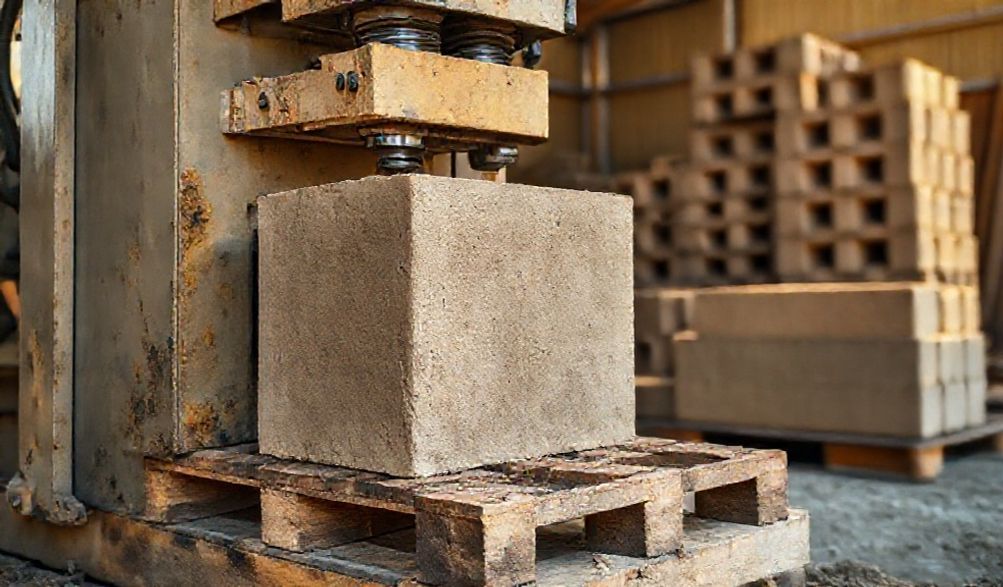
At its core, a compressed earth block machine is a mechanical or hydraulic press. Its sole purpose is to transform raw, damp earth into a dense, precisely shaped building block through the application of immense pressure. It is the enabling technology that makes earth construction scalable, consistent, and efficient.
Core Function and Output: Defining the Compressed Earth Block (CEB)
The product of this machine is the Compressed Earth Block itself. A CEB is not simply a lump of mud. It is a high-density, regularly sized block made from a carefully prepared mix of:
* Soil (Subsoil): Typically a blend of clay, silt, sand, and gravel sourced locally.
* Stabilizer: A small amount (often 5-10%) of cement or lime.
* Amazi: Added to achieve optimal moisture content for compaction.
Under pressures ranging from 500 to over 2,000 PSI, this mixture is compressed into a block that rivals the structural performance of conventional masonry. It’s crucial to distinguish CEBs from other earth materials:
* Adobe: Sun-dried mud bricks, which are larger, less dense, and not mechanically pressed.
* Fired Clay Bricks: Require high-temperature kilns, consuming vast amounts of energy and releasing CO2.
CEBs occupy a middle ground—mechanically stabilized for strength without the energy cost of firing.
A Brief History: From Ancient Roots to Modern Engineering
Humanity has built with earth for millennia, from the pyramids of Egypt to the rammed earth walls of the Great Wall of China. The modern CEB machine, however, has its origins in the mid-20th century. The iconic Cinva Ram, a manually operated lever press developed in Colombia in the 1950s, democratized block production for communities worldwide.
Today, technology has evolved dramatically. Modern machines utilize advanced hydraulic systems, interchangeable molds for different block shapes (including interlocking blocks), and even semi-automated production lines. This evolution from simple levers to sophisticated presses represents the fusion of timeless material science with contemporary engineering.
How Does a Compressed Earth Block Machine Work? The Process Demystified
Understanding the production cycle demystifies the machine and highlights where skill and science intersect. The process is methodical and repeatable.
The Four-Stage Production Cycle
-
Gutegura Ibikoresho: This is the most critical step outside the machine itself. Soil is sourced, screened to remove large debris and organic matter, and then mixed with the precise amount of stabilizer (cement/lime) and water. Consistency here is key to block strength.
-
Loading & Compression: The prepared mix is fed into the machine’s hopper. It falls into a compression chamber, where a powerful ram or piston applies extreme pressure—often measured in tons—for a few seconds. This force aligns the soil particles, eliminates air pockets, and creates a solid, cohesive block.
-
Guhagarika The newly formed block is smoothly ejected from the mold or die onto a waiting pallet, cart, or conveyor. On manual machines, this may involve pulling a lever to release the block.
-
Gukora: Unlike fired bricks, CEBs gain strength through curing. Blocks are stacked, kept under plastic or burlap, and lightly moistened for a period (typically 14-28 days). This allows the stabilizer (especially cement) to hydrate fully and develop its maximum compressive strength.
Key Machine Components and Their Roles
- Hopper: The funnel that holds and feeds the soil mix.
- Icyumba cyo Gufumbika & Imisase/Ibyuma byo Gukora The cavity that gives the block its shape and size.
- Ram/Head: The piston that delivers the compressive force.
- Sisitemu ya Amashanyarazi: Either a sisteme ya hydrolike (powerful and consistent, driven by an electric or diesel motor) or a mechanical leverage system (manual, like the Cinva Ram, or motor-assisted).
- Ikadiri The robust steel structure that withstands the immense forces of compression.
Key Benefits of Building with a CEB Machine
Choosing a CEB machine is an investment in a different paradigm of construction. The benefits span environmental, economic, and structural domains.
Exceptional Sustainability and Low Environmental Impact
- Energie Yitiriye Nke Cyane: The primary energy input is the compression force. There is no fossil fuel-fired kiln, making the carbon footprint a fraction of conventional masonry.
- Local Materials: Up to 95% of the material can be sourced on-site or nearby, slashing transportation emissions and costs.
- Natural & Non-Toxic: The blocks are made from earth, creating healthy indoor air quality with no off-gassing.
- High Thermal Mass: CEB walls absorb heat during the day and release it at night, naturally regulating interior temperatures and reducing heating/cooling energy needs by up to 50%.
- Fully Recyclable: At the end of its life, a CEB structure can return to the earth or be crushed and reused.
Remarkable Economic Advantages
- Kugabanya cyane igiciro cy'ibikoresho: The primary ingredient—soil—is often free. Stabilizer (cement) is the main cost, representing massive savings over purchasing all masonry units.
- Labor & Community Empowerment: The process can be learned quickly, enabling owner-builder projects or local job creation. It decentralizes production.
- Long-Term Utility Savings: The superior thermal performance translates directly to lower lifetime energy bills.
Proven Durability and Structural Integrity
- Ubushobozi Bwinshi Bwo Gukandagira: Properly made CEBs can achieve strengths exceeding 1,000 PSI, suitable for multi-story load-bearing walls. They meet and exceed many international building code standards.
- Kumirwa Umuriro: Earth does not burn. CEB walls provide excellent fire ratings.
- Pest & Sound Resistance: The density of the blocks deters insects and rodents and provides significant acoustic insulation.
Choosing the Right CEB Machine: A Buyer’s Checklist
Selecting a machine is not one-size-fits-all. Your choice must align with your project’s scale, budget, and context.
Assessing Your Project Scale and Needs
- Manual Machines (e.g., Cinva Ram style): Ideal for small projects, NGOs, and community workshops. Low cost, portable, no power needed. Output: 100-300 blocks per day.
- Hydraulic Machines (Mobile or Stationary): The workhorse for serious projects. Higher output (500-2,000+ blocks per day), more consistent pressure, but requires a power source (electricity, diesel, tractor PTO). Higher initial investment.
- Fully Automated Systems: For commercial production. Feature conveyor belts, auto-feed, and palletizing. Highest output and cost.
Critical Technical Specifications to Compare
- Compression Force: Measured in PSI or MPa applied to the block. Higher pressure generally means denser, stronger blocks. Look for machines that can achieve at least 800-1000 PSI on the block.
- Block Size & Mold Options: Standard block size is often similar to a concrete masonry unit (CMU). Ensure the manufacturer offers interchangeable molds for different shapes (e.g., half-blocks, interlocking patterns).
- Production Rate: Be realistic about your daily block needs, including curing time. A machine that’s too slow can stall a project; one that’s too large may be an unnecessary expense.
- Ubwiza bwo Kubaka Inspect the steel gauge, weld quality, and durability of components. This is a long-term investment—avoid flimsy construction.
Beyond the Machine: The Total System
A machine alone does not guarantee success. Consider the entire system:
* Soil Testing Kit: A set of sieves for particle analysis is essential.
* Ibikoresho Byongerewe: A mechanical mixer (pan or rotary) is invaluable. Don’t forget block carts, pallets, and curing covers.
* Support & Training: Choose a manufacturer or supplier known for providing clear manuals, accessible technical support, and training workshops. Availability of spare parts is critical.
Getting Started: Your First CEB Project Roadmap
Ready to embark on your CEB journey? Follow this roadmap to build a foundation for success.
Step 1: The Non-Negotiable – Soil Testing
Not all dirt is building material. Ideal soil has a balanced mix of clay (the binder), silt, sand, and gravel (the aggregate). You can perform simple field tests (ribbon test, jar test) for a rough idea, but for any serious project, send a sample to a geotechnical lab for a formal sieve and proctor analysis. This data is irreplaceable.
Step 2: Stabilization and Mix Design
Based on your soil test, you’ll determine the correct percentage of stabilizer (usually Portland cement for most soils). A typical range is 5-10% by weight. Equally important is achieving the optimum moisture content (OMC)—the exact amount of water needed for maximum compaction, as identified in the proctor test.
Step 3: Prototyping and Test Blocks
This is the most critical step for safety and credibility. Before producing thousands of blocks:
1. Make several batches of test blocks with your exact soil-stabilizer mix.
2. Cure them properly for 28 days.
3. Send them to a lab to be crushed in a compressive strength tester.
This verifies your blocks meet structural requirements and builds trust in your project. Never skip this step.
Step 4: Mastery Through Training
Seek out hands-on training. Workshops offered by experienced builders or manufacturers will teach you the nuances of machine operation, mix consistency, and block handling. Common beginner mistakes—like incorrect moisture, uneven filling of the mold, or improper curing—can be avoided with proper guidance.
Frequently Asked Questions (FAQ)
Q: Are compressed earth block homes safe and strong enough?
A: Absolutely. When properly engineered, stabilized, and built with sound construction techniques, CEB structures are extremely durable and safe. Modern building codes, such as the International Residential Code (IRC Appendix S), provide standards for their use. Historical earth structures around the world have stood for centuries.
Q: How much does a CEB machine cost?
A: Prices vary widely. Small manual presses start around $3,000. Robust hydraulic machines for home-scale projects range from $15,000 to $30,000. Large, high-output commercial systems can exceed $50,000. View this as a capital investment offset by massive savings in material purchases.
Q: Can I use the soil from my own property?
A: There’s a very good chance you can. However, you must test it first. The ideal soil is “right under your feet,” but sometimes amendments (adding sand or clay) or a small amount of imported material is needed to achieve the perfect blend.
Q: Are CEBs suitable for all climates?
A: Yes, with appropriate design. In wet climates, the key is to protect the walls from direct rainfall and rising damp. This is achieved through good “boots and a hat”: a raised foundation (stem wall) and wide, overhanging eaves. A moisture-resistant plaster (like lime or cement stucco) is the final protective layer.
Q: Where can I see examples and get plans?
A: Excellent resources include the Earth Architecture website and social media groups. Documentaries like “The Great Wall of Los Angeles” and books by pioneers like David Easton (“The Rammed Earth House”) are invaluable. Many machine manufacturers also provide plan sets and project galleries.
Conclusion
The compressed earth block machine is more than just a tool; it is a catalyst for change. It empowers individuals and communities to build beautiful, durable, and affordable shelters using the very earth beneath them. It represents a tangible path toward a more sustainable and resilient built environment.
Success with this technology lies at the intersection of three elements: the appropriate technology of the machine itself, the scientific understanding of soil mechanics, and the skilled craftsmanship of the builder. It demystifies construction and reconnects us with a truly regenerative way of building.
Your journey starts with a single step. Take that step today. Conduct a simple soil test on your land, reach out to a CEB machine manufacturer with your project details, or find a workshop to get your hands in the mix. The future of building is not only high-tech; it is profoundly grounded.
<