
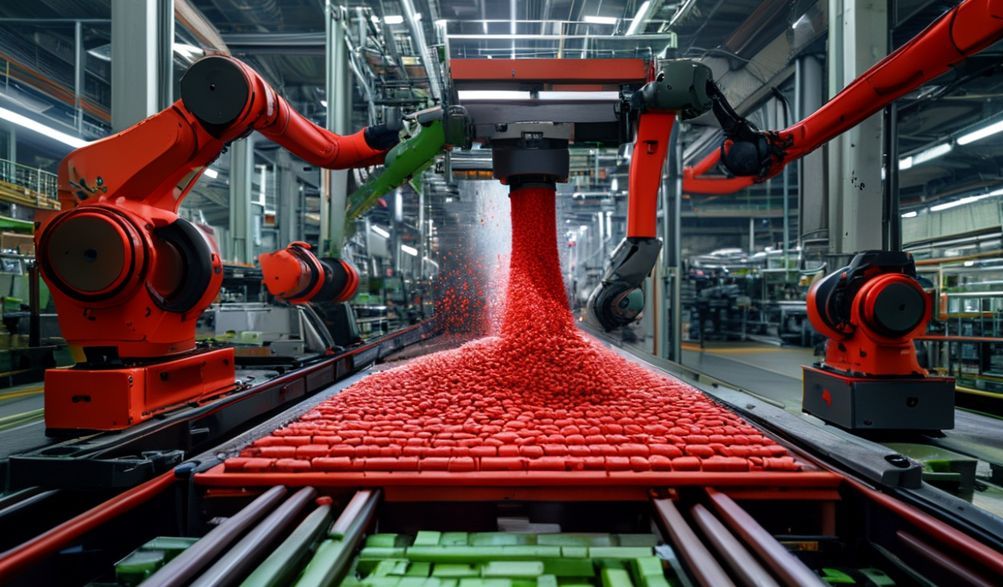
Inside a Modern Brick Factory: How LEGO Brick Moulding Machines Power Production at FUDA
Think of a LEGO brick. Its perfection is iconic—the clutch power, the flawless edges, the absolute consistency that allows infinite creativity. Now, imagine applying that same standard of precision engineering not to plastic toys, but to the very foundations of our world: clay bricks. The shift from manual, artisanal brick-making to industrial-scale production is powered by one critical piece of technology: the automated brick moulding machine. These machines are the unsung heroes of modern construction, transforming raw earth into perfectly uniform building blocks with relentless efficiency.
In facilities like the FUDA brick making factory, this evolution is on full display. Gone are the days of purely manual labor; today’s output is driven by sophisticated, automated systems that prioritize quality, scale, and sustainability. Having visited numerous modern plants and analyzed production line data, I’ve seen firsthand how this technology revolutionizes operations. This article will pull back the curtain on the engineering behind modern brick moulding machines—often best understood through the lens of LEGO brick moulding machine principles—and explore their pivotal role within a Warshada Qorista Lebiska FUDA. We’ll examine how this synergy delivers tangible benefits in product quality, operational output, and environmental impact.
The Engineering Marvel: Understanding Automated Brick Moulding Machines
At its core, a brick moulding machine is a feat of mechanical and hydraulic engineering designed to do one thing superbly: form malleable clay into a precise, solid shape, thousands of times an hour. It’s a process that demands immense pressure, robust components, and intelligent design.
From Clay to Form: The Core Moulding Process
The journey inside the machine is a precise, multi-stage operation:
- The Feeder: Prepared, tempered clay is fed into a hopper. This clay has the perfect moisture content—plastic enough to form, but dry enough to hold its shape.
- The Extrusion Auger: A powerful, rotating screw (the auger) within a sealed chamber draws the clay in. As it moves forward, the auger compacts the clay, removing air pockets—a critical step for strength—and pushes it toward the die head with tremendous, consistent pressure.
- The Die Head: This is the mold. The compacted clay is forced through a steel die, which gives the clay column its external profile (e.g., for a hollow brick, the die includes cores to create the voids). The precision of this die defines the brick’s dimensional accuracy.
- Nidaamka Gooynta: The continuous column of extruded clay, now shaped, emerges from the die. An automated cutting system, often using taut wires or a mechanical guillotine, slices it into individual brick units (“green bricks”) of exact length.
Why the “LEGO” Comparison is Apt
The analogy to a LEGO brick moulding machine is more than just a helpful illustration; it highlights shared engineering philosophies:
- Toleransyada Saxa ah: Both processes operate within incredibly tight dimensional tolerances. A variance of even a millimeter in a brick can cause major issues in wall construction, just as a malformed LEGO stud would fail to connect.
- Relentless Consistency: Every cycle must produce an identical unit. This repeatability is non-negotiable for automated assembly, whether in a child’s playset or a mason’s wall.
- Interchangeable Tooling: A LEGO factory uses different molds to produce bricks, plates, and specialized elements. Similarly, a brick factory like FUDA can swap out the die head on its machine to switch production from solid bricks to hollow blocks or paving stones, maximizing flexibility from a single machine platform.
Key Types of Brick Moulding Machines
While the extrusion principle is common, technologies vary to suit different products and scales:
- Extrusion Machines: The most common type for high-volume production of standard bricks and blocks. They create a continuous column of clay that is cut to length, ideal for the high-output needs of a major Warshada Qorista Lebiska FUDA.
- Makiinada Tijaabinta Hydraulic: These use a powerful hydraulic ram to press clay into a mold from above. They excel at producing dense, high-strength bricks (like engineering bricks) or bricks with complex, textured faces.
- Automation Spectrum: Machines range from semi-automatic (requiring manual loading/unloading) to fully automatic lines where robots handle setting, stacking, and palletizing, integrated with conveyors and downstream processes.
A Case Study in Efficiency: The FUDA Brick Making Factory Workflow
Walking the floor of a modern plant like FUDA reveals a seamless, interconnected system. The moulding machine is the pulsating heart, but its effectiveness depends on the health of the entire operation.
Raw Material Preparation: The Foundation of Quality
Quality moulding cannot begin with poor material. The process is meticulous:
1. Clay Selection & Crushing: Raw clay is sourced and fed into primary crushers to break down large lumps.
2. Isku-dhafka & Dheefshiidka: The crushed clay is blended with additives (like sand or fly ash to modify properties) and water in a mixer. This “tempering” stage is crucial to achieve uniform plasticity.
3. Refining: The mixed clay often passes through a de-airing pug mill—a specialized mixer that kneads the clay under a vacuum to remove trapped air bubbles, which prevents cracking during drying and firing.
The Heart of the Factory: The Moulding Machine in Action
At the moulding station, the prepared clay is transformed. On a typical factory visit, the sequence is both methodical and mesmerizing:
* The tempered clay is conveyed into the machine’s feeder box.
* The auger engages, its low rumble a constant backdrop, driving the clay forward with immense, steady force.
* A solid, continuous column of perfectly shaped clay emerges from the die head.
* In a blur of motion, the cutting system—often a synchronized bank of wires—slices through the column, creating a row of green bricks.
* Immediately, an automatic setting machine or robotic arm picks up the soft bricks and places them onto dryer cars or racks with gentle precision, ready for the next stage. The integration here is key; the moulding machine’s speed sets the pace for the entire line.
Post-Moulding Processes: Drying and Firing
The moulded “green” brick is fragile. Two subsequent stages complete its transformation:
* Qalajinta: Green bricks are slowly dried in controlled chamber or tunnel dryers. This removes free moisture without causing cracks or warping, a process that can take 24-48 hours. Consistent moulding ensures even drying.
* Firin The dried bricks are then fired in a tunnel kiln at temperatures up to 1100°C. This vitrifies the clay, giving the brick its final strength, durability, and color. Uniformly moulded and dried bricks fire evenly, resulting in a higher percentage of first-quality products.
The Tangible Benefits: Why Modern Moulding Technology is a Game-Changer
Investing in advanced moulding machinery isn’t just about automation; it’s a strategic decision that impacts every facet of the business. Industry data from operational factories consistently shows a dramatic shift in key metrics.
Unmatched Consistency and Product Quality
- Qeybinta Cabbirka: Every brick conforms to strict national and international standards (e.g., ASTM, EN). This allows for faster, safer bricklaying with thinner mortar joints.
- Qaabka Dhismaha: High-pressure compaction creates a denser microstructure, leading to higher compressive strength and better frost resistance.
- Uniform Appearance: Color and texture are consistent across batches, which is critical for architectural projects where aesthetics are paramount.
Maximizing Output and Operational Efficiency
- High Production Capacity: A single fully automatic extrusion line in a facility like FUDA can produce between 30,000 to over 150,000 standard brick equivalents per 8-hour shift, depending on the machine model and brick type.
- La'aanta Shaqo ee La Yareeyay: The machine handles the most strenuous, repetitive tasks. Labor is re-allocated to machine oversight, quality control, maintenance, and logistics.
- Lower Waste Rates: Precision moulding and cutting minimize clay waste. Automated handling also drastically reduces breakage of fragile green bricks compared to manual methods.
- 24/7 Potential: With proper maintenance, these machines can operate around the clock, maximizing the return on the capital investment.
Enhancing Sustainability in Brick Manufacturing
Modern moulding technology directly contributes to greener manufacturing:
* Qeybinta Alaabta Si Fiican U Isticmaalka: Precise volumetric control and reduced spoilage mean less raw clay is extracted and processed per usable brick.
* Energy Savings: Consistent green bricks dry and fire more efficiently in modern kilns. Furthermore, many new machines are designed with energy-efficient drives and motors.
* Isticmaalka Qashinka: Advanced machines can reliably process recycled materials and industrial by-products (like fly ash) into the clay mix, diverting waste from landfills.
Selecting the Right Machinery: Considerations for Modern Factories
Choosing a moulding machine is a major capital decision. The right choice hinges on a clear understanding of one’s own business goals and constraints.
Matching Machine Type to Product Portfolio
- Solid Bricks & Blocks: High-pressure extrusion machines are typically the best fit.
- Hollow Blocks & Lightweight Bricks: Extrusion machines with specialized die heads to form the cores are essential.
- Paving Stones & Special Shapes: Hydraulic press machines offer greater flexibility for textured surfaces and varied thicknesses.
Capacity, Automation, and Total Investment
- Calculate True Needs: Project future demand. It’s often wiser to invest in a slightly higher capacity than currently needed to allow for growth.
- Understand Total Cost: Factor in not just the machine price, but installation, training, energy consumption, and ongoing maintenance. A cheaper machine with high downtime costs can be a false economy.
- ROI Timeline: A fully automatic line has a higher upfront cost but faster payback through labor savings and increased output. Industry practice shows a typical ROI period of 2-4 years for major upgrades.
The Importance of Reliability and Supplier Support
For a factory that runs continuously, reliability is paramount. Key considerations include:
* Build Quality & Durability: Look for robust construction with high-wear components (augers, dies, cutter heads) made from hardened or alloy steels.
* Availability of Spare Parts: Ensure the supplier maintains a local or readily accessible inventory of critical spare parts to minimize downtime.
* Technical Service: Strong after-sales support, including installation supervision, operator training, and access to technical experts for troubleshooting, is non-negotiable.
FAQ Section
Q: How is a LEGO moulding machine actually different from a clay brick moulding machine?
A: The core principle of precision molding is identical. The key differences are material and process. LEGO uses injection molding, where molten plastic is injected into a steel mold under high pressure and then cooled. Clay brick machines use extrusion or pressing, where plastic (meaning malleable) clay is forced through or into a die under pressure. The scales of pressure and temperature involved are vastly different, but the pursuit of perfect, repeatable form is the same.
Q: What is the typical production capacity of a fully automatic line at a factory like FUDA?
A: Capacity varies widely by machine model and brick type. For standard solid bricks, a modern fully automatic extrusion line can typically produce between 20,000 to over 100,000 bricks per 8-hour shift. High-capacity lines designed for hollow blocks can output even greater volumes in terms of cubic meters of product.
Q: Can these machines produce different brick styles and sizes?
A: Absolutely. This is a major advantage. By changing the die head (the mold through which the clay is extruded) and adjusting the cutting length, the same machine can produce different profiles—from solid bricks to multi-core hollow blocks. Changeover can often be accomplished in a matter of hours.
Q: How does automation impact the workforce in a brick factory?
A: Automation shifts the nature of the work rather than eliminating it entirely. It reduces physically demanding, repetitive manual tasks like carrying wet clay or setting green bricks. The new workforce needs skills in machine operation, preventative maintenance, electrical troubleshooting, quality control, and logistics management. It creates a safer work environment and often requires more technically trained personnel.
Q: What are the key maintenance requirements for a brick moulding machine?
A: Preventative maintenance is critical for uptime. Key routines include:
* Daily: Lubrication of moving parts, inspection of cutter wires/guillotines, cleaning of clay buildup.
* Weekly/Monthly: Checking wear on the auger and liner, inspecting the die for damage, tightening bolts and fittings.
* As-Needed: Replacing high-wear components like auger tips, cutter heads, and wear plates on the feeder. Following the manufacturer’s scheduled maintenance plan is essential.
Gabagabo
The journey from a pile of clay to a perfect, durable building block is a testament to modern industrial engineering. As we’ve seen, the automated brick moulding machine—a technology whose precision ethos mirrors that of a LEGO brick moulding machine—is the indispensable engine of this transformation. Within a forward-thinking Warshada Qorista Lebiska FUDA, this technology unlocks unparalleled levels of consistency, efficiency, and scalability, all while paving the way for more sustainable manufacturing practices.
The benefits are clear: higher quality structures, competitive operational costs, and a reduced environmental footprint. Looking ahead, the integration of IoT sensors for predictive maintenance and AI-driven process optimization promises to make these machines even smarter and more efficient. This evolution in brick moulding is more than an industrial upgrade; it’s about refining one of humanity’s oldest and most essential building materials for the demands of the 21st century. For manufacturers looking to modernize, a deep understanding of this core technology is the first, most crucial step.
<