A Guide to Brick Machine Component Replacement
Establishing a Component Classification: From Consumables to Core Assemblies
Not all parts are created equal. The feasibility and advisability of self-replacement depend fundamentally on the component’s complexity, integration, and role in machine precision.
1.1 Category 1: Operator-Replaceable Consumables and Wear Items
These are components designed for routine replacement by trained plant personnel.
- Characteristics: Low to moderate cost, simple mechanical interface, minimal need for calibration or alignment post-installation, and high frequency of replacement.
- Typical Examples:
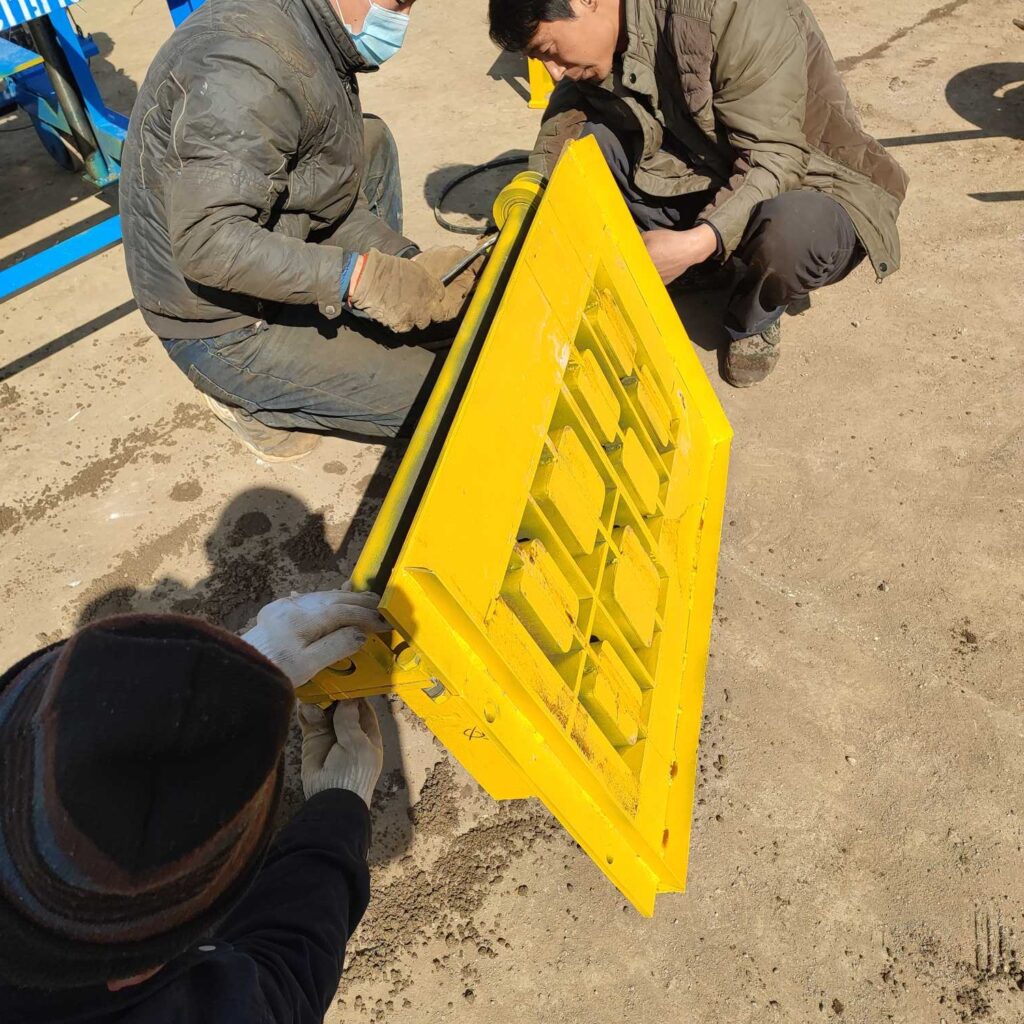
- Mold Liners and Wear Plates: Designed as bolt-in or slide-in modules. Replacement requires cleaning, careful fitting to avoid gaps, and torquing bolts to a uniform specification to maintain a flat, aligned molding surface.
- Filter Elements: (Hydraulic, oil, air). Critical for system health. The process involves depressurizing systems, capturing spillage, and ensuring correct sealing O-rings are in place.
- Standard Seals and Gaskets: For hydraulic cylinders and gearbox covers. Requires cleanliness, proper sizing, and careful installation to prevent pinching or rolling.
- V-Belts and Drive Chains: Involves tension adjustment to manufacturer specifications; incorrect tension leads to premature wear or power transmission failure.
- Ejector Pins and Basic Hydraulic Hoses: Requires matching part numbers and ensuring proper connection and seating.
1.2 Category 2: Technician-Level Mechanical and Electrical Components
Replacement requires a higher level of technical skill, specialized tools, and often post-installation calibration.
- Characteristics: Moderate to high cost, involves disassembly of sub-assemblies, requires alignment or calibration, and carries a risk of incorrect installation affecting machine function.
- Typical Examples:
- Hydraulic Cylinders (Rebuild or Replacement): Involves system depressurization, hydraulic line disconnection, mechanical unbolting, and precise realignment upon reinstallation. Incorrect port connection or mounting can cause catastrophic failure.
- Vibration Motor Replacement: Beyond unbolting, this requires ensuring the motor is of the identical specification (frequency, amplitude, power), that mounting surfaces are clean and parallel, and that all bolts are torqued in a star pattern to ensure even force and prevent imbalance.
- Sensors (Proximity, Pressure, Temperature): Requires understanding of electrical schematics, safe lock-out/tag-out procedures, and often calibration via the machine’s control panel to ensure the new sensor’s signal is correctly interpreted by the PLC.
- Bearings in Critical Locations: Pressing bearings onto shafts requires hydraulic presses and heating tools to avoid damaging the bearing or shaft. Incorrect installation guarantees rapid failure.
1.3 Category 3: Factory-Service Core Systems and Precision Assemblies
These replacements should almost exclusively be performed by manufacturer-trained specialists.
- Characteristics: Very high cost, involves the heart of the machine’s function, requires specialized diagnostic and calibration equipment, and is often linked to warranty coverage.
- Typical Examples:
- Main Hydraulic Pump or Valve Manifold Assembly: The core of the hydraulic system. Incorrect installation can lead to contaminant introduction, incorrect pressure profiles, and cascading damage throughout the system.
- Programmable Logic Controller (PLC) or Main Drive Inverter: The “brain” and “nervous system” of the machine. Requires not just physical installation but software loading, parameterization, and system-wide functional testing.
- Entire Vibration Table Rebuild or Frame Realignment: Impacts the fundamental geometry and dynamic balance of the machine. Requires laser alignment tools and profound expertise to restore original equipment manufacturer (OEM) tolerances.
- Major Structural Welding or Repair: Any repair affecting the machine’s frame or major supports must consider metallurgy, stress relief, and the restoration of original structural integrity.
The Prerequisites for Successful Self-Replacement: Beyond the Wrench
Attempting replacement without the proper foundation turns a maintenance task into a gamble.
2.1 The Indispensable Toolkit
This extends beyond standard mechanics’ tools.
- Ҳуҷҷатҳои техникӣ: Up-to-date, machine-specific manuals with exploded-view parts diagrams, torque specifications, hydraulic schematics, and wiring diagrams are non-negotiable.
- Specialized Tools: Include hydraulic pressure gauges, laser alignment tools, digital torque wrenches, bearing pullers and presses, and multimeters for electrical diagnostics.
- Lifting and Support Equipment: Proper hoists, slings, and support stands are essential for safely handling heavy components like mold boxes or hydraulic cylinders.
2.2 The Critical Human Factor: Skills and Mindset
- Mechanical Aptitude and Experience: A deep understanding of mechanical systems, hydraulics, and electrical fundamentals.
- Procedural Rigor: The discipline to follow technical instructions step-by-step, to record steps taken (e.g., wire labels, hose connections), and to adhere to safety protocols like lock-out/tag-out.
- Diagnostic Ability: The skill to understand чаро a part failed. Replacing a seized hydraulic pump without diagnosing and flushing the contaminated system that caused the seizure will doom the new pump to the same fate.
Risk-Benefit Analysis: The Commercial Calculus
The decision to replace in-house is a business calculation with multiple variables.
3.1 Potential Benefits of In-House Replacement
- Кам кардани вақти таътил: Eliminating wait times for an external technician can slash machine idle time, especially for common wear parts.
- Lower Direct Labor Costs: Avoiding high hourly rates for specialist travel and labor.
- Enhanced Operational Knowledge: Deepens the in-house team’s understanding of the machine, leading to better daily operation and early problem identification.
3.2 Significant Risks and Hidden Costs
- Voided Warranty: Unauthorized work on core systems often nullifies the manufacturer’s warranty, exposing the owner to full future repair costs.
- Incorrect Installation and Cascading Damage: A mistake can turn a $1,000 part replacement into a $20,000 catastrophic failure. For example, misaligned vibration motors can destroy bearings and crack the vibration table.
- Loss of Calibration and Performance: Even if the machine runs, it may not produce bricks to specification. Improperly installed molds lead to dimensional defects; poorly calibrated sensors cause erratic operation.
- Safety Hazards: Incorrectly reassembled high-pressure hydraulic systems or electrical panels pose severe risks of injury or fire.
- Lack of Documentation for Future Work: In-house work that isn’t meticulously documented can create mysteries for future technicians, increasing the cost and complexity of subsequent repairs.
The Evolving Role of the Distributor: From Parts Supplier to Technical Partner
In this landscape, the distributor’s value proposition expands dramatically.
4.1 Providing Decision-Support Frameworks
Help clients navigate the “replace ourselves vs. call a specialist” dilemma by providing clear guidelines based on the component categorization outlined above. Offer flowcharts or decision matrices.
4.2 Curating Support Packages
- Parts Kits with Instructions: For Category 1 items, provide comprehensive kits that include all necessary gaskets, bolts, and lubricants, accompanied by detailed, photo-based installation guides.
- Technical Support Hotlines: For Category 2 attempts, offer real-time telephonic or video support from a qualified engineer to guide the client’s technician through complex steps.
- Certified Field Service: For Category 3 work, provide access to factory-trained technicians, ensuring the work is documented, warranted, and performed to OEM standard.
4.3 Building a Culture of Preparedness
- Training Workshops: Offer hands-on training sessions for client maintenance teams focused on the replacement and adjustment of Category 1 and selected Category 2 components.
- Critical Spares Inventory Planning: Work with clients to develop a strategic inventory of fast-moving, high-impact wear parts (Category 1) to minimize downtime, while advising on just-in-time sourcing for more expensive, less frequently needed items.
Conclusion
The question of self-replacement for brick machine parts is not answered with a simple yes or no, but through a disciplined, hierarchical approach to maintenance management. For the distributor or procurement expert, the opportunity lies in elevating the conversation from mere parts sales to strategic asset management consultancy. By introducing clients to a clear component classification system, emphasizing the prerequisites of tools and knowledge, and honestly outlining the risk-benefit equation, you position your organization as an essential partner in their operational success. The end goal is to foster a client capable of confident, self-sufficient management of routine wear, while instinctively relying on expert partnership for complex, high-stakes interventions. This balanced approach maximizes machine availability and product quality, minimizes total lifecycle cost, and forges an interdependent business relationship built on trust and technical competence.
FAQ
Q1: What is the single most important document I need before attempting any part replacement?
A: The machine-specific, up-to-date technical manual and parts book is absolutely critical. This document contains the only validated instructions, torque specifications, schematic diagrams, and safety warnings for your specific machine model and serial number. Using generic knowledge or manuals from similar-looking machines is a primary cause of installation errors and subsequent failures.
Q2: How can I assess if my in-house team has the skills for a specific replacement task?
A: Conduct a honest skills gap analysis. For the component in question, list the required tasks (e.g., interpret hydraulic schematic, use a laser alignment tool, program a PLC parameter). Match these against the verified competencies of your team. If there are gaps in critical areas—especially in calibration, alignment, or system diagnostics—the task falls into a higher-risk category and likely warrants external support. When in doubt, always default to a more conservative assessment.
Q3: Are “will-fit” or generic replacement parts a good alternative to OEM parts?
A: This is a calculated risk that varies by component category.
- For Category 1 (Consumables): High-quality generic filters, standard seals, and certain bearings from reputable industrial brands can be acceptable, provided they meet or exceed the OEM’s specifications (micron rating, pressure rating, material composition).
- For Category 2 & 3 (Critical Components): Strongly discouraged. A “will-fit” hydraulic pump may have a slightly different flow characteristic, damaging the system. A non-OEM vibration motor may have an imbalanced rotor, causing destructive harmonics. The cost savings are illusory if the part leads to machine damage, poor product quality, or voided warranties on connected systems.
Q4: What are the key safety protocols that must never be skipped during part replacement?
A: Three protocols are non-negotiable:
- Lock-Out/Tag-Out (LOTO): Physically isolating and locking all energy sources (electrical, hydraulic, pneumatic) before any work begins.
- System Depressurization: Ensuring all hydraulic and pneumatic accumulators are fully bled and pressure is at zero before disconnecting any line or component.
- Proper Lifting and Support: Using rated equipment to handle heavy parts, never supporting the machine or components with improvised blocks or jacks that could fail.
Q5: As a distributor, how should I structure my parts and service offerings to cater to both self-reliant and full-service clients?
A: Develop a tiered portfolio:
- Tier 1 (DIY Support): Sell comprehensive wear-part kits with detailed guides. Offer paid, per-incident remote technical support via video call.
- Tier 2 (Assisted Service): Offer annual maintenance contracts that include scheduled technician visits for inspection and complex tasks, while the client handles daily maintenance and minor replacements.
- Tier 3 (Full Service): Provide comprehensive service-level agreements (SLAs) with guaranteed response times, covering all labor and parts, for clients who desire complete hands-off maintenance.
This allows you to match your support to the client’s specific capabilities and business model.