
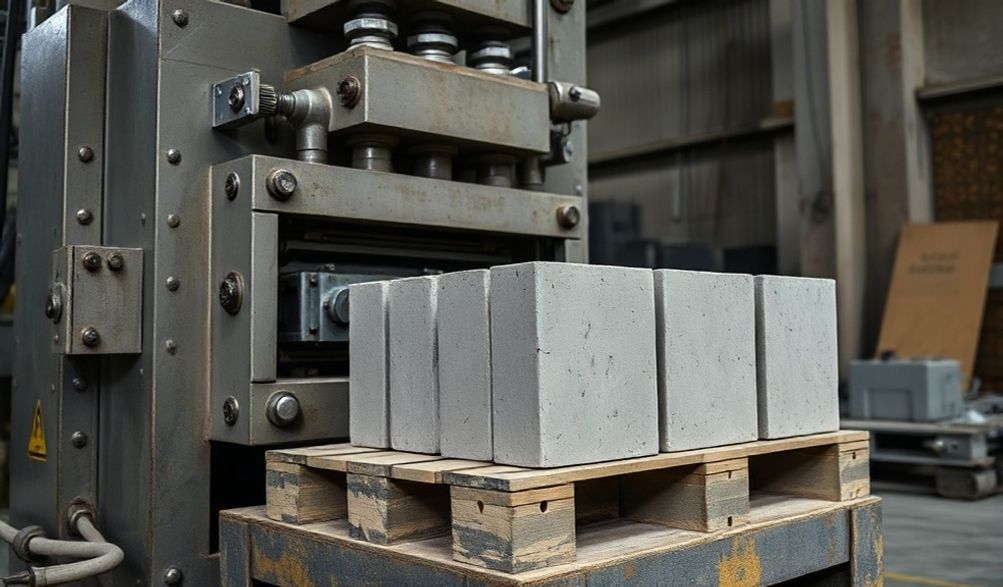
Роҳнамои пурра ба мошинҳои нимхудкори сохтани блокҳои холӣ бетонӣ
Муқаддима
Саноати сохтмони ҷаҳонӣ дар пойгаи доимӣ барои ёфтани маводи ҳам арзон ва ҳам пойдор қарор дорад. Дар маркази ин ҷустуҷӯ, бахусус барои лоиҳаҳои истиқоматӣ ва тиҷоратии камқабат, блоки холӣ муқаррарӣ ҷойгир аст. Маҳбубияти он бебас аст, ки изолятсияи гармидиҳӣ, қувваи сохторӣ ва камхарҷиро пешниҳод мекунад. Бо вуҷуди ин, барои сохтмончиёни хурд ва миёна, пудратчиён ва соҳибкорони орзуманд, истеҳсоли ин блокҳо мушкилоти ҷиддиеро пеш меорад.
Усулҳои дастии анънавӣ заҳматталаб буда, сифати нобаробар медиҳанд ва ба талаботи афзоянда қодир нестанд. Аз тарафи дигар, корхонаҳои комилан автоматизатсияшуда сармоягузории бузургеро талаб мекунанд, ки барои бисёриҳо дастнорас буда, ин имконро дар паси монеаҳои баланди молиявӣ маҳдуд мекунанд. Ин фосилаи байни ниёз ва дастрасӣ рушд ва инноватсияро бозмедорад.
Даромаданним-автоматии тайёркунандаи блокҳои ковоки бетонӣ—нуқтаи мувозинати муҳандисӣ. Ин дастур барои расидан ба аслҳо тартиб дода шудааст. Дар асоси дониши амиқи соҳавӣ, мушаххасоти техникӣ ва дониши амалии корӣ, мо ин қисми муҳими таҷҳизотро таҳлил мекунем. Мо меомӯзем, ки чӣ тавр он мувозинати устонаро байни самаранокӣ, сифат ва арзиш барқарор мекунад ва шуморо тавона мебахшад, ки барои лоиҳаҳои сохтмонӣ ё ширкати истеҳсолии худ қарори комилан огоҳона бигиред.
Мошини ним-автоматии истеҳсоли блокҳои пуст-бетонӣ чист?
Таъриф ва Принсипи Асосии Корӣ
Мошини ним-автоматикии истеҳсоли блокҳои холӣ (бандаки холӣ) як системаи механикии истеҳсолӣ мебошад, ки дар он равандҳои асосии ларзиш ва фишурдан ба таври автоматӣ иҷро мешаванд, аммо ворид кардани ашёи хом ва баровардани блокҳои тайёр бо ёрии дастӣ сурат мегирад. Ин навсозии муҳими технологӣ нисбат ба усулҳои пурра дастӣ буда, дар ҳоле ки мураккабӣ ва арзиши корхонаҳои пурра компютериро пешгирӣ мекунад.
Давраи амалиёт сода ва самаранок аст:
1. Хӯрок доданОмӯхтаи бетони омодашуда (семент, рег, агрегат) ба воситаи дастӣ ба қабулкунандаи мошин бор карда мешавад.
2. Пуркунӣ ва фишурдан:Омехта ба ковакҳои қолаб ворид карда мешавад. Дар пайи он мошин системаи ларзиш ва фишори гидравликӣ ё механикии худро фаъол мекунад ва омехтаро бо қувва ва басомади дақиқ фишурда мекунад.
3. Қолаббардорӣ ва партоб:Пас аз фишурдани қолаб, қолаб ба таври амудӣ боло бардошта шуда, блокҳои навташакл дар рӯи табақи истеҳсолӣ ё фарш боқӣ мемонанд.
4. Тозакунӣ ва табобат:Блокҳо, ки ҳоло шакли худро нигоҳ доштаанд, аз ҷониби оператор дастӣ гирифта шуда, ба ҷои шаклгирӣ барои қувват гирифтан интиқол дода мешаванд.
Қисмҳои асосӣ ва вазифаҳои онҳо
Фаҳмидани анатомияи мошин барои қадр кардани амалиёти он муҳим аст.
* Хоппер ва Фиддер: The entry point for the concrete mix. It ensures a consistent and controlled flow of material into the mold cavities.
* Mold/Cavities: The defining component. These hardened steel molds determine the final block’s size (e.g., 4″, 6″, 8″) and shape (hollow, solid, paver, interlocking). They are interchangeable, offering product flexibility.
* Системаи ларзишӣ: The heart of the machine. High-frequency vibrations remove air pockets and ensure the mix fully occupies the mold, which is critical for the block’s density and structural integrity.
* Прессҳои гидравликӣ ё механикӣ: Works in tandem with vibration to apply downward pressure, further densifying the concrete for higher compressive strength.
* Панели идоракунӣ: Houses the simple controls (often buttons or a lever) to initiate and manage the machine’s automated cycle, making operation intuitive.
How It Differs from Manual and Fully Automatic Machines
Positioning the semi-automatic machine clarifies its unique value proposition.
-
Vs. Manual Machines:
- Натиҷа: Dramatically higher production capacity.
- Мутаносибӣ: Automated vibration ensures every block has uniform dimensions, weight, and density.
- Меҳнат: Reduces physical strain and the number of workers needed per block produced.
-
Vs. Fully Automatic Machines:
- Сармоягузорӣ: Significantly lower upfront and operational costs.
- Complexity: Easier to operate, maintain, and repair; less dependency on specialized technicians.
- Флексӣ More adaptable for producing small, customized batches or changing product types frequently.
- Capacity: Lower maximum output, making it ideal for targeted, scalable production rather than mass, 24/7 manufacturing.
Key Benefits of Using a Semi-Automatic Block Machine
Optimized Production Efficiency & Consistency
This machine transforms production from an artisanal craft into a repeatable process. With typical outputs ranging from 800 то 2,000 блок дар як навбати 8-соата (depending on model and block size), it enables small teams to meet substantial project deadlines. The automated compaction cycle guarantees that each block is a near-perfect replica of the last, eliminating the quality fluctuations inherent in manual tamping and pouring. This consistency is crucial for efficient bricklaying and structural integrity.
Арзиши назарраси самарабахшӣ
The financial argument is compelling:
* Capital Outlay: It requires a fraction of the investment of a fully automatic plant with conveyor systems and robotic handlers.
* Хароҷоти меҳнатӣ: It optimizes labor, allowing 2-3 workers to achieve the output that would require 6-8 manual laborers, drastically reducing wage overheads.
* Return on Investment (ROI): For small and medium enterprises (SMEs) and startups, this balance makes the business case solid. The machine pays for itself by increasing revenue capacity while controlling the two major cost drivers: equipment and labor.
Фаъолияти чандир ва осонии истифода
Semi-automatic machines are designed for practicality. Changing a mold to switch from producing 4-inch hollow blocks to paving slabs can often be done in under an hour. This agility allows a single business to cater to diverse market needs. Furthermore, training an operator typically takes days, not weeks, reducing downtime and broadening the pool of potential workers. You are not locked into a single, high-volume product line.
Durability and Quality of Final Product
Ultimately, the machine’s value is proven in the block it produces. The controlled, high-amplitude vibration and precise pressure create blocks with:
* High density and low porosity.
* Superior compressive strength, often meeting or exceeding standard specifications (like IS or ASTM).
* Excellent surface finish and sharp edges.
This results in buildings that are stronger, more durable, and have better resistance to water penetration and weathering.
Омилҳои муҳиме, ки пеш аз харид бояд ба назар гирифт
Арзёбии талаботи истеҳсолии шумо
Begin with a clear business or project plan. Ask yourself:
* What is my current and projected daily block requirement?
* What mix of block sizes (4”, 6”, 8”) and types (hollow, solid, paver) will I need to produce?
* Is this for a specific construction project or for an ongoing manufacturing business?
Your answers will directly point you to the required machine capacity (blocks per cycle) and the number of mold sets you need to purchase.
Муайянкунӣ ва Хусусиятҳои Мошин
Drill down into the technical details:
* Манбаи барқ Electric motors are cleaner and quieter, ideal for established workshops with grid power. Diesel engines offer independence and are perfect for remote sites with unreliable electricity.
* Системаи Ларзишӣ: Look for dual-vibration systems (both a table vibrator and a mold vibrator) for superior compaction, especially for thicker blocks. Motor power (in HP or kW) indicates vibration strength.
* Вақти даврӣ: A faster cycle (e.g., 20-30 seconds) means higher hourly output. Compare models based on “blocks per hour.”
* Сифати қолиб: Molds made from hardened, high-chrome steel last exponentially longer than mild steel alternatives, maintaining block dimensional accuracy over thousands of cycles.
Space, Power, and Raw Material Requirements
Ensure your site is prepared:
* Фазо: Allocate space not just for the machine, but for material storage, mixing, and a protected curing area for fresh blocks.
* Қудрат Verify your electrical supply matches the machine’s voltage and phase requirements (e.g., 380V, 3-phase).
* Маводҳои хом: The machine can only be as good as the mix you feed it. Invest in well-graded, clean aggregates and quality cement. The right sand-cement-aggregate ratio is non-negotiable for quality blocks.
Supplier Evaluation: Building Trust (E-E-A-T Focus)
Your choice of supplier is as critical as your choice of machine. A reputable partner ensures long-term success.
* Checklist for Vetting Suppliers:
* History & Reputation: How long have they been in business? Look for established manufacturers.
* Дастгирии техникӣ: Do they offer installation guidance and operator training?
* Қисмҳои ивазшаванда: Is there a reliable supply chain for wear-and-tear parts like vibrator motors, springs, and mold liners?
* Warranty: What is covered and for how long? A standard warranty is 12 months on major components.
* Proof: Always ask for client testimonials, videos of machines in operation, and if possible, visit an existing installation to see the machine working firsthand.
Operation, Maintenance, and Best Practices
Step-by-Step Operational Guide
- Pre-Start Check: Ensure all bolts are tight, the mold is clean and properly secured, and the vibrators are free of hardened concrete.
- Хӯрок додан Use a consistent, semi-dry concrete mix. Overly wet mixes will cause blocks to slump; overly dry mixes won’t compact properly.
- Cycle Operation: Fill the mold, initiate the vibration and press via the control panel. Hold for the set time until compaction is complete.
- Бардоштани блок: Carefully lift the mold and use a pallet or fork to transfer the green blocks to the curing area without jarring them.
Essential Daily and Periodic Maintenance
Preventive maintenance is the key to longevity.
* Daily: Thoroughly clean the machine, mold, and hopper after each shift. Check for loose bolts and nuts.
* Weekly/Monthly: Lubricate all moving parts as per the manual. Inspect hydraulic oil levels and hoses for leaks. Check the tension on vibrator mounts.
* Troubleshooting: For sticking blocks, ensure the mold is clean and lightly oiled. For poor compaction, check vibrator function and the moisture content of your mix.
Ensuring Block Quality and Proper Curing
The machine makes the block, but curing gives it strength.
* Mix Design: Adhere to a proven mix ratio (e.g., 1 part cement : 6 parts aggregate blend) and maintain a low water-cement ratio for higher strength.
* Initial Setting: Keep freshly ejected blocks in a shaded, non-drafty area for 24 hours.
* Curing Method: Implement water curing (spraying or immersion) for at least 7-14 days. This process allows the cement to fully hydrate, achieving up to 90% of its potential strength. Properly cured blocks will have a darker color and a clear ringing sound when struck.
Applications and Business Potential
Истифодаи Идеалӣ ва Лоиҳаҳо
The semi-automatic machine is a versatile workhorse ideal for:
* Small to Medium Housing Projects: Enabling developers or self-builders to produce blocks on-site, reducing material transport costs and ensuring supply.
* Independent Block Manufacturing Businesses: The cornerstone for entrepreneurs starting a block yard to supply local builders and retailers.
* Government & Community Projects: Perfect for affordable housing initiatives, rural development, and infrastructure projects requiring localized material production.
* Diversified Product Lines: With additional molds, the same machine can produce concrete pavers, curb stones, garden edging, and solid blocks, allowing a business to adapt to market trends.
Building a Profitable Block Manufacturing Business
The model is straightforward but requires diligence.
* The Model: Purchase raw materials, manufacture blocks, sell to contractors, hardware stores, or direct to consumers.
* Profitability Drivers:
* Production Cost: Minimize this through efficient operation, bulk material purchasing, and good maintenance to avoid downtime.
* Market Price: Understand your local competitive landscape. Quality and reliability can often command a premium over cheaper, inconsistent alternatives.
* Самараи амалиётӣ: Maximize your daily output and optimize your labor.
* Marketing: Build a reputation for quality. Offer consistent sizing and strength. Provide delivery services. A simple compression test report from a local lab can be your most powerful sales tool.
Frequently Asked Questions (FAQ)
Q1: What is the average production output of a semi-automatic block machine?
A: Output varies widely based on block size and machine model. A realistic range is 800 to 1,500 standard (4″) hollow blocks per 8-hour shift. Larger blocks (6″, 8″) will reduce this number, while smaller pavers may increase it. Operator skill and workflow organization are also key factors.
Q2: What is the approximate price range for a good quality machine?
A: Prices can range from $5,000 to $20,000+ USD, depending on capacity, brand, level of automation, and power source. Crucially, the cheapest option is rarely the most cost-effective in the long run. Factor in build quality, supplier support, and operating costs.
Q3: Can one person operate this machine?
A: While technically possible for very small machines, it is highly inefficient and unsafe. An ideal team consists of 2-3 persons: one feeding the mixer/hopper, one operating the controls, and one removing and stacking blocks. This ensures a smooth, continuous, and safe production cycle.
Q4: What kind of after-sales support should I expect from a reliable supplier?
A: Expect comprehensive support: detailed installation manual, on-site or video-guided installation help, basic operator training, a clear warranty (minimum 1 year), readily available spare parts catalog, and access to technical support via phone or email for troubleshooting.
Q5: How do I ensure the blocks produced meet strength standards (e.g., IS/ ASTM)?
A: It’s a three-part formula: 1) Use a precise, standard-approved mix design with quality materials. 2) Ensure your machine is properly calibrated—vibration time and pressure are critical. 3) Implement rigorous, proper curing. For verification, periodically send sample blocks to a certified construction materials laboratory for compression testing.
Conclusion
The semi-automatic concrete hollow block making machine stands as a testament to practical innovation. It successfully bridges the gap between arduous manual labor and capital-intensive full automation, offering a scalable path to increased productivity, guaranteed quality, and sustainable profitability.
For the entrepreneur looking to launch a manufacturing business or the builder seeking control over their material supply chain, this machine represents a powerful and prudent investment. It empowers you to build not just structures, but also a stronger, more resilient business foundation.
As a final, critical piece of advice: prioritize quality, supplier reputation, and your specific operational needs over the allure of the lowest price tag. The right machine from the right partner is an asset that will serve you for years. We strongly encourage you to consult directly with reputable manufacturers, request live demonstrations, and speak to their existing customers. Make your decision armed with knowledge, and you will lay the perfect first block for your future success.
Ready to take the next step? Contact trusted industry suppliers today to discuss your specific requirements, request detailed specifications, and arrange a demonstration to see the potential in action.
<