
The Ultimate Guide to Choosing the Right Mixer for Blocks Making Machines
Муқаддима
In the world of concrete block manufacturing, the spotlight often shines on the block making machine itself—the towering press that forms and ejects the final product. Yet, hidden in plain sight, the true genesis of quality happens one batch earlier. The unsung hero of any successful block plant isn’t the machine that shapes the block, but the mixer that prepares its very soul: the concrete mix.
A homogeneous, perfectly proportioned mix is the non-negotiable foundation for producing high-quality, durable, and marketable concrete blocks. Every challenge—from inconsistent compressive strength and poor surface finish to excessive machine wear and crippling production downtime—can often be traced back to a single source: an inadequate mixing process. Using the wrong type of mixer or improper mixing practices doesn’t just compromise a single batch; it undermines your entire operation’s profitability and reputation.
This comprehensive guide is designed to shift your perspective. We will demystify the critical role of the mixer for blocks making machines, providing you with a detailed comparison of the available technologies, actionable selection criteria, and essential operational wisdom. Drawing on established industry standards, engineering principles, and hard-won practical experience, this resource will empower you to make an informed investment. The right mixer isn’t an accessory; it’s the strategic upgrade that boosts your production quality, efficiency, and, ultimately, your bottom line.
Why Your Mixer is the Heart of Your Block Production Line
Think of your block production line as a living system. If the block machine is the muscles that form the product, the mixer is the heart, circulating the lifeblood—the concrete mix—that determines the health and strength of everything that follows. Its performance is fundamental, not incidental.
The Direct Impact of Mix Quality on Block Integrity
The connection between mix quality and the final block is direct and profound. A superior mixer achieves a level of consistency that manual or inferior mechanical mixing cannot.
- Мустаҳкамии фишорӣ: This is the benchmark of block quality. A uniform distribution of cement throughout the aggregate matrix ensures a consistent chemical reaction. Inconsistent mixing creates weak spots, leading to failed tests and substandard batches.
- Density and Surface Finish: For architectural blocks, pavers, or any facing unit, aesthetics are critical. A homogeneous mix ensures even color distribution (especially when using pigments) and a consistent, void-free surface texture right out of the mold. A poorly mixed batch results in blotchy coloring, pitting, and a generally unprofessional appearance.
- Water-Cement Ratio Control: The stiffness of block concrete is unique. The mixer must be capable of evenly distributing minimal moisture. Inconsistent water dispersion leads to areas that are too dry (causing crumbling) or too wet (leading to deformation and longer curing times), directly affecting dimensional stability and early strength.
Efficiency and Cost Considerations
Beyond quality, the right mixer is a powerful engine for operational efficiency.
- Reduced Cycle Times: Modern forced-action mixers are designed to blend stiff, dry mixes thoroughly in 60-120 seconds. This rapid, reliable cycle time keeps your block machine fed without bottlenecks, maximizing the output of your entire plant.
- Кам кардани талафоти материалӣ: A thorough mix has minimal “rebound” or segregation. This means almost all the material you load is effectively used to form solid blocks, reducing raw material costs per unit produced.
- Lower Energy Consumption: An efficient mixer with the correct power and design for your batch size completes the job faster and with less strain on the motor. This translates to lower energy costs per batch compared to an overworked or undersized unit struggling to achieve blend.
Types of Mixers for Concrete Block Machines: A Detailed Comparison
Not all mixers are created equal, especially for the demanding task of blending dry-cast concrete. Understanding the core technologies is the first step to selecting the right partner for your block machine.
Пан Миксерҳо (Миксерҳои Амали Ҷабрӣ)
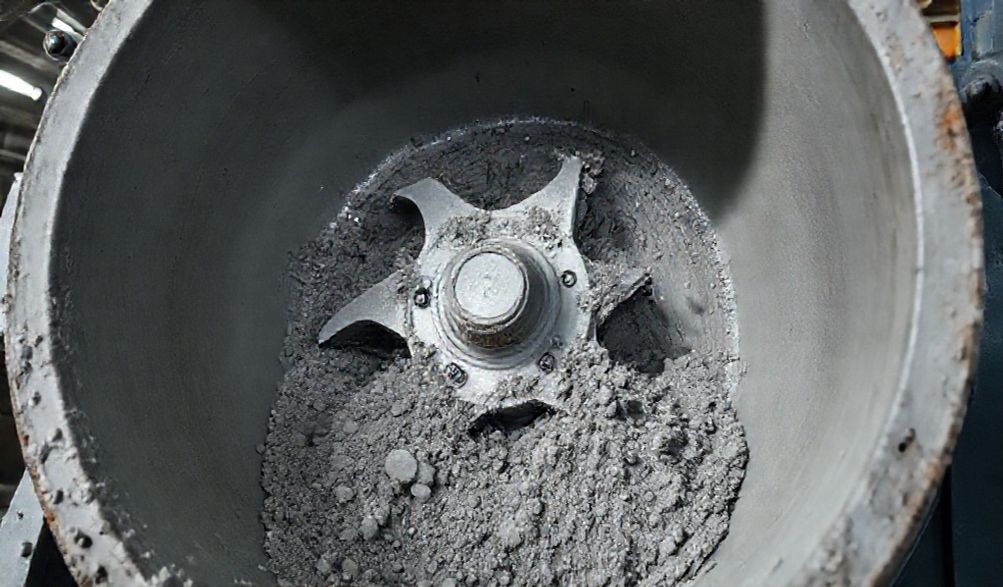
Чӣ тавр онҳо кор мекунанд: The mixing action occurs in a shallow, circular pan that rotates. Inside, one or more sets of fixed or counter-rotating stars, blades, or ploughs scrape and shear the mixture against the pan’s base and walls. This creates a intense, forced “kneading” action.
Беҳтарин барои:
* High-quality facing blocks and pavers where color consistency is paramount.
* Producing very stiff, dry-cast concrete mixes with low slump.
* Applications requiring exceptional homogeneity in smaller to medium batch sizes.
Муҳосибаҳо ва нуқсонҳо:
* Муҳоҷизот: Delivers arguably the highest mix homogeneity. Excellent for blending pigments and additives uniformly. Generally offers good access for cleaning and maintenance.
* Манфӣҳо The rotating pan and complex blade mechanisms can lead to higher wear on liners and blades compared to some designs. May have a slightly longer mixing cycle for very large batches.
Twin-Shaft/Paddle Mixers (Forced Action Mixers)
Чӣ тавр онҳо кор мекунанд: This mixer features a stationary mixing trough. Inside, two parallel shafts fitted with intermeshing paddle arms rotate at high speed. The paddles aggressively move the material in opposing, overlapping patterns, creating a violent and fast cross-current mixing action.
Беҳтарин барои:
* High-volume production plants where output speed is critical.
* Extremely stiff mixes like those used for Roller Compacted Concrete (RCC) or solid dense blocks.
* Large batch sizes, commonly found in fully automatic block production lines.
Муҳосибаҳо ва нуқсонҳо:
* Муҳоҷизот: Extremely fast and intensive mixing action. Highly efficient for large-capacity batches. Robust construction handles heavy, abrasive materials well.
* Манфӣҳо Higher initial capital cost. The intense action can be overkill for smaller operations. The intermeshing paddles require precise clearance maintenance.
Drum Mixers (Free-Fall Mixers)
Чӣ тавр онҳо кор мекунанд: The classic concrete mixer design. A rotating drum, equipped with fixed internal fins or blades, lifts the materials and allows them to fall back onto themselves through gravity. These come in tilting (to discharge) or non-tilting (with a chute) variants.
Беҳтарин барои:
* Volumetric batching or ready-mix applications where concrete is wetter.
* Very small-scale or start-up block operations with severe budget constraints.
* Mixes that are more plastic and less dry than typical block concrete.
Муҳосибаҳо ва нуқсонҳо:
* Муҳоҷизот: Simple design, lower initial purchase cost, and easy to operate.
* Манфӣҳо Least effective for the dry, no-slump mixes required by modern block machines. The free-fall action struggles to achieve the homogeneity needed for consistent block quality. Can lead to “balling” of cement and uneven moisture distribution.
Key Factors to Consider When Selecting a Mixer
Choosing a mixer requires a pragmatic assessment of your entire operation. Use these criteria as your decision-making framework.
Compatibility with Your Block Making Machine
This is the first and most critical check. The mixer must be a seamless part of your system.
* Batch Size: Your mixer’s capacity (in liters or kg) must match the hopper capacity of your block machine. An undersized mixer requires multiple batches per machine cycle; an oversized one wastes energy and material.
* Discharge Height & Method: The mixer must discharge cleanly into the block machine’s feed hopper or conveyor. Verify the discharge height and gate mechanism (pneumatic, manual) for a perfect fit.
* Control System Integration: For semi-automatic or fully automatic plants, the mixer’s controls (start, stop, discharge) must be integratable with the block machine’s PLC for a synchronized, hands-off production cycle.
Mixing Cycle Time and Production Capacity
Your mixer dictates the pace of your plant.
* Calculate your required output in blocks per hour.
* Work backwards: Know how many blocks are produced per machine cycle and how much mix that requires.
* Ensure the mixer’s batch capacityваtotal cycle time (loading, mixing, discharging) can keep up with this demand without creating a bottleneck. A good rule is that mixing time should be less than the block machine’s cycle time.
Material Characteristics and Recipe Flexibility
Consider not just what you mix today, but what you might mix tomorrow.
* Агрегатҳо: Can it handle your specific blend of sand, gravel, or crushed stone? Abrasive materials require more robust wear protection.
* Иловаҳо: If you use fibers, plasticizers, or accelerating agents, the mixer must disperse them effectively.
* Миқдори намӣ Confirm the mixer is designed for the very low moisture levels (typically 4-7%) of dry-cast concrete.
* Recipe Changes: If you produce multiple block types (e.g., hollow, solid, paver), ensure the mixer can adapt to slightly different recipes without extensive recalibration.
Durability, Maintenance, and Total Cost of Ownership
Look beyond the price tag to the long-term cost.
* Қисмҳои фарсудашаванда Inquire about the availability and cost of common wear parts like mixing blades/arms, pan/trough liners, and seals.
* Сифати сохтмон: Inspect the thickness of steel used, the quality of welds, the brand and rating of the electric motor and gearbox. Over-engineering here prevents costly downtime.
* Ease of Service: Are lubrication points accessible? Can blades be replaced without major disassembly? Is the interior easy to clean at the end of a shift? Good design saves labor and time.
Best Practices for Operating and Maintaining Your Mixer
A great mixer, poorly maintained, will quickly become a liability. These practices ensure longevity, safety, and consistent performance.
Loading Sequence and Mixing Time Optimization
Consistency starts with a consistent loading procedure.
* Recommended Sequence: A standard, effective sequence is:
1. Coarse aggregates (gravel)
2. Sand and any other fine materials
3. Cement (and dry pigments)
4. Water (added gradually and evenly during mixing)
* Mixing Time: Do not guess. For a new recipe, conduct tests. Take samples from the mixer at 60, 90, 120 seconds and have them tested for compressive strength. The optimal time is the shortest duration that yields consistent, maximum strength. Over-mixing wastes energy and can start to segregate materials.
Routine Maintenance Checklist
Preventative maintenance is non-negotiable.
Daily:
* Visually inspect for any loose bolts, leaks, or damage.
* Clean the interior and discharge area thoroughly after the last batch to prevent hardened concrete buildup.
Weekly:
* Check blade/paddle wear and clearance.
* Inspect and tighten all bolts, especially on blade arms and liners.
* Grease all lubrication points as specified in the manual.
Periodic (Monthly/Quarterly):
* Measure blade wear precisely. Plan for replacement if wear exceeds 25% of the original dimension.
* Check gearbox oil level and condition.
* Inspect liner thickness and plan for replacement before wear-through occurs.
Common Mixer Problems and Troubleshooting
- Problem: Inconsistent Mix Quality.
- Likely Causes: Severely worn blades, incorrect loading sequence, mixing time too short, or overloading the batch capacity.
- Problem: Excessive or Uneven Wear on Blades/Liners.
- Likely Causes: Highly abrasive aggregates, improper blade-to-liner clearance (too tight or too loose), or running the mixer empty.
- Problem: Motor Overheating or Overloading.
- Likely Causes: Overfilling the mixer beyond capacity, a jam in the mixing chamber (like a stray tool), or a failing motor bearing.
Frequently Asked Questions (FAQ)
Q1: Can I use a standard concrete drum mixer for my block making machine?
A: It is possible for very small-scale or experimental setups, but it is strongly discouraged for serious production. Standard drum mixers rely on gravity and are designed for wetter, more plastic concrete. They cannot adequately homogenize the dry, stiff mixes required by block machines, leading to poor block quality, machine clogging, and inconsistent results. Forced-action mixers (pan or twin-shaft) are the industry standard for a reason.
Q2: How often do mixer blades need to be replaced?
A: There’s no universal timeline; it depends entirely on the abrasiveness of your aggregates and your production volume. You should inspect blade thickness monthly. As a general guideline, replacement is typically necessary when the wear exceeds 25-30% of the blade’s original dimension. Significant wear drastically reduces mixing efficiency and homogeneity.
Q3: What is the ideal moisture content for mix in a block plant mixer?
A: The ideal content is specific to your raw materials and recipe. However, for dry-cast concrete block production, the mix is characteristically very dry—often with a total moisture content between 4% and 7% by weight. A common field test is the “ball test”: a handful of properly mixed concrete should compact into a ball that holds its shape without crumbling or leaving excess moisture on your hand.
Q4: Is a twin-shaft mixer always better than a pan mixer?
A: Not necessarily. It’s about application. Twin-shaft mixers are champions of speed and large-batch throughput, ideal for high-volume plants focused on standard blocks. Pan mixers are often considered artists for mix homogeneity, excelling at color blending and precision for high-end products like colored pavers or split-face blocks. The “better” mixer is the one that best aligns with your primary product mix, quality goals, and production scale.
Conclusion
The journey to perfect blocks begins long before the mold is filled. As we’ve explored, the mixer for your blocks making machine is a core determinant of your plant’s success—impacting everything from the structural integrity of your products to the efficiency of your bottom line. The choice between a pan mixer, twin-shaft mixer, or drum mixer is a strategic decision that hinges on your specific recipe, required output, and quality benchmarks.
As a final piece of expert advice, we strongly recommend a collaborative approach. Consult with both your block machine manufacturer and specialized mixer suppliers. Their combined experience is invaluable. Whenever possible, the most prudent step is to request a production trial using your actual local raw materials. Seeing and testing the mix quality firsthand is the only way to be truly confident in your investment.
Call to Action: Take a moment to assess your current mixing process against the guidelines above. Are there gaps in quality or efficiency? If you’re planning an upgrade or a new plant, use this guide as your foundation. For a detailed specification checklist to take to your equipment suppliers, [download our free guide] or contact our team of block production experts for a personalized consultation.
<