
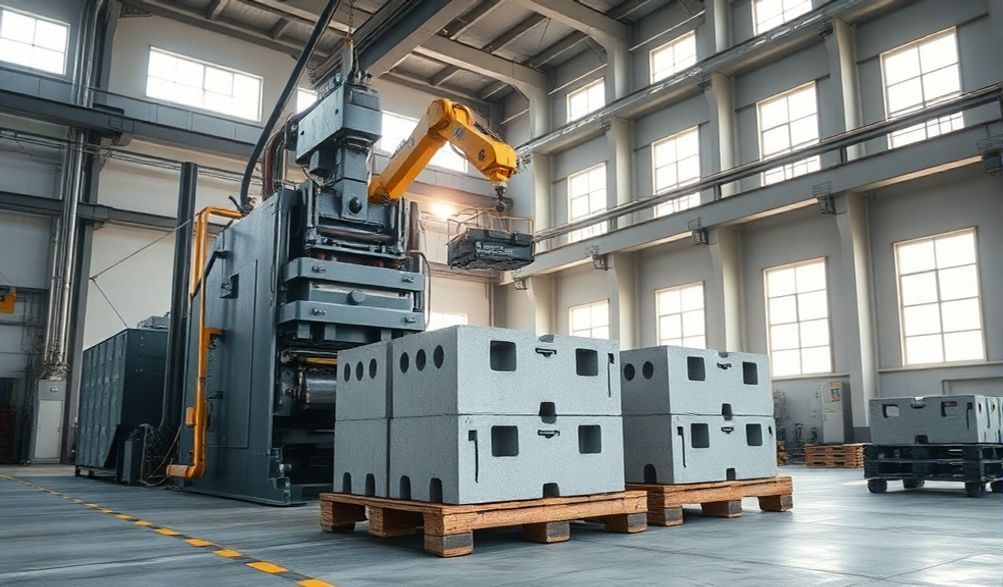
The Ultimate Guide to Brickwork Machines: Inside the FUDA Block Making Factory
The global construction industry is a relentless engine of progress. From soaring skyscrapers to essential infrastructure, the demand for high-quality, reliable building materials is insatiable. At the very foundation of this growth lies a simple, yet critical, component: the brick or concrete block.
For centuries, brick-making was synonymous with back-breaking labor, inconsistent quality, and slow, seasonal output. Today, these traditional methods are a bottleneck, unable to meet the scale, speed, and precision required by modern projects. The industry’s pain points—skyrocketing labor costs, material waste, and unpredictable results—demand a smarter solution.
Enter the paradigm of automated manufacturing, exemplified by the advanced brickwork machines from the FUDA block making factory. This guide is not a sales pitch, but a deep dive into the engineering and operational excellence that sets a new standard. Built on an analysis of manufacturing principles and industry best practices, this resource is designed for builders, contractors, and savvy investors seeking trustworthy information.
We will dissect the core technology of these machines, take you inside the efficient world of a FUDA factory, and explore the tangible benefits that make automated block production an undeniable upgrade for quality, profitability, and sustainability.
What is a Brickwork Machine? Core Technology Explained
Gone are the days of manual molds and inconsistent mixtures. A modern brickwork machine is a sophisticated, integrated system that automates the entire process of transforming raw materials into perfectly formed, high-strength construction blocks. It’s a symphony of mechanical and electronic components working in unison to deliver precision at scale.
Defining the Modern Brick and Block Making Machine
At its core, a brick or block making machine is a mechanized system designed to automate the mixing, molding, compacting, and often curing of raw materials like concrete, fly ash, aggregates, and water. The output is a consistent stream of precise bricks, hollow blocks, solid blocks, or pavers, ready for construction. This automation is the key to overcoming the limitations of manual labor.
Key Components of an Automated Block Making System
Understanding the machine starts with its essential parts:
- Миксер: The starting point of quality. A powerful, often pan-type mixer ensures raw materials are homogenized into a perfectly consistent, semi-dry concrete mix. Uniformity here is non-negotiable for the strength of the final block.
- Системаи конвейерӣ: This is the logistics network of the plant. Belt conveyors efficiently transport the mixed material to the molding chamber without segregation or delay, maintaining production rhythm.
- Molding Chamber & Hydraulic Press: The heart of the operation. Here, the mix is fed into a mold (which can be changed for different block types). A high-tonnage hydraulic press then applies immense pressure, often combined with high-frequency vibration.
- This dual action compacts the material, removing air pockets and creating a high-density block with superior compressive strength. The pressure (measured in tons) is a critical specification directly linked to block quality.
- Системи идоракунӣ The brain of the machine. A Programmable Logic Controller (PLC) automates the entire cycle—filling, pressing, ejecting. This ensures repeatable precision, simplifies operation, and allows for fine-tuning of production parameters.
Different Types of Brick Making Machines
The technology adapts to different project scales:
- Машинаҳои истеҳсоли блокҳои сабит: These are the workhorses of large-scale production, like the flagship models from FUDA. They are installed in a fixed location within a factory, offer the highest output, and are the centerpiece of a full production line.
- Машинаҳои муваққатии хиштӣ: Offering greater flexibility, these smaller machines can be towed to different construction sites. Output is lower, but they eliminate transport costs for blocks by producing them on-location.
- Egg-Laying Block Machines: A unique type that produces blocks and deposits them directly onto a level concrete curing slab, “laying” them like eggs. They are a good middle-ground for medium-scale production without the need for pallets.
Inside the FUDA Block Making Factory: A Model of Efficiency
A FUDA factory is more than just an assembly floor; it’s a testament to systematic engineering where every process is optimized for reliability and output. It’s here that individual machines transform into a seamless production ecosystem.
FUDA’s Commitment to Engineering and Design
The foundation of FUDA’s reputation is built on robust engineering. Machines are constructed from high-grade, reinforced steel to withstand the constant stress of high-pressure operation. This focus on durability translates to longer machine life, fewer breakdowns, and lower long-term maintenance costs—a direct reflection of their expertise and authoritativeness in heavy machinery manufacturing.
The Production Line Workflow
Walking through a FUDA plant reveals a choreographed flow of material and machinery:
- Raw Material Storage & Batching: Aggregates, cement, and fly ash are stored separately. An automated batching system precisely measures each component according to a pre-set mix design.
- Омехта кардан The batched materials are fed into the industrial mixer, where water is added to create a uniform, workable mix.
- Molding and Compaction: The mix is conveyed to the central brickwork machine. The PLC-controlled hydraulic press molds and compacts the blocks with immense force.
- Шифо додан: Freshly pressed blocks (called “green” blocks) are moved to a curing area. This can be a simple rack system in a sheltered yard or an advanced steam-curing chamber, which accelerates strength gain in hours rather than weeks.
- Palletizing & Packaging: Once cured, blocks are stacked on pallets, often automatically, and wrapped for secure storage and transport.
Quality Control at Every Stage
Trustworthiness is manufactured into every block. FUDA integrates quality control at multiple points:
* In-process checks monitor mix consistency and block weight.
* Finished blocks are regularly sampled for dimensional accuracy using precision gauges.
* Critical compressive strength tests are performed in an on-site lab, ensuring every batch meets or exceeds relevant international standards (like ASTM or ISO).
This relentless focus on QC guarantees builders receive a product they can depend on, project after project.
Advantages of Choosing a FUDA Brick Production Line
Investing in a FUDA system is an investment in tangible, operational advantages that impact the bottom line and project outcomes.
Unmatched Productivity and Cost-Efficiency
- Натиҷаи баланд: Machines produce thousands of uniform blocks per shift, a rate impossible with manual labor.
- Самараҳои меҳнатӣ: Automation reduces dependency on a large workforce, cutting significant recurring costs and minimizing management overhead.
- Material Optimization: Precise batching and mixing drastically reduce raw material waste, maximizing the yield from every ton of cement and aggregate.
Сифати бартари маҳсулот ва устуворӣ
Automation eliminates human error. Every block from a FUDA line has:
* Identical dimensions for faster, easier laying.
* Consistent high density and compressive strength for structural integrity.
* A clean, sharp finish that enhances the aesthetic of the final construction.
Гуногунии дар маҳсулоти мавҷуда
One machine can be the source for an entire catalog of products. By simply changing the mold in the press, the same production line can manufacture:
* Hollow blocks (for load-bearing and partition walls)
* Блокҳои сахт
* Сангҳои фарш ва пайвасткунакҳои фарш
* Curb stones and landscaping blocks
* Specialized architectural shapes
Sustainability and Eco-Friendly Production
Modern block making aligns with green construction:
* Use of Industrial By-Products: FUDA machines excel at incorporating fly ash (from coal plants) or slag, turning waste into valuable building material.
* Energy-Efficient Blocks: The resulting blocks often have better thermal properties, contributing to energy-efficient buildings.
* Истеҳсоли маҳаллӣ Reducing transport distances for heavy blocks lowers the overall carbon footprint of a project.
Key Considerations Before Investing in a Block Making Plant
Transitioning to automated production is a significant decision. Careful planning ensures your investment is sound and tailored to your goals.
Assessing Your Production Needs and Scale
Худ пурсед:
* What is my target daily or monthly output (in blocks)?
* Which block types are in highest demand in my local market?
* Do I have adequate space for the machine, raw materials, curing, and storage?
* What is the availability and cost of local raw materials (cement, aggregates)?
Financial Planning: Machine Cost vs. ROI
The initial investment is offset by long-term savings and revenue. Your ROI calculation should factor in:
* Capital Cost: The price of the machine and auxiliary equipment (mixer, conveyor, pallets).
* Хароҷоти амалиётӣ: Utilities, labor, maintenance, and raw materials.
* Revenue Potential: Local market price for blocks and the volume you can sell.
A well-run plant typically sees a strong ROI as it captures market share with higher quality and competitive pricing.
Beyond the Machine: Support and Service
The machine is just one part of the equation. The supplier’s experience and support network are critical. FUDA’s value lies in:
* Comprehensive Support: From factory layout advice to on-site installation guidance.
* Operator Training: Ensuring your team can run and maintain the machine efficiently.
* Дастрасии қисмҳои эҳтиётӣ: A global supply chain for genuine parts to minimize downtime.
This end-to-end partnership is what transforms a machinery purchase into a successful long-term business venture.
Applications of Machine-Made Blocks in Modern Construction
The high-quality blocks produced by these machines are versatile enough for virtually any project:
Residential and Commercial Building Projects
They form the core of walls, partitions, and foundations for houses, apartment complexes, offices, and shopping centers. Their consistency speeds up construction and improves finish quality.
Infrastructure and Landscape Development
- Pavements and Walkways: Interlocking pavers create durable, permeable, and attractive surfaces.
- Деворҳои нигоҳдорӣ: Specialized blocks are engineered for strength and stability in landscaping and civil engineering.
- Drainage and Culverts: Certain hollow blocks are used in utility construction.
Specialized Architectural and Decorative Uses
With colored mixes and textured molds, machine-made blocks can be used for facades, garden walls, and other aesthetic features, offering a cost-effective alternative to natural stone.
Frequently Asked Questions (FAQ)
Q1: What is the average production capacity of a FUDA block making machine?
A: Capacity varies significantly by model. A standard FUDA stationary machine can produce anywhere from 2,000 to over 20,000 blocks per 8-hour shift. The exact number depends on the specific machine model, the type of block being made (a solid block cycles faster than a complex hollow block), and the chosen level of automation.
Q2: How long does it take to set up and commission a new brickwork production line?
A: With a prepared, level concrete foundation and all utilities (power, water) in place, a basic production line can be installed and made operational within a few weeks. FUDA typically provides technical supervision to assist with installation and commissioning, ensuring a smooth start-up.
Q3: Can these machines use local raw materials?
A: Absolutely. This is a major advantage. FUDA machines are engineered to work with the cement, aggregates (sand, gravel, crushed stone), and fly ash available in your region. The factory provides tested mix design formulas to help you achieve optimal block quality with your local materials.
Q4: What kind of after-sales service does FUDA provide?
A: FUDA’s support is designed for long-term partnership. It includes detailed operation and maintenance manuals, instructional videos, remote technical support via phone or online, and access to a global network for genuine spare parts. This comprehensive support system is crucial for minimizing downtime and protecting your investment.
Q5: Are the blocks produced strong enough for load-bearing walls?
A: Yes, definitively. The high-pressure compaction process creates blocks with dense microstructure and compressive strength that far exceeds the requirements of most international building codes for load-bearing applications (e.g., ASTM C90). Regular quality control testing verifies this strength batch by batch.
Conclusion
The evolution from manual brick-making to automated production with advanced brickwork machines represents a fundamental leap forward for the global construction industry. As we’ve seen inside the FUDA block making factory, this technology is not just about replacing labor; it’s about elevating every aspect of production—quality, efficiency, versatility, and sustainability.
The core value proposition is clear: reduce project costs and timelines while simultaneously improving the integrity and finish of the built environment. For the entrepreneur, it opens a viable and profitable business opportunity in a perennial market.
Making the move to automated production is a strategic decision. It requires planning and the right partner. We encourage you to use this guide as a foundation for your research. The logical next step is to consult directly with factory experts who can analyze your specific needs, local market conditions, and raw materials to provide a customized solution and a clear path to your ROI.
Investing in proven technology from an established, support-focused manufacturer like FUDA is ultimately a decision based on long-term value, operational reliability, and building a foundation for future growth.
<