
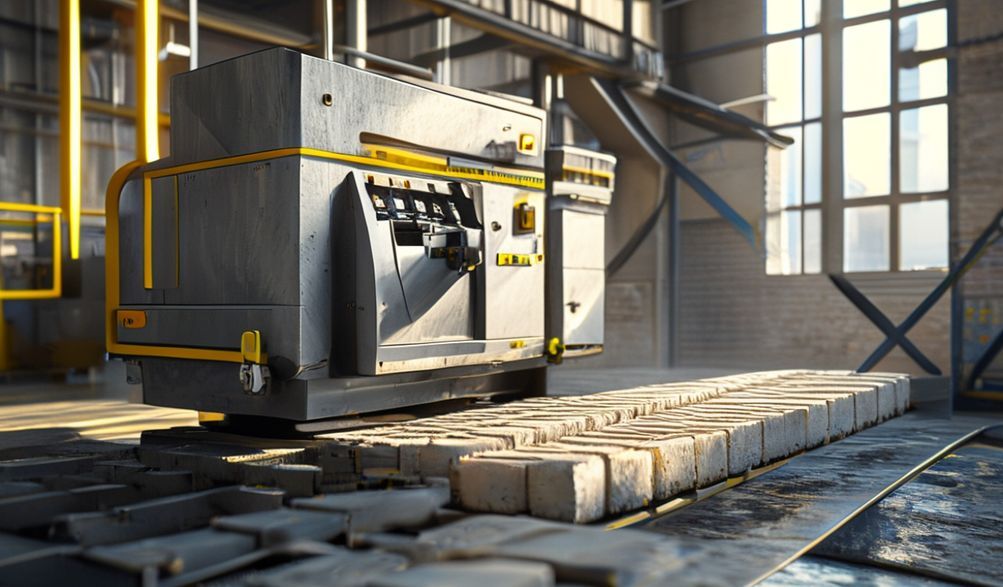
Дастури ниҳоии мошинҳои блокҳои бетонӣ: Намудҳо, нархҳо ва чӣ гуна интихоб кардан
From the foundations of our homes to the pavers in our gardens, concrete blocks are a fundamental component of the built environment. This global reliance on durable, cost-effective building materials is made possible by a critical piece of technology: the concrete block machine. For entrepreneurs, construction firms, and investors, understanding this machinery is the first step toward building a profitable business or optimizing a project’s supply chain.
This comprehensive guide is designed to be your authoritative resource. Drawing on industry knowledge, technical specifications, and practical operational experience, we will demystify concrete block machines. Whether you’re exploring how to start a block manufacturing business or seeking to improve your current production line, you will learn about the different types of machines, their key features, a realistic investment analysis, and a step-by-step framework for choosing the right equipment for your specific goals.
Understanding Concrete Block Machines: Core Concepts and Applications
Before diving into specifications and costs, it’s essential to grasp what these machines do and why they are so pivotal to modern construction.
What is a Concrete Block Machine?
A concrete block machine is a specialized piece of equipment designed to manufacture concrete masonry units (CMUs) through a process of compaction and molding. The basic operating principle involves three key stages:
- Омехта кардан Raw materials—typically cement, aggregates (sand, gravel, or crushed stone), and water—are combined to form a semi-dry concrete mix.
- Қолибгирӣ: This mix is fed into a mold cavity on the machine. Through high-frequency vibration and, often, hydraulic pressure, the mix is densely compacted to remove air pockets and achieve the desired shape.
- Шифо додан: The freshly formed, “green” block is then ejected onto a pallet to undergo curing, a process of controlled hydration that gives the block its final strength.
By automating and standardizing this process, these machines enable the rapid, consistent, and cost-effective production of the blocks that form the backbone of countless structures worldwide.
Common Products and Applications
The versatility of a block machine lies in its interchangeable molds. By simply changing the mold box, a single machine can produce a wide array of products:
- Блокҳои ҳолӣ: The most common product, used in load-bearing and non-load-bearing walls for residential and commercial buildings.
- Блокҳои сахт:Барои пояҳо, пиёдаравҳо ва майдонҳое, ки ба қуввати фишории баланд ниёз доранд, истифода мешавад.
- Сангҳои роҳсозӣ ва сангҳои ба ҳам пайвастшаванда: For driveways, walkways, and patios, available in various colors and shapes.
- Curb Stones & Landscape Edging: For roadways, garden beds, and decorative landscaping.
- Блокҳои махсус: Such as chimney blocks, lintel blocks, and partition blocks.
These products find applications in virtually every construction sector, from laying the foundation of a family home to building the retaining walls for major infrastructure projects and creating attractive hardscapes in public parks.
Types of Concrete Block Machines: A Detailed Breakdown
The market offers a spectrum of machines, from simple, hands-on models to fully automated production lines. Your choice fundamentally depends on your required output, budget, and labor availability.
Дастӣ ва ним-автоматӣ мошинҳо
- Амалиёт ва Натиҷа: These machines require significant operator involvement. For manual machines, every step—filling the mold, compacting (often via a lever), and ejecting the block—is done by hand. Semi-automatic versions may use a mechanical or hydraulic press for compaction but still require manual feeding and block removal. Production is low to medium, typically ranging from 500 to 2,000 blocks per 8-hour shift.
- Идеалӣ барои: Startups with severe budget constraints, small-scale projects like a personal homestead, or businesses focusing on niche, artistic block designs where volume is less critical than flexibility.
- Муҳосибаҳо ва нуқсонҳо:
- Муҳоҷизот: Very low initial investment, minimal electrical requirements, easy to understand and repair, highly flexible for custom products.
- Манфӣҳо High labor intensity and cost, inconsistent product quality dependent on operator skill, physically demanding, limited production capacity.
Машинаҳои стационарии пурра автоматӣ
- Амалиёт ва Натиҷа: These are complete production systems. They automatically handle material batching, mixing, molding, compaction, block ejection, and pallet stacking with minimal human intervention, often controlled by a Programmable Logic Controller (PLC). Output is high, ranging from 5,000 to over 20,000 blocks per 8-hour shift, depending on the model.
- Идеалӣ барои: Established block manufacturing yards (blockfields) with consistent, high-volume demand from construction companies and retailers. They are the workhorse of the commercial block industry.
- Муҳосибаҳо ва нуқсонҳо:
- Муҳоҷизот: Very high, consistent output; superior product uniformity and strength; lower labor cost per block; high efficiency and repeatability.
- Манфӣҳо Substantial upfront capital investment; requires significant factory space and stable, high-capacity power supply; more complex maintenance requiring trained technicians.
Fully Automatic Mobile Block Machines
- Амалиёт ва Натиҷа: Also known as “egg-layers” or mobile block makers, these self-contained units produce blocks directly on the ground at the construction site. They move forward after each production cycle, laying blocks in a pattern.
- Идеалӣ барои: Large-scale infrastructure projects (e.g., road construction, large perimeter walls) where transporting pre-made blocks would be logistically challenging and expensive. They eliminate transport costs for the final product.
- Муҳосибаҳо ва нуқсонҳо:
- Муҳоҷизот: Dramatically reduces transportation costs for large projects, allows for just-in-time production, versatile for on-site work.
- Манфӣҳо Generally slower than high-end stationary lines, product range is often limited to basic solid or hollow blocks, requires on-site material handling setup.
Key Features and Components: What to Look For
Beyond the broad categories, understanding the core components will help you evaluate the quality and suitability of any concrete block machine.
The Heart of the Machine: Mold and Vibration System
The mold and vibration system are responsible for the block’s final shape, density, and strength.
- Сифати қолиб: Industry practice shows that high-quality, hardened steel molds with precise machining are non-negotiable. They ensure dimensional accuracy, a smooth block finish, and long life before wearing out. Poor-quality molds lead to blocks sticking, rough edges, and frequent downtime for replacement.
- Системаи Ларзишӣ: This is what consolidates the concrete mix. Key factors include:
- Frequency & Amplitude: Optimal vibration (often 3,000-6,000 RPM) forces particles to settle densely, eliminating voids. The right combination is crucial for achieving the required compressive strength.
- Ҷадвали Ларзиш: A robust, balanced table ensures even vibration distribution across the entire mold, preventing weak spots in the final block.
Control Systems: PLC vs. Manual
The level of automation dictates consistency and operational ease.
- Manual Controls: Found on basic machines, involving levers, buttons, and manual timers. They rely entirely on operator skill and timing, leading to more variability.
- PLC (Назоратгари мантиқии барномашаванда): The brain of an automatic machine. A PLC allows for precise, repeatable control over every cycle parameter—vibration time, pressure, feed quantity, and movement sequences. This guarantees every block is identical. It also simplifies operation and often includes diagnostic functions for troubleshooting.
Production Capacity and Power Requirements
- Interpreting “Blocks Per Hour”: Always ask for the standard block size (e.g., 8x8x16 inch hollow block) used in the output claim. A machine rated for 2,000 solid blocks per hour will produce far fewer larger paver blocks. Consider the effective output for your specific product mix.
- Power Assessment: Machines can be electric, diesel, or hybrid. A large fully automatic line may require a robust 3-phase electrical connection. Mobile machines often use diesel engines. Ensure your facility or site can support the machine’s power needs, including peak load during operation.
The Investment: Cost Analysis and ROI Considerations
A transparent look at costs is essential for building a viable business plan and establishing trust in your decision-making process.
Breaking Down the Costs
- Machine Price Ranges:
- Дастӣ/Нимҳудакорӣ: $1,000 – $15,000 USD.
- Fully Automatic Stationary: $25,000 – $150,000+ USD, with large production lines reaching $500,000.
- Машинаҳои блоксозии мобилӣ: $20,000 – $80,000 USD.
- Hidden & Operational Costs: The machine invoice is just the start.
- Shipping & Installation: Can be significant for heavy international shipments.
- Training: Budget for operator and maintenance training.
- Қисмҳои ивазшаванда: An initial kit of common wear parts (mold liners, springs, seals) is wise.
- Foundation & Space: Your facility needs a strong, level floor and ample space for production, curing, and storage.
- Маводҳои хом: Cement, aggregates, and water are your recurring costs. Local availability and price directly affect margins.
Calculating Your Potential Return on Investment (ROI)
A simple framework can guide your profitability estimate:
- Estimate Daily Output: Based on the machine’s capacity and your planned operational hours.
- Determine Local Market Price: Research the selling price per block or paver in your target market.
- Calculate Gross Daily Revenue: (Output) x (Price per Unit).
- Subtract Daily Operational Costs: Raw materials + labor + utilities + maintenance + overheads.
- Analyze: Compare your estimated net daily profit against the total capital investment (machine + setup costs). This will give you a payback period.
Key Profitability Factors: Local demand and competition, your operational efficiency (reject block rate), economies of scale, and your ability to manage costs will ultimately determine your success.
How to Choose the Right Machine: A Step-by-Step Guide
This is where experiential knowledge becomes critical. Follow this practical guide to align your purchase with your long-term goals.
Assess Your Business Needs and Goals
Answer these questions honestly:
* What is my target market? (Local contractors, DIY retailers, large infrastructure tenders?)
* What specific block types do I need to produce? (Only standard hollow blocks, or a mix including pavers and curbs?)
* What is my required average daily or monthly production volume? (Be realistic about initial sales and growth.)
* What is my available budget, including setup and working capital?
Evaluate Supplier Reputation and Support
Your relationship with the supplier is as important as the machine itself. A trustworthy, authoritative partner provides invaluable security.
* Company History & Reviews: How long have they been in business? Seek out independent client testimonials or case studies.
* Дастгирии техникӣ: Do they offer installation supervision and comprehensive operator training?
* Warranty & Spare Parts: What is covered and for how long? Is there a reliable supply chain for spare parts, or will you wait months for a critical component?
* Transparency: Are they willing to share detailed specifications, video of the machine running, and contact details of past clients in your region?
The Importance of Testing and Trials
If possible, never buy a machine unseen. The gold standard is to visit the supplier or a client’s factory to see the machine in operation. At a minimum, insist on a production trial using your local raw materials. The characteristics of your local sand and aggregate can significantly affect block quality. A reputable supplier will encourage this, as it ensures you get a machine configured correctly for your conditions.
Operational Best Practices and Maintenance
Sustainable success requires moving beyond the purchase to proficient daily operation.
Essential Daily and Weekly Maintenance
A simple checklist can prevent major breakdowns:
* Daily: Clean the machine thoroughly at the end of each shift, removing all concrete residue. Check hydraulic oil levels and for leaks. Inspect mold components for wear or damage. Lubricate all moving parts as per the manual.
* Weekly: Tighten all bolts and nuts that may have vibrated loose. Check the vibration motor mounts and drive belts for tension and wear. Inspect electrical connections.
Troubleshooting Common Issues
Operators commonly report these problems:
* Blocks Sticking in Mold: Often caused by worn mold liners, insufficient release agent, or an overly wet concrete mix.
* Poor Surface Finish or Chipped Edges: Can indicate low compaction pressure, worn mold edges, or an incorrect mix design (too dry or too little cement).
* Low Block Strength: The most frequent causes are an incorrect water-cement ratio, insufficient vibration time/power, or low-quality cement.
Frequently Asked Questions (FAQ)
Q1: What is the average cost of a concrete block making machine?
Costs vary dramatically. Small manual machines can start around $1,000, while high-output, fully automatic production lines can exceed $150,000. Your specific needs will determine where in this spectrum you fall.
Q2: Can I use a concrete block machine for a small home business?
Absolutely. A manual or semi-automatic machine is a popular entry point for a small home business. Focus on niche markets, custom designs, or supplying a local community to build demand before scaling up.
Q3: What is the difference between a hydraulic and a vibration press machine?
These terms are often combined. “Vibration press” refers to the compaction method. “Hydraulic” refers to the system that applies the pressing force and ejects the block. Most modern stationary machines use a hydraulic system to apply pressure to a vibrated mold for optimal density.
Q4: How much space do I need to set up a block manufacturing plant?
For a small semi-automatic operation, a minimum of 5,000-10,000 sq. ft. is needed for the machine, raw material storage, block curing, and finished product inventory. Large automatic lines require 20,000 sq. ft. or more, including space for pallet storage and loading docks.
Q5: What kind of after-sales service should I expect from a reputable supplier?
Expect detailed installation manuals, availability of remote or on-site training, a clear warranty (at least 12 months on core components), and prompt access to spare parts. 24/7 technical support via phone or video call is a sign of a top-tier supplier.
Conclusion
Choosing and operating a concrete block machine is a significant decision that blends technical understanding with business strategy. We’ve journeyed from the core principles of how these machines work, through the detailed breakdown of types and features, to a realistic analysis of costs and a practical guide for selection. Remember, the most successful operations align their equipment choice with clear business goals and partner with a trustworthy, experienced supplier for ongoing support and training.
Your next step is to take this knowledge and apply it. Conduct further research on specific models, reach out to suppliers with your detailed requirements, and always request a material test with your local aggregates. For large-scale setups, consulting with a professional civil or mechanical engineer is a wise investment. By doing your due diligence, you lay the strongest possible foundation for your block manufacturing success.
<