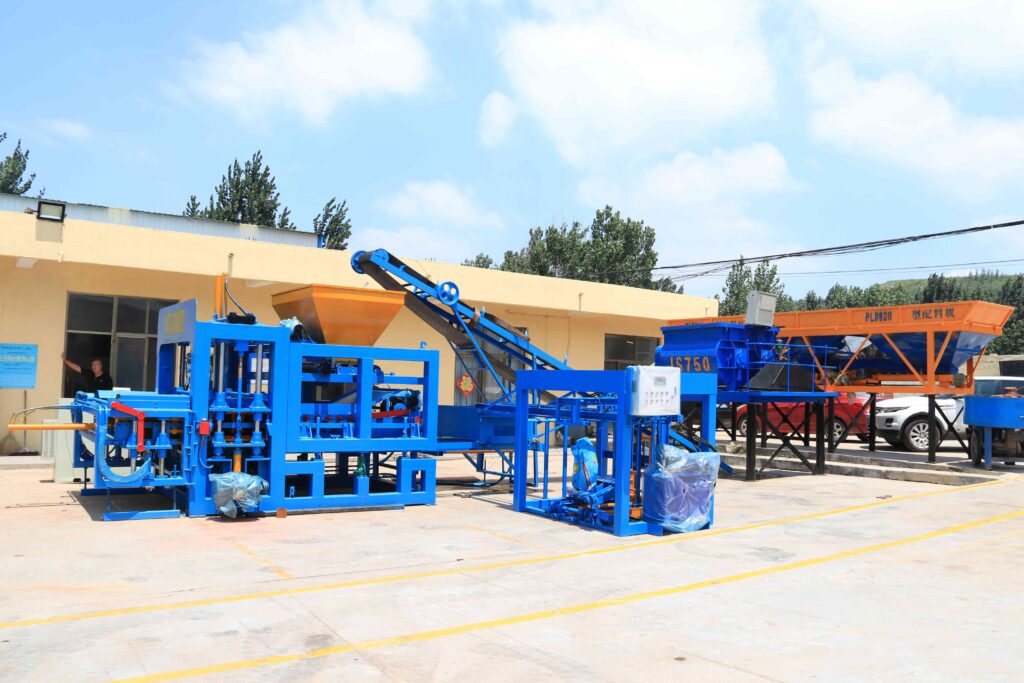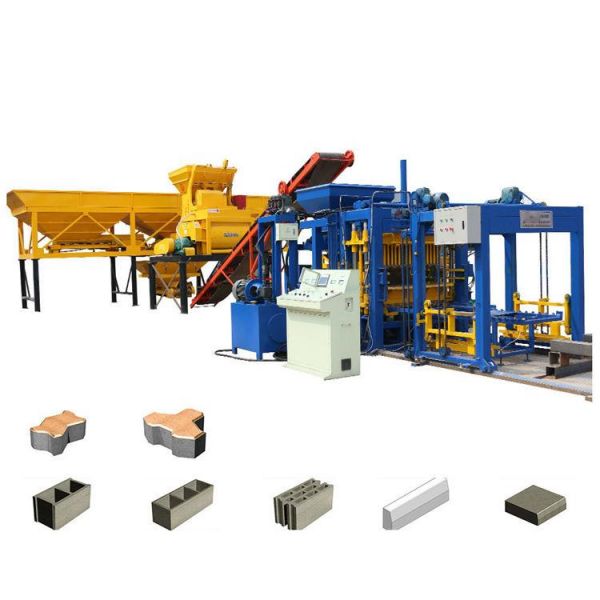
1. Таърифи Мошини Блоки Автоматӣ: Фар аз Автоматсозии Асосӣ
Дастгоҳи худкори блоксоз як системаи комил ва компютеришудаи истеҳсолотӣ мебошад, ки барои иҷрои тамоми давраи ташаккули блок — аз воридкунии моддаҳои хом то баровардани маҳсулоти ниҳоӣ ва палетишуда — бо мантиқи пешбарномарезӣ ва дасткории ҳадди ақали дастӣ таҳия шудааст. Ишораи "худкор" аз ҳамоҳангсозии ҳамаи зерсистемаҳо сарчашма мегирад, ки дар давоми давраи асосии истеҳсолот ба таъсири дастгоҳкор ниёз надорад.
1.1. Дифференсиаторҳои асосӣ: Интисоби раванди басташуда
Баръакси дастгоҳҳои ним-автоматӣ, ки метавонанд ниёз ба додани дастии омехта ё баровардани дастии палетҳо дошта бошанд, системаи воқеан автоматӣ бо раванди басташудаи модда ва палетҳо тавсиф мешавад. Омехтаи хом тавассути конвейерҳои автоматӣ аз як заводгирии марказии омехтакунӣ таъмин мешавад, ва палетҳои тайёршуда ба системаҳои сахтшавӣ интиқол дода мешаванд, дар давоми равандҳои истеҳсолии стандартӣ бе он ки коргар ба онҳо даст мезанад. Нақши инсон аз кори ҷисмонӣ ба назорати иҷроӣ ва баррасии техникӣ гузариш мекунад.
2. Компонентҳои меъмории Системи Автоматӣ
Мошина маркази экосистемаи худкори бузургтар мебошад. Тамоми имконияти он тавассути интегратсия бо чанд зерсистемаи асосӣ ба амал меояд.
2.1. Воҳиди назорати марказӣ: Маркази фармондеҳӣ
- Контроллерҳои мантиқии барномапазир (PLC):Ин ақли амалиётӣ аст. Он рецептҳои намудҳои гуногуни блокҳоро (вақти ларзиш, фишор, баландии сар) нигоҳ медорад ва пайдарпаии дақиқи ҳамаи амалҳои механикӣро ташкил медиҳад.
- Интерфейси ода-мошинӣ (HMI):Панели сенсорӣ, ки ба операторҳо имкон медиҳад ҳама ҷиҳатҳои равандро назорат кунанд - шумори даврҳо, фишори гидравлик, вазъияти моторҳи ларзонанда, огоҳиҳои хато - ва ивази маҳсулотро бо вуруди параметрҳо оғоз кунанд.
2.2. Системаҳои механикии асосӣ
- Системаи худкори хӯрокдиҳӣ:Дар баробари худ як анбори нигоҳдории болоӣ ва як ҷаъбаки хӯрокдиҳандаи мутақобила дорад. PLC ҳаракат ва суръати ҷаъбаки хӯрокдиҳандаро идора мекунад, то ҳар як ҷойи қолаб ҳаҷми якхела ва беҳтарини омехтаи бетонро гирад.
- Воҳиди фишор/лаппиши баланддақиқат:Ҷадвали қолиб дар моторҳи ларзиши қавӣ ва ҳамвақт насб шудааст. Сарфишори гидравликӣ, ки бо сенсорҳои хаттӣ роҳбарӣ мешавад, тоннажи такроршавандаро татбиқ мекунад. Ҳар давраи блок такрори дақиқи қувва ва ҳаракат аст.
- Тафсилоти коркард ва гардиши паллет:Ин як аломати автоматизатсияи пурра мебошад. Конвейери интегралӣ паллетҳои холӣро бо дақиқии миллиметрӣ дар зери қолаб ҷойгир мекунад. Пас аз партоби блок, конвейери дигар паллети пурборро мустақиман ба системаи табобат интиқол медиҳад. Даври баргардонидани паллетҳои тоза ва холӣ онҳоро ба мавқеи таъминот бармегардонад.
2.3. Системаҳои периферии интегратсияшуда
- Сарфаи худкори хомӯшӣ:Тахта бо системи сармоягузории компютерӣ идорашаванда таъмин карда мешавад, ки агрегатҳо, семент, об ва иловаҳоро бо таҳаммулпазирии дақиқ вазн карда, устувории омехтаро таъмин мекунад — ин унсури асосии ягонагии маҳсулот мебошад.
- Системи муолиҷаи автоматикунонидашудаПалетҳои боршуда одатан ба камераи муолиҷаи буғи пастфишор (кура) бо назорати автоматии ҳарорат ва намӣ интиқол дода мешаванд, ки тавассути ҳамон системаи назорати умумӣ ё системаи пайваст идора карда мешавад.
3. Раванди корӣ ва нақши назорати инсонӣ
Давраи автоматикӣ мӯъҷизаи муҳандисии ҳамоҳангшуда мебошад, ки дар тӯли чанд сония иҷро мешавад.
3.1. The Production Cycle Sequence
- Pallet Indexing: An empty, pre-oiled pallet is positioned on the machine table.
- Mold Charging: The feed box travels over the mold, precisely depositing the concrete mix.
- Фарсудан: The vibration motors energize, and the compression head descends, applying preset pressure for a set duration.
- Mold Lifting & Stripping: The head retracts, the mold lifts, and the blocks are stripped onto the pallet.
- Pallet Ejection & Transfer: The loaded pallet is pushed onto the outgoing conveyor, and the system immediately indexes the next empty pallet, initiating the next cycle.
3.2. The Shift in Human Responsibility
Operators are not cycle initiators but system supervisors. Their critical functions include:
- Monitoring: Watching the HMI for any deviations in pressure, cycle time, or motor load that might indicate a problem.
- Quality Sampling: Periodically checking block dimensions, weight, and appearance as per a statistical process control (SPC) plan.
- Responding to Alarms: Addressing fault conditions (e.g., pallet misalignment, low material in hopper) diagnosed by the PLC.
- Executing Changeovers: Inputting new product parameters and overseeing the mold change process, which may be semi-automated.
4. The Compelling Advantages for the Supply Chain
The investment in automatic technology delivers measurable benefits that resonate from the factory floor to the construction site.
4.1. Unmatched Product Consistency and Quality Assurance
- Dimensional Perfection: Eliminating human variability in feeding and handling results in blocks with near-identical dimensions. This is critical for modern masonry, enabling faster laying speeds, thinner mortar joints, and compatibility with prefabrication.
- Engineered Property Uniformity: Every block receives identical compaction energy, leading to uniform density, compressive strength, and absorption rates across the entire production run. This allows distributors to guarantee performance specifications with confidence.
4.2. Superior Production Economics and Scalability
- High Sustained Output: Automatic machines operate at optimal cycle times 24/7, with only planned maintenance pauses. They achieve a much higher “uptime” percentage than semi-automatic machines.
- Dramatically Reduced Labor Dependency: One or two operators can oversee an output that would require a large crew on a manual system. This mitigates labor cost inflation and skill shortages.
- Кам кардани талафот: Precision in batching and forming drastically reduces raw material waste and the production of off-spec units.
4.3. Enhanced Data Traceability and Sustainability Credentials
- Production Data Logging: The PLC records data for every cycle or batch, creating an immutable record of production. This supports traceability and simplifies root-cause analysis for any quality inquiries.
- Support for Sustainable Mixes: The precision of automated systems allows for the reliable use of high percentages of recycled aggregates (like crushed glass or C&D waste) and supplementary cementitious materials (like fly ash), as the machine can compensate for minor variations with consistent force. This enables manufacturers to produce blocks with verified high recycled content and lower embodied carbon for green building projects.
5. Strategic Implications for Distributors and Procurement Professionals
Understanding this technology enables smarter sourcing strategies and client partnerships.
5.1. A Key Metric for Supplier Evaluation
A manufacturer’s investment in automatic machinery is a strong proxy for their commitment to quality, capacity, and long-term stability. It signals an operation built for scale and consistency, representing a lower supply risk for high-volume or specification-critical projects.
5.2. Foundation for Value-Added Services
The digital data from an automatic plant enables new services. Distributors can potentially provide clients with:
- Batch Certificates: Digitally linked to specific shipments.
- Custom BIM Objects: Precisely dimensioned digital models of blocks for Building Information Modeling.
- Environmental Product Declarations (EPDs): Reliable, data-backed documentation of environmental impact.
5.3. Future-Proofing the Supply Chain
Automatic machines are the platform upon which further innovations—such as artificial intelligence for predictive maintenance, integration with robotic cubing systems, and lights-out manufacturing—will be built. Partnering with automated producers aligns your supply chain with the future trajectory of industrial manufacturing.
Conclusion
The automatic block machine is the definitive technology for modern, high-volume concrete masonry unit production. It represents the synthesis of mechanical engineering, materials science, and digital control, creating a system where quality and efficiency are engineered into every cycle. For the distribution network, products originating from such a system carry inherent assurances of reliability, performance, and consistency. By prioritizing partnerships with manufacturers utilizing this technology, distributors and procurement specialists do more than secure a supply of blocks; they invest in a supply chain defined by precision, transparency, and resilience. In a market where the integrity of the building envelope is paramount, specifying machine-made blocks from an automated source is not just a purchasing decision—it is a commitment to built-environment excellence.
FAQ (Frequently Asked Questions)
Q1: What is the primary cost-benefit analysis for a manufacturer to choose an automatic over a semi-automatic machine?
A: The analysis hinges on volume, labor costs, and quality requirements. The higher capital expenditure of an automatic machine is justified by significantly lower per-unit labor costs, higher throughput, and reduced material waste. For a producer supplying large distributors or major projects where consistency and volume are critical, the return on investment is clear. Semi-automatic machines may remain viable for small, niche markets or regions with very low labor costs, but they cannot match the consistency or scale of an automatic system.
Q2: How does maintenance for an automatic machine differ from simpler models?
A: Maintenance becomes more predictive and scheduled, but also more technically sophisticated. While there are more sensors and components, the PLC provides detailed diagnostic information, allowing technicians to anticipate failures (e.g., a gradual drop in hydraulic pressure). Maintenance is less about reactive fixes and more about following a computerized schedule for lubrication, part inspection, and replacement based on cycle counts, ensuring maximum uptime.
Q3: Can automatic machines handle complex or custom block designs as easily as standard ones?
A: Yes, but with considerations. The machine’s versatility is defined by its mold and PLC programming. Changing to a complex design (e.g., an interlocking paver) requires a mold change and loading the appropriate recipe (vibration time, pressure profile). While changeover takes time, once running, the automatic machine will produce that complex shape with the same unwavering consistency as a standard block. The limitation is the mechanical feasibility of stripping the shape from the mold, not the automation itself.
Q4: Does “automatic” imply the entire plant is unmanned?
A: No. The term “automatic” specifically refers to the block-forming cycle. A fully unmanned “lights-out” plant is a theoretical future stage. Current automatic plants still require skilled personnel for material handling oversight, quality control sampling, mold changes, maintenance, and managing the upstream/downstream logistics (batching plant, curing kiln, cubing). The automation eliminates the heavy, repetitive manual labor from the core forming process.
Q5: As a distributor, what visible signs should I look for when visiting a supplier to confirm they operate a true automatic system?
A: Key indicators include:
- Гардиши палет Look for an integrated conveyor system moving pallets to and from the machine automatically, not via forklift.
- Control Room: A dedicated control station with a digital HMI showing real-time production data.
- Material Feed: Overhead enclosed conveyors feeding mix directly into the machine hopper from a separate batching plant.
- Minimal In-Bay Labor: During stable production, you should see very few people near the machine itself—perhaps one monitor. The activity will be focused on quality checks and peripheral system management.