
The Ultimate Guide to China’s Automatic Concrete Block Production Machines in 2026
บทนำ
The world is building at an unprecedented pace. From urban housing projects to critical infrastructure, the demand for durable, cost-effective construction materials has never been higher. At the heart of this global construction boom lies a fundamental component: the humble concrete block. Its versatility, strength, and fire resistance make it indispensable. However, the method of its production is undergoing a radical transformation, shifting from labor-intensive manual processes to sophisticated, high-output automation.
For business owners, project managers, and entrepreneurs, this shift presents a significant opportunity. Automating block production can unlock new levels of efficiency, consistency, and profitability. Naturally, many turn to the world’s manufacturing powerhouse—China—where a vast array of automatic concrete block production machines is offered. Yet, this abundance brings its own challenge: how do you navigate a crowded market, distinguish quality from compromise, and secure a machine that is a true asset, not a liability?
Concerns about hidden costs, variable quality, unclear technical support, and the complexity of international logistics are common and valid. Sourcing heavy industrial machinery from halfway across the globe is a major investment that requires confidence and clarity.
This comprehensive guide is designed to be your definitive resource. Built on years of industry analysis and a deep understanding of the Chinese manufacturing landscape, we will demystify the entire process. We will explore the technology behind automatic block machines, break down the key types available, provide a trustworthy framework for evaluating suppliers, and outline a clear path for successful procurement. Our goal is to equip you with the authoritative insights needed to make an informed, confident investment that will power your growth for years to come.
Understanding Automatic Concrete Block Production Machines
เครื่องจักรผลิตบล็อกคอนกรีตอัตโนมัติคืออะไรและทำงานอย่างไร?
An automatic concrete block production machine is a fully integrated, programmable system designed to manufacture concrete blocks with minimal human intervention. It transforms raw materials—cement, aggregates, sand, and water—into precisely formed, high-density blocks through a continuous, mechanized process.
The core operation follows a seamless cycle, typically controlled by a Programmable Logic Controller (PLC):
- แบตช์มิกซ์ Pre-measured materials are conveyed into a mixer (often a pan or planetary mixer) to create a homogeneous, semi-dry concrete mix.
- การขึ้นรูปและการอัดอัด The mix is fed into a mold box on a vibrating table. High-frequency vibrations, combined with hydraulic pressure, compact the material to remove air pockets and ensure uniform density.
- Demolding & Lifting: The compacted block is lifted from the mold and transferred onto a pallet or directly onto a curing rack.
- Pallet Circulation & Curing: In stationary systems, pallets circulate to return empty for the next cycle. The fresh blocks are then moved to a curing chamber (often low-pressure steam) to gain initial strength.
- Stacking & Output: Finally, blocks are automatically stacked and prepared for transport to the storage yard.
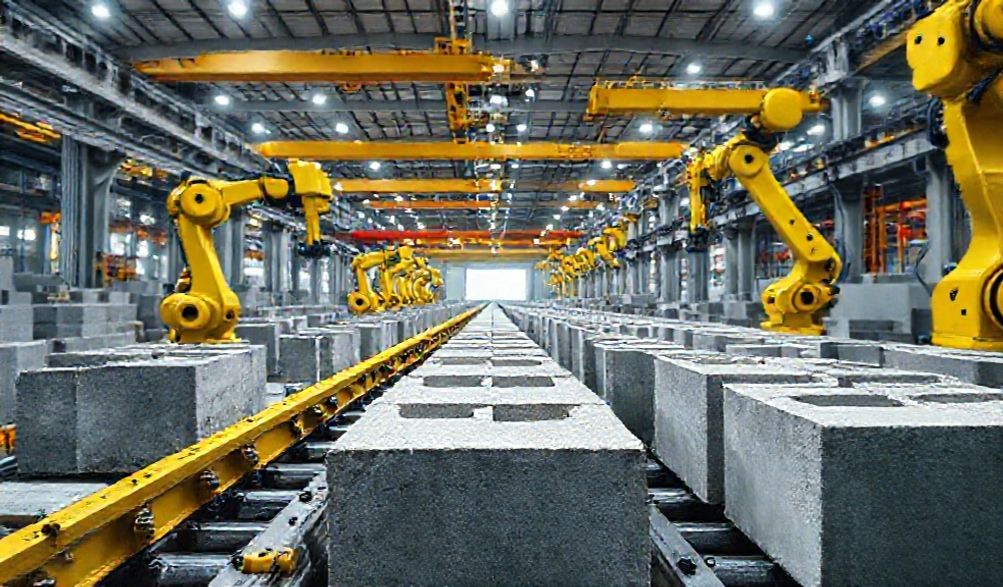
The “automatic” aspect is key. From material feeding to block stacking, the process is managed by sensors, conveyors, and robotic arms, ensuring remarkable consistency and output that manual or semi-automatic machines simply cannot match.
Key Advantages Over Semi-Automatic and Manual Machines
Upgrading to an automatic system is a strategic decision. Here’s why it delivers a superior return on investment for medium to large-scale operations:
- Dramatically Higher Production Output: While a manual machine might produce a few hundred blocks per day, an automatic machine can produce thousands per hour. This scalability is essential for meeting large contract demands and growing your business.
- Superior Consistency and Quality: Human variability is eliminated. Every block has identical dimensions, weight, and compressive strength, leading to better construction quality, less waste on-site, and enhanced customer trust.
- การลดต้นทุนด้านแรงงานอย่างมีนัยสำคัญ One automatic line, operated by 2-3 skilled personnel, can replace the output of 15-20 manual laborers. This drastically reduces long-term payroll expenses and management overhead.
- ความปลอดภัยในการปฏิบัติงานที่ได้รับการปรับปรุง Automating the heavy lifting, vibrating, and repetitive tasks minimizes worker exposure to physical strain and potential injury, creating a safer work environment.
- Better ROI and Competitiveness: Although the initial capital outlay is higher, the combination of lower per-unit cost, reduced labor, and higher-quality output leads to a faster payback period and a stronger competitive position in the market.
Key Types of Automatic Block Machines from China
Chinese manufacturers offer a range of automatic machines to suit different business models and project scales. Understanding these types is the first step in selecting the right fit.
Stationary Automatic Block Making Machines
- คำอธิบายและสิ่งที่เหมาะที่สุด: These are the workhorses of high-volume, fixed-location production. The machine remains in one place, typically integrated with a sophisticated pallet circulation system that feeds empty pallets in and moves block-laden pallets out for curing. They are the preferred choice for established block yards and dedicated factories.
- Typical Output Range: Production can vary widely, but common stationary models produce between 10,000 to 30,000 standard blocks (e.g., 400x200x200mm) in an 8-hour shift.
- Popular Chinese Models/Series: Look for designations like the ซีรีย์ QT (e.g., QT10-15, where numbers often indicate production capacity). These are robust, fully hydraulic machines known for their durability.
Mobile Block Making Machines (Egg-Laying Type)
- คำอธิบายและสิ่งที่เหมาะที่สุด: True to its name, this machine moves on wheels along a concrete production floor, “laying” blocks directly onto the ground like an egg. After laying a row, it moves forward to create the next. It’s an excellent solution for large, on-site projects (like building a housing colony) where transporting blocks from a distant factory is cost-prohibitive.
- ข้อได้เปบรียบหลัก It offers a การลงทุนเริ่มต้นที่ต่ำกว่า compared to a full stationary line with pallet systems. It eliminates the need for pallets and complex conveyors, simplifying operation and maintenance.
- Output Consideration: While highly efficient, output is generally slightly lower than high-end stationary lines, but its on-site advantage often outweighs this for specific project-based applications.
Fully Automatic Production Lines
- คำอธิบาย: This is the pinnacle of automation—a complete, turnkey plant. It integrates every component: an automatic batching plant, conveyor system, mixer, high-speed block machine, automatic stacker, and sometimes even robotic palletizers and surface coloring systems. The entire process from raw material to stacked, cured blocks is automated.
- เหมาะที่สุดสำหรับ: Large-scale industrial block manufacturers and entrepreneurs aiming to build a market-leading operation with minimal labor and maximum efficiency.
- Chinese Capability: China has developed significant expertise in designing, manufacturing, and exporting these complete lines. They offer a compelling value proposition, providing a single-source solution that can be customized to specific output and product mix requirements.
How to Choose the Right Chinese Supplier: A Trustworthy Guide
Selecting the right manufacturer is more critical than selecting the machine model. Your supplier is your long-term partner for support, parts, and technical advice.
Evaluating Manufacturer Expertise and Reputation
- Factory Visit & History: Prioritize suppliers with a มีประวัติการทำงานที่พิสูจน์แล้วมากกว่า 10 ปี. If possible, a factory visit is invaluable to assess their production capability, workshop organization, and quality control processes firsthand.
- Technical R&D Capability: A supplier with an in-house engineering team is more likely to offer customization, proper technical drawings, and meaningful support. Ask about their design process and innovation.
- Client Portfolio & Case Studies: Request verifiable references from international clients, preferably in your region. Ask for videos or photos of their machines in operation overseas.
- การรับรอง: Look for fundamental quality and safety certifications. ISO 9001 for quality management systems is a strong indicator. CE marking (for the European market) demonstrates adherence to EU safety, health, and environmental standards, even if you’re not exporting to Europe—it signals a commitment to higher manufacturing rigor.
ข้อกำหนดทางเทคนิคที่สำคัญที่ต้องตรวจสอบอย่างละเอียด
Don’t just focus on the headline “blocks per hour” figure. Dig into the details:
- กำลังการผลิต: Ensure the quoted output matches the specific block type and size you need. A machine’s output for hollow blocks will differ from solid pavers.
- Block Types & Mold Versatility: Can it produce the range of products you want to sell? (Hollow blocks, solid blocks, interlocking pavers, curbstones, grass blocks). Check the mold changeover process—is it quick and simple?
- ระดับการทำงานอัตโนมัติและระบบควบคุม The PLC is the machine’s brain. Reputable brands like Siemens or Mitsubishi offer greater reliability and easier troubleshooting. The Human-Machine Interface (HMI) touchscreen should be user-friendly.
- Core Components Quality: The heart of the machine. Inquire about the brands used for:
- ระบบไฮดรอลิก Renowned brands like Rexroth, Kawasaki, or Yuken.
- มอเตอร์สั่นสะเทือน: Italian or German-made motors (e.g., OLI, VEM) are often associated with superior performance and longevity.
- ส่วนประกอบทางไฟฟ้า Brands like Schneider or Siemens.
- ข้อกำหนดด้านพลังงาน: Confirm the voltage (e.g., 380V/50Hz) and total power (KW) to ensure compatibility with your local electrical infrastructure.
Beyond the Machine: Assessing After-Sales Service
The machine’s quality is only half the equation. The support you receive afterward defines your operational success.
- ข้อกำหนดการรับประกัน: Standard warranties are often 12 months for parts. Negotiate terms that cover key components like the hydraulic system and mainframe. Understand what is and isn’t covered.
- Availability of Spare Parts: How quickly can they ship common wear parts? Do they maintain a recommended spare parts list? What are the lead times?
- ฝ่ายสนับสนุนทางเทคนิค The most critical point. Does the price include on-site installation, commissioning, and operator training by factory engineers? For how many days? This service is non-negotiable for a smooth start-up.
- Remote Support Capability: Can they provide support via video call? Do they have clear electrical and hydraulic diagrams to share for troubleshooting?
Navigating Procurement and Logistics from China
The Sourcing Process: From Inquiry to Delivery
A structured approach minimizes risk and confusion:
- Request for Quotation (RFQ): Send a detailed specification sheet outlining your required block types, dimensions, daily output, and any special features.
- Technical Discussion: Engage with the supplier’s engineers to clarify details, review proposals, and request 3D layouts or flow diagrams of the proposed line.
- Proforma Invoice (PI): Once satisfied, the supplier issues a PI detailing the commercial terms, payment schedule, and delivery terms.
- Payment & Contract: Typically, a deposit (e.g., 30%) is paid via T/T (Telegraphic Transfer) or LC (Letter of Credit), followed by a balance payment before shipment. Sign a detailed commercial contract that includes all technical specs, warranty, and service terms.
- Production & Inspection: During the manufacturing period, request progress photos. Hire a third-party inspection company (like SGS, BV) to conduct a Pre-Shipment Inspection (PSI) to verify quality and functionality before the machine leaves the factory.
- Shipping & Customs: The supplier arranges shipping (based on agreed Incoterms). You or your freight forwarder will handle import customs clearance at your port.
Understanding Incoterms and Total Landed Cost
The machine’s FOB price is just the beginning. You must budget for the Total Landed Cost:
- Common Incoterms:
- EXW (ส่งมอบที่โรงงาน): You are responsible for everything from the factory gate onward (most risk/cost for buyer).
- เอฟโอบี (ฟรีออนบอร์ด): The supplier delivers the goods to the port and loads them onto the ship. You pay for sea freight, insurance, and destination costs.
- CIF (Cost, Insurance & Freight): The supplier pays for the sea freight and insurance to your destination port. You handle import duties and local delivery.
- Cost Components Checklist:
- Machine Cost
- Sea Freight & Marine Insurance
- Import Duties & Taxes (varies by country)
- Port Handling & Customs Clearance Fees
- Inland Transportation to Your Site
- Installation & Commissioning Costs (if not included)
- Spare Parts Inventory
Common Pitfalls and How to Avoid Them
- The “Too Good to Be True” Price Trap: An abnormally low price almost always correlates with inferior components, thin steel frames, and no meaningful after-sales service. Compare specifications line-by-line, not just the price tag.
- Vague Contracts and Specifications: Never proceed with just a Proforma Invoice. Insist on a formal contract that annexes all technical documents, parts lists, and service level agreements.
- Ignoring Communication Nuances: Be explicit, ask for confirmations in writing, and use diagrams. Consider using simple, clear language in all communications. Regular video calls during the negotiation and build phase are highly recommended.
FAQ: Your Questions on China’s Block Machines Answered
Q1: What is the typical price range for an automatic block machine from China?
ก Prices vary enormously based on automation level, capacity, and configuration. A basic mobile “egg-layer” might start around $30,000 – $50,000, while a mid-range stationary machine can be $70,000 – $150,000. A fully automatic turnkey production line can range from $200,000 to over $500,000. Always request a detailed quotation based on your specific needs.
Q2: Can Chinese machines produce blocks to international standards (ASTM, EN)?
ก Absolutely. Reputable manufacturers design their machines to be capable of producing blocks that meet ASTM C90, EN 771, or other international standards. The critical step is to clearly communicate your required block specifications (dimensions, compressive strength, density) to the supplier during the design phase so they can configure the machine accordingly.
Q3: How long does it take from order to delivery?
ก Generally, allow 30 to 60 days for production after order confirmation and deposit. Sea shipping then typically takes 30 to 45 days, depending on your destination port. Overall, a timeline of 3 to 4 months from order to having the machine at your site is a reasonable expectation.
Q4: Do suppliers provide installation and training?
ก Most reputable suppliers include the cost for 1-2 factory engineers to travel to your site for installation, commissioning, and operator training (usually for 7-15 days). This is a standard and critical part of the package. Confirm the duration and scope of this service explicitly in your contract.
Q5: What are the most reliable brands from China?
ก Rather than focusing on a brand name alone, focus on the manufacturer’s credentials. Seek out factories with a long history, strong in-house R&D, and verifiable overseas installation records in markets similar to yours. Research industry-specific B2B platforms and forums for user reviews, and always ask potential suppliers for direct client references you can contact.
สรุป
Investing in an automatic concrete block production machine from China is a strategic move that can fundamentally transform your construction business or project viability. The potential for scaled production, consistent quality, and reduced operating costs is immense. However, the path to realizing this potential hinges on informed decision-making and diligent partnership selection.
Success is not found in the cheapest quotation, but in the total value offered over the machine’s entire lifecycle. It is built on choosing a supplier whose expertise, component quality, and commitment to after-sales support match the sophistication of the machinery they sell.
Use this guide as your roadmap and checklist. Begin by clearly defining your project requirements and business goals. Prepare a detailed specification list, then engage with a shortlist of reputable manufacturers who can demonstrate their capability and reliability. Ask the tough questions, demand clear documentation, and plan for the full scope of logistics and support.
The right automatic block machine is more than a piece of equipment; it’s the engine for your future growth. With careful planning and the insights from this guide, you are well-equipped to make a choice that will build your success, block by block.
<