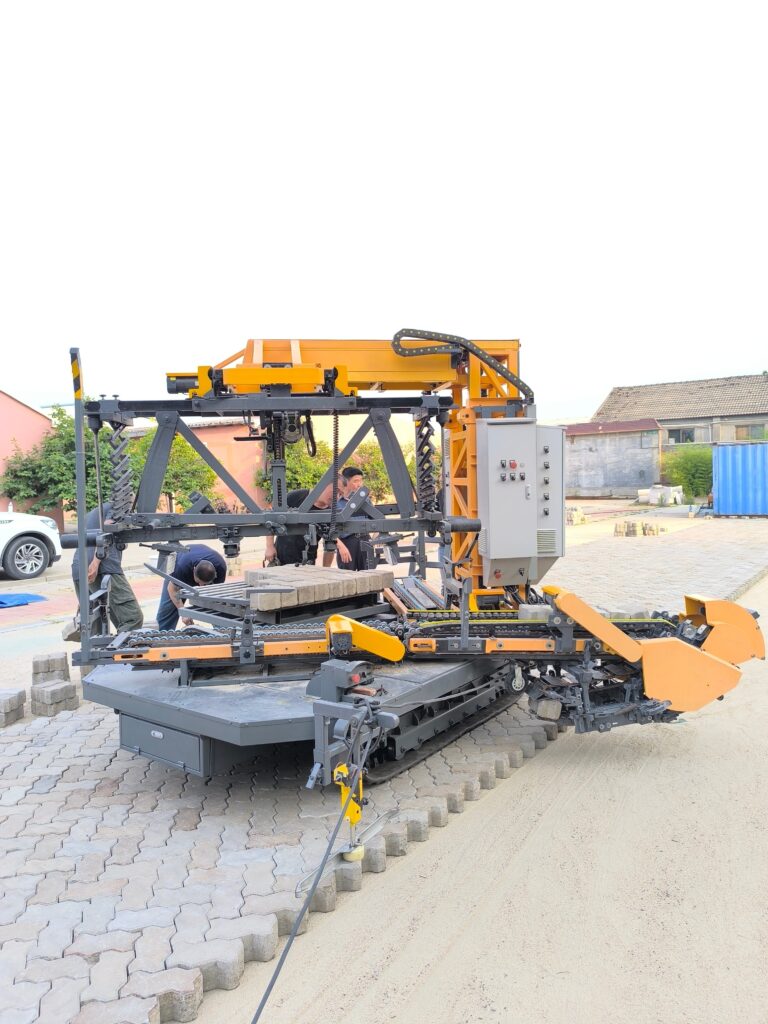
รากฐานทางเทคโนโลยีของเครื่องวางบล็อกสมัยใหม่
หลักการและกลไกการดำเนินงานหลัก
เครื่องจักรวางบล็อกสำหรับงานถนนได้รับการออกแบบมาเพื่อทำให้ขั้นตอนที่ต้องใช้แรงงานมากและใช้เวลานานที่สุดในการปูพื้นผิวถนนเป็นแบบอัตโนมัติ นั่นคือการวางและการจัดเรียงบล็อกแต่ละก้อนอย่างแม่นยำ หลักการทำงานพื้นฐานเกี่ยวข้องกับการส่งบล็อกอย่างต่อเนื่องจากถังเก็บจำนวนมากไปยังหัววางที่แม่นยำ ซึ่งจะทำการวางบล็อกเหล่านั้นลงบนพื้นทรายหรือปูนที่เตรียมไว้ตามรูปแบบที่กำหนดไว้ล่วงหน้า
กระบวนการเริ่มต้นด้วยระบบการให้อาหารและถังบรรจุเครื่องจักรนี้ถูกบรรจุด้วยบล็อกจำนวนมาก ไม่ว่าจะเป็นการบรรจุด้วยมือโดยทีมสนับสนุนหรือผ่านระบบสายพานลำเลียงที่ติดตั้งจากยานพาหนะสนับสนุน ภาชนะบรรจุได้รับการออกแบบให้รองรับบล็อกขนาดและรูปร่างต่างๆ โดยไม่ทำให้เกิดการอุดตันหรือความเสียหาย จากภาชนะบรรจุ บล็อกจะถูกส่งต่อไปยังโมดูลการจัดตำแหน่งและการปรับทิศทาง. This is a critical stage where vibratory trays, guide rails, and sometimes robotic grippers ensure each block is correctly oriented before it reaches the laying head. The sophistication of this module directly impacts the complexity of patterns the machine can create, from simple running bonds to intricate herringbone or circular designs.
The heart of the machine is the Laying Head and Placement Mechanism. This component picks up the oriented blocks and places them onto the road surface. Different technologies exist here, including:
- Vibratory Placement Heads: These use vibration to settle the block firmly into the bedding sand, ensuring immediate stability and reducing the need for subsequent compaction.
- Gripper-Based Systems: Utilizing mechanical or hydraulic grippers, these heads offer exceptional precision for delicate or specially shaped blocks.
- Combination Systems: Many advanced machines use a combination of grippers for precise placement followed by a vibrating element for compaction.
Finally, the machine incorporates a Guidance and Control System. Modern machines use a combination of mechanical string lines, laser guidance, and, most advanced, GPS and GLONASS satellite systems. This ensures the machine lays a perfectly straight and leveled course, even over long distances and undulating terrain. The entire operation is managed from an Operator Control Console, which can be a simple onboard panel or a sophisticated remote-control unit, allowing for real-time adjustments to pattern, spacing, and laying speed.
Classification by Mobility and Application Scale
The market for these machines is segmented based on their mobility and intended project scale, which is a primary determinant of their capabilities and, consequently, their price point.
- Walk-Behind and Semi-Automated Units: These are the most accessible entry point into mechanized block laying. They are compact, often manually propelled, and require a small crew to operate. Ideal for smaller-scale projects like residential driveways, garden paths, and minor municipal repairs, they offer a significant productivity boost over purely manual labor but lack the full automation of larger machines. Their primary advantage is lower initial investment and high maneuverability in confined spaces.
- Ride-On, Fully Automated Pavers: This category represents the mainstream for commercial road construction projects. These self-propelled machines are designed for high-volume output, capable of laying hundreds of square meters of pavement per day. The operator rides on the machine, monitoring the process and making adjustments via the control console. They feature integrated material handling systems, advanced guidance technology, and can handle a wide variety of block types and complex patterns. This is the most common category sought by civil construction firms for projects like urban streets, parking lots, and industrial areas.
- Track-Mounted and Heavy-Duty Systems: For the largest-scale infrastructure projects—such as highways, container ports, and airport runways—track-mounted block laying machines are deployed. These are massive, high-capacity units that offer superior stability and distribute ground pressure over a larger area, preventing damage to the subbase. They are engineered for continuous, 24/7 operation in demanding environments and represent the peak of technological advancement in this field, featuring fully automated logistics from material supply to final compaction.
Market Analysis: Demand Drivers and Product Segmentation for Distributors
Key Industries and End-User Profiles
For a distributor, understanding who buys these machines and why is crucial for effective marketing and sales. The end-user base is diverse, each with unique requirements.
- Civil Engineering and Construction Contractors: This is the largest and most demanding customer segment. They require robust, high-output, and reliable machinery to meet strict project deadlines. Their primary purchasing drivers are total cost of ownership (TCO), productivity (m²/day), after-sales service, and machine durability. They are less sensitive to initial price if the machine demonstrates superior uptime and lower long-term operational costs.
- Municipal and Government Bodies: Public works departments are significant purchasers, but their procurement processes are often governed by public tender regulations. They prioritize compliance with national standards, ease of maintenance, operator safety, and versatility to handle various public space projects, from roadways to pedestrian precincts. Lifecycle cost and local service support are critical factors.
- Landscape and Specialty Paving Companies: These firms often work on high-end commercial or residential projects where aesthetics are paramount. They value machines that can handle complex patterns, a wide range of non-standard block sizes and shapes, and offer high precision. For them, the machine is a tool to differentiate their service offering and command premium pricing.
Global Market Trends Influencing Procurement
Several macro-trends are shaping the demand for block laying machinery, presenting both opportunities and challenges for distributors.
- The Shift Towards Sustainable Construction: There is a growing preference for permeable paving solutions to manage stormwater runoff. Machines that can efficiently lay permeable blocks are increasingly in demand. Furthermore, the durability and long lifecycle of block-paved roads, which can be easily repaired by replacing individual blocks, align with sustainable infrastructure goals.
- Labor Shortages and Cost Inflation: The chronic shortage of skilled labor in the construction industry across many regions is a powerful driver for automation. Machines that can do the work of dozens of laborers with greater consistency and speed offer a compelling return on investment, mitigating rising labor costs and dependencies.
- Technological Convergence: The integration of Building Information Modeling (BIM) is on the horizon. Future machines will be able to import a digital 3D model of the project and execute the paving plan with minimal human intervention, reducing errors and optimizing material usage. Distributors need to be aware of this trend to future-proof their product portfolios.
A Detailed Breakdown of Pricing Structures and Investment Considerations
Primary Factors Determining Machine Price
The price of a block laying machine is not a single figure but a reflection of a multitude of engineering and feature-based factors.
- ระดับการทำงานอัตโนมัติ This is the single most significant cost driver. A basic walk-behind model may represent the most affordable option, while a fully automated, ride-on paver with GPS guidance will command a substantially higher price. The integration of robotic material handling from a supply vehicle further increases the capital cost but also the potential ROI.
- Laying Capacity and Output Speed: Machines are rated by their theoretical maximum laying speed (e.g., blocks per minute or square meters per hour). Higher output capacities require more powerful engines, larger hoppers, faster and more robust conveyance systems, and more sophisticated control systems, all contributing to a higher price tag.
- Versatility and Pattern Flexibility: A machine capable of laying only a simple stretcher bond will be less expensive than one that can be quickly reconfigured to lay multiple complex patterns like herringbone or basket weave. The complexity of the laying head and the software that controls it directly impacts cost.
- Guidance System Technology: The type of guidance system is a major differentiator. Systems relying on physical string lines are less expensive. Laser-guided systems offer a mid-range option, while fully integrated, high-precision GPS/GNSS systems with 3D grade control represent the premium, most costly option, essential for large-scale, high-accuracy projects.
- Build Quality and Component Sourcing: The quality of materials used in the chassis, the robustness of the hydraulic systems, and the brand and reliability of the engine and electronic components (PLCs, sensors) have a direct bearing on the machine’s durability, uptime, and ultimate cost. Machines built with industrial-grade components for severe duty cycles will be priced higher than those with lighter-duty components.
Understanding the Total Cost of Ownership (TCO)
For your B2B clients, the initial purchase price is only one part of the financial equation. A sophisticated buyer will evaluate the Total Cost of Ownership, which includes:
- ราคาซื้อครั้งแรก The capital outlay for the machine itself.
- Shipping and Import Duties: Costs for delivering the machine to the client’s location.
- Training Costs: Ensuring operators and maintenance staff are proficient.
- Operating Costs: Fuel consumption, wear parts (rubber tracks, laying head components), and hydraulic fluids.
- Maintenance and Repair Costs: Scheduled servicing and unscheduled repairs. This is where service support from the distributor becomes critical.
- ค่าใช้จ่ายจากการหยุดทำงาน The single largest hidden cost. A reliable machine with high uptime and readily available spare parts protects the client’s project timelines and profitability.
- มูลค่าการขายต่อ A well-maintained machine from a reputable manufacturing lineage will retain a higher residual value.
Distributors who can articulate and provide data to support a favorable TCO for their machines, rather than just competing on initial price, will win the trust and business of larger, more sophisticated contractors.
Strategic Purchasing Criteria for B2B Buyers
For distributors and procurement managers, selecting the right machine to add to their inventory or deploy on a project requires a disciplined, multi-faceted approach.
- Technical Due Diligence: Beyond the sales brochure, conduct a deep technical review. Evaluate the machine’s specifications in the context of your target market’s needs. Scrutinize the engine power, hydraulic pressure ratings, control system programmability, and the ease of changing patterns. Request detailed technical documentation and circuit diagrams for the hydraulic and electrical systems.
- Compliance and Certification: Ensure the machine complies with all relevant safety and emissions standards in the target market (e.g., CE, EPA Tier 4, etc.). Non-compliance can lead to massive fines, import rejections, and project stoppages.
- Manufacturer Support and Parts Logistics: The relationship with the manufacturer is paramount. Investigate their production capacity, quality control processes, and financial stability. For distributors, a reliable supply of spare parts is non-negotiable. Inquire about the parts inventory strategy, lead times for non-stock items, and the availability of technical support from the factory.
- Warranty and Service Agreements: A comprehensive warranty is a sign of the manufacturer’s confidence in their product. Understand the terms, duration, and what is included and excluded. For large distributors, negotiating a customized service level agreement (SLA) for technical support and parts delivery can be a key competitive advantage.
- Financial Modeling and ROI Analysis: Build a detailed financial model to project the return on investment. Factor in the TCO elements, projected utilization rates, and the potential revenue generation (or cost savings) the machine will enable. This model will justify the investment to stakeholders and help in selecting the machine that offers the best long-term value.
Conclusion
The market for block laying machinery in road construction is dynamic and ripe with opportunity for informed distributors and procurement specialists. The transition from manual labor to mechanized solutions is a global, irreversible trend driven by the compelling economics of speed, quality, and efficiency. Success in this field requires moving beyond a simplistic focus on price per unit. It demands a sophisticated understanding of the underlying technologies, a clear-eyed view of the market drivers, and a strategic approach to evaluating the total cost of ownership and the manufacturer-distributor partnership.
The most successful players will be those who can position these machines not just as products, but as productivity solutions. They will be the ones who provide their clients with the data, support, and expertise needed to justify the investment and maximize the return. By focusing on the core principles outlined in this guide—from the mechanics of the laying head to the nuances of TCO—B2B decision-makers can make confident, profitable choices that will fuel their growth in the competitive and ever-evolving infrastructure landscape.
Frequently Asked Questions (FAQ)
Q1: What is the typical output range I can expect from a medium-duty, ride-on block laying machine?
ก Output varies significantly based on block size, pattern complexity, and site conditions. However, a typical medium-duty, fully automated machine can lay between 400 and 800 square meters per 8-hour shift. Simpler patterns with larger blocks will be at the higher end of this range, while complex patterns with smaller cobblestones will reduce the daily output.
Q2: How does the maintenance regimen for these machines compare to other construction equipment?
ก The maintenance intensity is generally moderate. It requires daily greasing of bearings, checking hydraulic fluid levels, and cleaning. Periodic maintenance (e.g., every 500 hours) involves changing hydraulic filters and engine oil. The most significant maintenance costs are associated with wear parts, such as the rubber tracks, vibration elements in the laying head, and conveyance system components. A well-maintained machine can have an operational lifespan exceeding 10,000 hours.
Q3: Can one machine handle vastly different block sizes and shapes?
ก Most machines are designed with a degree of versatility, but they are not universally adaptable. Changing block sizes or shapes typically requires a changeover kit, which may include different hopper inserts, orientation guides, and sometimes a different laying head. The time for changeover can range from 30 minutes to several hours. It is crucial to discuss the specific range of block products your clients use with the manufacturer to ensure compatibility and understand the associated changeover costs and times.
Q4: What are the primary operational cost drivers for an end-user?
ก The main operational costs are:
- Fuel/Diesel: For the engine powering the hydraulics and propulsion.
- แรงงาน The machine operator and a small support crew for loading and site preparation.
- ชิ้นส่วนที่สึกหรอ Regular replacement of components like tracks, vibration pads, conveyor belts, and gripper elements.
- อะไหล่: For unplanned repairs of hydraulic cylinders, sensors, or electrical components.
- Transport: The cost of moving the machine between job sites, which requires a low-bed trailer.
Q5: What is the typical lead time for procuring a new machine from order to delivery?
ก Lead times can vary widely based on the manufacturer’s location, production schedule, and machine customization. For a standard model from stock, delivery might be 4-8 weeks. For a customized machine with specific features, the lead time can extend to 4-6 months. It is vital to factor this into inventory planning and project proposals. Always secure a formal delivery schedule from the manufacturer as part of the purchase agreement.