1. กายวิภาคของระบบการผลิตอัตโนมัติ
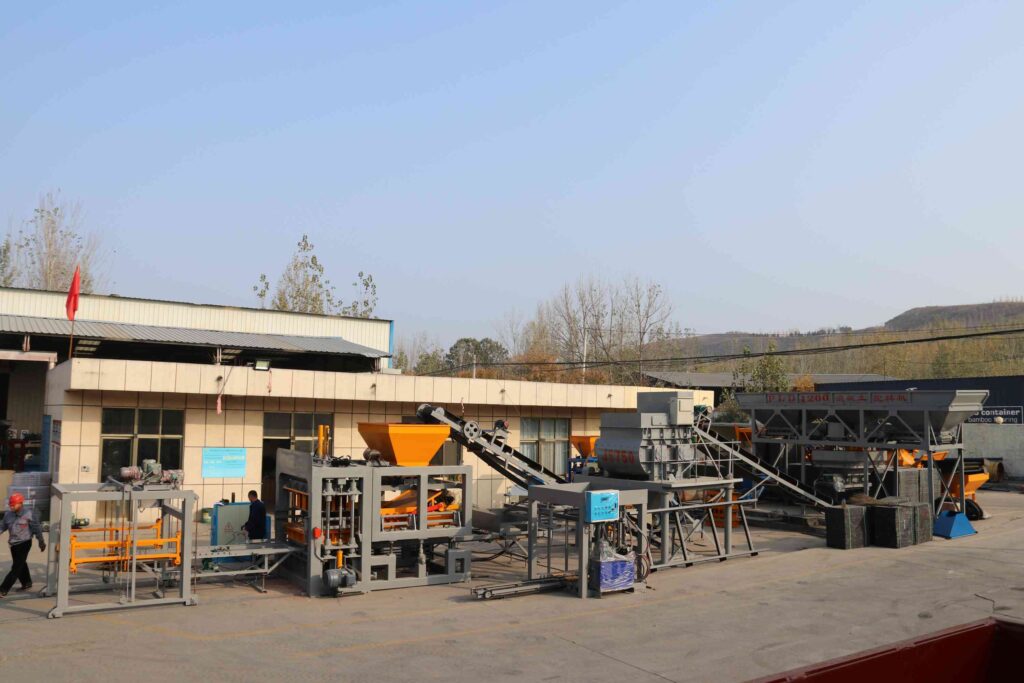
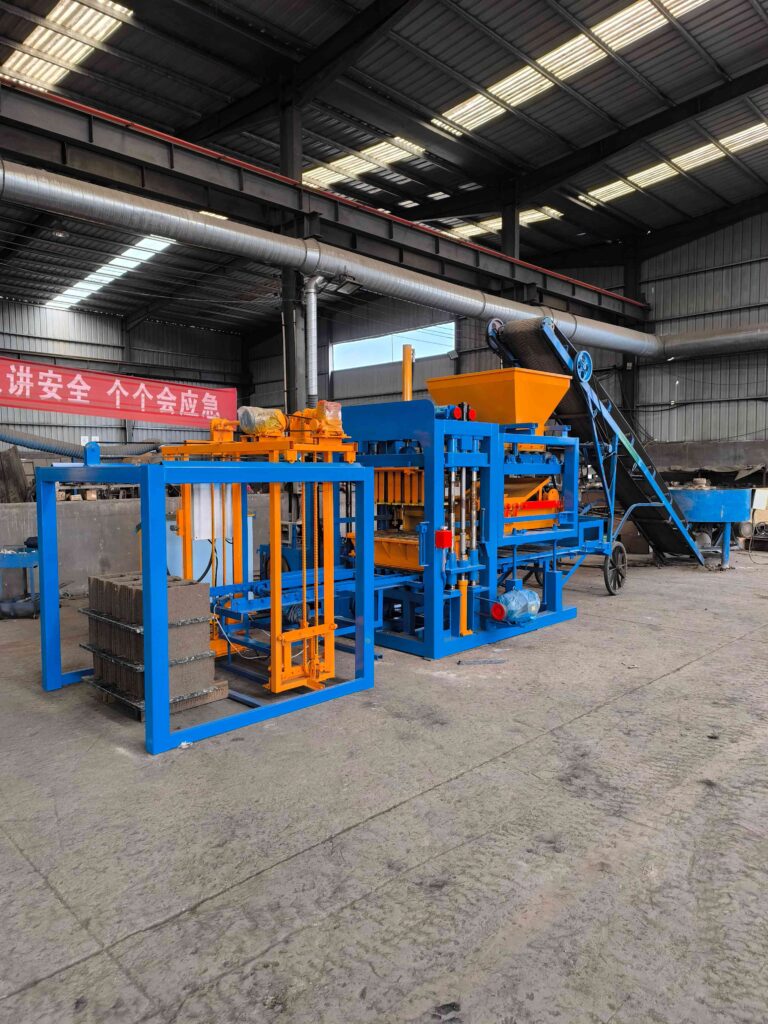
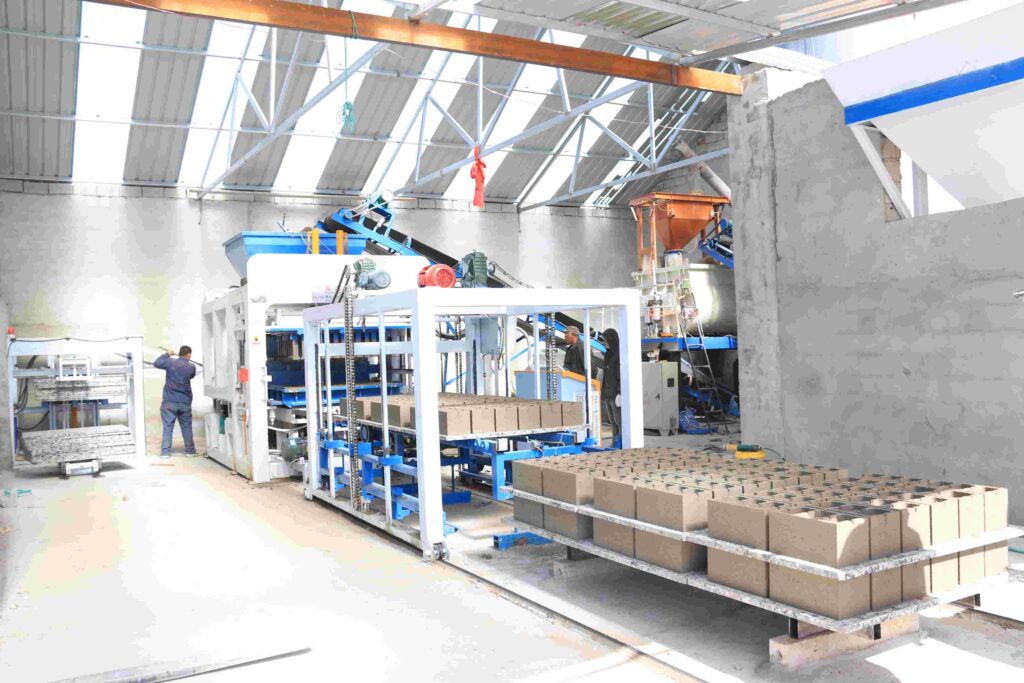
เครื่องจักรผลิตอิฐบล็อกอัตโนมัติไม่ใช่หน่วยเดี่ยว แต่เป็นการผสานระบบย่อยหลายส่วนที่ทำงานประสานกันอย่างซับซ้อน การทำความเข้าใจโครงสร้างนี้คือขั้นตอนแรกสู่การตระหนักถึงคุณค่าและโครงสร้างต้นทุนของมัน
1.1. ระบบย่อยหลักและหน้าที่การทำงาน:
- ระบบควบคุมส่วนกลางสมองของกระบวนการดำเนินงาน ตัวควบคุมลอจิกที่โปรแกรมได้ (PLC) พร้อมด้วยหน้าจอสัมผัสสำหรับการเชื่อมต่อระหว่างมนุษย์กับเครื่องจักร (HMI) เป็นผู้ควบคุมทุกการกระทำ มันเก็บสูตรสำหรับผลิตภัณฑ์ต่าง ๆ ตรวจสอบข้อมูลการผลิต และให้ข้อมูลการวินิจฉัย
- ระบบการจัดการวัสดุและการแบตช์นี่รวมถึงถังรวมวัสดุ ถังซีเมนต์ สกรูลำเลียง และระบบชั่งน้ำหนักแบบแม่นยำ ซึ่งช่วยให้มั่นใจว่าสัดส่วนของวัตถุดิบ (ทราย มวลรวม ซีเมนต์ เถ้าลอย น้ำ) ที่ส่งไปยังเครื่องผสมนั้นถูกต้องแม่นยำ เพื่อรับประกันคุณภาพของผลิตภัณฑ์ที่สม่ำเสมอ
- The Mixing System: Typically a heavy-duty pan mixer is used to homogenize the semi-dry concrete mixture. The consistency of this mix is critical for the final block’s strength and surface finish.
- The Block Forming Machine: The heart of the line. It receives the mixed concrete, distributes it into molds, and subjects it to simultaneous high-frequency vibration and high-pressure compaction. This dual action densifies the mixture, creating a strong, precisely shaped block.
- The Pallet Circulation System: A network of chain conveyors that moves pallets (steel plates) in a continuous loop—from the block ejector, through a return circuit, and back under the mold for the next cycle.
- The Curing System Integration: While not always included in the base machine price, an integrated system for handling the curing process is a hallmark of full automation. This can include automatic stackers that place green blocks onto curing racks and load them into climate-controlled chambers.
1.2. The Production Workflow:
The process is a continuous, closed loop:
- Raw materials are automatically batched and mixed.
- The mixture is conveyed to the block machine’s hopper.
- The machine fills the mold, vibrates, and presses the block.
- The finished block is ejected onto a pallet.
- The pallet conveys the block to an automatic stacker.
- Stacked blocks are moved to a curing area.
The entire sequence is managed by the PLC, requiring only supervisory personnel.
2. Decoding the Price List: A Tiered Analysis of Investment Levels
The market for automatic machines is segmented into distinct tiers, each defined by its level of integration, output, and sophistication. The following price list provides a realistic framework for budgeting and sales positioning.
2.1. Tier 1: Entry-Level Automatic Machines
This tier is designed for entrepreneurs ready to move beyond semi-automatic production but with a more constrained capital budget. These systems automate the core block-forming and pallet circulation but may lack integrated batching or stacking.
- Typical Configuration:
- Automatic block machine with hydraulic system and PLC control.
- Basic pallet circulation conveyor.
- Does not include cement silo, automatic batching, or stacker.
- Production Output: 4,000 – 8,000 blocks per 8-hour shift.
- Estimated Price Range: $12,000 – $20,000
- Primary Cost Drivers:
- Machine size and cycle speed.
- Quality of the hydraulic power pack and PLC.
- Inclusion of a basic color feeder for paving stones.
2.2. Tier 2: Standard Fully Automatic Production Lines
This is the most commonly deployed solution for commercial block yards and growing businesses. It represents a complete, turnkey production cell.
- Typical Configuration:
- Fully automatic block machine with multi-directional vibration.
- Complete pallet circulation and return system.
- Automatic planetary or pan mixer.
- Automatic stacker with layer sheets.
- Cement silo and screw conveyor.
- Aggregate storage hoppers with weighing belts.
- Production Output: 10,000 – 25,000 blocks per 8-hour shift.
- Estimated Price Range: $20,000 – $40,000
- Primary Cost Drivers:
- Output Capacity: The single largest factor.
- Level of Sophistication: Features like an automatic mold change system, robotic pallet brush/oiler, and more advanced HMI.
- Auxiliary Equipment Quality: The capacity and durability of the mixer, silo, and conveyors.
2.3. Tier 3: High-Capacity Industrial Plants with Integrated Curing
For the large-scale investor targeting regional supply contracts, this tier includes complete automation of the production and curing processes.
- Typical Configuration:
- All components of a Tier 2 line.
- Fully automated rack transfer system for curing.
- Automated feeding of racks into a steam curing tunnel or chamber.
- Larger, more robust material handling systems.
- Advanced production software with data logging.
- Production Output: 30,000 – 100,000+ blocks per 24-hour period.
- Estimated Price Range: $50,000 – $80,000+
- Primary Cost Drivers:
- Curing System Technology: The type (tunnel vs. chamber), size, and automation level of the curing system.
- Plant-Wide Control System: Integration of SCADA or MES for overall plant management.
- Civil Works and Infrastructure: The scale of the building and foundations required.
3. Strategic Financial Analysis: Justifying the Capital Expenditure
For an end-user, the decision to invest in an automatic machine is a major financial commitment. Distributors must be equipped to present a clear business case.
3.1. The Direct and Indirect Cost Savings:
- Labor Optimization: A Tier 2 line can replace 30-40 manual laborers with a crew of 4-6 skilled operators and technicians, resulting in massive long-term savings and reduced management complexity.
- Material Yield: Precision batching eliminates human error, reducing cement consumption by 5-10% and ensuring optimal use of every raw material input.
- Reduced Rejects and Waste: Automated consistency leads to a defect rate of less than 0.5%, compared to 5-10% in manual operations, directly boosting profitability.
- Energy Efficiency per Unit: While total energy consumption is high, the cost per block is minimized due to the high output and efficiency of modern electric and hydraulic systems.
3.2. The Revenue Enhancement Drivers:
- Superior Product Quality: The ability to produce consistent, high-strength blocks allows manufacturers to command premium prices and secure contracts with quality-conscious clients like government bodies and large construction firms.
- Production Scalability and Reliability: The ability to reliably fulfill large, time-sensitive orders builds a reputation for dependability, which is a powerful competitive advantage.
- Product Diversification: Quick mold changeovers enable a single line to produce a diverse portfolio (e.g., hollow blocks, solid bricks, pavers, curbs), allowing the business to adapt to market trends.
3.3. Framework for ROI Calculation:
A simplified calculation for a Tier 2 line might look like this:
- Annual Additional Revenue: (Increased Daily Output × Selling Price × Operating Days) + (Premium Price for Quality)
- Annual Cost Savings: (Reduced Labor Cost) + (Reduced Material Cost) + (Lower Waste Disposal Cost)
- Annual Operating Cost: (Energy + Maintenance + Labor for line)
- Net Annual Profit: (Additional Revenue + Cost Savings) – Operating Cost
- Simple Payback Period: (Total Machine Investment) / (Net Annual Profit)
For a well-utilized Tier 2 line, payback periods of 2-4 years are common.
4. Essential Procurement and Partnership Criteria
Sourcing automatic machinery is a strategic partnership that will impact your business for years.
4.1. Vetting the Manufacturer:
- Technical Documentation: Request detailed electrical, hydraulic, and mechanical drawings. A professional manufacturer will have comprehensive documentation.
- Factory Audit and Reference Checks: If possible, visit the manufacturing facility. Speak to existing clients who have operated the equipment for over a year to understand its real-world performance and reliability.
- Warranty and Service Level Agreement (SLA): Scrutinize the warranty terms. What is covered and for how long? What is the guaranteed response time for technical support?
4.2. Key Questions for the Supplier:
- “What is the expected ‘up-time’ percentage for this machine?”
- “Can you provide a list of recommended spare parts for the first two years of operation and their costs?”
- “What is the training curriculum for our clients’ operators and maintenance staff?”
- “How does the control system handle fault diagnostics and alarms?”
Conclusion: Leading the Market through Strategic Equipment Sourcing
The proliferation of automatic brick block manufacturing technology is a definitive trend shaping the future of the global construction materials industry. For distributors and procurement agents, this represents a significant opportunity to move beyond commodity transactions and become enablers of industrial-scale success for their clients. The price list for this equipment is a direct reflection of its potential to drive down operational costs, ensure unmatched product quality, and create a scalable, profitable business model.
Success in this field demands a consultative approach. It requires the ability to guide clients through the capital investment decision, backed by a thorough understanding of the technology’s financial mechanics and a commitment to a long-term support partnership. By mastering the introduction and cost structures of automatic brick block manufacturing machines, your business can cement its role as a vital link in the value chain, empowering builders and entrepreneurs to construct the future, block by perfect block.
Frequently Asked Questions (FAQ)
Q1: We see machines with similar output specifications at vastly different price points. What are the hidden factors behind this?
The discrepancy often lies in component quality, engineering precision, and design lifespan. A lower-priced machine may use generic hydraulics, a simpler PLC, and lighter-gauge steel, aiming for a 5-7 year lifespan. A premium machine will use branded, industrial-grade components, feature more robust engineering to minimize vibration and wear, and be designed for 15-20 years of continuous service. The true “cost” is the total expense over the machine’s operational life, including maintenance and downtime.
Q2: How critical is the availability of local technical support and spare parts?
It is absolutely critical. An automatic production line is the core of your client’s business. A single day of downtime can result in significant financial loss. Therefore, the supplier’s ability to provide rapid spare parts delivery and dispatch qualified service engineers is a top-tier consideration. A slightly higher initial cost from a supplier with excellent local support is almost always a better investment than a lower cost from a supplier with poor support infrastructure.
Q3: What are the typical infrastructure and utility requirements for a Tier 2 automatic line?
Clients must prepare for substantial requirements:
- Space: A minimum of 5,000 to 10,000 sq. ft. of covered, high-ceilinged space.
- Power: A stable, high-capacity 3-phase electrical connection (typically 100-300 KVA).
- Foundation: A massive, reinforced concrete foundation engineered to handle dynamic loads.
- Water: A consistent, clean water supply.
- Compressed Air: For pneumatic controls on the stacker and other auxiliaries.
Q4: How versatile are these lines in producing different products, and what is involved in a product changeover?
They are highly versatile, but changeover complexity varies. Switching between products of the same height may require only a software recipe change. A full mold change to produce a different product type (e.g., from a 6-inch hollow block to a paving stone) is a mechanical process that requires trained personnel and can take 1-3 hours. More expensive machines often feature quicker mold-change systems to minimize downtime.
Q5: What is a realistic timeline from placing an order to achieving full production?
For a Tier 2 system, a realistic timeline is 4-6 months. This includes manufacturing, sea freight, customs clearance, installation, and commissioning. For Tier 3 plants, the timeline can extend to 8-12 months. It is crucial to manage client expectations regarding this timeline from the outset.
Q6: Beyond the machine price, what are the other significant costs a client must budget for?
The total project cost often exceeds the machine price. Key additional costs include:
- Shipping, Insurance, and Import Duties.
- Civil Works: Factory building, foundation, and utility connections.
- Installation and Commissioning: Travel and labor costs for the installation team.
- Initial Spare Parts Inventory.
- Operator and Maintenance Training.
- Working Capital for raw materials and operating expenses until revenue stabilizes.