A Strategic Blueprint for Market Entry and Operational Launch
The journey from concept to production is a phased process, where each stage builds upon the last. Rushing any phase invites substantial risk.
Phase 1: Comprehensive Market Analysis and Strategic Positioning
Before investing a single dollar in machinery, you must validate the business case.
1.1. Demand Assessment and Competitive Landscape
- Quantifying Demand: Analyze local and regional construction trends, infrastructure projects, and housing start data. Engage with architects, contractors, and existing distributors to understand volume needs, preferred brick types (clay, concrete, fly ash), and specifications (facing, engineering, pavers).
- Competitor Analysis: Map existing manufacturers. Assess their capacity, product range, price points, strengths, and weaknesses. Identify market gaps: Is there unmet demand for a specific color, texture, size, or sustainable product? Your goal is to find a defensible niche, whether it’s cost leadership, product specialization, or superior service.
1.2. Defining Your Product Portfolio and Value Proposition
- Start Focused: It is wiser to master one or two high-demand products initially (e.g., standard concrete hollow blocks and pavers) rather than attempting a full catalog. This simplifies production, raw material sourcing, and quality control.
- ข้อเสนอคุณค่า: Will you compete on price, quality consistency, custom capability, rapid delivery, or sustainable credentials (e.g., using recycled aggregates)? Your entire operation will be designed to deliver this promise.
Phase 2: Business Planning and Financial Modeling
This phase translates market opportunity into financial reality.
2.1. The Formal Business Plan
- Executive Summary: A concise overview of the venture.
- Company Description: Legal structure (LLC, Corporation), location, and mission.
- Market Analysis: Findings from Phase 1.
- Organization & Management: Your team’s expertise and roles.
- Product Line: Detailed description of initial products.
- Marketing & Sales Strategy: How you will reach and sell to distributors, contractors, and developers.
- Funding Request & Financial Projections: The heart of the plan.
2.2. Detailed Financial Projections
- Capital Expenditure (CapEx): Land, factory building, machinery, installation, and initial vehicle fleet.
- Operating Expenses (OpEx): Raw materials (cement, aggregates, clay), labor, utilities, maintenance, marketing, administration, and loan repayments.
- Revenue Projections: Based on realistic capacity utilization (start at 60-70% in year one), pricing strategy, and sales forecasts.
- Break-Even Analysis: Calculate the monthly production volume at which total revenue equals total costs. This is a critical management target.
- Cash Flow Forecast: The most crucial document. It models the timing of cash inflows and outflows. Manufacturing is capital-intensive; you must ensure you have enough working capital to cover expenses before customer payments arrive.
Phase 3: Technical and Operational Setup
This is where the plan becomes physical reality.
3.1. Site Selection and Facility Planning
- Location Criteria: Proximity to raw material sources (to minimize transport cost) and key markets. Access to reliable utilities (3-phase power, water). Suitable zoning and environmental permits. Adequate space for production, raw material storage, finished goods yard, and future expansion.
- Factory Layout: Design for efficient material flow—from raw material bay, to mixing, to forming, to curing, to storage and dispatch. A logical flow minimizes handling and boosts productivity.
3.2. Machinery Selection and Acquisition
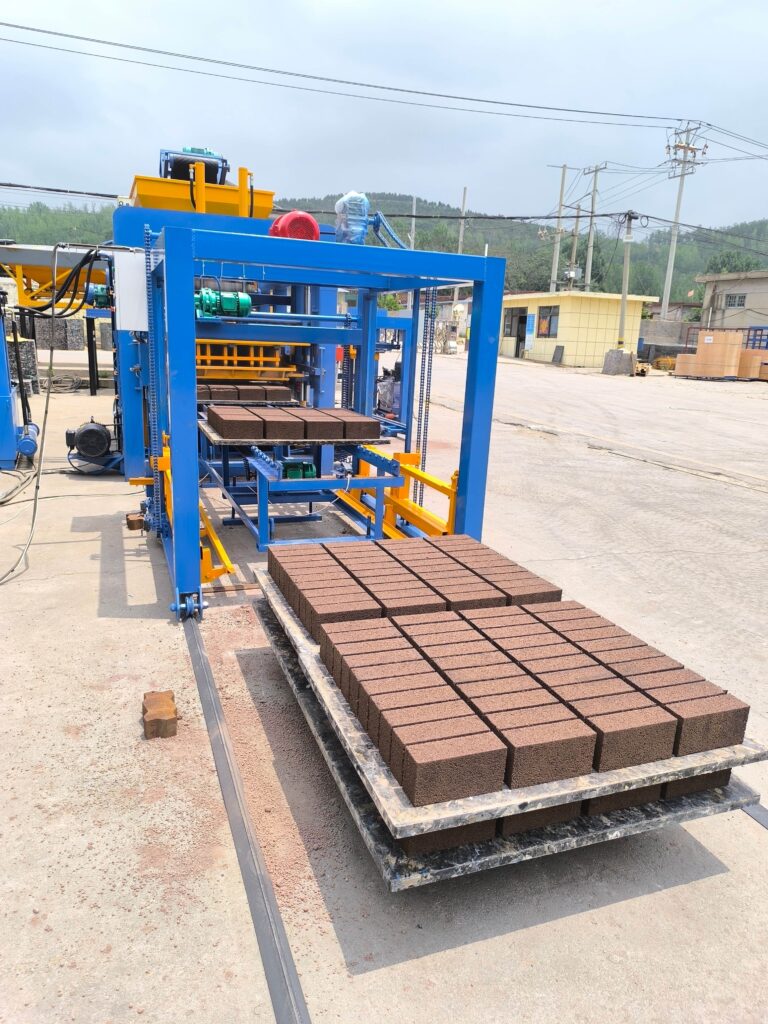
- Technology Choice: The core decision between concrete block making machines (stationary or mobile) and clay brick making machinery (extruder and kiln). This is dictated by your product choice, market, and capital.
- Capacity Planning: Match machine output to your realistic sales forecast. It is better to have a slightly undersized machine running at 90% capacity than an oversized one at 40%.
- New vs. Used: New machines offer warranties and latest technology but higher cost. Quality used machines can reduce CapEx but require expert inspection and may have higher maintenance costs. The choice impacts your risk profile and initial cash outlay.
- อุปกรณ์เสริม Do not overlook the need for a mixer (pan or planetary), conveyor systems, palletizers, and transport equipment (forklifts, trucks).
3.3. Raw Material Sourcing and Supply Chain
- Secure Reliable Suppliers: Establish contracts for cement, aggregates, pigments, and other additives. Consistency in raw material quality is non-negotiable for product consistency.
- Quality Testing: Set up a basic lab or partner with a local lab to test incoming raw materials (e.g., cement grade, aggregate gradation, clay plasticity).
3.4. Human Resources and Training
- Key Roles: Production Manager, Maintenance Technician, Machine Operators, Quality Control Inspector, Sales Representative.
- Training Investment: Comprehensive training on machine operation, safety protocols, preventative maintenance, and quality standards is essential. Skilled labor is a competitive advantage.
Phase 4: Legal, Regulatory, and Quality Foundations
- Business Registration and Licenses: Complete all local, state, and federal business registrations and obtain necessary manufacturing licenses.
- Environmental and Safety Compliance: Obtain air and water permits if applicable. Implement strict safety protocols (Lock-Out/Tag-Out, PPE) from day one. This protects your employees and limits liability.
- Quality Certification: Pursue relevant industry certifications (e.g., ASTM, ISO standards for your products). This is not just for marketing; it imposes a disciplined quality management system that builds customer trust.
Phase 5: Commercial Launch and Market Penetration
- Production Trials and Stock Building: Run the machine, refine the process, and build an initial inventory before announcing your launch.
- Sales and Distribution Channel Development: Will you sell direct to large contractors, through established distributors, or via a retail yard? A hybrid approach is common. Develop professional sales materials, price lists, and sample kits.
- Brand Building and Marketing: Develop a strong brand identity that communicates your value proposition. Attend trade shows, engage with construction industry associations, and leverage digital marketing to reach specifiers.
Conclusion: Building a Business, Not Just a Factory
Starting a brick manufacturing business is a formidable endeavor that tests entrepreneurial mettle. Success is not merely a function of owning a machine; it is the result of a meticulously orchestrated symphony of market insight, financial prudence, operational rigor, and commercial acumen.
The most common pitfall is underestimating the working capital required to bridge the gap between paying for materials and labor and receiving payment from customers. The second is neglecting the commercial function—assuming a “build it and they will come” mentality. Your factory is a cost center; your sales and distribution network is the profit center.
For the investor or distributor looking to integrate backward, this venture offers control over supply, quality, and margins. However, it demands a long-term commitment and a management mindset that balances the relentless focus of daily production with the strategic vision for growth and adaptation.
Ultimately, a successful brick manufacturing business becomes a pillar of the local construction industry. It provides essential materials, creates skilled jobs, and contributes to the built environment. By following a disciplined, phased approach and respecting the complexity of the undertaking, you lay not just bricks, but the foundation for a lasting and profitable enterprise.
FAQ
Q1: What is the minimum investment required to start a small-scale brick manufacturing business?
A: There is no universal figure, as it varies wildly by geography, technology choice, and scale. However, for a small, semi-automated concrete block plant in a developing market, a realistic minimum investment can range from $6,000 to $50,000. This might cover a basic machine, mixer, simple shelter, raw material for initial stock, and operating capital for 3-6 months.
Q2: Which is more profitable, clay bricks or concrete blocks?
A: Profitability is driven by local market dynamics, input costs, and operational efficiency, not the product type alone. Clay bricks often have a higher perceived value and price point but require more energy (firing) and sophisticated technology (kilns). Concrete blocks have lower processing costs but can face more intense price competition. Analyze your local market: which product has stronger demand, better margins, and less saturated competition? The “more profitable” product is the one you can produce reliably and sell effectively in your specific context.
Q3: How long does it take from starting construction to first sales?
A: For a greenfield project (starting from empty land), a realistic timeline is 12 to 24 months. This includes site acquisition, permitting, factory construction, machine procurement and installation, commissioning, trial runs, and initial marketing. A project using existing buildings and simpler technology might be compressed to 6-9 months. Factor in significant buffer time for bureaucratic delays, which are common in industrial projects.
Q4: What is the single biggest operational risk once production starts?
A: Beyond market risks, the single biggest operational risk is failure to achieve consistent product quality. Inconsistency in dimensions, strength, or color leads directly to high rejection rates, lost customers, and a damaged reputation. This risk is mitigated by investing in process control, a rigorous quality assurance lab, and extensive operator training from day one. Quality is your most important sales tool.
Q5: Should I focus on selling to distributors or directly to contractors and developers?
A: This is a strategic channel decision.
- Using Distributors: Provides faster market reach, leverages their existing customer relationships, and reduces your sales and logistics burden. However, it reduces your margin.
- Direct Sales: Yields higher margins and direct customer relationships but requires building a larger, skilled sales team and managing numerous smaller accounts and deliveries.