
The Complete Guide to Brick Factory Machines: Inside the FUDA Brick Making Factory Process
Introduction
From the ancient walls of Jericho to the soaring skyscrapers of today, the humble brick has been a foundational pillar of human civilization. Yet, while the brick itself is timeless, the methods for producing it have undergone a quiet revolution. Gone are the days of purely manual, sun-dried mud bricks. The modern construction industry demands consistency, strength, and scale—requirements that traditional methods struggle to meet due to labor intensity, environmental variability, and quality inconsistency.
Enter the modern brick factory machine. This isn’t just a single piece of equipment; it’s the heart of an automated, precision-driven production line that transforms raw earth and industrial by-products into perfectly uniform building blocks. This automation is the definitive solution, delivering unprecedented efficiency, superior quality control, and a significantly reduced environmental footprint.
This guide is crafted from industry expertise and technical knowledge, drawing on the established practices of leading manufacturers in the field, such as the FUDA brick making factory. It is designed to be a trustworthy resource for business owners planning an investment, engineers designing a production line, and procurement managers evaluating equipment. We will delve into the machinery that powers modern brick production, demystify the automated factory process, and provide a clear framework for selecting the right equipment for your specific goals.
Understanding Modern Brick Factory Machinery
At its core, a brick factory is a symphony of interconnected machines, each performing a specialized task. Understanding these components is the first step in appreciating the efficiency of a modern setup.
Core Components of a Brick Production Line
A fully integrated production line consists of three primary stages:
- Raw Material Preparation Machines: This is where the process begins. Crushers reduce large chunks of clay, shale, or aggregate to a consistent size. Screens then sift the material to ensure a uniform particle mix, which is crucial for final brick strength. Finally, Mixers (often pan or paddle mixers) blend the raw materials with a precise amount of water to achieve the perfect plasticity for molding.
- Brick Forming Machines: The Heart of the Operation. This is where the prepared mix is shaped into bricks or blocks. The forming process—whether by high-pressure vibration, hydraulic compression, or extrusion—defines the brick’s density and initial (“green”) strength. Modern machines use interchangeable molds to produce a variety of brick types from the same core equipment.
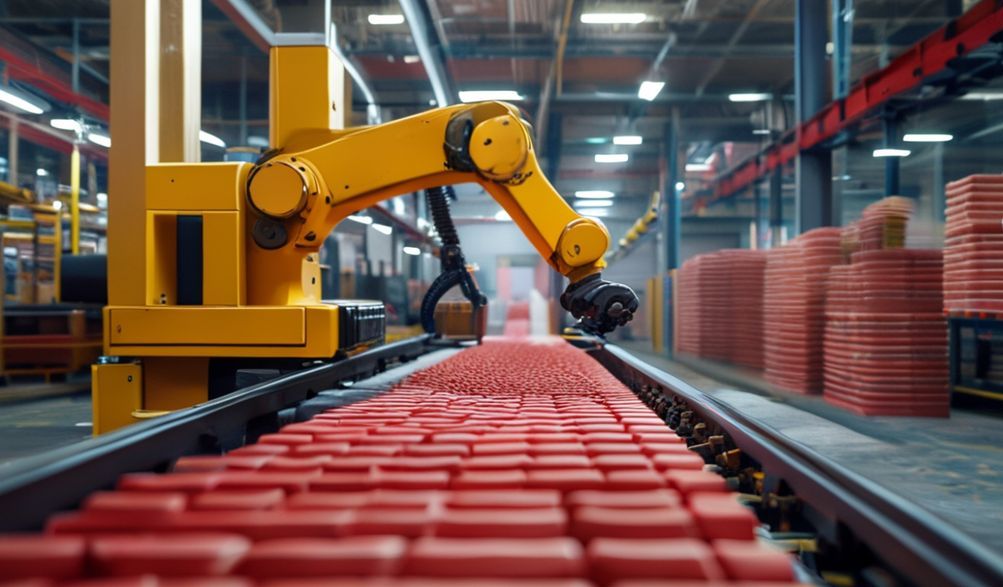
- Automation & Handling Systems: The unsung heroes of productivity. Conveyors (belt, roller, or chain) seamlessly move materials and green bricks between stages. Stackers, de-stackers, and palletizers automate the handling of finished products, drastically reducing manual labor and minimizing breakage. These systems are typically managed by a central Programmable Logic Controller (PLC).
Types of Brick Making Machines
The choice of forming machine is pivotal and depends on your desired product and scale.
- Hydraulic Press Machines: These are the powerhouses for producing high-density, high-strength concrete bricks, paving stones, and interlocking blocks. They use immense hydraulic pressure (measured in tonnes) to compact the material in a mold, resulting in products with excellent compressive strength and a smooth finish. They are ideal for premium construction projects.
- Extrusion Machines: Commonly used for hollow blocks and clay bricks, these machines force the prepared material through a shaped die (like a giant pasta maker). The continuous column of material is then cut to size by wires. This process is excellent for creating complex internal geometries (holes/webs) that reduce weight and improve insulation.
- Egg-Laying & Static Machines: These are often the entry point for small to medium-scale production. The “egg-laying” type molds a block and then moves aside to deposit (“lay”) it directly onto the curing yard floor before returning to its starting position. Static machines produce bricks in a fixed position. They are more labor-intensive but have a lower initial investment.
Key Specifications & What They Mean for Your Output
When comparing machines, look beyond the price tag. These specs tell the real story:
- Cycle Time & Production Capacity: This is usually listed as “blocks per hour” or “per 8-hour shift.” A faster cycle time means higher output. For example, a machine with a 15-second cycle time can theoretically produce 240 blocks per hour. Remember to factor in efficiency losses for maintenance and mold changes.
- Pressure Force (Tonnes): Directly correlates to the final brick’s compressive strength. Higher pressure compacts the raw material more densely, removing air pockets and creating a stronger bond. For structural bricks, this is a non-negotiable specification.
- Power Requirements & Operational Footprint: You must ensure your factory’s electrical supply can handle the machine’s demand (measured in kW). The physical dimensions of the machine and its required clearance for operation define the factory layout. Efficient design minimizes wasted movement of materials.
Inside the Process: How an Automated Brick Factory Like FUDA Operates
Walking through an automated factory reveals a seamless, continuous flow from raw pile to packaged pallet. Let’s break down the step-by-step journey.
Step-by-Step: From Raw Material to Finished Brick
- Stage 1: Raw Material Reception and Quality Control: Incoming materials (cement, fly ash, aggregate, clay) are tested for consistency. This is the most critical quality control point, as inconsistent input guarantees inconsistent output.
- Stage 2: Proportioning, Crushing, and Mixing: Materials are batched by weight or volume using automated feeders for precision. They are then crushed (if needed), screened, and mixed with water to achieve a homogeneous, workable consistency.
- Stage 3: Automated Molding and Forming: The mixed material is fed into the brick forming machine. Under high pressure or vibration, it takes the shape of the mold. Green bricks are then automatically transferred onto pallets or curing racks by handling systems.
- Stage 4: Curing and Drying: This is where the bricks gain their strength. In natural curing, bricks are stored in controlled conditions for weeks. Steam curing chambers (autoclaves) accelerate this process using heat and pressure, allowing bricks to reach market strength in 24 hours or less, significantly speeding up production cycles.
- Stage 5: Automated Handling, Sorting, and Packaging: Cured bricks are automatically de-stacked, inspected, and sorted. They are then packed onto pallets, often wrapped in plastic for weather protection, and moved to the storage yard by forklifts or conveyors, ready for shipment.
The Role of Quality Control in a Modern Factory
In an automated factory, quality control is not an afterthought; it’s embedded in the process.
- In-process Testing: Operators regularly perform dimensional checks on green bricks and test their “green strength” to ensure they can survive handling.
- Final Product Testing: Samples from each batch are tested in a lab for compressive strength (the load they can bear), water absorption (affects durability in freeze-thaw cycles), and density. Reputable factories adhere to international standards like ASTM or ISO.
- Consistency as a Hallmark: The ultimate goal of automation is not just speed, but predictable, unwavering quality. Every brick in a batch meeting the same high standard is what builds a factory’s reputation.
Sustainability in Brick Manufacturing
Modern factories are increasingly eco-conscious. Key practices include:
- Use of Industrial By-products: Fly ash (from coal plants) and slag (from steel production) are widely used as primary raw materials. This reduces landfill waste and the need to quarry virgin clay or aggregate.
- Water Recycling Systems: Closed-loop water systems collect and recycle water from the mixing and cleaning processes, minimizing freshwater consumption.
- Energy Efficiency: Modern machines are designed for lower power consumption per block. Optimized curing cycles and heat recovery systems in steam chambers further reduce the overall carbon footprint.
Selecting the Right Brick Factory Machine: A Buyer’s Guide
Investing in a brick production line is a major decision. A systematic approach will ensure your investment pays dividends for years.
Assessing Your Production Needs & Business Goals
Start by looking inward:
- Project Scale: Are you supplying a massive infrastructure project or serving local housing developments? Your target output dictates the size and automation level of the line.
- Target Brick Types: The machine must match the product. A hydraulic press is needed for solid paving stones, while an extruder is necessary for hollow blocks. Many machines offer versatility with mold changes.
- Raw Material Availability: Your local material mix is key. A region rich in clay points toward extrusion, while an area with abundant fly ash is ideal for hydraulic pressing of concrete bricks.
Evaluating Machine Suppliers and Manufacturers
The manufacturer is as important as the machine.
- Importance of Manufacturer Reputation & History: Look for companies with a long track record, like FUDA. A proven history suggests reliability, iterative design improvements, and industry stability. Research their installed base and ask for client references.
- Technical Support, Training, and After-Sales Service: The relationship begins after purchase. Ensure the supplier offers comprehensive installation supervision, operator training, and readily available technical support. Downtime is lost revenue.
- Availability of Spare Parts: Confirm that critical spare parts (hydraulic seals, vibration motors, control panels) are in stock and can be shipped quickly. A service contract can provide peace of mind.
Cost Analysis: Investment vs. Long-Term ROI
Think in terms of total cost of ownership, not just purchase price.
- Initial Cost vs. Operational Efficiency: A more expensive, automated machine may produce 3x the output with half the labor, paying for itself in a short time.
- Labor Cost Reduction: Automation directly reduces the number of workers needed for manual handling, stacking, and moving, leading to significant long-term savings.
- Durability and Maintenance: A robustly built machine from a quality manufacturer will have lower lifetime maintenance costs and less unscheduled downtime than a cheaper, less durable alternative.
Case Study & Industry Insights: The FUDA Brick Making Factory Model
While specific proprietary details vary, examining the model of an established manufacturer like FUDA reveals industry best practices that lead to success.
Overview of an Established Manufacturing Approach
- Integration of Advanced PLC Control Systems: Their production lines are typically governed by centralized, user-friendly PLC interfaces. This allows for precise control over mixing ratios, pressure, cycle times, and diagnostics, ensuring repeatability and simplifying operation.
- Emphasis on Robust Machine Design for 24/7 Operation: Machinery is built with heavy-duty components—reinforced frames, industrial-grade hydraulics, and durable vibration systems—to withstand the demands of continuous production cycles.
- Customization of Production Lines: Rather than a one-size-fits-all approach, they often work with clients to customize the line. This can include specific mold designs for unique block profiles, adjusting conveyor layouts to fit an existing factory space, or integrating particular raw material feeders.
Lessons from Successful Brick Factory Setups
The machine is only part of the equation. Successful implementation requires:
- Proper Factory Layout and Workflow Design: The factory floor must be designed for a logical, linear material flow—from raw storage to mixing, molding, curing, and dispatch—with minimal backtracking or congestion.
- Training Skilled Personnel: Even the most automated line needs skilled technicians for maintenance and troubleshooting, and attentive operators for monitoring. Investing in training is investing in uptime.
- Building a Consistent Raw Material Supply Chain: Partnering with reliable suppliers for cement, aggregates, and fly ash is essential. Fluctuations in material quality are the fastest way to compromise your final product’s integrity.
FAQ Section
Q1: What is the typical production capacity of a medium-sized brick factory machine?
A medium-sized hydraulic press or extruder can typically produce between 8,000 to 20,000 standard bricks (or 1,000 to 3,000 hollow blocks) per 8-hour shift, depending on the model and cycle time.
Q2: What are the main differences between hydraulic and extrusion brick making machines?
Hydraulic machines use vertical compression to create dense, solid products like paving stones. Extrusion machines push material through a die to create continuous profiles, ideal for hollow blocks and clay bricks. The choice depends on your desired product type and raw material.
Q3: What raw materials can be used with modern brick making machines?
A wide variety: clay, shale, concrete (cement, sand, aggregate), and industrial wastes like fly ash, slag, and even certain types of construction debris. The machine must be selected and configured for your specific material mix.
Q4: How important is after-sales service when purchasing heavy machinery like a brick plant?
It is critically important, often more so than a marginal price difference. Reliable, fast technical support and spare parts availability are the primary defenses against costly production stoppages that can cripple your business.
Q5: Can brick factory machines produce different types and sizes of bricks?
Yes, versatility is a key feature. By changing the mold in the forming machine, a single production line can often manufacture different sizes of solid blocks, hollow blocks, paving bricks, or interlocking stones.
Q6: What are the key factors affecting the final strength and quality of the bricks produced?
The primary factors are: 1) The quality and consistency of raw materials, 2) The compression force/pressure during forming, 3) The precise water-to-cement/clay ratio, and 4) The controlled curing process.
Q7: How automated can a brick production line become? What is the human role?
A line can be fully automated from mixing to palletizing, including robotic handling and pallet wrapping. The human role shifts from manual labor to supervision, quality control monitoring, machine maintenance, and system management via the control interface.
Conclusion
The evolution from manual brick-making to automated factory production represents a fundamental leap in how we build our world. Brick factory machines deliver the trifecta of modern industry: unmatched efficiency, guaranteed quality, and scalable output. They transform brick manufacturing from a craft into a precise engineering discipline.
As this guide has outlined, investing in this technology is a strategic business decision that requires careful planning. It necessitates due diligence, focusing not just on the machine’s specs but on the manufacturer’s reputation for support and reliability—a principle embodied by established industry players like the FUDA brick making factory.
Looking ahead, the future points toward even greater integration of the Internet of Things (IoT) for predictive maintenance, the use of alternative and recycled materials, and smarter, more energy-efficient machines. Let this guide serve as your foundation. Continue your research, consult with technical experts, and, most importantly, visit the factories of potential suppliers. Seeing a machine in operation and discussing your needs directly with engineers is the best way to ensure your investment lays a solid foundation for your business’s future growth.