
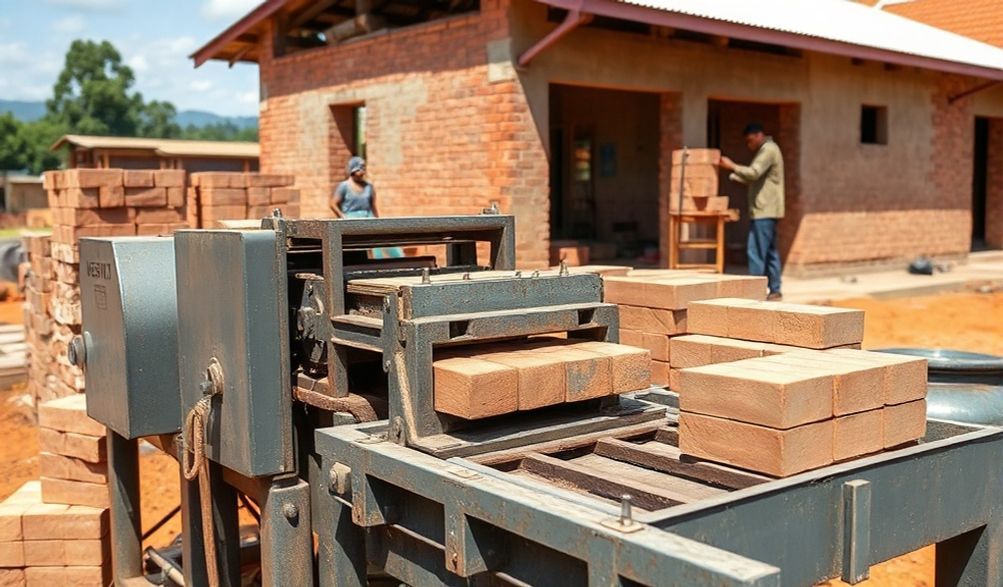
The Ultimate Guide to Rwanda Brick Making Machines: Types, Costs & Top Suppliers (2026)
Introduction
Rwanda’s skyline is transforming. Driven by ambitious national goals like Vision 2050 and the National Strategy for Transformation (NST1), the country is experiencing a sustained construction boom. The Rwanda Housing Authority reports a need for hundreds of thousands of new housing units to meet urbanization and population growth, particularly in expanding cities like Kigali. At the heart of every new home, school, hospital, and road lies a fundamental building block: the brick.
Yet, for many builders, contractors, and entrepreneurs, a critical bottleneck persists. Reliance on traditional, manual brick production leads to inconsistent quality, unpredictable project timelines, and soaring labor costs. How can Rwanda build its future if its foundational materials are variable and production is slow?
The solution is revolutionizing construction sites across the nation: the modern brick making machine. This guide is designed to cut through the noise. As industry professionals with on-the-ground experience in the East African market, we provide expert, unbiased, and practical advice. Our goal is to empower construction companies, real estate developers, ambitious local entrepreneurs, and government project managers in Rwanda to make a confident, informed investment that boosts quality, efficiency, and profitability.
Why Invest in a Brick Making Machine in Rwanda?
Investing in brick production technology is no longer a luxury; it’s a strategic decision aligned with Rwanda’s growth trajectory. Understanding the local context is key to seeing the full value proposition.
The Rwandan Construction Landscape: Growth, Demand, and Government Initiatives
Rwanda’s economy is on a steadfast path of growth, with significant public and private investment flowing into infrastructure and real estate. Urbanization rates are climbing, and government initiatives like the “Green City Kigali” pilot and the Affordable Housing Program are creating unprecedented demand for standardized, quality building materials.
This policy-driven demand, coupled with private sector development, translates directly into a booming market for bricks. The old method of manual molding cannot keep pace with the scale, speed, or quality standards required by modern projects and discerning buyers. A brick making machine positions you at the center of this economic engine.
Key Benefits Over Manual Brick Production
- Superior & Consistent Quality: Machines apply precise, repeatable pressure and vibration. This produces bricks and blocks with uniform size, density, and compressive strength, ensuring compliance with Rwanda Standards Board (RSB) guidelines. Consistent quality minimizes structural issues and reduces waste on-site.
- Dramatically Increased Production Speed: While a skilled artisan might produce 500-800 bricks per day, a basic manual machine can produce 2,000-3,000. Semi-automatic models can output 5,000-10,000 blocks daily. This speed is crucial for meeting tight project deadlines and scaling output.
- Long-Term Cost Efficiency: Although the initial investment is higher, the Return on Investment (ROI) is compelling. You drastically reduce per-unit labor costs and material waste. Over a single large project or a year of operation, the machine often pays for itself, turning a cost center into a profit center.
- Entrepreneurial Opportunity: This isn’t just for self-use. A reliable machine allows you to start a commercial brick supply business, catering to the vast demand from smaller builders and individual homeowners, creating jobs and building a sustainable enterprise.
Types of Brick Making Machines Suitable for Rwanda
Choosing the right type of machine is the most critical decision. The “best” machine depends entirely on your scale, budget, and business model.
Manual Brick Making Machines
These are lever-operated or simple hydraulic presses that require significant human effort to feed, compress, and eject blocks. They are not automated but provide a massive upgrade over hand-molding.
- Operation: An operator fills the mold with raw material (soil-cement mix), manually applies pressure via a lever, and releases the formed block.
- Best for: Individual homeowners, very small-scale projects, startups with minimal capital, and community co-ops in rural areas where labor is available but capital is limited.
- Pros: Lowest upfront cost, simple to understand and repair, no electricity needed.
- Cons: High physical labor requirement, lower output, quality can vary with operator fatigue.
Semi-Automatic Brick Making Machines
This is the sweet spot for many growing Rwandan businesses. They use an electric or diesel engine to power a hydraulic system and vibratory table, automating the compaction and vibration process. The operator primarily feeds raw material and removes finished blocks.
- Operation: The operator places the mix in the hopper. The machine automatically feeds the mold, compresses the block with vibration and high pressure, and ejects it onto a pallet. The operator stacks the pallets.
- Best for: Small to medium-sized construction companies, dedicated brick-making SMEs, and housing development projects requiring a steady, reliable supply.
- Pros: Excellent balance of output and cost, consistent quality, reduces heavy labor, versatile in product types.
- Cons: Higher initial investment than manual machines, requires a power source, needs basic technical knowledge for maintenance.
Fully Automatic Brick Making Machines
These are industrial production lines. They feature automated material feeding, mixing, molding, curing, and stacking, often controlled by a programmable logic controller (PLC). Human intervention is minimal, primarily for monitoring.
- Operation: Raw materials are loaded into a feeder, and the entire process—from mixing to palletizing—is automated. Output can be directed to a curing chamber.
- Best for: Large construction firms, industrial-scale brick manufacturing plants, and suppliers aiming for major government or commercial contracts requiring vast, consistent output.
- Pros: Maximum output with minimal labor, unparalleled consistency, highest efficiency for very large volumes.
- Cons: Very high capital investment, requires significant space and stable three-phase power, complex maintenance requiring specialist technicians.
Mobile Brick Making Machines
A game-changer for specific projects, these are compact, trailer-mounted units (often semi-automatic) that can be towed directly to a construction site.
- Operation: Similar to a semi-automatic machine but designed for portability and quick setup on relatively flat ground.
- Best for: Large, remote infrastructure projects (e.g., roads, dams, rural schools), developers building on large tracts of land where transporting bricks is costly. In our experience, projects in the hilly terrain of Rwanda’s Western and Northern Provinces can see significant logistical savings with this model.
- Pros: Eliminates brick transport costs, allows on-site production tailored to daily needs, reduces brick damage from handling.
- Cons: Output is typically lower than stationary semi-automatic models, requires on-site raw material and fuel/power management.
Key Features to Consider Before Buying
Beyond the machine type, these features will determine your long-term satisfaction and profitability.
Production Capacity (Blocks per Hour/Day)
Don’t just buy the biggest machine. Match capacity to your realistic demand.
* For on-site project use: Calculate your peak daily brick requirement and add a 20-30% buffer.
* For a commercial supply business: Start with a realistic sales forecast for Year 1 and choose a machine that can meet 70-80% of that. You can scale up later.
Brick Type and Size Versatility
The ability to produce multiple products future-proofs your investment. Look for machines that can easily interchange molds for:
* Hollow Blocks: Standard for wall construction, reducing weight and material use.
* Solid Blocks: For foundations and high-load areas.
* Interlocking Bricks: Crucial for Rwanda’s sloped terrain and seismic considerations. They require no mortar for laying, are ideal for retaining walls, and align with modern building techniques.
* Paving Stones: For driveways, walkways, and landscaping, a high-margin add-on product.
Power Source: Electric, Diesel, or Hybrid?
This decision hinges on your location and Rwanda’s infrastructure.
* Electric: Cleaner, quieter, and lower operating cost if you have a reliable grid connection. Essential for automatic machines. Consider a generator backup for areas with intermittent supply.
* Diesel: Full independence from the grid. Preferred for remote sites or mobile operations. Factor in fuel costs, noise, and emissions.
* Hybrid: Offers the flexibility to switch between power sources, providing valuable redundancy. Ideal for areas where grid reliability is a concern.
Durability and After-Sales Support
This is non-negotiable. A machine is a long-term asset.
* Durability: Look for robust frames, high-quality hydraulic cylinders, and hardened steel molds. Thicker steel and reputable component brands (e.g., Siemens, Mitsubishi for electronics) indicate longevity.
* After-Sales Support: This is the most critical factor for success in Rwanda. Prioritize suppliers who offer:
* A clear warranty (1+ years on core parts).
* Available local technicians or training for your staff.
* A physical warehouse of spare parts in Kigali or East Africa (Nairobi, Dar es Salaam).
* Proven service contracts with other clients in the region.
Cost Analysis and Supplier Insights for Rwanda
Transparent financial planning prevents unexpected setbacks.
Understanding the Price Range
Prices vary widely based on type, capacity, and brand. Here are estimated brackets in Rwandan Francs (RWF) as of 2026 projections:
* Manual Machines: RWF 1.5 million – RWF 4 million.
* Semi-Automatic Machines: RWF 8 million – RWF 25 million.
* Fully Automatic Machines: RWF 40 million – RWF 150 million+.
* Mobile Machines: RWF 15 million – RWF 35 million.
Always clarify what’s included: Installation, on-site training, a starter set of spare parts (filters, seals), and mold for one block type should be part of the negotiation.
Evaluating Suppliers: Local Dealers vs. International Manufacturers
- Local/Regional Dealers (based in Kigali or East Africa):
- Pros: Easier communication, faster delivery and parts logistics, understanding of local market conditions, potential for quicker service calls.
- Cons: May have a limited range of models, prices may include their markup.
- Direct International Manufacturers (e.g., from China, India, Turkey):
- Pros: Potentially lower FOB prices, widest selection of models and customization.
- Cons: Complex logistics, import duties, language/time zone barriers, major after-sales challenges if no local representative.
Trust Verification Checklist: Ask any supplier for:
1. Client references from Rwanda, Kenya, Uganda, or Tanzania. Call them.
2. Proof of a physical office or warehouse in the region.
3. A detailed service and warranty contract in writing.
4. Documentation of conformity with relevant international or RSB standards.
Hidden Costs to Budget For
Failing to plan for these can cripple your project:
1. Import Duties & Taxes: Consult the Rwanda Revenue Authority (RRA) for the latest HS codes and rates for construction machinery. Budget 15-25% of the CIF value for duties and VAT.
2. Shipping & Logistics: Includes sea freight, port clearance in Dar es Salaam or Mombasa, and trucking to Kigali/your site. Get a detailed quote from a freight forwarder.
3. Installation & Commissioning: Some suppliers include this, others charge extra.
4. Operator Training: Essential for efficiency and safety.
5. Maintenance Fund: Set aside 3-5% of the machine’s cost annually for spare parts and routine servicing.
Operational Tips and Maintenance for Longevity
Your machine’s performance depends on how you operate and care for it.
Setting Up Your Operation
- Site: Choose a level, well-drained area with enough space for raw material storage, production, and block curing (a critical 7-14 day process for strength).
- Raw Materials: Rwanda’s local soil can be effective, but a soil test is highly recommended to determine the optimal cement-soil ratio. Inconsistent soil quality is a primary cause of poor bricks. Source quality Portland cement from reliable suppliers.
Routine Maintenance Checklist
- Daily: Clean the machine thoroughly after use, especially the mold and hopper. Check hydraulic oil levels and for leaks. Grease all moving points (pivots, bearings).
- Weekly: Inspect bolts and nuts for tightness. Check vibration motor mounts. Clean the hydraulic oil filter.
- Monthly: Change hydraulic oil and filters as per manual. Inspect mold liners for wear. Check electrical connections for tightness.
Troubleshooting Common Issues
- Blocks are weak or crumbly: Incorrect water-cement-soil ratio. Conduct a mix test.
- Blocks stick in the mold: Mold needs lubrication (use a recommended release agent) or is damaged/worn.
- Poor surface finish: Vibration time or pressure is insufficient, or the mix is too dry.
- Machine vibrates excessively: Loose bolts on the vibration motor or frame.
- Hydraulic system is slow/weak: Low oil level, clogged filter, or worn pump.
Frequently Asked Questions (FAQ)
Q1: What is the most popular type of brick making machine in Rwanda for a small business?
A: The semi-automatic machine is the most popular choice. It offers the ideal balance of affordable automation, significant output (enough to supply a business), and manageable technical complexity for a growing enterprise.
Q2: Can these machines use Rwanda’s local soil effectively? Do I need a soil test?
A: Yes, they are designed for local soils. However, a soil test is strongly advised. It determines the clay, silt, and sand composition, telling you the exact percentage of cement needed to produce strong, durable blocks, saving you money on cement and preventing production failures.
Q3: What are the import regulations and average duty for bringing a machine into Rwanda?
A: You will need a Certificate of Conformity (from PVoC agent at origin), commercial invoice, packing list, and bill of lading. Duties vary; consult the RRA. Generally, expect a total tax and duty burden of 15-25% of the CIF value. A reliable freight forwarder is essential.
Q4: How do I find a reliable technician to service my machine in Rwanda?
A: This is why supplier choice is key. Choose a supplier who provides training for your staff and has a local service network. Alternatively, established mechanical workshops in Kigali that service heavy equipment can often be trained on specific machines.
Q5: What is the typical payback period for a medium-sized brick making machine investment in Rwanda?
A: For a semi-automatic machine running a commercial supply business, the payback period can range from 12 to 24 months, depending on management, market demand, and pricing. For on-site use on a large project, it can pay for itself on that single project by eliminating purchased brick costs.
Q6: Are there any government incentives or financing options for this equipment?
A: While there is no direct subsidy for brick machines, initiatives like the Business Development Fund (BDF) and various commercial bank loans target SME growth in manufacturing and construction. Presenting a solid business plan for a brick-making enterprise can help you access such financing. Always check with RDB (Rwanda Development Board) for the latest support programs.
Conclusion
Investing in a brick making machine in Rwanda is more than a purchase; it’s a strategic commitment to quality, efficiency, and growth. The journey involves carefully matching the machine type to your needs, prioritizing durable build quality and—above all—ensuring robust after-sales support within East Africa. By understanding the total costs, from import duties to maintenance, you can build a realistic and profitable business plan.
This investment empowers you to build better, contribute to Rwanda’s infrastructure goals, and create sustainable economic value. As you move forward, conduct thorough due diligence: visit supplier operations if possible, speak to their existing clients, and consult with fellow builders and entrepreneurs.
The future of Rwandan construction is not only about building up but building smart. Embracing efficient technology like brick making machines, and exploring sustainable trends such as incorporating recycled materials into your blocks, positions you at the forefront of the nation’s green growth journey. Your next step is to turn this knowledge into action.