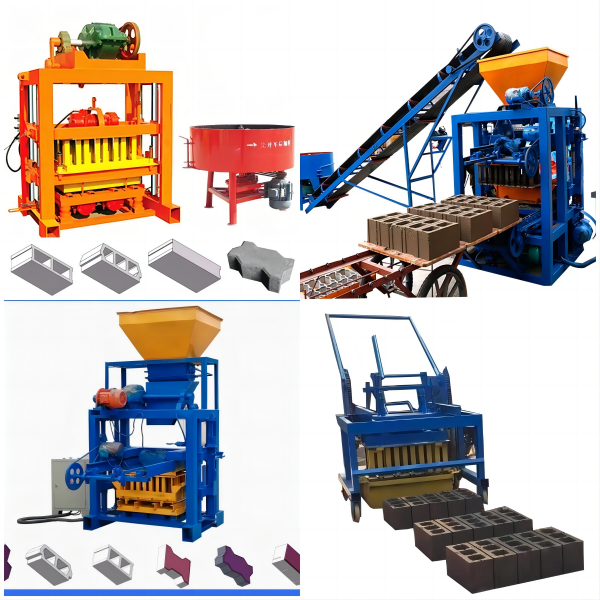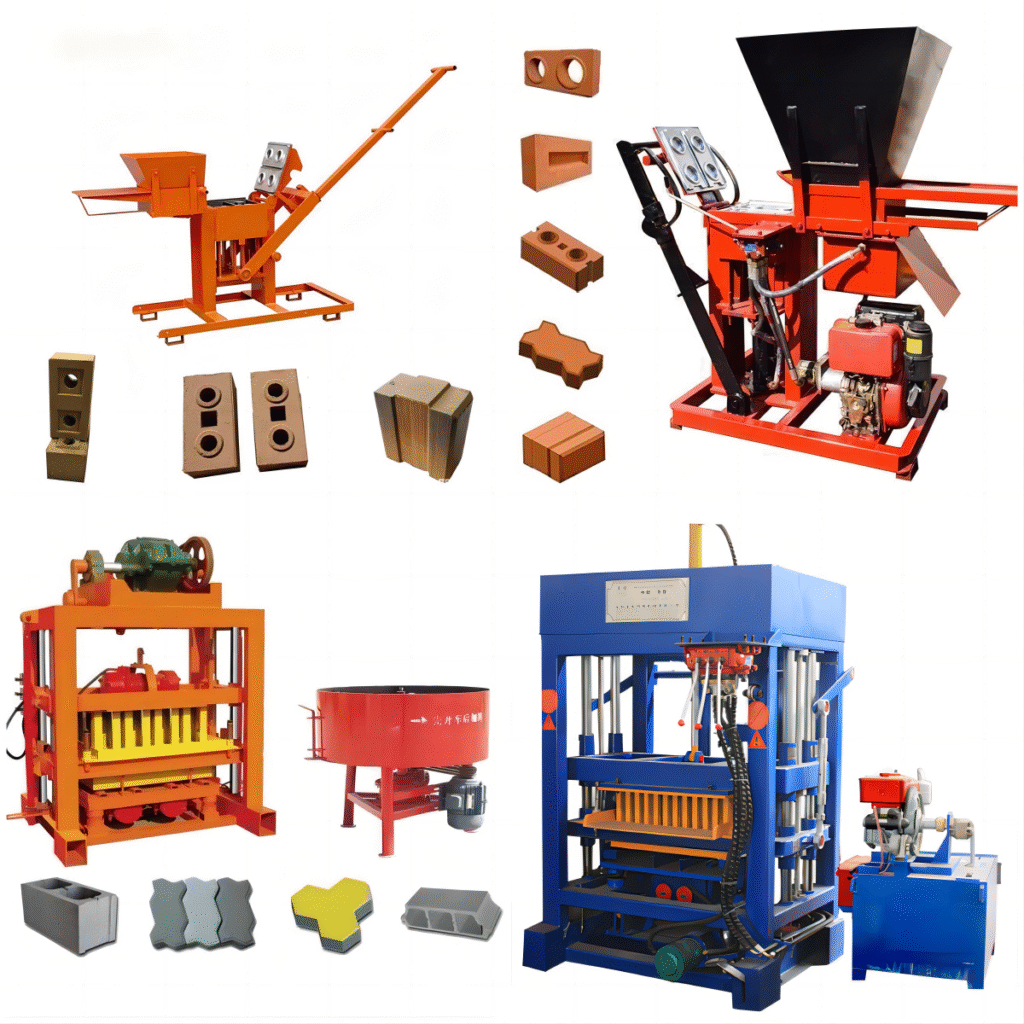
Blok maşynlarynyň görnüşleriniň çuňňur derňewi
1. Işleme usuly we awtomatlaşdyryş derejesi boýunça klassifikasiýa
Awtomatizasiýanyň derejesi esasy tapawutlandyryjy bolup, önümçilige, işçi güýjüne we maýa goýumlaryna gönüden-göni täsir edýär.
1.1. El bilen blok maşynlary
Bular blok önümçilige iň esasly we amatly giriş nokatlarydyr.
- Mehanizm:Adamdan doly işleýär. Işçiler betony el bilen garyşdyrýarlar, galyplary doldurýarlar we leňňer ýa-da gidrawliki domokrat bilen basyş edýärler. Soňra maşyn goýberilýär we täze blok el bilen aýrylýar we guramaga goýulýar.
- Esasy aýratynlyklary:
- Gaty pes başlangıç maýa goýumy:Pes başlangıç maýasyna eýe bolan kiçi kärhanalar ýa-da täze başlanan işler üçin ideal.
- Aşaýlyk önümçilik:Önümçilik haýal, işçiniň başarnygyna we dözümliligine bagly.
- Zähmetiň ýokary intensiwligi:Dowamly önümçilik üçin birnäçe işçi gerek.
- Çeýelçilik:Göçürmek aňsat we galyplary üýtgedip, dürli görnüşdäki bloklary öndürip biler.
- Strategiki Goşundy Paýlaýjylar ÜçinNyrna bazarlary oba gurluşyk taslamalaryny, kiçi göwrümli jemagat ösüşlerini we başlangyç maýa goýumynyň iň az möçberini gözleýän telekeçileri öz içine alýar. Olar giriş harydy hökmünde hyzmat edýär, ýöne çäkli giňişleýin ulanyş mümkinçiligini hödürleýär.
1.2. Ýarym awtomatiki blok maşynlary
This category represents the most popular balance between productivity, cost, and flexibility for small to medium-sized businesses.
- Mehanizm: These machines integrate mechanical or hydraulic systems for key processes—primarily compaction and vibration—while material handling (feeding, mold filling, and product removal) is performed by operators. They often feature a simple control panel to manage the cycle.
- Esasy aýratynlyklary:
- Moderate Investment and Output: Significantly higher production than manual machines (typically 1000-3000 blocks per 8-hour shift) with a reasonable price point.
- Iş güjüne bolan garaýyşyň azalmagy: One or two operators can manage the machine, improving consistency.
- Improved Product Quality: Powered vibration ensures better compaction, leading to denser, stronger blocks with a consistent finish.
- Köpýönlilik: Can be configured with different molds and often include a simple pallet circulation system.
- Strategiki Goşundy Paýlaýjylar Üçin The core product for many distributors. Ideal for clients supplying local housing markets, medium-sized construction firms, and paver manufacturers. The sweet spot for businesses ready to scale from manual operations.
1.3. Fully Automatic Block Making Plants
These are complete production systems designed for large-scale, high-volume manufacturing with minimal human intervention.
- Mehanizm: Fully integrated systems comprising automated batching and mixing units, conveyor belts for material transport, a central computerized control panel, and sophisticated machines with automatic mold filling, high-pressure compaction, and robotic product handling. Finished blocks are automatically stacked and transferred to curing racks or chambers.
- Esasy aýratynlyklary:
- Ýokary Kapitallaýşanma: Requires significant upfront investment but offers the best long-term ROI for high-volume production.
- Exceptional Output: Capable of producing tens of thousands of blocks per shift.
- Minimal Labor: Only a few skilled personnel are needed for supervision and maintenance.
- Superior Consistency and Quality: Computer-controlled processes eliminate human error, guaranteeing product uniformity.
- High Efficiency: Continuous operation with integrated curing systems maximizes plant utilization.
- Strategiki Goşundy Paýlaýjylar Üçin Target large block manufacturers, industrial clients, and government infrastructure projects. These are complex sales involving technical consultation and often require after-sales support partnerships.
2. Classification by Mobility and Plant Setup
2.1. Stationary Block Machines
- Düşündiriş: Heavy-duty machines fixed in a dedicated factory setting. They form the core of semi-automatic and fully automatic production lines.
- Üstünlikler: Designed for stability, high vibration, and sustained heavy use. They allow for optimal workflow layout with integrated peripherals (mixers, conveyors, stackers).
- Seretgeler: Require a permanent, solid foundation and are not intended to be moved.
2.2. Mobile Block Machines (Block Making Machines on Wheels)
- Düşündiriş: Self-contained units mounted on a trailer or a mobile frame, enabling on-site production.
- Üstünlikler:
- Eliminates Transport Costs: Produces blocks directly at the construction site, drastically reducing logistics for large projects.
- Fresh Block Usage: Blocks can be used within days, accelerating project timelines.
- Market Flexibility: Operators can move the machine between different project sites as needed.
- Strategik Ulanma: Highly appealing to large construction contractors, government bodies building infrastructure in remote locations, and disaster rehabilitation projects.
3. Classification by Production Method and Output Type
3.1. Egg-Laying Block Machines
- Düşündiriş: A popular type of mobile or semi-stationary machine. After compaction, the machine lifts vertically (like a laying hen), leaving the newly formed block on the ground or on a pallet directly beneath it. The machine then moves forward (or is moved) to the next position to repeat the cycle.
- Üstünlikler: Simple design, lower cost than stationary machines, and ideal for producing blocks cured in-situ.
3.2. Static Block Making Machines
- Düşündiriş: The mold and compaction system remain stationary during the production cycle. Pallets are fed into the machine, blocks are formed, and then ejected onto a conveyor or rack for transport to a curing area.
- Üstünlikler: More robust construction allows for higher vibration and pressure, leading to superior block density. The foundation of most semi- and fully automatic stationary plants.
4. Specialized Block Making Machines
Beyond standard hollow or solid blocks, specialized machines cater to niche markets with higher value products.
4.1. Paver and Interlocking Block Machines
- Düşündiriş: Specifically engineered to produce high-precision paving slabs, interlocking bricks, and retaining wall units. They exert extreme pressure (often through hydraulic systems) to create very dense, low-porosity products with excellent aesthetic surface finishes.
- Market: Landscaping, municipal projects, decorative driveways, and commercial pavements.
4.2. Curbstone and Kerb Making Machines
- Düşündiriş: Designed to produce long, linear concrete products for road edging, gutters, and landscape borders. They may use extrusion or slipforming technology alongside traditional vibration.
4.3. Interlocking Compressed Earth Block (CEB) Machines
- Düşündiriş: These machines compress stabilized soil (with a small amount of cement or lime) into high-strength, eco-friendly blocks. They address the growing market for sustainable, low-carbon building materials.
Netije
The landscape of block production machinery is diverse, offering solutions for every segment of the construction market. For the astute dealer or procurement professional, success lies in matching the correct machine type to the specific needs and constraints of the end-user. A thorough evaluation of factors such as target market size, available capital, labor costs, desired output, and product specialization is essential.
Manual machines open doors in emerging economies, semi-automatic models drive growth for SMEs, and fully automatic plants dominate industrial-scale production. Meanwhile, mobile and specialized machines unlock unique opportunities in on-site construction and niche markets. By leveraging this detailed, categorical knowledge, business intermediaries can provide invaluable consultancy, build trust with clients, and strategically position their product offerings to capture growth across the entire value chain of construction material production.
Frequently Asked Questions (FAQ)
Q1: What are the key factors a client should consider before choosing a block machine?
A: Guide clients to assess: 1) Projected Daily/Annual Production Volume. 2) Available Investment Budget (including foundation and ancillary equipment). 3) Type of Products to be manufactured (hollow blocks, pavers, etc.). 4) Labor Availability and Cost. 5) Elýeterli ýer we elektrik üpjünçiligi at the plant site. 6) Local Market Demand for specific block types and strengths.
Q2: What is the typical return on investment (ROI) period for a semi-automatic block machine?
A: The ROI period varies widely based on local market prices for blocks, raw material costs, operational efficiency, and machine utilization. For a well-managed operation with steady demand, a semi-automatic machine can often see ROI within 12 to 24 months. A detailed business plan factoring in local variables is crucial.
Q3: Can one machine produce different types of blocks and pavers?
A: Yes, most semi- and fully automatic machines are designed for modular mold systems. By changing the mold (a process that can take from minutes to a couple of hours), the same machine can produce a wide range of products—from 4-inch to 8-inch blocks, to various paver patterns and specialty shapes. This versatility is a key selling point.
Q4: What are the essential auxiliary equipment needed for a functional block yard?
A: A complete setup requires: 1) A concrete pan mixer or planetary mixer for consistent raw material blending. 2) A belt conveyor or forklift for material handling (optional in semi-auto, essential in auto). 3) Block carts or pallet racks for transporting and curing green blocks. 4) A cement silo (for large plants). 5) A storage area for raw materials and finished products.
Q5: How important is after-sales service and technical support when purchasing a machine?
A: It is absolutely critical. Reliable access to spare parts, maintenance guidance, and troubleshooting support directly impacts machine uptime and longevity. Distributors should emphasize their service network, availability of critical wear parts (like mold liners and vibration motors), and offer comprehensive operator training as part of the value proposition.