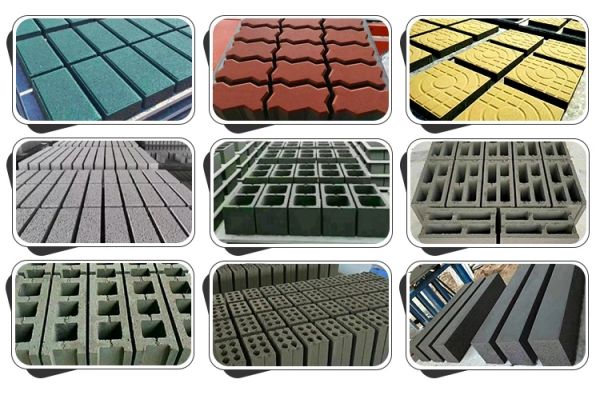
I. Foundational Distinction: Product Dimensional Standards and Classification
The core difference originates from the dimensional and structural specifications of the final product, which in turn dictates the machine’s design parameters.
A. Defining the Output: Brick vs. Block
- Brick (Standard/Modular): In modern masonry, a “brick” typically refers to a small, solid or cored unit designed to be laid in courses with mortar joints. Its key characteristic is its size and one-handed manipulation. A standard modular brick has nominal dimensions (including mortar joint) of 8″ x 2.67″ x 4″ (200mm x 70mm x 100mm). Its actual dimensions are slightly smaller to account for a 10mm mortar joint. Bricks are designed to be picked up and laid by a mason using one hand.
- Block (Concrete Masonry Unit – CMU): A “block” is a larger, predominantly hollow building unit. Standard concrete blocks are significantly larger, with a common nominal face dimension of 16″ x 8″ (400mm x 200mm), and a depth ranging from 4″ to 12″ or more. Their defining feature is their hollow-core design, which reduces weight, improves thermal and acoustic insulation, and allows for reinforcing steel and grout to be placed within. Blocks are designed to be handled with two hands.
B. Formal Classification Systems
Globally, building standards (like ASTM, EN, or IS codes) provide formal definitions. Machines are often engineered to produce units that comply with these specific standards. A “block machine” is designed to produce CMUs meeting the dimensional and compressive strength criteria for structural blocks, while a “brick machine” may target specifications for clay or concrete bricks.
II. Machine Design and Operational Divergences
The product specifications necessitate distinct engineering approaches in the machinery itself.
A. Mold Design and Cavitation
- Brick Machine Molds: Designed for high cavitation. A single mold may contain 10, 12, 15, or even more individual brick cavities to achieve competitive production rates due to the small size of each unit. The mold structure is intricate but designed for smaller individual cavities.
- Block Machine Molds: Feature lower cavitation but larger individual cavities. A standard mold may produce 3, 4, or 6 full-sized blocks per cycle. The mold is heavier, with thicker walls and larger internal volumes to form the hollow cores via specially shaped mold “webs” and “liners.”
B. Compaction Force and Vibration Requirements
- Brick Machines: While requiring significant force, the pressure per square inch (psi) on a solid or lightly cored brick is managed differently. The focus is on rapid cycling and filling many small cavities evenly.
- Block Machines: Require immense total compaction force to adequately densify the concrete mix around the deep webs and large faces of a hollow block. The vibration system is more powerful and often tuned to ensure the stiff concrete mix flows completely into all corners of the large, complex cavity to prevent “shadowing” or weak spots.
C. Material Handling and Production Scale
- Brick Production: The high-cavity count necessitates a consistent, rapid flow of material. Feed systems must be precise to fill many small cavities uniformly without segregation.
- Block Production: Due to the larger volume of material per unit, the feeding system must handle bigger batches per cycle. The overall output is measured in square meters of wall area or number of blocks, recognizing that a single block covers the area of many bricks.
III. Market Application and End-Use Scenarios
The choice between brick and block is driven by the architectural, structural, and economic requirements of a construction project.
A. Primary Use Cases for Machine-Made Bricks
- Aesthetic and Facing Applications: Solid or textured concrete bricks or traditional clay bricks are often used as a veneer or facing over a structural core (concrete, block, or frame). Their smaller size allows for more intricate detailing.
- Pagpapalitada at Pag-aayos ng Tanawin: Brick machines heavily service the paver market, producing interlocking or standard paving units for driveways, walkways, and plazas.
- Small-Scale or Residential Projects: For smaller structures, walls, or partitions where the scale of blocks would be cumbersome.
- Historical Restoration: Matching existing brickwork in restoration projects.
B. Primary Use Cases for Machine-Made Blocks
- Structural Wall Systems: Concrete blocks are the primary load-bearing element in countless commercial, industrial, and residential structures. Their size and strength make them efficient for building walls quickly.
- Infrastructure and Retaining Walls: Specialized blocks (like interlocking or gravity units) are used for retaining walls, sound barriers, and other civil engineering applications.
- Backbone of the Construction Industry: Blocks form the core of the masonry supply business for mainstream construction. The market volume for standard hollow blocks typically far exceeds that of structural bricks.
C. Commercial Implications for Distributors
- Client Profile: A block machine client is often a larger-scale supplier or contractor focused on the main structural envelope of buildings. A brick machine client might be a specialist supplier of facing materials, pavers, or a smaller producer serving a niche residential or landscaping market.
- Sales Conversation: For blocks, the discussion centers on structural performance, insulation values, and building speed. For bricks, the conversation shifts to aesthetics, color consistency, texture, and weathering properties.
IV. The Gray Area: Overlap and Hybrid Machines
The market is not always binary. Technological convergence creates a significant area of overlap that distributors must understand.
A. The “Brick and Block” Machine
Many modern hydraulic press machines are hybrid systems. By simply changing the mold, the same machine base can produce:
- Standard hollow blocks.
- Solid concrete bricks (sometimes called “maxi” or “jumbo” bricks, which are larger than traditional bricks but smaller than blocks).
- Paving stones.
- Decorative screen blocks.
- Commercial Advantage: This versatility is a powerful selling point, especially for SMEs. It allows a single investment to service multiple market segments (structural, aesthetic, landscaping).
B. The Importance of Precise Terminology in Commerce
For a distributor, precision matters. Marketing a machine as a “Brick and Block Making Machine” is accurate for a versatile press. However, when a client specifically requests a “block machine,” they are likely signaling a need for high-volume production of standard CMUs, and the recommendation should prioritize machines engineered for that dominant function, even if they have multi-purpose capability.
V. Strategic Decision Framework for B2B Stakeholders
Guiding a client requires a systematic evaluation to determine the optimal focus.
- Analyze Local Construction Practices: Is the regional market dominated by concrete block structural walls or brick veneer systems? What do major contractors and developers typically specify?
- Assess Raw Material Economics: Are aggregates suitable for high-strength concrete blocks readily available? Is there access to quality clay for brick production?
- Define Client Ambition: Is the client aiming to be a bulk supplier to housing projects (favoring blocks) or a specialty provider to architects and landscapers (favoring bricks/pavers)?
- Evaluate the Versatility Premium: Does the business plan justify investing in a more versatile “brick and block” machine, or is a dedicated, higher-output block machine more economically sound for a focused operation?
Conclusion
The distinction between a brick machine and a block machine is fundamentally rooted in the dimensional, functional, and commercial destiny of the product it is engineered to create. While a brick machine prioritizes high-volume replication of smaller, often solid units for aesthetic and paving applications, a block machine is a powerhouse designed to form the large, hollow building blocks that constitute the very skeleton of modern construction.
For the B2B professional, understanding this dichotomy is critical for market segmentation and accurate client advising. However, the most significant commercial insight lies in recognizing the convergence of these technologies in versatile hydraulic presses. The astute distributor will therefore master a dual narrative: the ability to articulate the pure technical distinctions for clients with specialized needs, while also championing the economic benefits of flexible, multi-product machines for entrepreneurs seeking market agility. Ultimately, success lies not in forcing a choice between “brick” or “block,” but in expertly guiding the client to the machinery platform—whether dedicated or hybrid—that most effectively translates their local market opportunity into a profitable and sustainable production enterprise.
Frequently Asked Questions (FAQ)
Q1: Can a machine that makes blocks also make traditional, small clay-style bricks?
A: A standard concrete block machine cannot make fired clay bricks, as that is an entirely different process (extrusion and kiln-firing). However, a versatile hydraulic press machine can, with the correct mold, produce solid concrete units that are dimensionally similar to traditional bricks. These are called concrete bricks or “clay-style” concrete bricks. They are a cementitious alternative but lack the ceramic properties of fired clay.
Q2: Which type of machine generally has a higher profit margin for the end-user producer?
A: Margin is not dictated by the machine type but by product value and market dynamics. Standard hollow blocks are often lower-margin, high-volume commodities. Specialized bricks (e.g., colored, textured facing bricks) or premium paving stones can command significantly higher margins per unit but may have lower sales volume. The machine enabling production of higher-value niche products can lead to better margins, but market access is key.
Q3: Is one type of machine more expensive than the other?
A: Cost is driven by capacity, automation, and component quality, not primarily by whether it’s called a brick or block machine. A large, fully automatic block plant is vastly more expensive than a small manual brick press. However, for comparable production capacity (in terms of square meters of wall area produced per day), a block machine and a brick machine would be in a similar price range, as they require similar force and sophistication.
Q4: We see machines advertised as making “interlocking bricks.” Are these bricks or blocks?
A: This is a key example of terminology overlap. “Interlocking bricks” are often, in fact, magkakabit-kabit na bloke by dimensional standard. They are frequently larger than a traditional brick and are used for load-bearing walls or retaining walls. It is essential to look at the product’s actual dimensions and structural purpose rather than the name. The machine for these is fundamentally a block machine with a specialized mold.
Q5: As a distributor, should we specialize in one type or carry both?
A: For most distributors, carrying a range of versatile “brick and block” machines is the most strategic approach, as it covers the largest addressable market. Specialization in dedicated, high-output block machines makes sense if your regional market is overwhelmingly dominated by concrete frame-and-block construction. Specializing in dedicated brick/paver machines is viable if you are targeting the landscaping, paving, or architectural veneer supply chains specifically. A mixed portfolio centered on versatile cores is typically the safest commercial strategy.